Category: Daily Dispatch

  • Yo-Yo Ma at 67 A Musical Life

    Yo-Yo Ma at 67 A Musical Life

    The years, they do fly by. How could Yo-Yo Ma be 67? It seems only yesterday we were celebrating his 60th birthday.

    Arguably the most visible and charismatic cellist of his generation, Ma was born on October 7, 1955. He’s recorded more than 90 albums and been recognized with 19 Grammy Awards. In addition, among innumerable other honors, he has been the recipient of the National Medal of the Arts and the Presidential Medal of Freedom. As recently as 2020, he was included in Time Magazine’s “100 Most Influential People.”

    Ma began playing cello at the age of 4. That’s when he “put away childish things” – that is to say, a juvenile pursuit of the violin, viola, and piano! At 5, he began performing in public, and at 7, played for Presidents Dwight D. Eisenhower and John F. Kennedy. At 8, he was introduced to American television audiences courtesy of Leonard Bernstein. The next year, Isaac Stern brought him along to “The Tonight Show with Johnny Carson.”

    This was all before Ma attended Juilliard, where he studied with Leonard Rose. He dropped out of Columbia – only to attend Harvard. He spent four summers at the Marlboro Music Festival, where he played under the direction of legendary cellist and conductor Pablo Casals. He’s been friends with Emanuel Ax, a regular chamber music partner, since their student days.

    Ma has long been acclaimed for his interpretations of the Bach Cello Suites, chamber music by Beethoven and Brahms, and most of the major concertos for cello and orchestra. However, his first commercial recording, believe it or not, was of the Cello Concerto by English composer Gerald Finzi. Ma recorded the piece while in his early 20s, with the Royal Philharmonic Orchestra conducted by Vernon Handley.

    Later, having conquered the classical concert hall and established his mastery of the standard repertoire, Ma proved increasingly restless and exploratory, with forays into Baroque music on period instruments, American bluegrass, Argentinean tango, improvisatory duets with Bobby McFerrin, and several musical journeys along the Silk Road.

    He’s also been active in film, contributing to the soundtracks of “Seven Years in Tibet” and “Memoirs of a Geisha” for John Williams and “Crouching Tiger, Hidden Dragon” (the recipient of an Academy Award for Best Original Score) for Tan Dun. And of course his album of arrangements of Ennio Morricone themes sold faster than a tray full of cannoli.

    Ma’s friendship with Williams also yielded a cello concerto, which they first recorded together in 1994. My most recent Ma acquisition is his recording of the concerto in its revised version, released earlier this year on Sony Classical, and of course it’s wonderful. However, the earlier release has an alluring bonus in Williams’ “Elegy,” reworked from material originally conceived for “Seven Years in Tibet” – six transporting minutes of unalloyed loveliness.

    Ma is one of classical music’s last media celebrities, whether introducing kids to the cello on PBS’ “Arthur,” “Sesame Street,” or “Mr. Rogers’ Neighborhood,” or playing Bach in support of dancer Misty Copeland and sitting in with the band on “The Late Show with Stephen Colbert.”

    I’ve been privileged to see him in concert several times. His love for music is such that it is not unusual for him to return after intermission, following a star turn in a big concerto, to modestly sit with the rest of the cello section and play in a symphony on the second half.

    All in all, I suspect he’s a really good guy. Happy birthday, and thanks for everything, Yo-Yo Ma!


    John Williams’ “Elegy”

    On Colbert with Misty Copeland

    At the age of 7, presented by Leonard Bernstein

    “Crouching Tiger, Hidden Dragon”

    Ma with saxophonist Joshua Redman, playing “Crazy Bus” on “Arthur”

    On “Sesame Street”

    Gerald Finzi’s Cello Concerto

    Bach, Suite No. 1 for Unaccompanied Cello

  • Lifeforce Space Vampires 80s Sci-Fi Horror

    Lifeforce Space Vampires 80s Sci-Fi Horror

    What do you get when you team the director of “The Texas Chainsaw Massacre” with the writer of “Alien,” the special effects supervisor of “Star Wars,” and the composer of “The Pink Panther?”

    Why, an apocalyptic science fiction horror movie about naked French vampires from outer space, of course!

    Expect no less from The Cannon Group, which, in the 1980s, under the guidance of the stunningly prolific Menahem Golan and Yoram Globus, kept our cinemas supplied with a steady stream of low-budget candidates for some of worst movies ever made.

    Oddly, “Lifeforce” (1985) actually had a respectable budget, a creative team with an impressive track record (“Poltergeist,” released two years earlier, was the biggest hit of director Tobe Hooper’s career), and Mathilda May in all her glory, more special than any special effect in the entire movie.

    Yes, I saw it in the theater. Which means 30-foot-high naked French vampires from space!

    For all May’s considerable charms, “Lifeforce” turned out to be a draining experience – less from harrowing suspense, unfortunately, than from numbing ennui. But returning to the film now, nearly 40 years later, I find more appreciation of its goofy retro vibe. It’s the kind of film that, 60 or 70 years ago, would have had Bernard Quatermass staving off extraterrestrial threats to humanity.

    One miscalculation was in changing the film’s original title from “The Space Vampires,” the name of Colin Wilson’s novel, upon which it was based. It would only have lent to the pulpy tone and perhaps prepared audiences for a nostalgic mélange of B-movie exploitation.

    As it was, a would-be blockbuster that should have had everything going for it, “Lifeforce” was a box-office flop. Who knew the world wasn’t ready for naked French vampires from outer space?

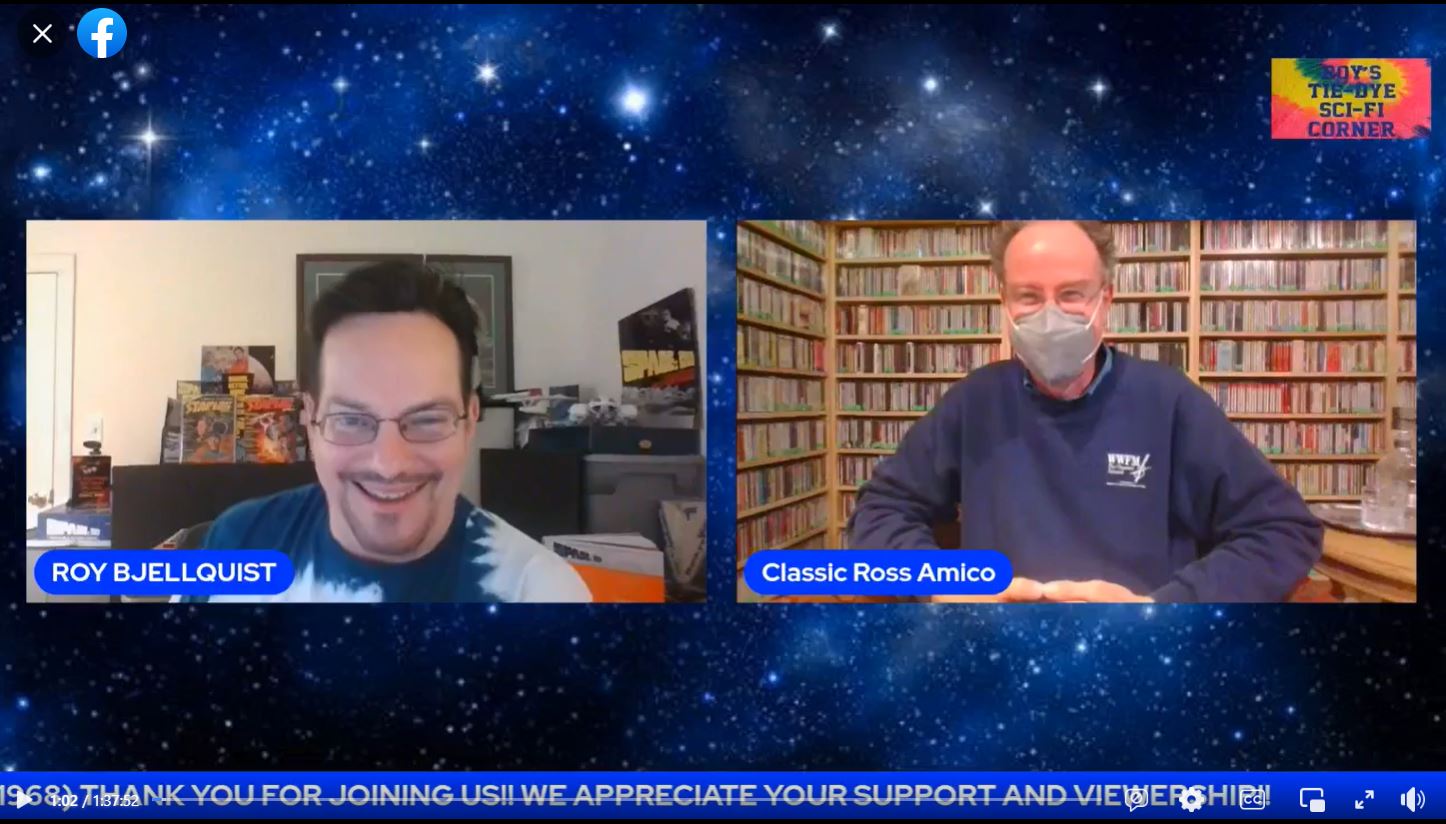
    All will be revealed when Roy and I unveil the secrets of “Lifeforce,” on the next Roy’s Tie-Dye Sci-Fi Corner. Leave your bald assessments in the comments section, when we livestream on Facebook, this Friday evening at 7:30 EDT!

    https://www.facebook.com/roystiedyescificorner

  • Nyiregyházi: Lost Genius of the Silver Screen

    In “The Beast with Five Fingers” (1946), Peter Lorre plays an unstable musicologist, haunted by the disembodied hand of a murdered pianist, which exhibits a marked predilection for Brahms’ arrangement of Bach’s “Chaconne.”

    Max Steiner, who is said to have studied piano with Brahms as a child, makes the “Chaconne” the basis of his score, to the extent of orchestrating it for several key sequences. I fail to mention, Brahms wrote the piece for left hand alone. Get it?

    It’s possible the piano is played on the film’s soundtrack by Victor Aller, the brother-in-law of Felix Slatkin (that is, Leonard Slatkin’s uncle). But many sources also credit Ervin Nyiregyházi.

    I venture to guess, you are probably unfamiliar with Nyiregyházi, and perhaps even more so at a loss as to how to pronounce his name. (It’s said kind of like “Nyeer-edge-ha-zee.”)

    Nyiregyházi was a child prodigy, born in Budapest in 1903. He studied with Ernő Dohnanyi and Frederic Lamond, a pupil of Franz Liszt. At 15, he played Liszt’s Piano Concerto No. 2 with the Berlin Philharmonic, conducted by Arthur Nikisch. His Carnegie Hall debut two years later drew mixed reviews, with critics lauding his “brilliant technical equipment,” “originality” and “white heat of sincerity, conviction of faith,” but notably less enthusiastic about his “erratic” conceptions and “arbitrary disregard of the obvious intentions of the great composers.”

    Oh, please. Nyiregyházi was obviously a pianist in the great Romantic tradition. Parallels have been drawn between his technique and that of the great Liszt himself.

    No less than Arnold Schoenberg, high priest of dodecaphonic music, who philosophically disagreed with many of the pianist’s interpretive choices, fairly gushed about him in a letter to Otto Klemperer: “What he plays is expression in the older sense of the word…. The sound he brings out of the piano is unheard of… although he appears to be a man of intelligence and not just some flaccid dreamer…. Such fullness of tone I have never encountered before…. One never senses that it is difficult, that it is technique – no, it is simply a power of the will, capable of soaring over all imaginable difficulties in the realization of an idea.”

    Unfortunately, Nyiregyházi was hobbled by a traumatic childhood. That he hated his mother is no understatement. (As a result of her coddling, he literally did not know how to tie his own shoes.) Whether or not she was the underlying cause of his lack of confidence, I leave it for others to divine, but by his early 20s, he started to self-combust.

    First, he sued his concert manager, alleging that he was being treated as an inferior artist. Nyiregyházi lost the suit, which led to his being blackballed in the industry. On some level, his lashing out was likely a reflection of his own insecurity. He avoided playing the standard repertoire out of fear of being compared to other pianists. By the time Schoenberg heard him, he was nearing a dead end.

    Nyiregyházi would marry ten times. One of his wives attacked him with a knife; he divorced another because she yawned during one of his concerts. He lived most of his life in poverty, and was reduced to sleeping in subway stations and on park benches.

    In 1928, at the age of 25, with six dollars in his pocket, he moved to Los Angeles. There he found work playing piano reductions of film scores. Eventually, he worked as a hand double in movies like “A Song to Remember” (the Chopin biopic starring Cornel Wilde), “Song of Love” (about the Schumanns and Johannes Brahms, with Katharine Hepburn, Paul Henreid, and Robert Walker – and Henry Daniell as Liszt), and possibly “The Beast with Five Fingers.”

    But Nyiregyházi was bad with finances, had taken to drink, and had little clue how to manage his own career. In 1946, he appeared in concert wearing a black hood and billed himself as “Mr. X – Masked Pianist.” It’s said that he didn’t own a piano for 40 years.

    Late in life he reemerged, both in concerts and on studio recordings. By that point, he was in his 70s, and critics were still divided, praising him on the one hand as “Franz Liszt reincarnated,” and on the other deriding him as “slipshod” and “amateurish.”

    He declined a lucrative offer to return to Carnegie Hall. Instead, his last concerts were given in Japan. He died of cancer in L.A. in 1987 at the age of 84.

    Among his own original compositions (he composed over a thousand) were works with titles like “Goetz Versus the Punks,” “It’s Nice to be Soused,” “Shotgun Wedding,” and “Vanishing Hope.”

    Tormented and self-destructive, Nyiregyházi nevertheless earned many notable fans, including Bela Lugosi, Gloria Swanson, Jack Dempsey, Theodore Dreiser, Rudolf Valentino, and Harry Houdini.

    He made some Ampico piano rolls in the 1920s, and as mentioned, some studio recordings 50 years later. But the latter were made at the far end of a rough life. Beyond anything he may have done for the movies, there were no recordings made when Nyiregyházi would have been in his prime. Written accounts of his concerts and critical discernment of his technique, filtering out the imperfections of those late records, offer frustrating glimpses of what might have been.

    If you’re interested to learn more about this most eccentric pianist, there was a book written about him in 2007, “Lost Genius: The Curious and Tragic Story of a Musical Prodigy,” by Kevin Bazzana.

    In the meantime, you’ll find more – much more, and sufficiently lurid – here:

    THE FALL AND RISE OF ERVIN NYIREGYHAZI, L.A.’s SKID ROW PIANIST

    1924 piano roll of Franz Liszt’s Transcendental Etude No. 4 in D minor, “Mazeppa”

    “Nyiregyházi Plays Liszt,” from 1974

    1978 Canadian Television documentary

    “The Beast with Five Fingers” trailer

  • Falletta Celebrates Lukas Foss at Carnegie Hall

    Falletta Celebrates Lukas Foss at Carnegie Hall

    What a great night last night at Carnegie Hall! JoAnn Falletta and the Buffalo Philharmonic Orchestra celebrated the centenary of the birth of Lukas Foss.

    In addition to being a brilliant composer, conductor, pianist, and educator (he succeeded Arnold Schoenberg as professor of music at UCLA), Foss was music director in Buffalo from 1963 to 1970.

    Falletta served as his associate conductor at the Milwaukee Symphony Orchestra (where Foss was director from 1981 to 1986), later assuming the directorship he once held in Buffalo. Falletta has been music director in Buffalo since 1999. Her recordings of opulent repertoire and music by unjustly neglected composers for the Naxos label, among others, hold an honored place in my CD collection.

    She’s also one heck of a nice person. She gives so much of herself (she’s been a guest on my radio shows three or four times over the years, twice in person), I honestly wonder where she finds the energy.

    Last night’s program was all (or mostly) Foss, including “Ode for Orchestra,” “Three American Pieces” (with concertmaster Nikki Chooi, violin), the “Renaissance Concerto” (with Amy Porter, flute), “Psalms” (with the Choir of Trinity Wall Street), and the Symphony No. 1. Also included, as kind of an encore after “Psalms,” was the famous “Alleluia” by Foss’ teacher, Randall Thompson.

    I never dreamt I’d get to hear so much Foss in one place. In a sense, I feel like I got more “Foss” than I did when I actually met him in person, over 30 years ago. His was a great era for American music. I wish that particular generation of American composers would be represented more frequently in our concert halls. To bring a full program to Carnegie was very special indeed.

    A truly memorable evening, then. Thanks to JoAnn Falletta, the Buffalo Philharmonic, and everyone else who helped to make it possible.

    And a special thank you to Paul Moon, who scored me my ticket and was my generous host for the day!

  • Amazon’s Decline Frustrates Music Lovers

    What’s going on with Amazon?

    It used to be, in a pinch, and with Amazon Prime, I could get most any major release delivered within two days.

    Now I notice that many CDs are available only from offsite dealers, a good many of those that are actually in stock – as in, actually shipping from Amazon – are now ridiculously overpriced, and of those, many won’t be delivered for at least three days. Not all, mind you, but many.

    And I’m not talking about unknown artists on tiny labels. I’m talking about Sir Neville Marriner and Sir Colin Davis on London/Decca and Philips, evergreen recordings made in the 1980s that have never been out of the catalogue. I would say it seems like Amazon is really trying to push everyone to its streaming, which personally I won’t do and is not really helpful in instances when I want to send a gift.

    The claim could be parroted that the CD is on the way out, but the fact of the matter is that CD sales have actually been on the rise the past few years, and most classical music folks still want their physical media.

    Quit trying to drive the market, corporations. There are still millions of us out there who want to collect, want to fill out our music libraries, want quick access to libretti and intelligently written liner notes, enjoy cover art, appreciate the ease of programming multimovement works, want to be able to play CDs in our cars, and not to be constantly lashed to the internet!

    I do most of my CD shopping with online specialty dealers these days, many of them overseas, or close to home at Princeton Record Exchange. But when I need it quick, with guaranteed shipping, Amazon has always been a convenient fallback, both for gift-giving and for a hard-pressed radio programmer.

    This recent increase in asspainery isn’t just limited to CDs. A few weeks ago, I received a notice from Amazon that something is going on with their magazine subscriptions too, and I’ll now have to look elsewhere for Opera News.

    Of course, I won’t let it hinder my consumption. The fact that classical music continues to be so marginalized only makes me want to pad my libraries even more. Outlets like Amazon are just going to get an even slenderer slice of the pie.

    I’ll have to make sure to start planning my Christmas shopping a little earlier this year. For Amazon, I guarantee two-day shipping for the back of my hand and my whisky breath.

Tag Cloud

Aaron Copland (93) Beethoven (95) Composer (114) Film Music (136) Film Score (143) Film Scores (255) Halloween (94) John Williams (195) KWAX (229) Leonard Bernstein (103) Marlboro Music Festival (125) Movie Music (151) Mozart (88) Opera (206) Philadelphia Orchestra (89) Picture Perfect (174) Princeton Symphony Orchestra (108) Radio (88) Ross Amico (244) Roy's Tie-Dye Sci-Fi Corner (290) The Classical Network (101) The Lost Chord (268) Vaughan Williams (103) WPRB (396) WWFM (881)

DON’T MISS A BEAT

Receive a weekly digest every Sunday at noon by signing up here


RECENT POSTS