Last night I must have been getting blocked by telepaths, because I was having a dickens of a time remembering anyone’s names (Dennis Leary, Judy Davis, George Sanders, etc.). Either that, or Roy’s COVID fog is spreading. Or, I suppose, I may just be getting old.
But it is the Christmas season, so I’ll be charitable to myself and chalk it up to an undigested bit of beef, a blot of mustard, a crumb of cheese, a fragment of underdone potato… There was more of gravy than of grave about last night’s discussion.
At least “The Avengers” (1961-69) is still fresh. Here’s our conversation about the series and its 1965 holiday episode “Too Many Christmas Trees.”
We don’t know what we’re doing next week yet (we’re still negotiating over Christmas devil movies), but if you’re a “Space: 1999” fan, you might enjoy a special edition of Roy’s Tie-Dye Sci-Fi Corner, tomorrow afternoon, as David Hirsch and Robert Wood join Roy to discuss their new book, “Maybe There: The Lost Stories from Space: 1999.”
Drop by, “Space” out, and leave your comments, when they livestream on Facebook, YouTube, etc., THIS SUNDAY AFTERNOON AT 2:00 EST.
A day late and a dollar short. The story of my life!
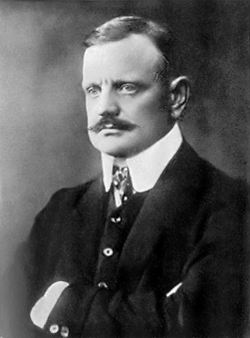
The day after Jean Sibelius’ birthday anniversary, there’s plenty of cigar smoke in this six minutes of historic footage of the composer and his family, in and around their home, Ainola, located about 20 miles outside Helsinki.
I had the good fortune to enjoy a friendship with one of the composer’s grandchildren, the son of Heidi (featured at the link), when he was living in Philadelphia and later, believe it or not, my hometown of Easton, PA!
Anssi Blomstedt, a documentary filmmaker, now makes his home back in Helsinki. He also directed a feature film, “Axel” (1990), about Sibelius’ friendship with Axel Carpelan. It was Carpelan who suggested the name “Finlandia” for what became Sibelius’ most famous composition, and Sibelius dedicated his most frequently-performed symphony, the Symphony No. 2, to him.
The film is based on a novel, “Axel,” by Bo Carpelan, who was the subject’s great-nephew. Come to think of it, Anssi gave me a copy of the book, and it occurs to me that I never read it. Perhaps I’ll add it to my January reading list.
Speaking of “Finlandia,” if you’ve never seen this, you owe it to yourself to watch it. You won’t be sorry. In fact, it will probably make you want to move to Finland.
This week being what it’s been, I somehow forgot to write a stand-alone promotion of this evening’s Roy’s Tie-Dye Sci-Fi Corner. At least I did mention it at the end of my Monday post, in which I linked our Sunday discussion of “Chitty Chitty Bang Bang.”
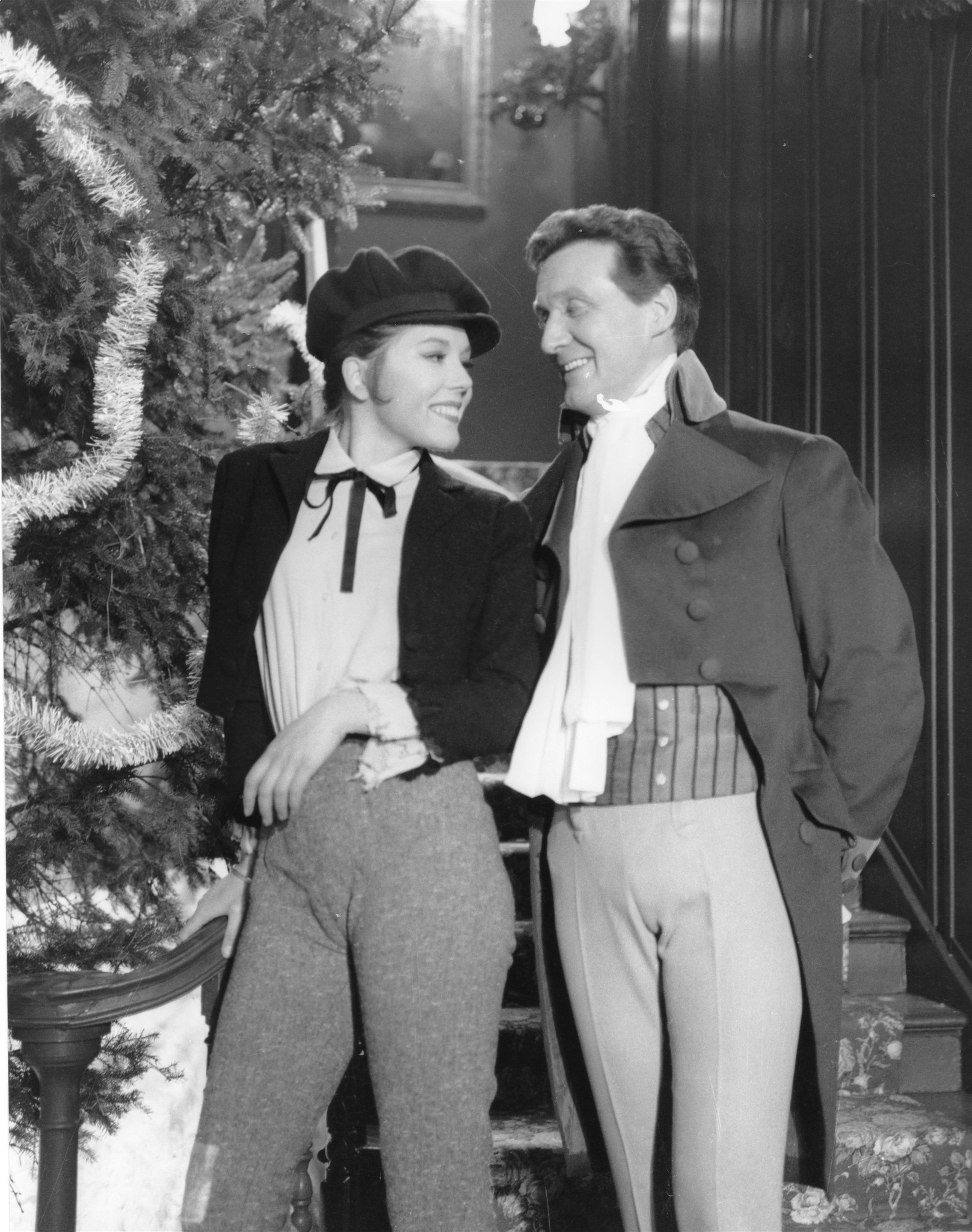
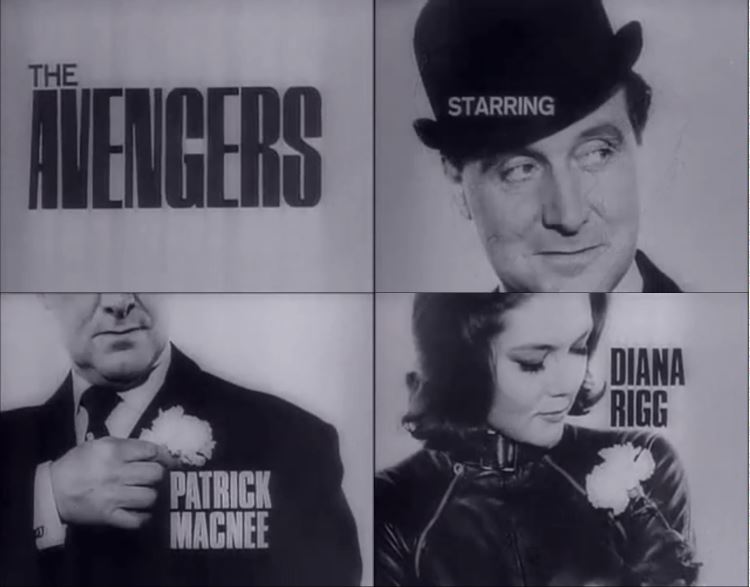
Tonight, Roy and I will be at our stylish best, though a mite confused as to which side of the road to drive, during our conversation about “The Avengers” (1961-9). Not Iron Man, Captain America, and the gang, mind you, but the snazzy UK spy-fi series, widely regarded to have achieved its apex when Diana Rigg as Emma Peel bantered with Patrick Macnee’s John Steed. Week after week, the duo managed to defend Britain against a seemingly endless procession of nefarious plots, a surprising number of them with the aim of world domination.
To narrow our focus and keep it seasonal, the conversation will center on the surreal holiday episode, “Too Many Christmas Trees” (1965), in which Mrs. Peel and Mr. Steed find themselves at a fancy dress at a manor house overseen by Charles Dickens fanatics. Great fun for admirers of the series, with plenty of wry smiles for Dickens lovers – and some wonderfully bizarre dream sequences.
We have Great Expectations for this Droodless mystery, in which Oliver Twist (Mrs. Peel) and Sidney Carton (Steed) experience Hard Times in a Bleak House. It will the best of the times and the worst of times when you join us in the comments section, as we livestream on Facebook, YouTube, etc., this Friday evening at 7:30 EST!
I don’t know what’s going on with me. First of all, it doesn’t feel like Christmas. I could blame it on the early start for Advent or the weather being too warm. The grass keeps greening here, and there’s still new growth. And now, suddenly, it’s the birthday of Jean Sibelius. So much for “8 Days of Sibelius,” as I have been known in past years to celebrate the composer in a series of daily posts starting at the beginning of the month. Whatever it is that has gotten into me, I seem to have become unstuck in time. And not like Vonnegut’s Billy Pilgrim, mind you.
Be that as it may, so much of the wonder of music, especially long-form music, is how it plays with our perception of time. Symphonies are often narratives, even if there is no story. The internal logic of a piece creates the illusion of movement, a sense of connections being made, and even varying degrees of momentum.
Sibelius was a master at manipulating time in works like his Symphony No. 5. The piece begins with a musical sunrise, the merest suggestion of the grandeur to come, with perhaps a meditation of the natural world stirring to life; and then somehow, before we know it, the ground is shifting seismically beneath our feet, and we’re in the middle of a scherzo. The effect is thrilling, yet, when executed properly (always a challenge for conductors), seems totally organic.
And that ending! There is no other symphony like it in the repertoire. It’s as if the composer has mastered time itself, and brought everything to an abrupt halt, over six staggered, monolithic chords, leaving the listener suspended at the very peak of sublimity,.
Sibelius worked hard to achieve his effects. The Symphony No. 5 was given its world premiere on his 50th birthday, December 8, 1915. A second version, which only partly survives, was unveiled the next year. The final version, the version we all know and love, was given its performance on November 24, 1919. To contemplate the level of objectivity he managed to attain in reshaping the raw material of his first thoughts is staggering. Like Beethoven, Sibelius worked very hard to realize his genius.
Perhaps whenever I get to feeling unstuck, a healthy attitude would be to imagine myself, like someone listening to Sibelius’ Symphony No. 5, suspended between moments of sublimity.
Happy birthday, Jean Sibelius.
Symphony No. 5 (final version, 1919)
Original version (1915, with some very notable differences)
In 1997, I was sitting behind the desk in my bookshop in Philadelphia, when an older couple wandered in. The man was evidently careful about his movements, understandable, even under the best of circumstances, since one had to navigate a foyer with some stairs and then usually a dog when entering the space.
After some time browsing, they approached the desk, and the man asked to see a piece of ephemera he noticed, a booklet on the composer and critic Virgil Thomson, that I had on low shelf beside me, waiting to be priced. This started a conversation, in the course of which it was revealed that he himself was a composer. When he told me his name, he seemed especially gratified that I knew who he was.
But John Duffy’s Emmy Award-winning music for the PBS television documentary “Heritage: Civilization and the Jews” was played quite often on the local classical music station, especially around the Jewish holidays. (Duffy himself was Irish Catholic.) He and I had a lovely exchange, and when he asked me how much I wanted for the book, I told him it was on the house.
The Duffys were in Philadelphia for the premiere of his new opera, “Black Water” (on a libretto by Princeton writer Joyce Carol Oates), at Plays and Players Theater, which was two blocks away from the shop. Perhaps in reciprocation for my generosity, he offered to comp me into the show.
This was on a weekday. At the time, I was working the weekend mornings at WWFM in Trenton-Princeton, so it would be around 1:30 or 2:00 by the time I got back to Philadelphia and found parking on a Saturday or Sunday afternoon.
That Saturday, I returned, and a friend of mine, who regularly sat the store in my absence, said that a kindly old gentleman had stopped by and dropped off something for me. John Duffy had gone to Tower Records and picked me up a copy of his CD “Freedom Works.” It was the only disc in stock that had selections from “Heritage.”
With the CD he left the following note, rendered in a shaky hand:
“Dear Ross: I wanted you to have a copy of FREEDOM WORKS. Tracks 6, 7 & 8 are based on my HERITAGE score. All best, John Duffy
“P.S. I hope you found BLACK WATER absorbing. Thank you for the Thomson book.”
Duffy already appeared unsteady when I met him, when he was only in his early 70s. He suffered from ill health later in life, but he held on until the 2015, reaching the ripe age of 89. He impressed me as an optimistic and gentle soul. In addition to his work as a creative artist, he went out of his way to help others in his field. He was founder and president of Meet the Composer, an organization that initiated countless programs to advance American music, from creation to performance and recordings.
On the same CD he left, with “Three Jewish Portraits” (from “Heritage”), was his Symphony No. 1 and “A Time for Remembrance” – a “peace cantata,” as he subtitled it – commissioned in 1991 by the U.S. government to mark the 50th anniversary of the attack on Pearl Harbor that killed 2,403 Americans, wounded 1,178 others – sailors, soldiers, airmen, marines, and civilians – and precipitated the United States’ entry into World War II. After listening to the music, I promptly added it to my regular repertoire for radio broadcast on December 7.
In his booklet notes, the composer writes that it is “Dedicated to my sister, Agnes Duffy, Ensign, U.S. Navy, Nurse, IN HER MEMORY: and in remembrance of all those who die in war: the men, women, and children killed and maimed at Pearl Harbor; my cousin, Edward Quirk, Machinist’s Mate, USS Shaw; the men entombed in the USS Arizona; those at Hiroshima, Normandy, Bergen-Belsen, and more. MAY PEACE PREVAIL IN THEIR NAMES.”
The texts are taken from a poem by Rupert Brooke, a speech by Franklin Delano Roosevelt, an African American spiritual, and actual letters written by sailors aboard the USS Arizona. On the recording, the performance features James Earl Jones, narrator, Cynthia Clarey, mezzo-soprano, and the Milwaukee Symphony, conducted by Zdenek Macal. You can listen to it here.
Duffy himself lied about his age when enlisting during the war. He became part of the Amphibious Scouts and Raiders, forerunners to the Navy SEALs, before deploying on the USS Hopping, a destroyer escort in the Pacific. His duties included detonating Japanese mines by shooting them from ship deck. When his ship took fire from shore batteries at Okinawa, the sailor standing next to him was killed. Duffy had to stand guard over the dead man’s body until burial at sea in the morning. That night watch determined the course of his life. “Since our time is so fleeting and unpredictable,” he later commented, “I knew I had to dedicate my life to music.”
John Duffy on his own war experiences and his decision to become a composer: