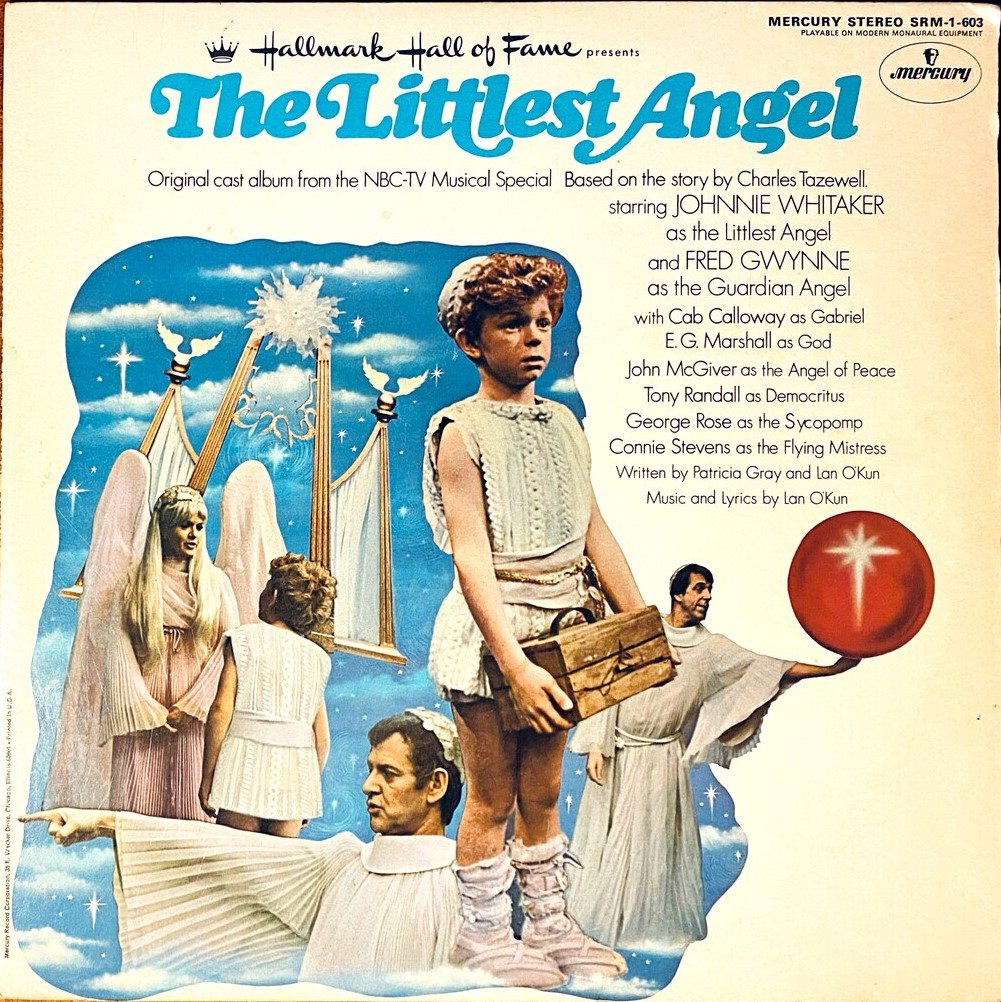
Here’s our little conversation about “The Littlest Angel” (1969). Little Johnny Whitaker finds himself in heaven, under the care of Fred Gwynne, Cab Calloway, Connie Stevens, Tony Randall, John McGiver, and E.G. Marshall (as God). Not the littlest discussion, since it still ran to an hour and a half, but there were plenty of nostalgic digressions, leavened by a little aseasonal misanthropy, since I started out with a headache. But the Advil soon took effect, and things were merry and bright in the Tie-Dye universe. You can eavesdrop on our ruminations here.
Next week, “Scrooge” (1970) is undoubtedly more my speed (it’s not just a story; it’s a lifestyle), with Leslie Bricusse riding the coattails of Lionel Bart’s smash musical “Oliver!” Albert Finney and Alec Guinness (as Marley’s ghost) do their game best to put a fresh spin on Dickens’ oft-adapted “A Christmas Carol.”
We’ll be boiled in our own pudding with a stake of holly through our hearts, on this heartwarming Christmas edition of Roy’s Tie-Dye Sci-Fi Corner. Join Fezziwig for a round of “Roger de Coverley” in the comments section, when we livestream on Facebook, YouTube, etc., NEXT WEEK AT A SPECIAL TIME: THURSDAY EVENING, DECEMBER 22, AT 7:00 EST!
While Beethoven inevitably hogs the limelight on his birthday every December 16, I think composer Rodion Shchedrin deserves at least a mention this year, as he’s just turned 90. If you know Shchedrin at all, it’s probably for his audacious reworking of Bizet themes into his “Carmen Suite” (1967) for strings and percussion.
He also wrote a series of concertos for orchestra. The most notorious of these is called “Naughty Limericks” (1963). My favorite is probably the Concerto for Orchestra No. 3 (1989), subtitled “Old Russian Circus Music.”
The liturgical work “The Sealed Angel” (1988), for choir and flute, is based on a story by Nikolay Leskov. If you’re interested in hearing the whole thing, the individual movements are posted separately here, in the form of a YouTube playlist.
Finally, Shchedrin plays Rachmaninoff with Yevgeny Kissin and Daniil Trifanov – piano six-hands!
If you’re curious as to how to pronounce Shchedrin’s last name, as a classical music announcer I learned that the “shch” should be said as in “freSH CHeese” (i.e. “SH-CHedrin”).
Happy birthday, Rodion Shchedrin!
PHOTO: The composer with his late wife, Bolshoi ballerina Maya Plisetskaya, for whom he frequently composed. (The “Carmen Suite” was written for her.) Plisetskaya died in 2015 at the age of 89.
Only nine days until Christmas. Are you feeling the heat yet?
Just remember, the Christmas season isn’t all about the gifts. It’s also about the birth of…
BEETHOVEN!
That’s right, Beethoven’s birthday is widely celebrated on today’s date. There’s no actual record of when he was born, but we know he was baptized on December 17, 1770. So it’s likely today is the anniversary of his nativity.
As you sweat it out on line at the post office or checkout counter, consider amusing yourself by contemplating what you might get classical music’s most iconic composer.
Here’s a literal wish list scrawled by Beethoven. Among the desired items: soap, a mousetrap, a knife, and a metronome. In 2011, the list sold at auction for over $73,000.
Happy birthday, Ludwig Van, with angry sugar plums dancing in your head!
More about the contents – and the context – of Beethoven’s list:
Hurry up and put on your jammies and brush your teeth, and we’ll allow you to stay up for our chat about “The Littlest Angel” (1969) on the next “Roy’s Tie-Dye Sci-Fi Corner.”
Johnny Whitaker of “Family Affair,” “Sigmund and the Sea Monsters,” and “Tom Sawyer” fame teams up with always loveable Fred Gwynne, forever saddled with Herman Munster, to headline this Hallmark Hall of Fame holiday special based on the popular children’s book by Charles Tazewell.
Shades of “Amahl and the Night Visitors” (also about a shepherd boy who winds up offering Baby Jesus the humblest of gifts, only to find favor in the eyes of the Lord), “The Littlest Angel” proves a diverting mix of music and kitsch. There are “state-of-the-art” video tape chroma key studio effects (with plenty of bleed-through and visible wires galore) and a starry supporting cast that includes Cab Calloway, Tony Randall, Connie Stevens, John McGiver, George Rose, James Coco, and E.G. Marshall – one of the “12 Angry Men” (which explains a lot) – as God.
If you can suppress your cynicism, the songs do have an endearing quality. The music and lyrics are by Lan O’Kun, brother-in-law of Lamb Chop ventriloquist Shari Lewis, for whom he churned out hundreds of scripts (and won an Emmy). O’Kun also took several game cracks at the Broadway musical. Over the course of his long career, he also worked with Barbra Streisand, Frank Sinatra, Glen Campbell, Duke Ellington, and Peggy Lee.
Watching the show last night, I couldn’t help but chuckle at the splashier musical numbers, which reminded me of something out of Mel Brooks. Wouldn’t you know it, the end credits revealed that the arrangements and orchestrations were by Brooks’ longtime collaborator, John Morris.
We’ll explore all angles of “The Littlest Angel” on the next Roy’s Tie-Dye Sci-Fi Corner. Devil’s food cake will be served in the comments section, when we livestream on Facebook, YouTube, etc., this Friday evening at 7:30 EST!
After generations as one of the most hypnotic of Christmas songs, “Carol of the Bells” regains the political significance of its first appearance here in the United States 100 years ago.
This most indelible of carols was originally conceived by Mykola Leontovych (1877-1921) as “Shchedryk,” a New Year’s carol, in 1914. Traditionally, it is sung in Ukraine on the eve of the Julian New Year (January 13). The title is derived from the Ukrainian word for “bountiful.” The original text is about a swallow that foretells great fortune with the arrival of spring:
A little swallow flew
and started to twitter,
to summon the master:
“Come out, come out, O master,
look at the sheep pen,
there the ewes have yeaned
and the lambkins have been born
Your goods are great,
you will have a lot of money.
If not money, then chaff:
you have a dark-eyebrowed wife.”
Shchedryk, shchedryk, a shchedrivka,
A little swallow flew.
The song was popularized in the West, following a performance at Carnegie Hall in October 1922 by the Ukrainian Republic Cappella (a.k.a. Ukrainian National Chorus ), a group that Leontovych co-founded. The concert was the first stop of a North American tour, designed to assert Ukraine’s independence and affirm its cultural identity. Two months later, Ukraine was part of the Soviet Union.
American choral master Peter Wilhousky, himself of Ukrainian stock, was in the Carnegie Hall audience. He later outfitted the melody with English lyrics to create “Carol of the Bells.”
Ironically, Christmas secured not only Leontovych’s immortality, but also his doom. He happened to be visiting his parents’ house at Christmas in 1921, when a traveler came to the door and requested lodging for the night. The stranger was put up in a room with Leontovych. At sunrise, Leontovych was shot and the family robbed.
The murder may have been politically motivated. As noted, the Ukrainian Republic Cappella was active in promoting Ukrainian independence, and Leontovych had made his share of enemies. His eldest daughter recalled him saying that he had documents that would allow him to leave the country for Romania. He claimed those papers had been rifled through. Also, the stranger turned out to be an agent of the secret police.
“Carol of the Bells” was brought back to Carnegie Hall earlier this month, performed by the Ukrainian Bandurist Chorus of North America and Ukrainian Shchedryk Children’s Choir, as part of a program to support Ukraine in its latest struggle.
Peace on earth and good will toward men is an ongoing project.
PHOTOS: St. Sophia Cathedral tower bells, Kyiv; Ukrainian National Chorus on tour in 1922 (one of the stops, Princeton University); Ukrainian Shchedryk Children’s Choir at Carnegie Hall in 2022