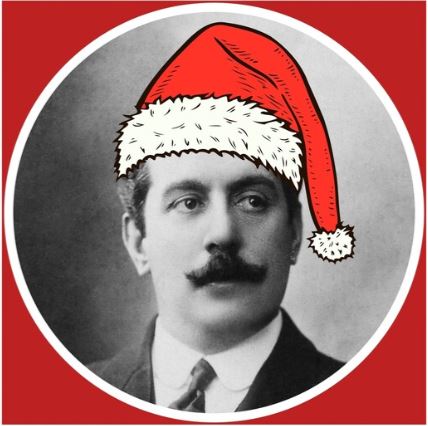
Puccini?! What you doing, being born so close to Christmas?
No matter, here’s a student work, his “Capriccio sinfonico.” Puccini wrote the piece in 1883, while still at the Milan Conservatory. You may recognize some of the music since he later recycled it in his most frequently performed opera, “La bohème.” You’ll detect the bohemians at around the 4-minute mark.
Now that you’re in the mood for hopeless Christmas romance, here’s Luciano Pavarotti and company in Acts I & II of “La bohème,” set on Christmas Eve. Interestingly, the production is directed by Gian Carlo Menotti (he of “Amahl and the Night Visitors” fame). Mimi is sung by Fiamma Izzo d’Amico – no relation, surely?
If you need to get away from the candles and clove of Windham Hill, there’s always Godfrey Winham.
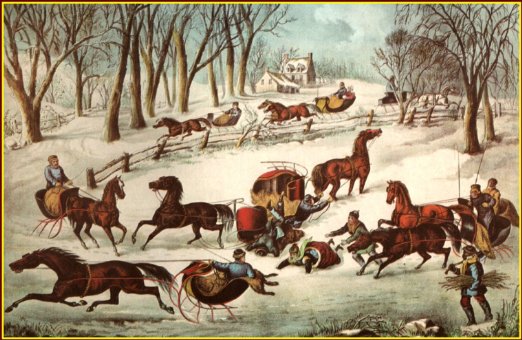
When Winham takes on a Christmas classic, it’s like a great, big, satisfying ice ball in the face of George Winston. He’s as bracing as a ride in a one-horse open sleigh.
Winham is probably best-known for his role right here in Princeton as an electronic music pioneer. As might be expected, this didn’t lead to a lot of toe-tappers. One day, after listening to some of Windham’s music, his son asked him if he could write something a bit simpler. This was the impetus for a 26-minute set of keyboard meditations on a familiar Christmas tune, titled “Variations on a Theme by James Pierpont” – otherwise known as “The Jingle Bells Variations.”
This is music a grown-up Schroeder would be proud to own. You can listen to it here, starting about 26 minutes into the program
If you are at all interested in Princeton and the history of computer music, and you haven’t checked out this podcast yet, you owe it to yourself to do so:
This is my favorite version of “Jingle Bells” – presented by the Robert DeCormier Singers as it was originally published in 1857.
BONUS! Leopold Mozart’s “A Musical Sleigh Ride,” complete with neighing horses, excitable hounds, and whip cracks. As a radio host, I made it a point to share this fun recording with the Eduard Melkus Ensemble every year on my last shift before Christmas. At home, it drove the dogs crazy.
With extreme winter weather expected to disrupt travel and last-minute Christmas shopping across much of the country, there’s plenty of music about winter recreation to fuel your imagination as you cozy-in around the hearth.
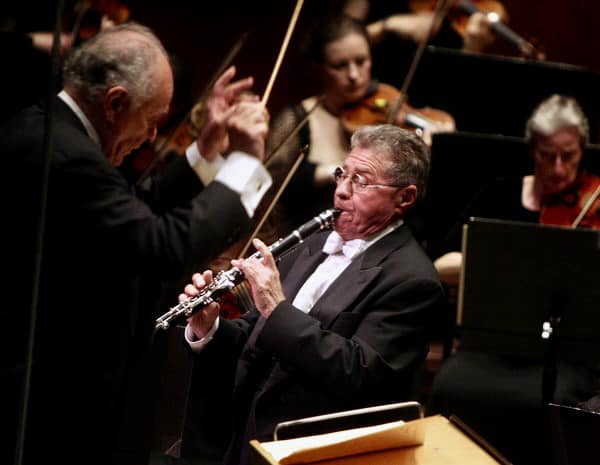
Another piece of living history has left us. Clarinetist Stanley Drucker died on Monday, at the age of 93.
Drucker played with the New York Philharmonic for over 60 years. For 49 of those, he served as principal (beginning in 1960). In total, he played some 10,200 concerts in New York. He appeared as soloist with the orchestra some 150 times. On June 4, 2009, he was acknowledged with a Guinness World Record for longest career as a clarinetist, logging his Philharmonic career at 62 years, 7 months, and 1 day.
Prior to his New York tenure, he played with the Indianapolis Symphony (from the age of 16!). On the journey from Indianapolis to New York, he also managed to work with Adolf Busch’s Busch Little Symphony and serve as principal clarinetist with the Buffalo Philharmonic.
In 2007, Gustavo Dudamel said of Drucker, “He’s a legend. The history of the orchestra is in him.”
R.I.P.
Drucker, described here by Leonard Bernstein as “our orchestra’s high-priced soloist,” playing his signature piece, the Copland Clarinet Concerto (following a four-minute Bernstein intro)
The Carl Nielsen concerto (done all in one take, in an era before digital editing)
The world premiere of the John Corigliano concerto (written for him)
New York Philharmonic tribute
Profile on ABC News, upon his retirement from the Philharmonic at the age of 80
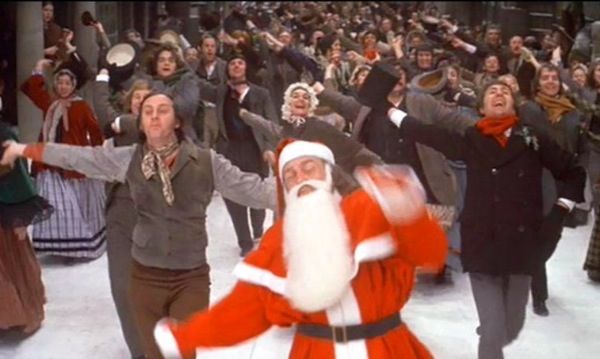
Is there a more jubilant conclusion to any version of Charles Dickens’ “A Christmas Carol?” Oh my! Thank you very much, indeed!
Albert Finney’s make-up as “Scrooge” (1970) is a bit of a distraction (he was only 33 at the time, in this, his first big-screen “character role”) and Leslie Bricusse’s hit-and-miss score makes “Chitty Chitty Bang Bang” seem like Noel Coward, but the choreography and energetic commitment to the enterprise make it a satisfying entry in the unlikely craze for Dickens musicals, unleashed by Lionel Bart’s “Oliver!”
This characterization of the Humbug-spouting miser isn’t as straightforward as some. Finney and director Ronald Neame (“The Horse’s Mouth,” “The Prime of Miss Jean Brodie,” “The Poseidon Adventure”) offer us premature glimpses of Scrooge’s nascent goodness and almost childlike humor, stirred by metaphoric spiritual visitations and the “milk of human kindness,” but willfully tamped down by obstinate backslidings. Until, of course, his redemption inspires the usual eruption of joy.
I have to confess, I was a little cranky when I sat down to watch it late last night, but the film succeeded in instilling a little holiday spirit and made me miss what movies used to be able to accomplish.
The discussion will be generous when Roy and I dive headlong into this Christmas pudding, on a special holiday edition of Roy’s Tie-Dye Sci-Fi Corner. All the punch will be in the comments section, when we livestream on Facebook, YouTube, etc., at a special time, THIS THURSDAY EVENING AT 7:00 EST!
If you’ve ever had a house guest that just wouldn’t leave, I’m sure you can sympathize with poor Charles Dickens. Although perhaps you wouldn’t be as snide about it to your friends.
So what happened when Hans Christian Andersen, author of the most depressing Christmas story ever, “The Fir Tree,” met the author of “A Christmas Carol?”
For all he understood about the human heart, Andersen, bless his sensitive soul, seemed totally oblivious to social cues. At the very least, as a Dickens superfan, he had no concept of personal space. Perhaps in Denmark, in those days, they were unfamiliar with the maxim: always leave them wanting more.
You can learn more about it – but be ready to wince – here: