Remember, remember, the Fifth of November – and don’t forget to turn your clocks for an extra hour of Guy Fawkes Night! Daylight Saving Time ends at 2 a.m. Sunday.
William Byrd, a “Gentleman of the Chapel Royal,” was one of the best loved and certainly one of the most powerful musicians in England. In 1575, Queen Elizabeth granted him and Thomas Tallis – who had been a “Gentleman” from the time of Henry VIII – a 21 year monopoly on polyphonic music and a patent to print and publish music.
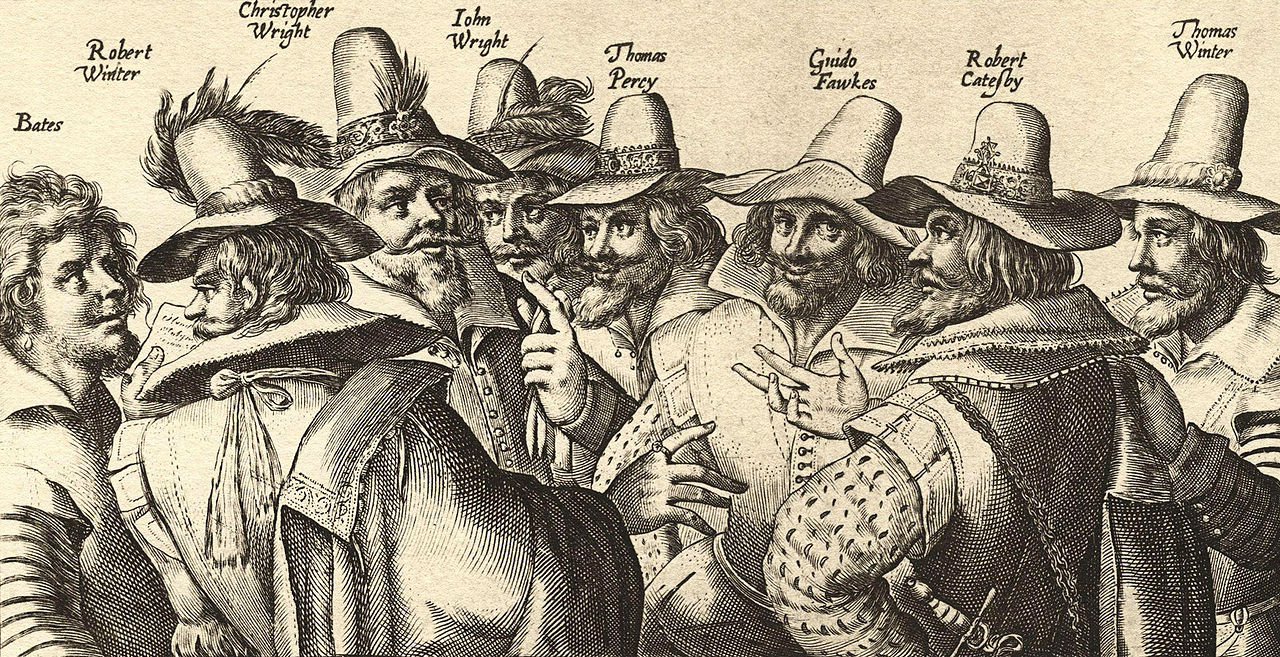
Despite Byrd’s favored status within the Anglican Church, he converted to Catholicism, and even rubbed shoulders with Robert Catesby, who formulated the Gunpowder Plot to blow up Parliament in 1605, during the reign of James I, for which Guy Fawkes gained his undying notoriety.
Though Byrd was never subject to imprisonment for his religion, he was involved in numerous lawsuits and subjected to heavy fines. Elizabeth interceded on his behalf at least once. He participated in illegal services, and the texts he chose to set to music could, at times, have a subversive edge. In particular, as a Catholic in a Protestant country, he became fond of texts related to persecution. Comparatively speaking, he went unmolested, because of his record of allegiance to the crown.
This week on “Picture Perfect,” as the shadows lengthen, we revisit the world of film noir, a genre notoriously slippery to define, but easy to know when you see it – with its long shadows and moral ambiguities; cock-eyed camera angles and snappy repartee; isolation and innuendo. It’s a genre wherein a pair of gams is an invitation to the gallows; wherein a man’s best friend – and sometimes his worst enemy – is his Colt .38, wherein only cigarettes and bourbon can ease the pain.
The labyrinthine mystery at the heart of “The Big Sleep” (1946) is so disorienting, even the book’s author, Raymond Chandler, couldn’t tell whodunit. Who cares? Humphrey Bogart and Lauren Bacall get some more steamy dialogue to satisfy fans of “To Have and Have Not,” and there’s plenty of Bogie pounding the pavement and tossing off tart one-liners in pursuit of the truth. But my favorite scene involves Dorothy Malone, who runs the hottest bookstore in town.
Whenever there are gallows to be built or gangsters to be beaten, Warner Bros. could be counted on to assign Max Steiner.
“Touch of Evil” (1958) is often considered to be the last of the classic noirs. Yet another brilliant feature by Orson Welles, it was taken out of the master’s hands and re-edited by the studio. The film was restored only in 1998, to bring it closer to Welles’ original design.
If you can get past Charlton Heston as a Mexican, “Touch of Evil” is one of the director’s best films. Welles himself is unforgettable as corrupt police captain Hank Quinlan. He’s joined by Janet Leigh, Joseph Calleia, Akim Tamiroff, and Marlene Dietrich, against a rogues’ gallery of memorable hoodlums and lowlifes.
The film is celebrated, for, among things, a sustained and fluidly-executed tracking shot, which spans over three minutes – an eternity in film – documenting two threads of overlapping action. The score, by Henry Mancini, is equally arresting, as it often seems as if it’s diegetic – whatever music happens to be playing on a radio or in a nightclub – lending its own counterpoint to the seedy drama.
“Chinatown” (1974) is one of the best of the neo-noirs of the 1970s. Jack Nicholson plays private dick J.J. Gittes, who takes on a seemingly routine case that begins to spiral out of control. When producer Robert Evans rejected Philip Lambro’s original score, Jerry Goldsmith stepped in as a last-minute replacement. The composer was hired with the understanding that he had only ten days to write and record new music. For his effort, Goldsmith received an Academy Award nomination.
Finally, we’ll have music by the king of noir composers, Miklós Rózsa. Before he came to be stereotyped for his work on epic films like “Ben-Hur,” “King of Kings” and “El Cid,” Rózsa provided scores for genre classics such as “The Strange Love of Martha Ivers,” “The Killers, “Brute Force,” and “The Naked City.”
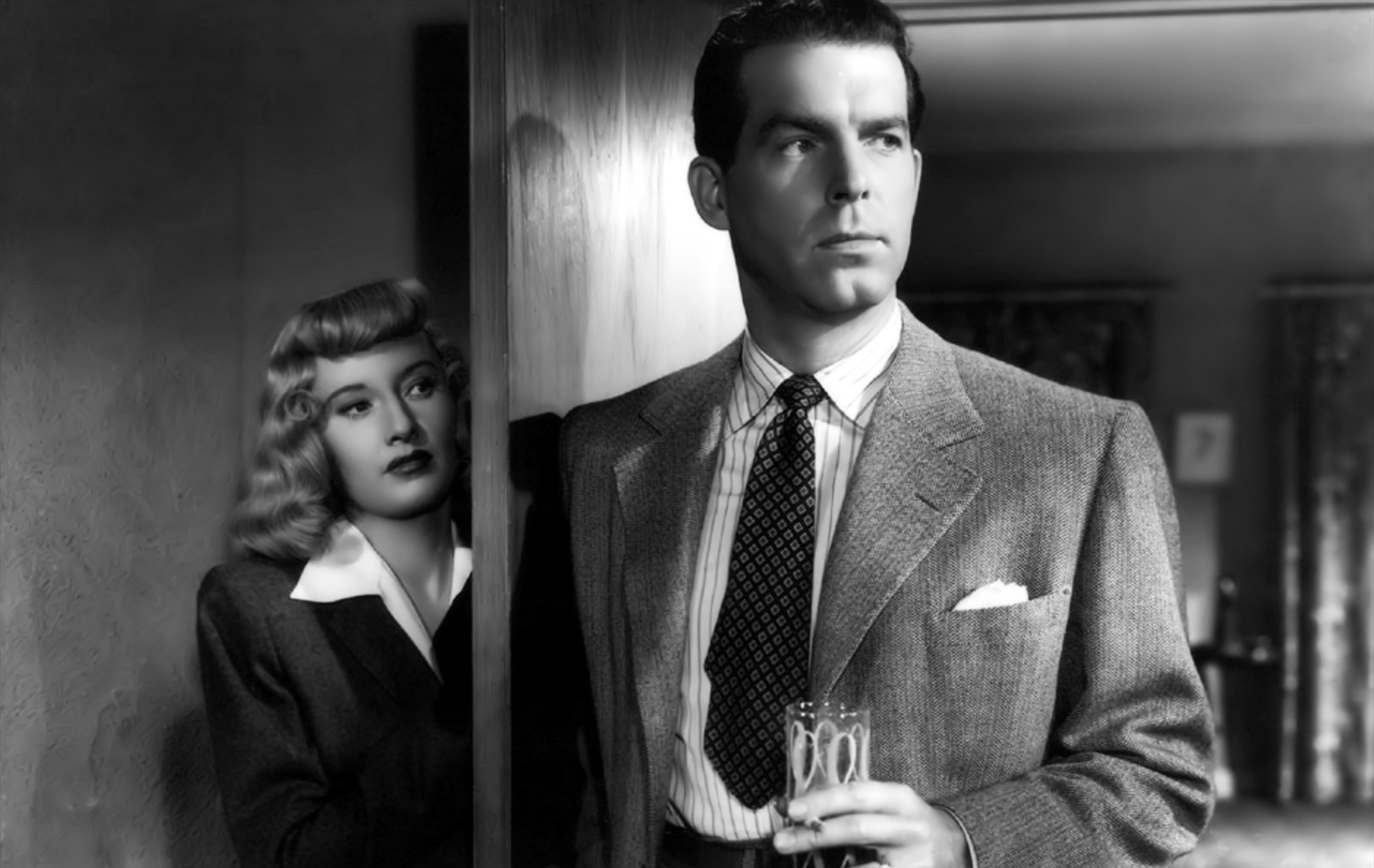
We’ll hear an extended suite from “Double Indemnity” (1944). Sultry Barbara Stanwyck ensnares insurance salesman Fred MacMurray in a plot to bump off her husband for the insurance money, sparking an investigation by MacMurray’s boss, Edward G. Robinson. Director Billy Wilder shows how it should be done, in one of the high-water marks of the genre.
Put on your rumpled linen suit, draw the Venetian blinds, and play the sap for nobody. We’ve got a nose for noir this week, on “Picture Perfect,” music for the movies, this Saturday evening at 6:00 EDT, on WWFM – The Classical Network and wwfm.org.
If you enjoy either of my weekly shows (or both!), or any of the other music you hear on The Classical Network, please consider making a contribution today. We’re celebrating our 40th anniversary on the air and online. If you’re in a position to do so, why not make a donation right now at wwfm.org. Thank you in advance for your generosity and for your continued support of WWFM The Classical Network!
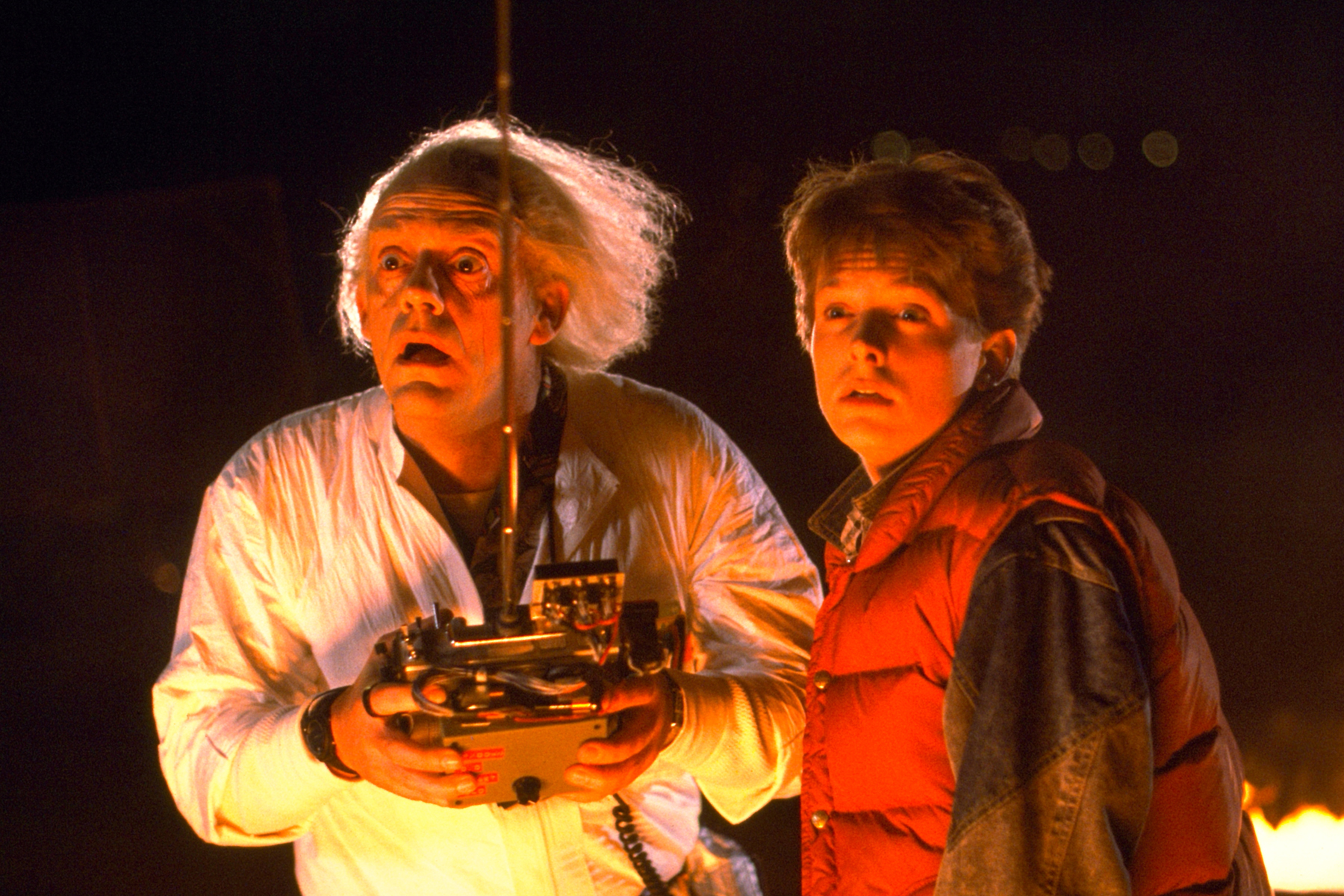
Time got away from us last night, as we realized we were cresting two hours in our discussion of “Back to the Future” (1985). There’s got to be some irony in that. And there was still plenty left on the table.
This last of a golden age of summer blockbusters was the time travel movie we didn’t know we needed. Now who would want to do without it?
You can watch the entire conversation, with viewer comments, at the link. And make a mental note to change your clocks tonight, as we “fall back!”
Whereas this week’s show went by like a flash of lightning meeting a DeLorean tearing down Main Street at 88 m.p.h., next week may wind up being a bit of a slog – at least for Classic Ross Amico, who is no big fan of “Space: 1999.” Gerry Anderson’s “The Day After Tomorrow” (1975) looks to be cut from the same cloth.
At least it’s directed by Charles Chrichton, who directed “The Lavender Hill Mob” and “A Fish Called Wanda,” and surely anything with Brian Blessed is worth watching. It’s only 47 minutes long – actually a pilot for a projected TV series – so hopefully I’ll be able to make it through, provided I can find it streaming anywhere.
My enthusiasm is not assured on the next Roy’s Tie-Dye Sci-Fi Corner. Please bring your insights to the comments section, so Roy has something to play off of, when we livestream on Facebook, Twitter, and YouTube, next Friday evening at 7:30 Eastern STANDARD Time.
Having had the opportunity to listen to Franz Liszt’s “A Faust Symphony” a couple of times over the past few days, my thoughts lighted on Carl Tausig. Amusingly, now that I think about it, it was during the movement associated with Mephistopheles. And wouldn’t you know it, today is Tausig’s birthday.
Tausig was Liszt’s supremely talented, though impish protégé. Some say that he was his greatest pupil.
Tausig joined Liszt in Weimar at the age of 14. Energetic to a fault, he got up to all sorts of mischief, including sawing the ends off piano keys in order to make the instrument more challenging to play. He also hocked the original, unpublished manuscript of “A Faust Symphony,” an entire year’s labor, for a mere pittance. Fortunately, Liszt was able to retrieve it.
Tausig then joined Richard Wagner in his political exile in Switzerland, where the boy’s boisterous behavior caused the operatic master his own share of distress. There must have been something exceptionally endearing in his personality, since he was always quickly forgiven.
At a birthday celebration for the young pianist, Liszt predicted, with a twinkle in his eye, that Tausig would become either a great blockhead or a great master.
Regrettably, his career was cut short. He died of typhoid fever, aged only 29 years.
Happy birthday, Carl Tausig, scamp to the Romantic masters.
2 Concert Etudes, Op. 1
Fantasia on Moniuszko’s “Halka”
PHOTOS: Carl Tausig (left), with Franz Liszt and Richard Wagner, looking vexed
I only just learned late last night that James Litton died on November 1.
Litton was well-known in Princeton and abroad for his long association with the American Boychoir, of which he served as music director from 1985 to 2001. Under his leadership, the choir performed more than 2,000 concerts in 12 countries and 49 states. He also broadened the choir’s palette by allowing singers with changing voices to remain.
Litton prepared the ensemble for performances with a number of the world’s leading orchestras, including the Berlin Philharmonic, the Boston Symphony, the Boston Pops, the Chicago Symphony, the Israel Philharmonic, the National Symphony, the New York Philharmonic, the Philadelphia Orchestra, the San Francisco Symphony, and the Vienna Philharmonic. In addition, he made many recordings with the group, and oversaw its participation in television commercials, television shows, and movies.
After stepping down in Princeton, he became choirmaster at Washington National Cathedral. He was regarded as one of the country’s finest choral music directors, and his influence was wide, but close to home, he will always be associated in people’s memories with the American Boychoir.
At the time of his death, Litton was 87 years-old.