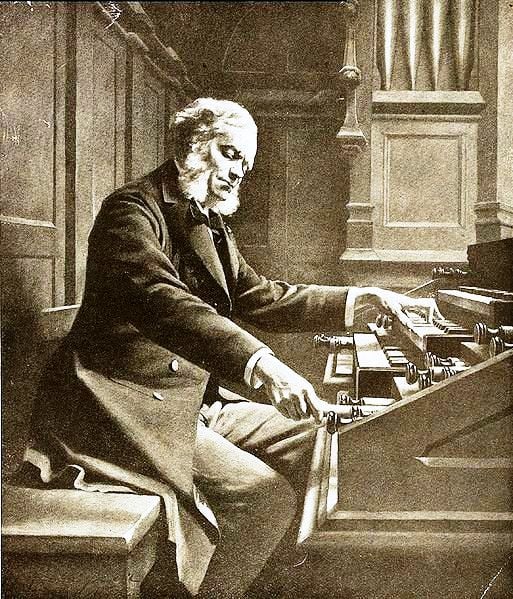
César Franck wrote a highly-regarded symphony, which I’ve been very slow to warm to (it’s taken decades, in fact). Never liked the insipid theme of the last movement. But I’ve gotten to the point where at last I’m willing to concede its overall greatest.
Much more congenial to me are his symphonic poems and his lovely chamber music.
No comment on the organ works – although I once attended a “Franckathon” at St. Clement’s Church in Philadelphia, back in the 1990s, at which his complete output for the instrument was presented, with two intermissions. Just to say I did. Well, that and for the free doughnuts and coffee.
He may very well have had the finest mutton chops in the world, I’ll grant him that.
Happy birthday, César Franck.
Symphony in D minor
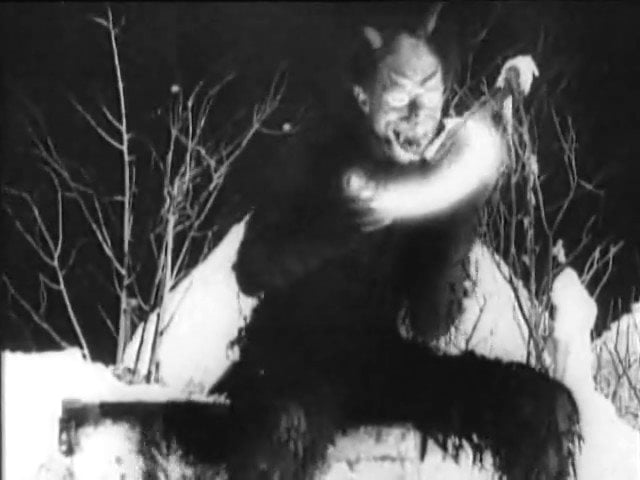
“Le Chasseur maudit” (“The Accursed Huntsman”)
Piano Quintet in F minor
Violin Sonata in A major
“Grande pièce symphonique,” played by Marcel Dupré
Only ten days into the month of December, and you’re already played-out on all the tinsel and consumerism? Reinvigorate your Christmas spirit with Nikolai Rimsky-Korsakov and Władysław Starewicz!
Rimsky-Korsakov’s “Christmas Eve” was given its first performance at St. Petersburg’s Mariinsky Theater on this date in 1895. The opera, based on a story from Nikolai Gogol’s collection “Evenings on a Farm Near Dikanka,” is part fairy tale and part farce. Gogol’s source material is steeped in Ukrainian folklore.
In Ukraine, Christmas Eve is a solemn occasion, marked by fasts and sacred services. Meatless dishes are served for Holy Night supper. But there are also carols. And the caroling is no simple singing of Christmas songs! Similar to the mumming traditions of the British Isles, there is also a fair amount of play involved, with ritualistic dancing and even the participation of a live goat. As in the West, pre-Christian symbols and rituals are embraced in the celebration of Christmas, to lend cheer to the shortest days and hope for a fertile spring.
With this in mind, is it any surprise that Gogol’s story tells of the theft of the moon by the Devil, amorous peasants secreting themselves in burlap sacks, and a ride through the air, on the Devil’s back, to collect the Tsarina’s slippers?
My preferred recording of Rimsky-Korsakov’s “Christmas Eve” is still the one from 1948, conducted by Nikolai Golovanov:
In 1912, Starewicz, Polish-born Russian pioneer of stop-motion animation, directed a live-action adaptation of the tale, called “The Night Before Christmas.” Here it’s silent, so you’ll have to provide your own soundtrack. At least the intertitles are translated:
More wondrous still is Starewicz’s animated classic, “The Insects’ Christmas,” from 1911. It’s not Christmas until beetles skate to Tchaikovsky’s “The Seasons.” Watch it now and be astonished!
Starewicz directed a number of films on subjects that were also made into operas, by Rimsky, Tchaikovsky, Mussorgsky, and Glinka, including adaptations of “Russlan and Ludmilla” (1913), “The Snow Maiden” (1914), “The Sorotchninsk Fair” (1918), and “May Night” (1918).
With the holidays awash in silver and gold, I’ll be soaking in horilka for Christmas.
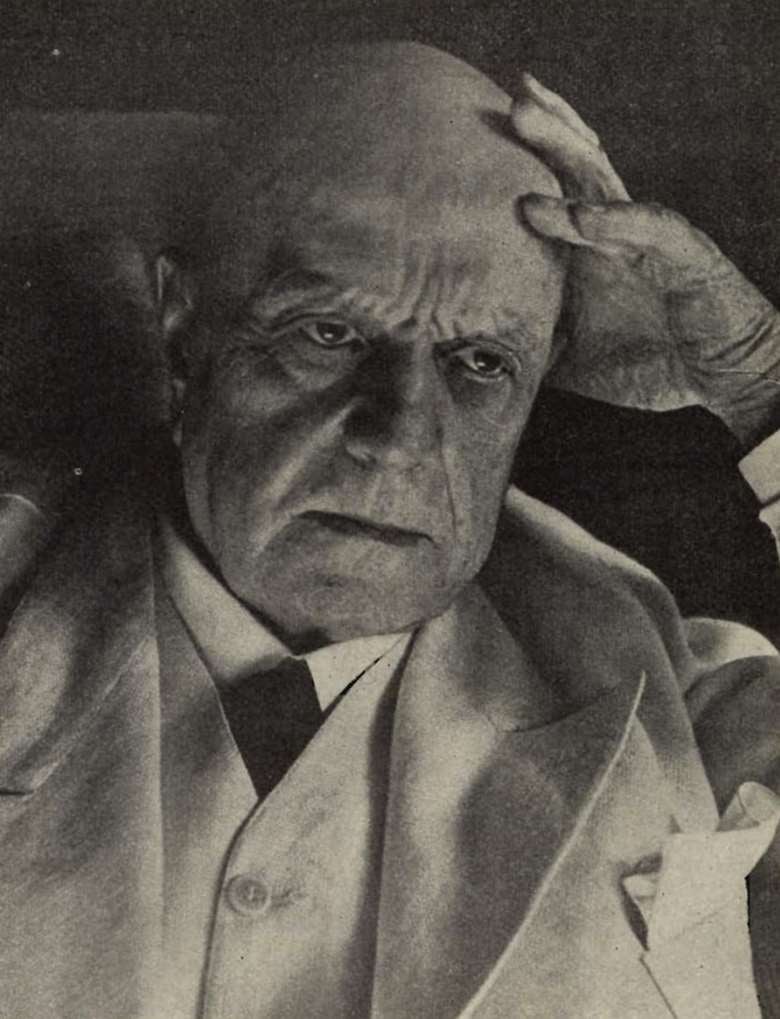
Okay, this will probably be my last Sibelius post for the present. But I wrote most of it yesterday, and I don’t want it to go to waste!
Even now, 64 years after his death, no composer has held as profound an influence over the cultures of the North. Given that Sibelius composed no major works for the last 30 years of his life, we’re talking about close to a century. That’s quite a long shadow.
Here’s an interesting work by Norwegian composer Ragnar Søderlind (born 1945). His Symphony No. 8, “Jean Sibelius in memoriam,” was written in 2004-05. The symphony alludes to some of Sibelius’ own music, including the organ work “Surusoitto.” “Surusoitto” is thought to contain material from Sibelius’ own unreleased Eighth Symphony.
Sibelius never completed his Symphony No. 8, or so he’d have us believe. Perhaps he just didn’t complete it to his satisfaction. After the Symphony No. 7 and the tone poem “Tapiola,” written in the mid-1920s, he’s said to have completed no further major works. But it certainly wasn’t for want of trying.
At the very least, he grappled with the Eighth, the manuscript of which he is supposed to have destroyed. I heard as much from the mouth of his own grandson, who claimed to have been present at its burning. Did Sibelius finish it?
Only within the past ten years, a few tantalizing sketches have surfaced, seemingly out of nowhere. Is it possible more could have survived? Perhaps somewhere, among the composer’s papers, a draft might even exist. I’m not in favor of “reconstruction” from mere fragments, but if there is a somewhat complete version of the symphony, even in embryonic form, it would be a thrill to be able to hear it.
It makes my heart ache to listen to these sketches and contemplate that there actually could have been another Sibelius symphony. Had the composer only been able to defy his demons and hold it together one more time!
Could it have topped his crowning achievement, the Seventh Symphony? Sibelius didn’t think so, which is why, likely, he consigned it to flames of woe.
“Surusoitto” (“Funeral Music”) – does it contain material intended for the Symphony No. 8?
Longtime followers of this page know that I tend to go a little berserk around the time of Sibelius’ birthday. In fact, for the past few years, I’ve honored “Eight Days of Sibelius,” from the start of the month to December 8 – conveniently, the actual anniversary.
Well, this year, somehow, it slipped by the wayside. I always have Sibelius’ birthday firmly in mind, but I forgot all about the “Eight Days.” Which is why you may have gotten slammed yesterday by multiple Sibelius posts, which I hope at least you found interesting or informative. There’s just so much Sibelius material to share, and I’m always setting it aside, making a mental note to save it for December. Trouble is, the memory isn’t so well-oiled as it used to be!
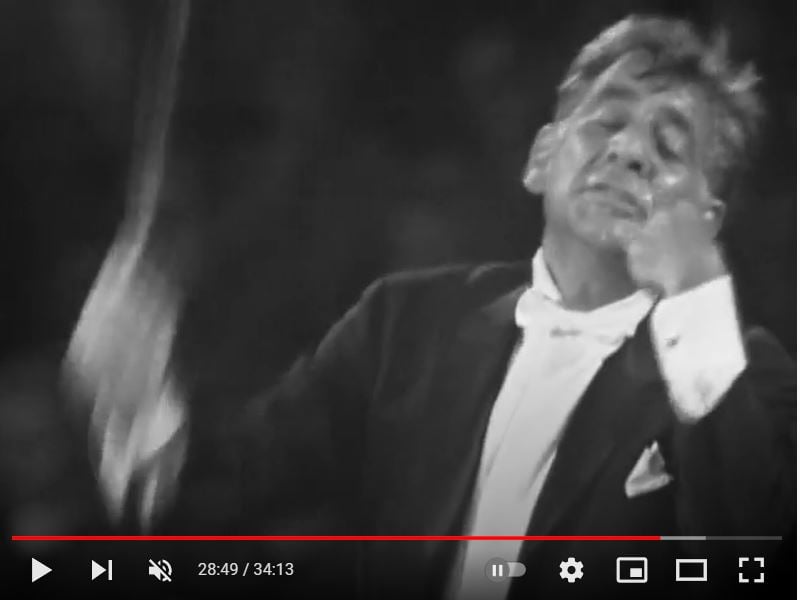
With that in mind, I hope you won’t turn up your nose at a little leftover birthday cake. I mentioned in one of my posts yesterday that Sibelius’ Fifth Symphony is a personal favorite. I haven’t always found Leonard Bernstein to be the ideal interpreter of Sibelius’ symphonies, but I still can’t pass up a live performance. I saw Bernstein conduct it at Carnegie Hall once, back in the 1980s, and it was a fabulous occasion, to be able to hear Lenny work his magic like some grizzled Kalevala wizard.
Here he is, with the London Symphony Orchestra, in 1966:
A sublime, ennobling start to any day – even if the interpretation may not always be my particular glass of vodka.
Who knew that the Finnish master, Jean Sibelius, so dreaded the darkest time of the year? Finland’s kind of a bad place to live, then, don’t you think?
The composer once confided to his secretary, “The darkest weeks of the year, from my birthday [December 8] until Christmas, when the sun is at its lowest, are always a difficult time for me.”
I could say it’s a difficult time for me, too, but for entirely different reasons!
They aren’t exactly sung in the streets here in the United States, but Sibelius’ Christmas songs are some of the most beloved in Finland.
He compiled five of them, written between 1897 and 1913, and published them in 1915 as his Opus 1.
The best-known of these is the fourth of the set, “En Etsi Valtaa Loistoa” (“I seek not power, glory or gold”), which he composed in 1909.
The text is by Zacharias Topelius:
I seek not power, glory or gold,
I wish for the light of Heaven and peace on Earth.
Let Christmas bring happiness and put us in mind of heavenly things.
Neither power nor gold but peace on Earth.
May the wonder of Christmas come to both poor and rich;
Into Earth’s darkness bring the light of Heaven.
For you I yearn, you I await, Lord of Earth and Heaven,
Now bring sweet Christmas to poor and rich.
Here it is arranged for male chorus, followed by the fifth of the set, “High are the snowdrifts.”
“High are the snowdrifts” for women’s voices
“I seek not power” in a jazzy arrangement, played in a snowy field!