Category: Daily Dispatch

  • Yule Goat Krampus and Dark Christmas Lore

    Yule Goat Krampus and Dark Christmas Lore

    December 5th, and all at once it’s Christmas! At least in my admittedly idiosyncratic worldview. At any rate, today is the day several of my favorite midwinter folk figures elide.

    In light of Christmas’ often nightmarish roots in paganism, it’s a wonder that the holiday has evolved into the anodyne festival of advertising and consumerism it has. Of course, we’re all familiar with the religious significance of Christmas – December 25th, the observance of Christ’s birth – but there was an awful lot of celebrating going on well before the Nativity.

    Abundant pre-Christian symbols and rituals were assimilated into modern Christmas, borrowed from our distant ancestors, who marked the death of the old year and the birth of the new. Evergreen, holly, and mistletoe are all around us. Though we’ll probably never fully get a handle on all of them, their secret origins lost to time, it is these “Ghosts of Christmas Past” that make Old World traditions such a source of endless fascination.

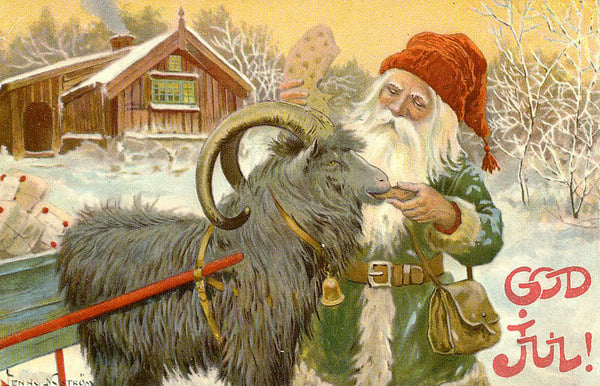
    This Sunday night on “The Lost Chord,” on the eve of Saint Nicholas Day, we’ll take an imaginative journey to the realm of Joulupukki (literally “Yule Goat”) – the Finnish Santa Claus – and enjoy an evocative portrait of his stomping grounds, around Korvatunturi (Ear Mountain), in Savukoski, Lapland.

    One of Northern Europe’s wackier Christmas traditions, the Yule Goat may have derived from the worship of Thor. After all, the God of Thunder’s chariot was drawn by goats. In the Christmas version, the goat is led about by Saint Nicholas, possibly as a symbol of the subjugation of evil.

    Whatever the goat’s function, its involvement goes way back. For hundreds of years, rowdy young men in costumes would go door to door to act out plays and demand gifts. One of these would take the part of the ornery Yule Goat. This is the reason Scandinavians sometimes refer to the practice of wassailing as “going Yule Goat.”

    In the 19th century, the Goat’s role was transformed into a giver of gifts. Though the Goat has since been replaced by a humanoid Father Christmas, in Finland he is still referred to by the name Joulupukki – yes, Yule Goat.

    Nowadays, the Goat is mostly seen in its incarnation as a miniature tree ornament, made of straw and bound by red ribbon. A notable exception is the Gävle Goat, a 40-foot version, constructed every year in Gävle, Sweden. More often than not, this winds up being set aflame. But more about that another time.

    Tonight’s broadcast also happens to coincide with Krampusnacht. In Austria, Germany, and Hungary, on the night of December 5th, it is customary for Saint Nicholas to visit all the little girls and boys. His companion on these excursions is Krampus, an ominously-horned and whiplash-tongued Alpine demon, who scampers down from his mountain lair, festooned with chains and cowbells. Good children receive a gift from the hands of St. Nick. The naughty are handed over to Krampus, to be beaten with a switch and consumed by hellfire.

    So play the music loud! Enjoy evocative portraits of the land of Joulupukki. We’ll hear a suite from “The White Reindeer,” composed for an award-winning film about a shapeshifting, vampiric Laplander, by Einar Englund; “Cantus Arcticus,” featuring actual bird songs recorded in the bogs of Liminka, near the Arctic Circle, by Einojuhani Rautavaara; and “Northern Lights,” a musical response to the Aurora borealis, by Uuno Klami.

    It’s a Christmas bait-and-switch, with plenty of Old World traditions, but no actual Christmas music! It will be guaranteed to get your goat. Sample the sounds of true north, on “Pole Position,” this Sunday night at 10:00 EST, on WWFM – The Classical Network and wwfm.org.

  • Star Trek’s Epic Music Galaxy

    Star Trek’s Epic Music Galaxy

    Space… the final frontier. This week, on “Picture Perfect,” beam aboard for some of the best “Star Trek” music in the galaxy. We’ll hear enterprising selections from the beloved media franchise.

    In retrospect, it’s hard to conceive of “Star Trek,” the original series (1966-69), staggering toward cancellation after a mere three seasons on NBC, so much a part our shared cultural consciousness it has become. The show’s popularity expanded through syndication. Still, prior to the blockbuster success of “Star Wars,” the only other “Trek” would be an animated series that aired on Saturday morning television from 1973 to 1974 (to be discussed tomorrow evening on Roy’s Tie-Dye Sci-Fi Corner).

    In 1977, the one-two box office punch of “Star Wars” and “Close Encounters of the Third Kind” revealed a latent hunger for science fiction that gave “Star Trek” the final boost it needed to reach the silver screen.

    “Star Trek: The Motion Picture” (1979), long-awaited, was ambitious to a fault. Its approach seemed especially ponderous next to the souped-up dog fights of a galaxy far, far away. However, there was undeniably a nostalgic satisfaction in seeing the original crew reassembled on the deck of a refurbished Enterprise, and the production values were nothing less than first-rate.

    Robert Wise directed. Wise was involved in the production of any number of classic films, dating back to the 1930s, including “The Day the Earth Stood Still,” “West Side Story,” “The Haunting,” and “The Sound of Music.” He also edited “Citizen Kane.”

    “Star Trek: The Motion Picture” sported state-of-the-art special effects (by Douglas Trumbull no less), and a knock-out music score by Jerry Goldsmith. I remember leaving the theater on the film’s opening night and remarking that the movie was all right, but the music was fantastic.

    There’s a six-minute, music-and-special effects showpiece of a shuttle flying around the drydocked Enterprise that’s a perfect marriage of music and film. It’s like nothing you’re ever likely to encounter in movies today – and more’s the pity.

    The “ST: TMP” theme has always been a fan favorite, but its resurrection, beginning with the launch of the television series “Star Trek: The Next Generation,” cemented its broader familiarity.

    “Star Trek” had always positioned itself as thoughtful science fiction, and in the case of the first film perhaps it tried a mite too hard. “ST: TMP” strove for stately, but what it wound up achieving was stasis. Although a box office success, the film received mixed reviews and performed below industry expectations. However, it still made enough money to justify a sequel.

    “Star Trek II: The Wrath of Khan” (1982) was a belated continuation of an episode from the original series, “Space Seed,” in which a genetically engineered superman is revived from suspended animation and attempts to take over the Enterprise. Khan, of course, was played by Ricardo Montalban, now with gleaming chest and silver mullet – worlds away from his contemporaneous characterization as Mr. Roarke on TV’s “Fantasy Island.”

    The tone of the film proved a refreshing change of pace, playing up the character relationships that made the original series so enjoyable and providing enough action to satisfy audiences attuned to post-“Star Wars” spectacle. Moreover, it cleverly draws on nautical iconography – while “Star Wars” had its dogfights, “Wrath of Khan” deals more in broadsides – and that nautical flavor extends to the film’s brilliant score, by James Horner. The project proved an important stepping stone to Horner’s acceptance as an A-list composer.

    Another memorable episode of the original series dealt with the usually unflappable Spock losing his cool, as he teeters into pon farr, a period of madness that strikes every seven years during which a Vulcan must mate or die.

    “Amok Time” (1967) opened the show’s second season. It featured alien-world papier-mâché boulders, oversized Q-tip like weapons, and what is now widely recognized as the “Star Trek fight music.” This music was reused in several subsequent episodes and has since been widely parodied.

    The composer was Gerald Fried, who wrote the music for Stanley Kubrick’s first four films. He also provided most of the score for the landmark television mini-series “Roots.”

    Following the disappointing box office of “Star Trek: Nemesis” in 2002, the film franchise was put on hiatus for the next six-and-a-half years, possibly the result of “Star Trek” fatigue – too many movies and too many television series.

    J.J. Abrams was hired in the hopes of revitalizing “Trek” with a fresh makeover. Abrams’ approach might best be summed up as “Damn the social issues! Damn the philosophical underpinnings! Damn the continuity! Full speed ahead!” The result is undoubtedly entertaining, though very much of our time, with a lot of action at the expense of the ideas and humanity that made earlier incarnations more resonant.

    The “reboot” scored a hit with critics and general audiences, though it remains controversial with fans of the original series. Even the title suggests a new beginning, as the film was titled, simply, “Star Trek” (2009). The story employs an alternative timeline, so that the filmmakers are no longer beholden to more than 40 years’ worth of accrued “Star Trek” lore. It’s the kind of thing that is done all the time in comic books. Whether or not the result is for the best, I leave to you.

    Neither is the music quite as rich as that for some of the earlier installments, though it does generate a fair amount of excitement within the context of the film. The composer is Michael Giacchino.

    I hope you’ll join me for these selections from “Star Trek,” on “Picture Perfect,” music for the movies. The music won’t be the only thing that’s transporting. Set phasers for “fun,” this Saturday evening at 6:00 EST, on WWFM – The Classical Network and wwfm.org.
  • Bach’s 300th Anniversary Love Story

    Bach’s 300th Anniversary Love Story

    What do you get someone for their 300th wedding anniversary? That’s like gold times six.

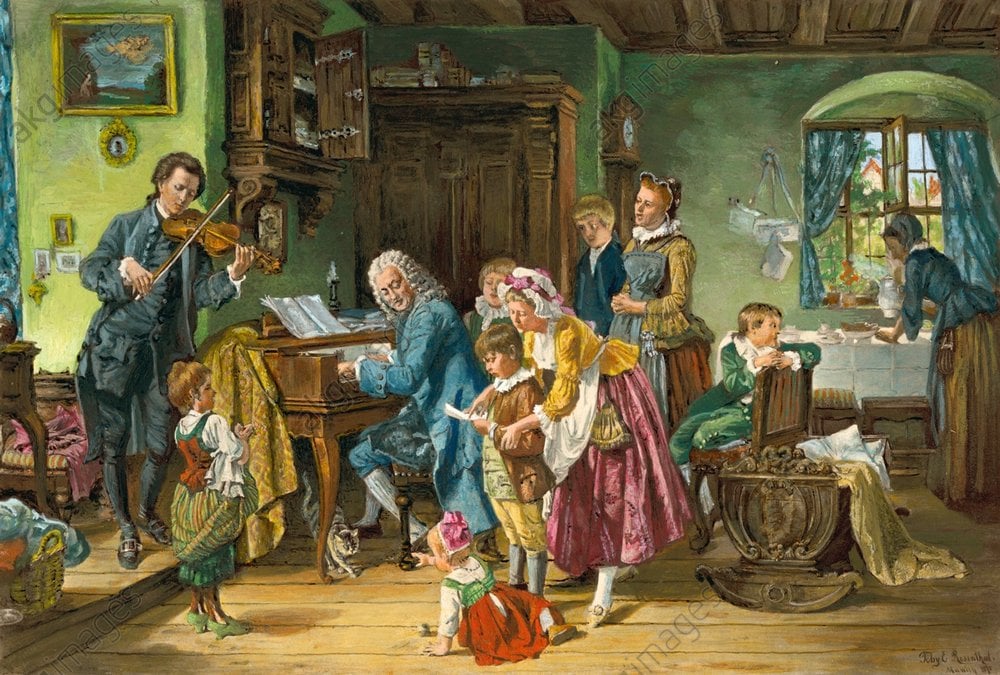
    It was on this date in 1721 that Johann Sebastian Bach, 36, married Anna Magdalena Wilcke, 20. She was Bach’s second wife, a soprano at the princely court of Anhalt-Cöthen. Bach had been working there as Kapellmeister since December 1717. His first wife, Maria Barbara Bach, died 17 months earlier.

    In 1723, the Bachs moved to Leipzig when Johann Sebastian was hired as Cantor at the Thomasschule (St. Thomas School). Anna Magdalena continued to sing professionally, and the couple’s shared interest in music contributed to a happy homelife. Bach wrote a number of works dedicated to her and assembled two volumes of “Anna Magdalena Bach Notebooks.”

    In addition, Anna Magdalena organized musical evenings at the Bach home, with the participation of family and guests, making their house a center of attraction. Together, they raised the children from Bach’s first marriage, alongside 13 of their own. Seven of these died in infancy or childhood.

    After Bach’s death in 1750, Anna Magdalena continued to care for their two youngest daughters and her stepdaughter. Increasingly, she became dependent on charity and handouts from the Leipzig city council. Ultimately, she had to rely on public begging to survive.

    The only one of their sons to provide any financial assistance was Carl Philipp Emanuel Bach – and he was a child of Bach’s first marriage. Anna Magdalena died on the street, penniless, in 1760, and was buried in a pauper’s grave.

    Roughly 35 years earlier, in markedly happier times, Bach unveiled his latest cantata, the Cantata No. 62, “Nun komm, der Heiden Heiland” (“Now come, Savior of the heathens”), on the first day of Advent, which fell on this date in 1724. The work was inspired by an Advent hymn of Martin Luther.

    Bach would compose over 200 such cantatas in Leipzig, largely in fulfillment of his duties as Cantor at the Thomaskirche (St. Thomas Church). The premiere of his Advent cantata coincided with Johann Sebastian and Anna Magdalena’s “leather anniversary.”


    The ”Anna Magdalena Bach Notebook”

    Gustav Leonhardt in a very silly wig, in “The Chronicle of Anna Magdalena Bach”

    https://www.youtube.com/watch?v=VlRK1VzKGns

    Advent cantata “Nun komm, der Heiden Heiland,” BWV 62


    IMAGE: “Bach with His Family at Morning Devotion” (1870), by Toby Edward Rosenthal

  • Alvin Lucier Dies: A Room and a Remembrance

    Alvin Lucier Dies: A Room and a Remembrance

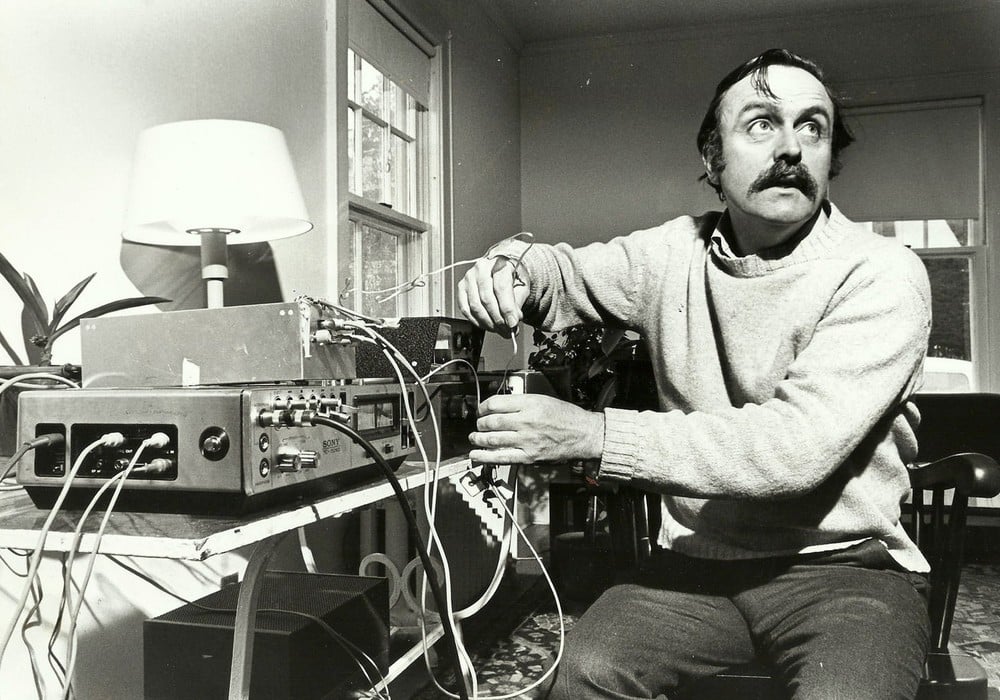
    I was sitting in a room… when I learned Alvin Lucier died.

    Lucier, perhaps best known for “I Am Sitting in a Room” (1969), the influential 45-minute sound art piece recognized as a landmark in Minimal tape music, was 90 years-old.

    If you’ve never heard it, find yourself a quiet place, rid yourself of all distractions (no phones, no people, no cheating), turn down the lights, kick back, and enjoy the trip.


    An interview with Lucier from 2019

    https://tapeop.com/interviews/130/alvin-lucier/

    Lucier at MoMA

    https://www.moma.org/explore/inside_out/2015/01/20/collecting-alvin-luciers-i-am-sitting-in-a-room/

    Hot off the press of the New York Times

    https://www.nytimes.com/2021/12/01/arts/music/alvin-lucier-dead.html

  • Finding Bliss at Princeton Record Exchange

    Finding Bliss at Princeton Record Exchange

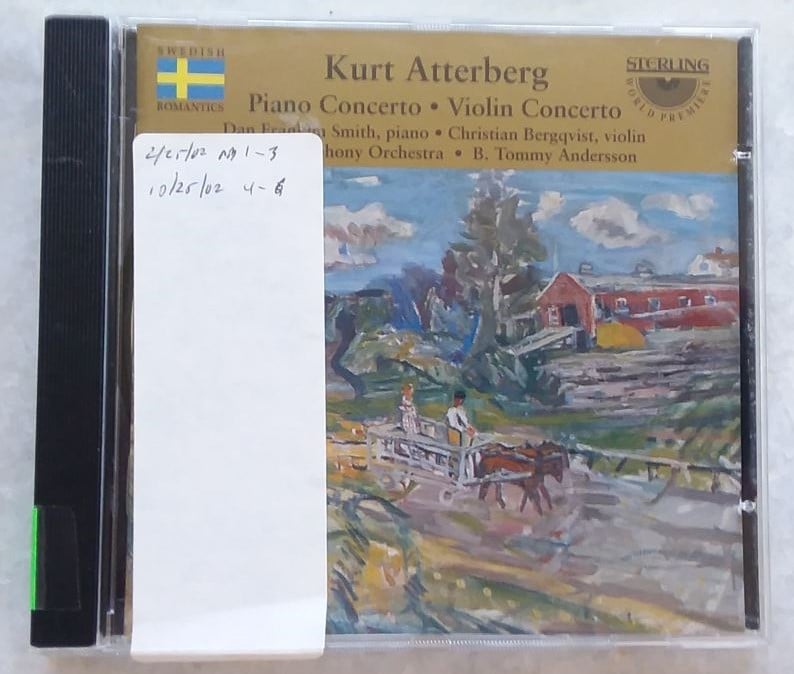
    I was at Princeton Record Exchange the other day, when something surreal happened. I was down on my knees, flipping through the dollar bins on the floor of the classical section, when I espied a CD of music by the Swedish composer Kurt Atterberg. The spine indicated a couple of concertos I knew I didn’t have in my collection. But what I found momentarily disorienting was a label on the front of the jewel case that sported some very familiar scrawl.

    Was this a CD from the WWFM library? At first, I thought so. It was only upon further reflection that the truth became clear. This CD belonged to my former colleague, Bliss Michelson.

    I know I’ve mentioned it before, but Bliss and I had a long association, from the time he taught me the ropes at WWFM in Trenton-Princeton, in 1995, to only a few years ago, when we were both on-call hosts at WRTI in Philadelphia. Bliss died in March from complications of COVID-19.

    At WWFM, we had these labels that we affixed to the jewel cases of the CDs in the station library, on which we indicated the date and time the individual contents were played. At some point, we transitioned to a spread sheet on the computer, but we kept up the stickers all the same.

    For some of us, our programming was heavily supplemented by music from our collections. To help keep track, Bliss carried over the labeling system to his own records. Many was the time that I’d be going through the library only to alight upon an interesting CD I hadn’t noticed there before. Of course, it was one of Bliss’ discs, accidentally shelved. On those occasions, I would leave it on his desk with a post-it note.

    Then and now, his scrawl is unmistakable. So someone must have sold at least some of his collection to Princeton Record Exchange. It would have been fairly recently, since the price tag bears the date of 11-21.

    What I learned from Bliss is incalculable. In particular, he really expanded my knowledge of Nordic repertoire. We were both Sibelius fans, and Bliss was enormously proud of his Swedish heritage. It’s a strange coincidence to have made the discovery of this CD. Bliss continues to introduce me to new music, even from beyond the grave.

    You too might be interested to give it a listen, because it’s a knockout. If you love Rachmaninoff, Atterberg’s Piano Concerto is a one-way ticket to Valhalla. The movements are posted separately, so let the playlist run.

    How is it I never encountered this before? Thank you, Bliss!

Tag Cloud

Aaron Copland (93) Beethoven (95) Composer (114) Film Music (136) Film Score (143) Film Scores (255) Halloween (94) John Williams (195) KWAX (229) Leonard Bernstein (103) Marlboro Music Festival (125) Movie Music (151) Mozart (88) Opera (207) Philadelphia Orchestra (89) Picture Perfect (174) Princeton Symphony Orchestra (108) Radio (88) Ross Amico (244) Roy's Tie-Dye Sci-Fi Corner (290) The Classical Network (101) The Lost Chord (268) Vaughan Williams (103) WPRB (396) WWFM (881)

DON’T MISS A BEAT

Receive a weekly digest every Sunday at noon by signing up here


RECENT POSTS