Category: Daily Dispatch

  • Hawthorne’s Haunting Tales in Classical Music

    Hawthorne’s Haunting Tales in Classical Music

    In part to surreptitiously extend my Halloween celebration into November, and in part to vicariously wallow in secret Puritan guilt in the lead-up to Thanksgiving, I’ve been spending the past couple of weeks revisiting a volume of Nathaniel Hawthorne favorites. Some of these I’ve not read for close to 40 years. Very much to the author’s credit, I still remembered most of them fairly well.

    Hawthorne is never over-the-top macabre enough to bring genuine shudders in the manner of Edgar Allan Poe, nor do I think that was particularly his aim. His allegory is always just a little too refined. And in the 21st century, sadly, I think we are all a little too much inured to the horrors of history, hypocrisy, and the human heart for many of these tales to pack much of a surprise.

    That said, for me “The Birthmark” will always remain a masterpiece of dread. Furthermore, at his best, Hawthorne can be atmospheric and even witty, both in his phraseology and in his depictions of wackadoodle witches’ sabbaths and deviled-ham Satans.

    But for the most part, even though the stories are short, I feel as if he tends to overstate his point, if not outstay his welcome. We get it, Nate. Next!

    It was while reading “The Celestial Railroad” that I recalled this piano piece by Charles Ives, and that gave me the idea to share a few links to some Hawthorne-inspired classical music.

    “The Celestial Railroad”

    Ives revisited the material in his Fourth Symphony’s second movement, subtitled “Comedy”

    He also devoted a movement to Hawthorne in his Piano Sonata No. 2, the “Concord Sonata.” Here’s the whole thing. “Hawthorne” begins at 16:26. As instructed, the pianist employs a 14 ¾ strip of wood on the keys, the better to achieve Ives’ tone clusters.

    A suite from Howard Hanson’s “Merry Mount,” after “The Maypole of Merry Mount”

    Lawrence Tibbett as Wrestling Bradford, from “Merry Mount”

    A selection from Margaret Garwood’s “The Scarlet Letter”

    An aria from Daniel Catán’s “La hija de Rappaccini” (“Rappaccini’s Daughter”)

    A suite from Vaughan Williams’ opera “The Poisoned Kiss,” inspired in part by “Rappaccini’s Daughter”
  • Aaron Copland Birthday Celebration

    Aaron Copland Birthday Celebration

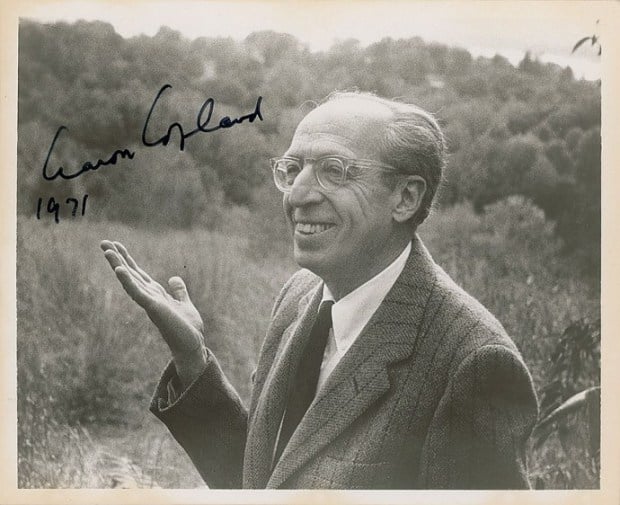
    The world was a better place with Aaron Copland in it. How fortunate that one of our greatest composers lived through an era when so much could be documented on film. With Thanksgiving right around the corner, here’s a Copland cornucopia, for his birthday.

    Copland conducts “El Salón México,” for his 60th

    Bernstein introduces Copland’s Clarinet Concerto

    Copland conducts it in L.A., with Benny Goodman the soloist
    https://www.youtube.com/watch?v=iYwPJrRnGSE

    Copland plays his Piano Concerto, with Bernstein conducting

    Copland conducts “Appalachian Spring” in D.C. on his 80th

    Copland’s 80th birthday concert (complete), hosted by Hal Holbrook; conducted by Rostropovich, Bernstein, and Copland himself. Just listening to the composer’s opening remarks… we don’t have people like this anymore.

    Copland interviewed and playing the coda of “Appalachian Spring” at the piano in his studio

    “Appalachian Spring,” complete 1958 television broadcast with Martha Graham

    “Aaron Copland: A Self Portrait”

    Seiji Ozawa conducts Copland’s arrangement of “Happy Birthday” for Bernstein’s 70th

    Happy birthday, Aaron Copland!

  • Karl Krueger Champion of American Music

    Karl Krueger Champion of American Music

    Born in New York City to German immigrant parents, Karl Krueger’s sympathies were never far from the American heartland. He served as artistic director and principal conductor of the newly founded Kansas City Symphony from 1933 to 1943. But his greatest legacy lay in a series of pioneering recordings he made for the Society for the Preservation of the American Musical Heritage.

    This Sunday night on “The Lost Chord,” we’ll sample from some of these, set down for the society he established in 1958. Its purpose was to document and promote works by neglected American composers, who at the time were little more than footnotes in our music history books. Significantly, the records were distributed first to libraries, as opposed to commercial retailers. A number of the recordings have been reissued over the years by The Library of Congress and Bridge Records, Inc.

    Leave it to Krueger to unearth possibly the most interesting work by Horatio Parker. Parker, the hidebound teacher and aesthetic nemesis of Charles Ives, wrote two symphonic poems, both of which were recorded by Krueger. Wholly unexpected is Parker’s treatment of “Vathek,” the early gothic novel by William Beckford. The novel blends elements of the supernatural, excess, and immorality in an Oriental setting.

    Arthur Farwell, best remembered for his work inspired by Native American sources, wrote incidental music in 1916 for a play by Lord Dunsany, called “The Gods of the Mountain.” The work is another piece of Orientalism, in this case about a band of beggars who impersonate a city’s stone gods and partake of much sensual indulgence, until the real gods return and change the impostors to stone. In a final twist, the inhabitants of the city take the transformation of the beggars as verification of their status as genuine gods.

    Finally, we’ll hear music by Arthur Foote, who has fared better than some other American composers of his era. His rarely-heard work from 1900, “Four Character Pieces after the Rubaiyat of Omar Khayyam,” is drawn from a piano cycle he composed the previous year. It was given its first performance by the Chicago Symphony, under the direction of Frederick Stock.

    Krueger’s father wanted him to be lawyer, but the pull of music proved to be too strong. He studied in Vienna with Robert Fuchs and became the assistant of conductor Arthur Nikisch. Nikisch referred him to Franz Schalk, conductor of the Vienna State Opera. Krueger was appointed assistant conductor to the Opera and the Vienna Philharmonic. Schalk proclaimed, “I have no doubt that he will play an important role among the leading orchestral conductors of his time.”

    Though he also served as principal conductor of the Seattle Symphony, from 1926 to 1932, as music director of the Detroit Symphony Orchestra, from 1943 to 1949, and was invited back to guest conduct the Vienna Philharmonic, Krueger’s name is largely unrecognized today, beyond the sphere of collectors.

    By the end of its run, Krueger’s Society had issued over 100 LPs of American music, with some of the repertoire dating as far back as the 18th century. Karl Krueger died in Illinois in 1979 at the age of 85.

    I hope you’ll join me for “Pioneer Spirit” – Karl Krueger circles the wagons for American composers – this Sunday night at 10:00 EST, on WWFM – The Classical Network and at wwfm.org.

  • Semi-Documentary Film Scores Copland Thomson & More

    Semi-Documentary Film Scores Copland Thomson & More

    A “semi-documentary” is documentary-like, but allows staged or fictional elements, sometimes recreations or reenactments, sometimes flat-out embellishments, often with non-actors playing most of the roles. This week on “Picture Perfect,” enjoy music from four acclaimed examples.

    Aaron Copland, one of America’s most respected composers, was more active in film than most people realize. He even won an Academy Award in 1950, for his score to “The Heiress.”

    During the World War II, Copland was approached by the Office of War Information to score a brief film about the resettlement of European refugees in a rural Massachusetts town. The film was called “The Cummington Story” (1945). The music is rather interesting in that, having been written at the height of Copland’s “populist” phase, he employs melodies which were later fleshed out into more familiar concert works, such as the Clarinet Concerto and “Down a Country Lane.”

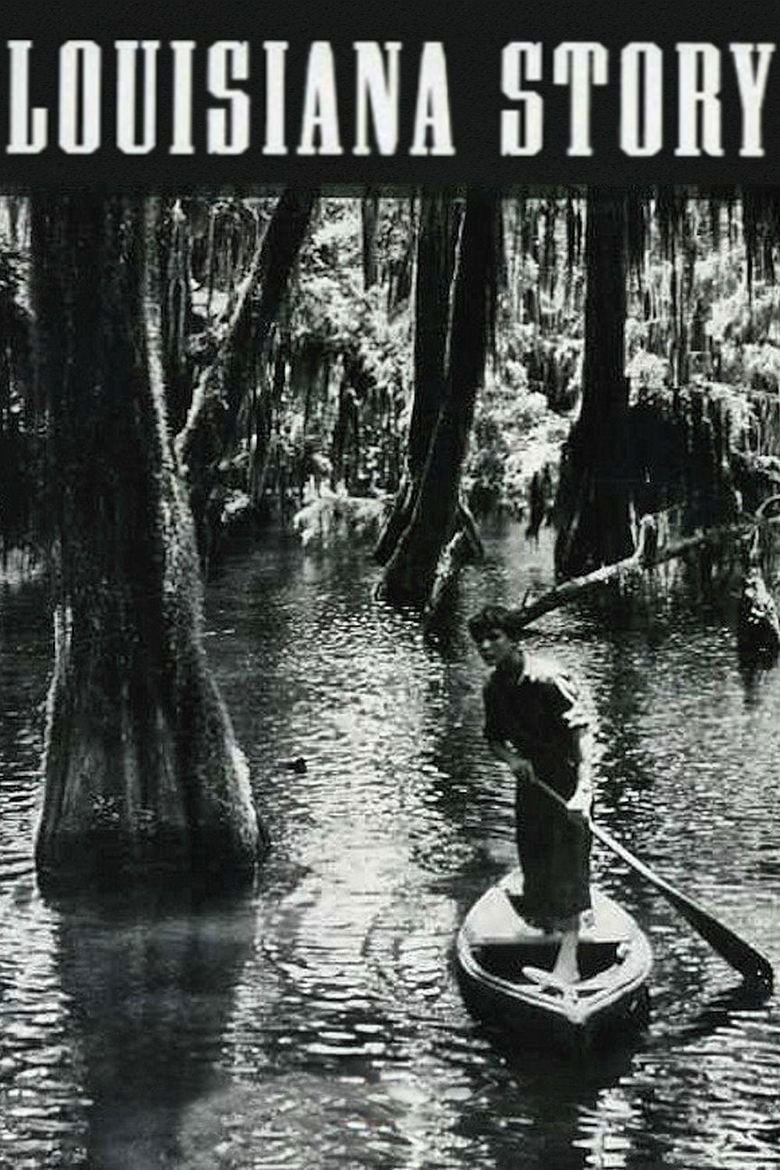
    Director Robert Flaherty’s “Louisiana Story” (1948) is often misidentified as a straight documentary. (Flaherty made the first commercially-successfully, feature-length documentary, “Nanook of the North,” in 1922 – itself later revealed to have been more of a docudrama.) However, the plot is entirely fictional, an idealized story of a Cajun family that reaps the rewards of oil drilling that takes place in an inlet behind its house. The film was shot on location in bayou country, using Cajun locals as actors, giving it a certain verisimilitude.

    Although it was selected for preservation in the United States film registry by the Library of Congress as being “culturally, historically or aesthetically significant,” and its script was nominated for an Academy Award, “Louisiana Story” acts as a kind of time capsule in its naiveté. Perhaps the most interesting aspect of the entire project is the film’s score, by American composer and revered critic of the New York Herald Tribune, Virgil Thomson. So far, it is the only film score ever to be awarded the Pulitzer Prize for Music.

    Like Copland and Thomson, Ulysses Kay is associated more with his works for the concert hall. Nevertheless, he wrote music for numerous television shows and documentaries in the late 1950s and early ‘60s. His first scoring assignment was for an experimental quasi-documentary called “The Quiet One” (1948), a film about an abused African American child and his subsequent coming of age. The film received an Oscar nomination for Best Story and Screenplay, and was listed as one of the ten best movies of the year by the New York Times and the National Board of Review. Kay, a long-time resident of Teaneck, NJ, was a rarity in the world film scoring, a composer of color.

    Finally, we’ll turn to Morton Gould and “Windjammer” (1958), the only film ever to be shot in the widescreen “Cinemiracle” format. “Windjammer” depicts the training cruise of a fully-rigged sailing ship, from Oslo, across the Atlantic, to the Caribbean, New York, and back home again. Its dreamy theme music is full of the romance of the high seas.

    Artistic truth is based on fact this week. I hope you’ll join me for an hour of selections from semi-documentaries on “Picture Perfect,” music for the movies, this Saturday evening at 6:00 EST, on WWFM – The Classical Network and wwfm.org.

  • Isis Tribute on Roy’s Tie-Dye Sci-Fi Corner

    Isis Tribute on Roy’s Tie-Dye Sci-Fi Corner

    The trees continue to demonstrate their disdain for all things Roy. Another downed sequoia knocked out his power for most of the day yesterday and apparently internet connectivity could only be achieved through his smartphone.

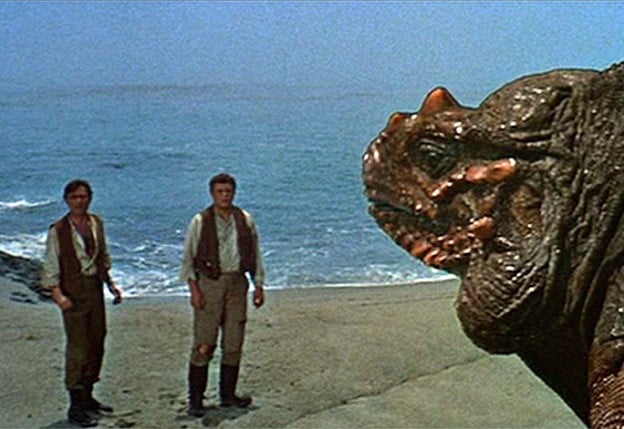
    In the end, he was able to join us from the dark side of the moon (i.e. Phillipsburg, NJ) for a “Journey to the Center of the Earth” (1959). Hey, it’s to be expected that the Wi-Fi would be terrible at the earth’s core. Nevertheless, we soldiered on, probably talking over one another on occasion, but if you pretend that Roy took the red pill and is now living in the Matrix, you’ll be just fine.

    That gives us a week to the straighten it all out, as next time we’ll be slipping into our footie jammies and pouring ourselves heaping bowls of Cap’n Crunch for a journey back to 1970s Saturday morning television and a tribute to the late Joanna Cameron. Those of a certain age will recognize her as mighty “Isis” (1975-77). At a point, she was also listed in the Guinness Book as having appeared in the most national television commercials in advertising history! Cameron died last month at the age of 73.

    Joining us will be Lisa Everetts of the podcast “POP ninja,“ who was a personal friend of Cameron. Like us, “Pop Ninja” exudes an inordinate amount of affection for 1970s and ‘80s nostalgia. Check it out. It’s fun.

    Then join us for our recollections of “Isis” on the next Roy’s Tie-Dye Sci-Fi Corner. Leave your moral lessons in the comments section. We’ll be crowing “Tut!” when we livestream on Facebook, next Friday evening at a special time, 8:00 EST!

    https://www.facebook.com/roystiedyescificorner

Tag Cloud

Aaron Copland (93) Beethoven (95) Composer (114) Film Music (136) Film Score (143) Film Scores (255) Halloween (94) John Williams (195) KWAX (229) Leonard Bernstein (103) Marlboro Music Festival (125) Movie Music (151) Mozart (88) Opera (207) Philadelphia Orchestra (89) Picture Perfect (174) Princeton Symphony Orchestra (108) Radio (88) Ross Amico (244) Roy's Tie-Dye Sci-Fi Corner (290) The Classical Network (101) The Lost Chord (268) Vaughan Williams (103) WPRB (396) WWFM (881)

DON’T MISS A BEAT

Receive a weekly digest every Sunday at noon by signing up here


RECENT POSTS