To get you in the mood for tonight’s broadcast of John Williams’ Violin Concerto No. 2, on PBS’ “Great Performances,” here’s a throwback to Williams conducting selections from “Star Wars,” on “Previn and the Pittsburgh” (aired on March 26, 1978) – back when “Star Wars” was still fresh, and back when PBS was still PBS.
Interesting to find that Williams had already done considerable tinkering in his concert arrangement of the “Throne Room and End Title” music. It was perfect in the movie, John! A lot of vim in the performance, though. The diptych opens with “Princess Leia’s Theme.”
Anne-Sophie Mutter – the former Mrs. Previn – will be the soloist on tonight’s broadcast of the Violin Concerto No. 2, again with Williams conducting. The concert was filmed at Tanglewood in July. The program will also feature Andris Nelsons and the Boston Symphony Orchestra, performing music by Aaron Copland, Igor Stravinsky, and Jesse Montgomery.
The show airs here at 9:00 PM EST. Consult your local listings. You’ll find an interview and promos here:
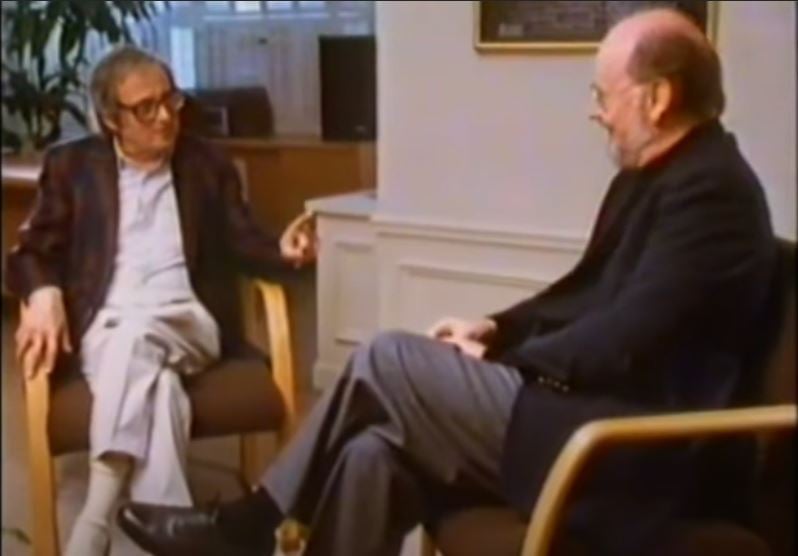
Previn interviews Williams in 1988 (pictured), and Williams is in an unusually candid mood. The two were old friends, of course, who had already known one another for 30 years. I’d never actually never seen it before, and it’s terrific. Maybe Williams’ best interview.
There’s been frost on the pumpkins, but the last of the crickets fiddle still. Likewise, The Classical Network aims to continue to provide music all through the winter months. Help keep us warm and well-provisioned with your contribution today. In turn, we will do our best to make your listening environment homey and happy.
On Day 5 of our “7 Days for $70K” membership campaign – a pop-up fundraiser designed to wrap-up before Thanksgiving – join us in giving thanks for great music on the radio. Make a donation today at 1-888-232-1212 or online at wwfm.org.
Our gratitude is in our grace notes. Thank you for your support of WWFM – The Classical Network!
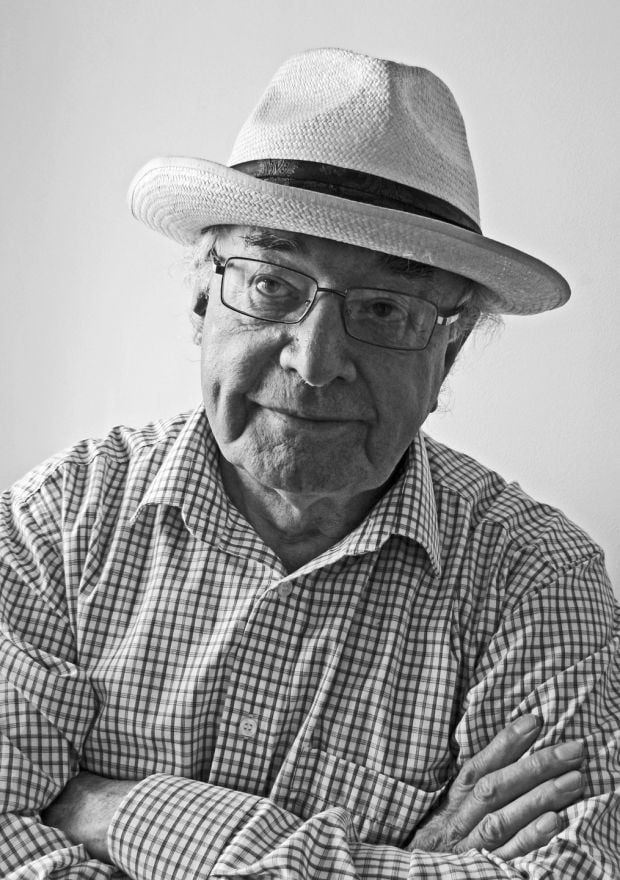
Sorry to learn of the death of Irish composer John Kinsella. Kinsella died on Tuesday at the age of 89. His passing was announced yesterday. Kinsella was Ireland’s most prolific symphonist. His most recent symphony, the Symphony No. 11, written in homage to Sibelius, was given its debut by the RTÉ National Symphony Orchestra in November of 2019. He once commented that the summit of his life would be to have the work performed in Finland.
Kinsella was born in Dublin in 1932. His burgeoning musical interests were fostered by his parents, his father (who worked for Guinness Brewery) buying him scores and acting as his guide to broadcasts they listened to together on the family radio – in the “magic corner,” as the composer described it. Though encouraged by a number of notable names in Irish music (Gerard Victory, Brian Boydell, and Proinnsías Ó Duinn, among others), Kinsella was largely self-taught as a composer. The core of his education was the study of scores and recordings, attending live concerts, and playing chamber music on the viola.
In 1968, he was appointed senior assistant in the music department at RTÉ (Raidió Teilifís Éireann, or Radio Television Ireland).
During the first phase of his career as a composer, he was attracted to European avant-garde techniques, with a particular fascination with serialism. But by the late ‘70s, he began to call into question the validity of everything he had thus far written.
Following the completion of his String Quartet No. 3 in 1977, he completely stopped writing for a period of eighteen months in order to regroup. When again he put pencil to paper, it was with a determination to pursue his own creative voice, which would develop regardless of current trends. Few would have anticipated that Kinsella would make his greatest mark as a classical symphonist. He didn’t finish his First until the age of 52.
With the completion of his Second, in 1988, he retired early from RTÉ (by then, he was Head of Music, and much involved with the RTÉ Symphony and RTÉ Concert Orchestra), in order to devote himself full-time to composition. In addition to his body of symphonies, he also leaves two violin concertos, a cello concerto, five string quartets, and many other chamber, instrumental, choral and vocal works.
He was celebrated as a composer of stature throughout the British Isles. Recordings of his works have appeared on the Chandos, Naxos, Marco Polo, and Toccata Classics labels.
Kinsella’s music has been featured on my Sunday night program, “The Lost Chord,” several times over the years, most recently on March 14, when I aired his Symphony No. 3, “Joie de vivre.”
He was the younger brother of the poet Thomas Kinsella, now 93. Interestingly, my copy of “The Táin” is in the Kinsella translation. John too was inspired by the epic – frequently described as “The Irish Iliad” – to compose the orchestral work “Cúchullainn and Ferdia: Duel at the Ford.”
RTÉ honored Kinsella today by resharing this broadcast on its website of his Symphony No. 11, in concert, coupled with a performance of Sibelius’ Symphony No. 3. Prokofiev’s “wild and witty” Piano Concerto No. 3 is merely icing on the cake.
R.I.P. John Kinsella
Symphony No. 4 “The Four Provinces” (1991)
“Essay for Orchestra” (1980), soon to become the first movement of his Symphony No. 1
Symphony No. 2 (1988)
Symphony No. 9 for strings (2004)
Violin Concerto No. 2 (1989)
A selection from “Cúchullainn and Ferdia: Duel at the Ford” (1988)
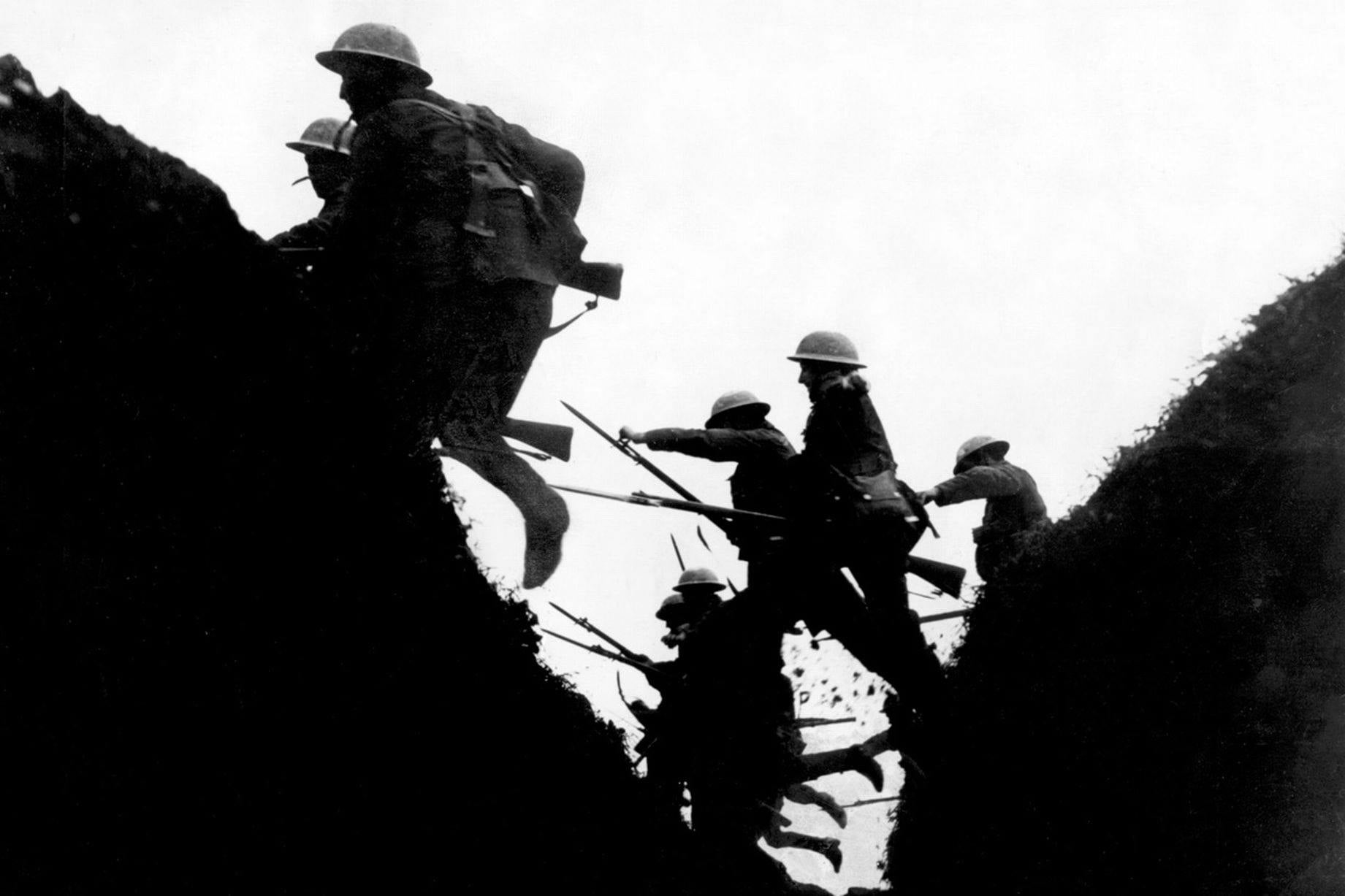
It was on November 11, 1918 – the eleventh hour of the eleventh day of the eleventh month – that representatives of the Allied Forces and Germany sat down to sign the Armistice that concluded hostilities on the Western Front, formally ending the “War to End All Wars.”
Five years later, John Foulds’ “A World Requiem,” conceived as a memorial to the dead of all nations, was given its first performance, on November 11th, 1923. The work was embraced by the public, though critical reaction was mixed. Subsequent performances took place from 1924 to 1926 as part of a Festival of Remembrance. After that, it lay unheard for some eight decades, until resurrected by conductor Leon Botstein.
Botstein has dusted off more than his share of worthy curiosities over the years, though few more ambitious than “A World Requiem.” A performance of the 90-minute piece requires up to 1,250 musicians. The work’s world premiere recording, on the Chandos label, was taken from a live concert presented on Armistice Day 2007, at the venue in which the work was first heard, Royal Albert Hall London.
The Requiem’s texts were derived from various spiritual sources by the composer’s wife, Maud MacCarthy, built on fragments from the Requiem Mass, as well as writings of John Bunyan and the Hindu poet Kabir. The overall tone is more Brahms than Britten. Part One of the oratorio promises peace and rest; Part Two conveys radiant visions of paradise.
I had assumed that the work’s neglect had to do with the dual concerns of cost and evolving musical taste. However, around the time of the Requiem’s revival, it was discovered that performances may actually have been suppressed by the BBC, possibly at the instigation of Sir Adrian Boult – this despite the fact that Foulds donated all proceeds to the poppy appeal for the British legion. You can read more about the alleged “banning” of the Requiem here:
Across the pond and closer to home, in 1954, at the urging of U.S. veterans, Armistice Day was renamed Veterans Day. Though the intent of the holiday is frequently confused with that of Memorial Day, Veterans Day is a time to honor ALL military veterans, not just those who died in service to their country.
Foulds’ gargantuan oratorio could serve double-duty. Sadly, it is almost never performed at all.
The oratorio falls into 20 movements (two parts subdivided into ten each) for soloists, massed choirs, including children’s choirs, large orchestra, offstage instrumentalists, and organ. A progressive tonal framework is spiced with quarter tones, cluster chords, and certain repetitive sequences.
War’s the pity. Always remember, and thank you to those who served.
Part I
1 I Requiem – 8:44
2 II Pronuntiatio – 4:05
3 III Confessio – 5:46
4 IV Jubilatio – 5:06
5 V Audite – 7:04
6 VI Pax – 3:53
7 VII Consolatio – 5:08
8 XIII Refutatio – 0:38
9 IX Lux Veritatis – 1:19
10 X Requiem 3:25
45:08
Part II
1 XI Laudamus – 6:30
2 XII Elysium – 6:24
3 XIII In Pace – 3:17
4 Hymn of the Redeemed – 4:37
5 XIV Angeli – 3:27
6 XV Vox Dei – 3:07
7 XVI Adventus – 4:01
8 XVII Vigilate – 2:03
9 XVIII Promissio et Invocatio – 7:30
10 XIX Benedictio – 1:41
11 XX Consummatus 2:06
When Walt Disney let the cork out of the bottle on “20,000 Leagues Under the Sea” (1954), he inadvertently launched the “Decade of Verne” – a notion bolstered by Michael Todd’s star-studded “Around the World in 80 Days” (1956). “Around the World” was recognized with a shelf-full of Academy Awards, including one for Best Picture, and the luster of prestige was added to the glitter of box office gold.
The rest of ‘50s and early ‘60s were punctuated by big screen adaptations of Jules Verne’s novels of adventure and scientific speculation. Verne was the very thing to lure viewers out of their living rooms, away from their television sets and back into theaters, as production designers and effects artists were given carte blanche to fill their canvases with eyepopping visuals.
One of the more successful of these cinematic translations is “Journey to the Center of the Earth” (1959), inspired by Verne’s 1864 novel. Captain Nemo himself, James Mason, heads a ragtag scientific expedition – including a bumbling pupil, the widow of his scientific rival, a Norse giant and his pet goose – to the earth’s core, his observations alternating between wonder and Henry Higgins-like exasperation, as he ponders why a woman can’t be more like a man.
Though the movie is absorbing and entertaining in a way that few spectacles are today, it requires an extra leap of imagination to comprehend what it would have been like to experience it for the first time in a movie palace, in Cinemascope, with Bernard Herrmann’s alternately ominous and thunderous score.
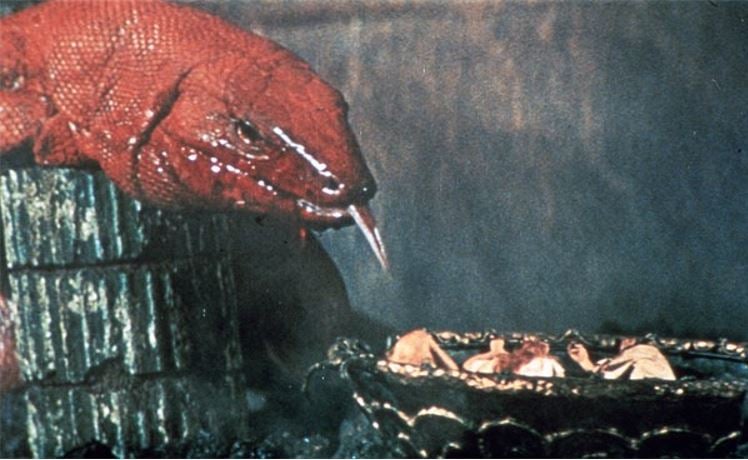
Our discussion of the film is bound to be a rather thin substitute, but preparations are underway for Roy and I to go spelunking on the next Roy’s Tie-Dye Sci-Fi Corner. We’ll be skirting phosphorescent pools and fleeing giant lizards. Keep feeding us rope in the comments section, as we livestream on Facebook, this Friday evening at 7:00 EST!