Category: Daily Dispatch

  • Support WWFM Classical Radio Fundraiser

    Welcome to the second day of The Classical Network’s pop-up fall fundraiser, “7 Days for 70K” – seven days scattered across October and November during which we hope to elicit your support for great music on the radio.

    Are you able to toss us a few bones? WWFM hosts will be on hand to encourage your support until 6 pm EDT! Make your donation today by calling 1-888-232-1212 or contributing online at wwfm.org.

    Your commitment is our calcium, especially during these lean times. Thank you for your generosity in keeping the music “alive” on WWFM – The Classical Network!

    https://wwwfm.secureallegiance.com/wwfm/WebModule/Donate.aspx?P=DEFAULT&PAGETYPE=PLG&CHECK=vOU2bz5JCWmgCDbf53nm9ezWDeZ%2beA1M

  • Gretchaninov Buried Near Six Flags

    Gretchaninov Buried Near Six Flags

    Stop me if you’ve heard this before. I know I posted about it a couple of times in the past, but it’s been a few years. There’s actually a pupil of Nikolai Rimsky-Korsakov buried outside Six Flags Great Adventure.

    That’s right, Alexander Gretchaninov, who began composing in pre-revolutionary Russia, opted to decompose in New Jersey.

    Gretchaninov, born on this date in 1864, wrote five symphonies, four string quartets, two piano trios, sonatas for violin, cello, clarinet, and balalaika, several operas, and numerous other works.

    He claimed not even to have seen a piano until the age of 14, when he entered the Moscow Conservatory. He did so without the approval or even the knowledge of his father, a businessman who expected his son to take over the family firm.

    Gretchaninov studied there with Sergei Taneyev – who had studied with Tchaikovsky – and Anton Arensky. After a quarrel with Arensky, he moved to St. Petersburg to study with Arensky’s teacher, Rimsky-Korsakov.

    By that point, Gretchaninov’s parents had basically disowned him. Rimsky, who recognized the teenager’s extraordinary talent, devoted extra time to his instruction and even assumed the role of a surrogate father, helping to support him financially. The two formed an intimate bond which lasted until Rimsky’s death in 1908.

    Gretchaninov returned to Moscow and wrote quite a bit of music for the theater and the Russian Orthodox Church. He achieved such acclaim that in 1910 the Tsar awarded him an annual pension.

    After the Revolution, Gretchaninov hung on for about eight years. Eventually he decided he’d had enough and left for France in 1925. In 1939, at the age of 75, he settled in the United States. He finally became an American citizen.

    He died in New York in 1956, at the age of 91. His remains are buried outside the church at Rova Farms, a Russian enclave in Jackson Township, Ocean County. One hopes he is buried deep enough that the lions don’t get him.

    Happy Birthday, Alexander Gretchaninov!


    A playlist of Gretchaninov’s liturgical music:

    And a sampler of his symphonies:

  • Beecham’s Byronic Manfred

    Beecham’s Byronic Manfred

    “Oh God! If it be thus, and thou art not a madness and a mockery, I yet might be most happy…” So laments Lord Byron’s Manfred when confronted by the specter of Astarte.

    Manfred is the quintessential Byronic hero, a romantic superman who endures unimaginable sufferings and mysterious guilt in connection with the death of his beloved. He wanders the Alps, longing for extinction, and meets his fate defiantly, rejecting all authority, corporeal and supernatural.

    Robert Schumann was intoxicated by Byron’s dramatic poem from the time he first encountered it at the age of 19 in 1829. In 1848, he began to compose music for it, concurrently with that for his “Scenes from Goethe’s ‘Faust.’” Wrote Schumann, “I have never before devoted myself to a composition with such love and such exertion of my powers as to ‘Manfred.’” The piece was given its first performance in Weimar in 1852, with Franz Liszt conducting.

    This Sunday night on “The Lost Chord,” we’ll hear highlights from a recording made 102 years later by Sir Thomas Beecham.

    When Beecham came to record Schumann’s incidental music in 1954, it was an act of total reimagination. Unquestionably the work, as written, contains much attractive music. However, if we’re to be completely frank, it can be a bit dramatically static at those times when the music falls silent in deference to florid monologue. Beecham recognized this and enlisted the help of Eugene Goossens and Julius Harrison to assist him in orchestrating a number of Schumann’s piano pieces to be used as underscore for some of the spoken dialogue. He also incorporated a couple of part-songs and even invented a ballet. Fear not! Beecham’s license is nowhere as extreme as that he would later take with Handel’s “Messiah.”

    Beecham’s Byronic credentials are unimpeachable. Byron was among his favorite poets. Of course, he also happened to conduct one of the great recordings of “Harold in Italy” (after “Childe Harold’s Pilgrimage”), with the violist William Primrose. Furthermore, Beecham had been familiar with Schumann’s “Manfred” since at least 1918, when he led two performances of the complete incidental music at the age of 39. Some 36 years later, he decided to resurrect the work via a broadcast performance and then as a program at Royal Festival Hall.

    I first encountered this remarkable recording in the 1980s, in the middle of the night, when it was broadcast over the late, lamented WFLN, for 48 years Philadelphia’s classical music station. Henry Varlack used to play it from time to time on his program, “Sleepers Awake.” Having not heard it for a while, I called in to his Friday night/Saturday morning listener request show, and he told me with regret that the record had become so worn that it was no longer suitable for airplay.

    Imagine my excitement, then, when I learned in the mid-‘90s that it was being reissued on CD. I promptly special-ordered it from England, and it couldn’t get here fast enough. That was on the Beecham Collection label – alas now long out of print. It has since appeared and disappeared (like Astarte?) on Sony.

    The recording features actors, chorus, and orchestra. Laidman Browne may be a bit long-in-the tooth for Byron’s anti-hero, but no one relishes “eeeeeeeeviiiiiiiiiiiiiiiiiiiiiiiiiilllllllll” quite like him.

    I hope you’ll join me for “Byronic Beecham,” this Sunday night at 10:00 EDT, on WWFM – The Classical Network and wwfm.org.

  • Sofia Gubaidulina at 90 A Musical Maverick

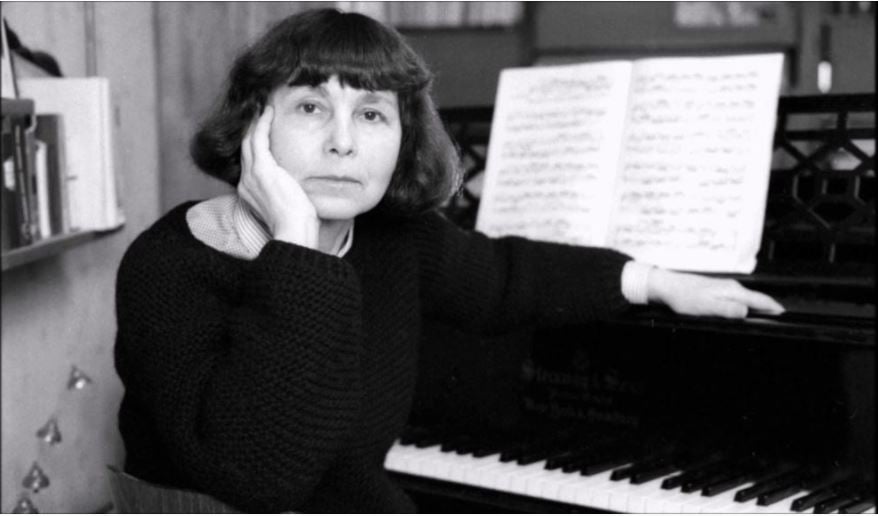
    Sofia Gubaidulina at 90 A Musical Maverick

    Sofia Gubaidulina is 90 today. Boy, does she have an ear for color! Actually, there is little about this composer that could be dismissed as run-of-the-mill. Having lived for nearly 60 years under a regime that frowned on too much individuality, she pushed hard against the outside of the box. Her works have earned her an international reputation as one of the most important composers to emerge from the USSR during the second half of the 20th century.

    Gubaidulina discovered music at the age of 5. She would go on to study at the Kazan Conservatory. The other great interest of her childhood was spirituality, especially as expressed in the works of the great composers – Bach, Mozart, and Beethoven. Her fascination with religion and spirituality was something she knew intuitively to keep to herself while living in the Soviet Union.

    Music became her escape from socio-political strictures. During her time at the conservatory, there were actually raids on the dormitories, during which scores by decadent Western composers (and Stravinsky!) would be confiscated. Her own music was denounced as “irresponsible.”

    Privately, she was encouraged by Shostakovich. She found a safe outlet for her particular brand of modernist expression in writing for film. Of mixed ethnicity (her father was Tatar), she founded a folk instrument ensemble, Astreja, in the mid-‘70s. In 1979, she was blacklisted for unauthorized participation in festivals of Soviet Music in the West.

    She came to international attention in the late ‘80s thanks to Gidon Kremer, who championed her violin concerto, “Offertorium.”

    Gubaidulina’s highly individual music is steeped in mystical spiritualism. Her works are informed by a kind of longing for human transcendence, a yearning for greater truths central to our being. But she seldom searches the same way twice.

    Since 1992, she has made her home in Hamburg. Her awards and honors have been many.

    Happy birthday, Sofia Gubaidulina!


    “Canticle of the Sun” for cello, chamber choir and percussion (1997)

    “Fachwerk” for bayan, percussion and string orchestra (2009)

    “Concerto for Two Orchestras” for orchestra and jazz band (1970)

    “The Wrath of God” (2019)

  • Spooky Comedy Film Scores for Halloween

    Spooky Comedy Film Scores for Halloween

    Spooky comedies. A seeming oxymoron. Perhaps in an attempt to subvert our fears, or to generate laughter from tension, filmmakers have frequently juxtaposed humor with the supernatural – or at any rate death.

    This week on “Picture Perfect,” we’ll conjure some Hallowe’en spirit with music from four macabre comedies.

    Frank Capra’s screen adaptation of “Arsenic and Old Lace” (1944) was actually shot in 1941, but it could not be released until after the hit stage play, by Joseph Kesselring, had concluded its Broadway run.

    The film starred Cary Grant, Priscilla Lane, Raymond Massey, Peter Lorre, Jack Carson, and Capra favorites James Gleason and Edward Everett Horton.

    Two seemingly innocuous spinster aunts poison lonely old men and have them buried in their basement, by a family member who believes that he’s Teddy Roosevelt. (He thinks that he’s digging the Panama Canal.) Massey and Lorre play a murderer on the lam and his plastic surgeon, respectively, who hole up in the house, unaware that Massey’s body count pales next to that of his unwitting hosts.

    The score, by Max Steiner, is as manic as Grant’s performance – perhaps a mite overdone, with its breakneck allusions to familiar melodies – but it bears the same distinctive gloss as other Steiner classics like “Gone With the Wind” and “Casablanca.”

    Composer Bernard Herrmann will always be most closely associated with the films of Alfred Hitchcock. In particular, his music for the shower scene in “Psycho” has entered the popular consciousness as few other film scores have. Hitchcock and Herrmann collaborated on nine films in all. The first of these was a black comedy called “The Trouble with Harry” (1955), a droll farce about a corpse that materializes in a New England community and can’t seem to stay buried.

    Don Knotts and a haunted house – that’s the high concept behind “The Ghost and Mr. Chicken” (1966). How could it possibly miss? Knotts’ elastic-faced terror finds a goofy foil in Vic Mizzy’s score. Mizzy also wrote music for “The Addams Family.”

    Finally, in a kind of twist on “Topper,” Alec Baldwin and Geena Davis play a recently-deceased couple who try to scare off the inhabitants of their former home, in “Beetlejuice” (1988). In desperation, they enlist the services of a manic “bio-exorcist” (a loosy-goosy Michael Keaton) and things get seriously antic.

    The music is by Danny Elfman, as always a fan of Nino Rota, although he also pays homage to the Stravinsky of “The Soldier’s Tale” and frequently alludes to Raymond Scott. There’s even a touch of Bernard Herrmann in one of the tracks, as Elfman evokes the skeleton fight from “The Seventh Voyage of Sinbad.”

    I hope you’ll join me for a mishmash of horror and humor this week, on “Picture Perfect,” music for the movies, this Saturday evening at 6:00 EDT, on WWFM – The Classical Network and wwfm.org.
Tag Cloud

Aaron Copland (93) Beethoven (95) Composer (114) Film Music (136) Film Score (143) Film Scores (255) Halloween (94) John Williams (195) KWAX (229) Leonard Bernstein (103) Marlboro Music Festival (125) Movie Music (151) Mozart (88) Opera (207) Philadelphia Orchestra (89) Picture Perfect (174) Princeton Symphony Orchestra (108) Radio (88) Ross Amico (244) Roy's Tie-Dye Sci-Fi Corner (290) The Classical Network (101) The Lost Chord (268) Vaughan Williams (103) WPRB (396) WWFM (881)

DON’T MISS A BEAT

Receive a weekly digest every Sunday at noon by signing up here


RECENT POSTS