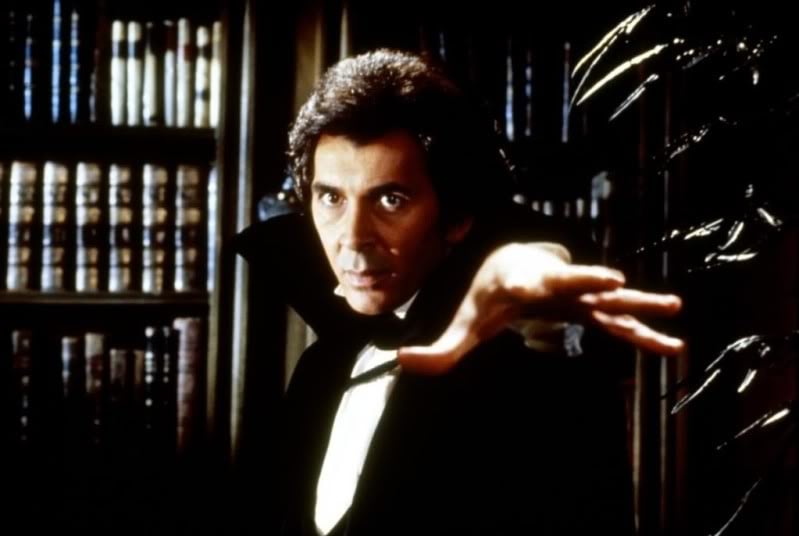
Last night, Roy and I attempted to shed a little light on “Dracula” – the 1979 Frank Langella version. I had a few bones to pick, so be forewarned if you never drink… whine. Our conversation is in the vault. Grab a crucifix and a stake and meet us here:
Then I hope you’ll join us next Friday for a mad monster party, when SciFi Distilled’s Mike and Marybeth join us for… “Mad Monster Party” (1967)!
You undoubtedly recognize Rankin-Bass from their classic Christmas specials, including “Rudolph the Red-Nosed Reindeer” and “Santa Claus is Coming to Town.” Well, what if they had been enlisted to make a kind of feature-length “League of Extraordinary Monsters?” All your favorites are here: Dracula, Frankenstein’s monster, the Wolfman, the Invisible Man, Dr. Jekyll and Mr. Hyde, Quasimodo the Hunchback, and the Creature from the Black Lagoon, among others.
Boris Karloff and Phyllis Diller lend their voices. Mad Magazine’s Harvey Kurtzman wrote the script. The film sports plenty of other in-jokes for classic monster lovers and Golden Age movie buffs.
Costumes will be donned! We’ll be all duded up in our undead apparel for “Mad Monster Party” on the next Roy’s Tie-Dye Sci-Fi Corner. Leave your tricks or treats in the comments section, as we livestream on Facebook, next Friday evening at 7:00 EDT!
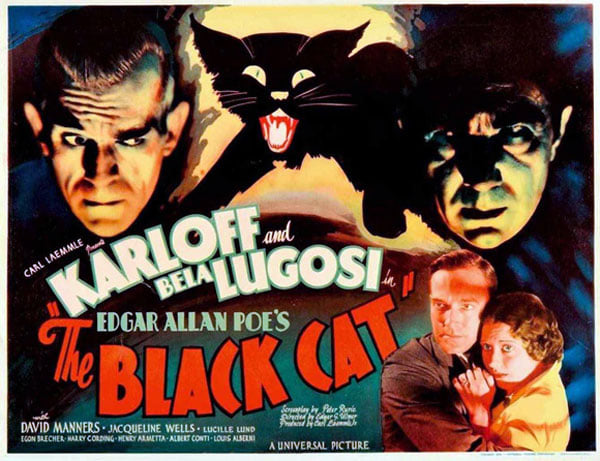
On the anniversary of the birth of Franz Liszt – and with Halloween right around the corner – some altruistic chap took the time and effort to compile all the classical music adapted for use in “The Black Cat” (1934), with Boris Karloff and Bela Lugosi.
Liszt’s music frequently turns up in those pre-code horror movies. Why was he considered so spooky? Was it because of his “Mephisto Waltzes?” His “Totentanz?” His “Faust Symphony?” More than likely it was because he was in the public domain.
Liszt features prominently in “The Black Cat”s underscore, with an orchestration of his Piano Sonata in B minor, the orchestral version of his “Hungarian Rhapsody No. 3,” the symphonic poem “Tasso: Lament and Triumph,” and of course “Les Preludes.”
The Liszt goes on. You can Liszt-en to it here:
There’s even Liszt in this “faux” trailer (and Bach and Schubert and near-Tchaikovsky too):
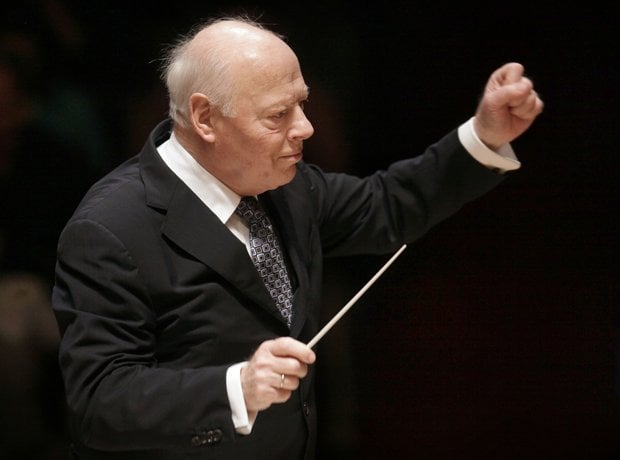
By the time I learned last night of the death of Bernard Haitink, there was little I could do about it. I had had a late dinner and watched a movie, and it was all I could do to brush my teeth and struggle through a chapter in bed.
With the dawn of another day, I can share my recollection of working as a clerk at Sam Goody in the 1980s – essentially signing my paycheck back over to the company in exchange for CDs – and the piecemeal acquisition of my first Shostakovich cycle, with Haitink conducting. Really, in the early days of compact disc, if you wanted all the symphonies, there weren’t any other options. I’ve since acquired complete cycles by Kondrashin and Barshai, and powerful one-offs by any number of other conductors, but I’ve always hung on to Haitink. He also took a remarkable interest in Vaughan Williams, recording all the symphonies, unusual for a major conductor outside of England – especially so for someone from mainland Europe.
For many, Haitink’s memory will be indivisible from his long association with the Concertgebouw Orchestra of his native Amsterdam. He also held important conducting posts with the London Philharmonic Orchestra (1967-1989), Glyndebourne Opera (1978-1988), the Royal Opera House, Covent Garden (1987-2002), the Staatskapelle Dresden (2002-2004), and the Chicago Symphony (2006-2010). Chicago wanted him longer, but he declined, citing his advancing age. His final concert was in Lucerne, on September 6, 2019, with the Vienna Philharmonic.
As a music-lover, concertgoer, and record collector for over 40 years, I am sorry to lose anyone as prominent as Haitink has been. He was one of the last lions of the podium of his generation. It’s funny that he received so much recognition for his performances of the core Germanic repertoire (especially Brahms and Beethoven), since I mostly found his recordings in this department to be rather uninteresting. He did, however, often deliver in unexpected places.
He received nine Grammy nominations, for a complete Beethoven cycle, Beethoven’s “Missa solemnis,” Brahms’ “A German Requiem,” and Mozart’s “Don Giovanni,” but also for recordings of Vaughan Williams’ “A Sea Symphony” and “Sinfonia Antartica” and Holst’s “The Planets.” He won twice, for Janacek’s opera “Jenufa” in 2003 and again in 2008 for a later recording of Shostakovich’s Symphony No. 4.
Here are some links to a few of my favorite Haitink recordings:
A live performance of Shostakovich Symphony No. 15
Debussy’s “Images”
A concert broadcast of John McCabe’s “Chagall Windows”
Since today is Liszt’s birthday, from Haitink’s complete recordings of the symphonic poems, “Die Ideale”
Finally, the European Union Youth Orchestra giving its all in a Haitink specialty, Bruckner’s Symphony No. 7
Bernard Haitink was 92 years-old. Thank you, Maestro, and R.I.P.
“…[T]hou was a skellum,/A blethering, blustering, drunken blellum;/That frae November till October,/Ae market-dae thou was na sober.”
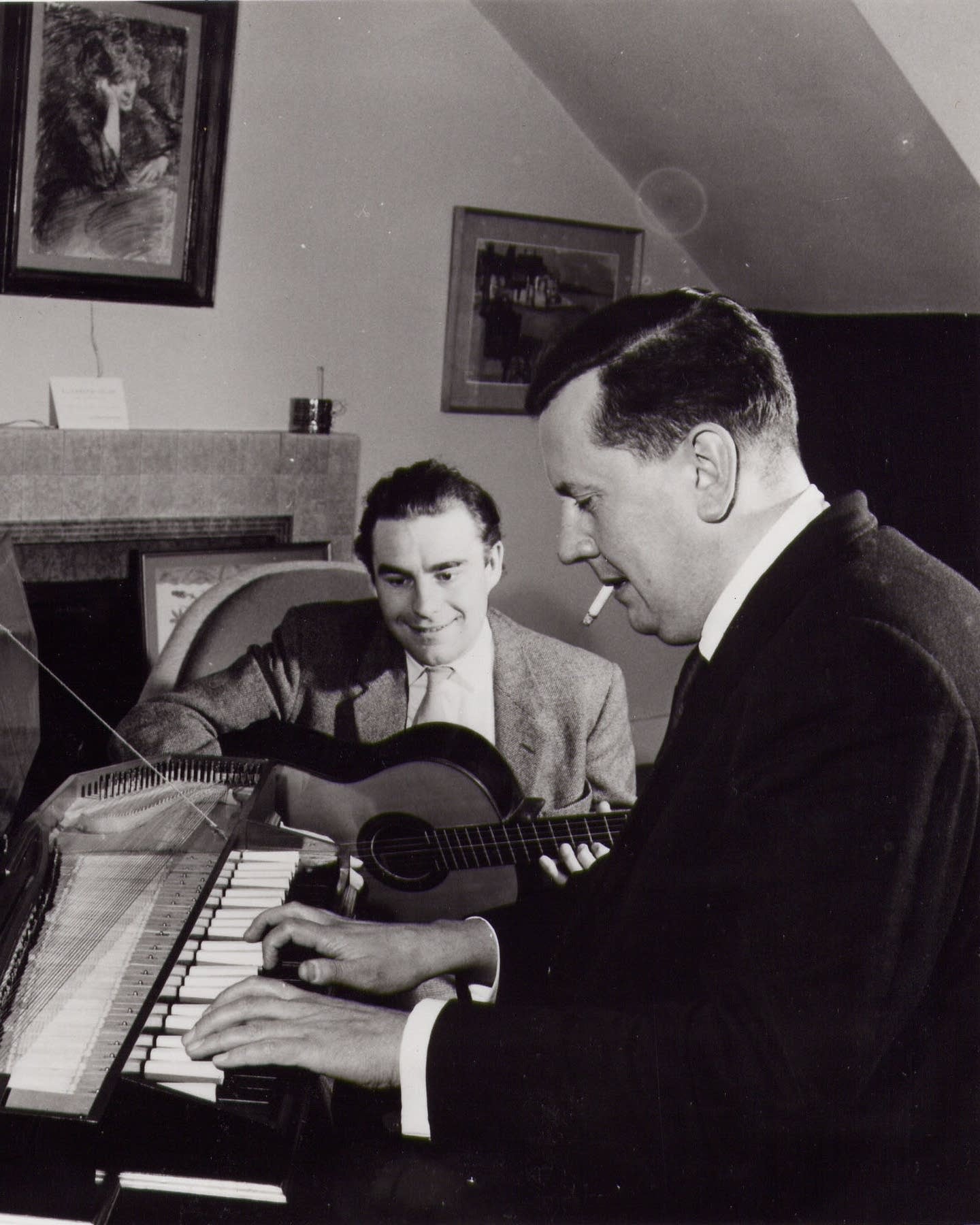
Rabbie Burns wrote those lines about Tam O’Shanter. But they just as well could have applied to Sir Malcolm Arnold. Both men were, more or less, fond of the bottle, and both were driven by demons.
Arnold, born 100 years ago today, began his professional career as a trumpeter with the London Philharmonic Orchestra. He was appointed its principal in 1943.
During World War II, he registered as a conscientious objector. However, following the death of his brother, a pilot in the RAF, he was moved to enlist. At least for a time. While he never saw actual combat, serving instead in a military band, he quite literally shot himself in the foot so that he could return to civilian life.
In 1948, he retired from orchestral playing to devote himself exclusively to composition. He possessed a rare melodic gift, which served him well in his light music and film scores. He won an Academy Award in 1957 for his work on “The Bridge on the River Kwai.”
However, Arnold also had his dark side, as can be detected in certain passages of his symphonies. He was frequently cantankerous, often inebriated, and also highly promiscuous. He attempted suicide at least twice. He was treated for depression and alcoholism, rising above both, but in the early 1980s was given only a year to live. He actually lasted another 22, during which he completed his Symphony No. 9, among other works.
Arnold died in 2006, one month shy of his 85th birthday. He was a brilliant composer, of great facility. When Malcolm Williamson was named Master of the Queen’s Music in 1975, Sir William Walton quipped that they had given the job to the wrong Malcolm. For a man with so many personal demons, Arnold wrote reams of perfectly delightful music.
A good example, and one of my favorite Halloween pieces, is the programmatic overture “Tam O’Shanter” (1955). On market day, Burns’ antihero tarries at a pub, in defiance of his wife, then staggers out into the night. Under ominous skies, he detects the sound of bagpipes emanating from the ruins of an old church. Pressing his face to a chink in the mortar he espies “Auld Nick,” the Devil himself, “in shape o’ beast,” presiding over a coven of high-stepping witches and warlocks. When a particularly comely witch catches Tam’s eye, in his drunkenness, he roars, “Weel done, Cutty-sark!” (a reference to her short skirt). This brings the forces of darkness down up him, and there is a hell-for-leather sprint by horseback for a nearby river, since spirits are said not be able to cross running water.
If you’re interested in the rest, you can read it for yourself here:
Frank Langella’s characterization of Bram Stoker’s Dracula drove the critics wild when the play by Hamilton Deane and John L. Balderston was revived on Broadway in 1977. It was the same adaptation that propelled Bela Lugosi to the big screen. But when the film “Dracula” (1979) was released a couple of years later, reviews were mixed.
Langella retained his dreamy magnetism, and the producers managed to secure Sir Laurence Olivier and Kate Nelligan for the parts of Van Helsing and Lucy, respectively, but I wonder if John Badham was the best choice for director. Badham had just come off the enormous box office success of “Saturday Night Fever,” and it looks as if his Dracula retains John Travolta’s hair. You know, just for luck.
I haven’t seen the film for decades, and having rewatched it now after rereading the book (for the first time in 30 years), I’ve got a few bones to pick. I hope you’ll join Roy and me tomorrow night, on the next Roy’s Tie-Dye Sci-Fi Corner, when I sink my fangs into “Dracula.” Enjoy some extra garlic on your pizza as you share your thoughts in the comments section. We’ll livestream with the undead on Facebook, this Friday evening at 7:00 EDT!
I remember being so excited, watching this trailer as a 13 year-old at the movies. When Langella leaped through a window and transformed into a wolf in mid-flight to John Williams’ music, it was almost more than I could bear. Watch the trailer (so much crisper and more intoxicating in the theater) here: