Category: Daily Dispatch

  • Columbus Opera Rediscovered Franchetti’s Lost Score

    Columbus Opera Rediscovered Franchetti’s Lost Score

    Before Columbus Circle, Columbus OH, and the Knights of Columbus came… He Who Must Not Be Named.

    He may be a controversial figure today, but Christopher Columbus sure did inspire a lot of music. I’ve had this recording (bottom right) on the shelf for a few years now. I think today is probably as good a time as any to take it down and see what it’s all about.

    “Cristoforo Colombo” was composed in 1892 to mark the 400th anniversary of Columbus’ first voyage to the New World. It is said to be Alberto Franchetti’s magnum opus. Franchetti (1860-1942) was a nobleman of independent means, who studied with Josef Rheinberger and Felix Draeseke.

    Dubbed “the Meyerbeer of modern Italy,” his style synthesizes Wagner, Meyerbeer, and the contemporary school of Italian verismo. His most popular success was the opera “Germania,” which was held in high regard by both Toscanini and Caruso. In fact, in his day, Franchetti’s reputation was right up there with those of Mascagni and Cilea, second tier composers, perhaps, but on a good day they could still rise to an occasion. Unfortunately, “Germania” drifted out of circulation following the First World War.

    Later, in accordance with Fascist racial laws, Franchetti’s works were banned from public performance. Franchetti was not only out of fashion; he was Jewish. Mascagni, composer of “Cavalleria Rusticana,” went out on a limb to plead his case before Mussolini.

    Interestingly, it was Franchetti who had first been offered the libretto of “Tosca,” which of course eventually wound up in the hands of Giacomo Puccini. “Tosca” remains one of the most frequently performed operas in the world.

    “Cristoforo Colombo” was given its debut in Genoa – Columbus’ birthplace – on October 6, 1892. The same year, it was performed at La Scala, Milan. Its North American premiere took place in Philadelphia, presented by the Philadelphia-Chicago Grand Opera Company at the Metropolitan Opera House on North Broad Street, on November 20, 1913. Tito Ruffo sang the title role.

    The opera is nothing if not ambitious. It encompasses intrigues at the Spanish court, the encouragement of Queen Isabella, the voyage of discovery, an attempted mutiny, adventures in the New World, a love affair between one of Columbus’ associates and a native princess, and Columbus’ disgrace, disillusionment, and death.

    Fascinatingly, for an opera necessarily tied to the conquest of the Americas, the Church comes in for some particularly harsh treatment. Already, in 1892, the clerics are critically portrayed in their violent attempts to evangelize the indigenous peoples.

    Despite its early success, “Cristoforo Colombo” was deemed to be too long, and a lot of cuts were made, especially to the segments set in the New World. The final version excises Columbus’ adventures in the Americas altogether! It looks as if this recording, set down 30 years ago for the Koch Schwann label, restores the American material.

    This is not a political statement, but rather a musical one. Hey, for three bucks from Princeton Record Exchange, I think it’s worth exploring.


    Enrico Caruso’s first published recording, captured in a Milanese hotel room on April 10, 1902, was an aria from Franchetti’s “Germania,” which he had introduced at the opera’s world premiere only a month before:

    The Columbus expedition sights land:

    Not your cup of espresso? Here’s a Franchetti symphony:


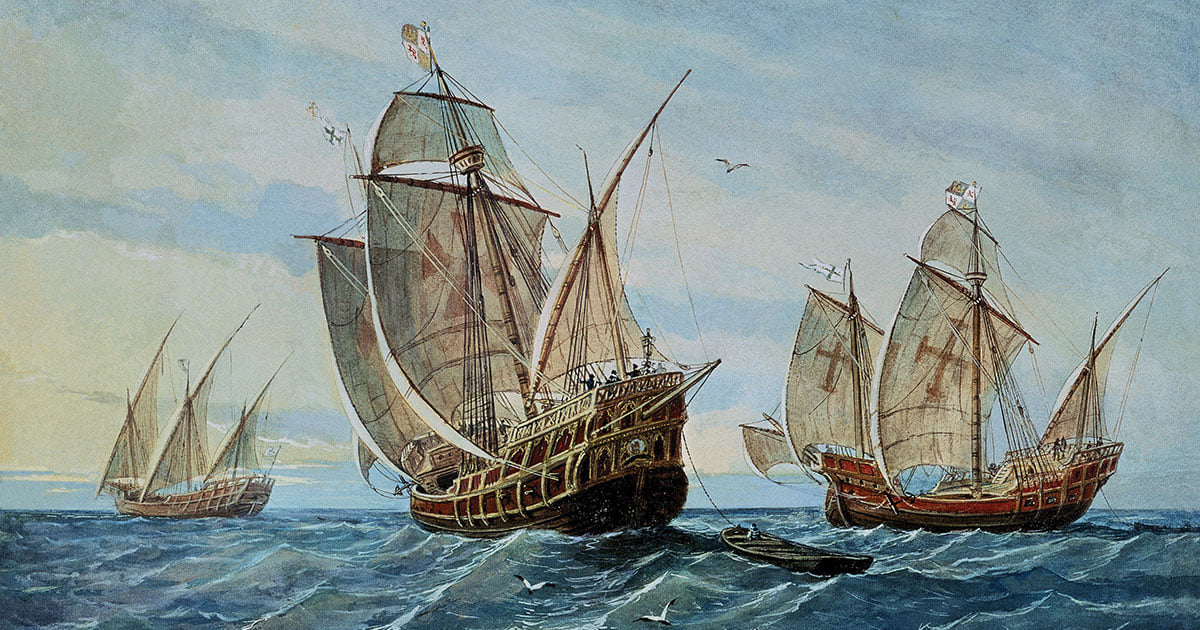
    IMAGES (top): “La Pinta, La Niña and La Santa Maria” by Rafael Monleón y Torres; (bottom, left to right) Alberto Franchetti; Franchetti, Mascagni and Puccini; Koch recording of “Cristoforo Colombo”
  • Vernon Duke Autumn in New York

    Vernon Duke Autumn in New York

    It’s autumn in New York!

    Vernon Duke (né Vladimir Dukelsky) was born in what is now Belarus on this date in 1903. In Kiev, he studied composition under Reinhold Gliere. He left the USSR in 1920, traveling to New York, where he was befriended by George Gershwin. In fact, it was Gershwin who suggested a name-change to something a bit more comprehensible to American audiences. (Gershwin himself was born Jacob Gershowitz.)

    For a time, Duke ping-ponged back and forth to Europe, where he fulfilled a commission by Serge Diaghilev (for the ballet “Zephyr and Flora”). The work impressed Sergei Prokofiev, and the two became fast friends. Dukelsky’s Symphony No. 1 was given its premiere in Paris, under Serge Koussevitzky, on the same program as excerpts from Prokofiev’s “The Fiery Angel.”

    Around the same time, Duke began contributing material to musical comedies in London. This laid the groundwork for a return to New York in 1929. There, he continued to composed “serious” works, while insinuating himself into the Broadway scene. A number of his songs – “April in Paris,” “Autumn in New York,” “Taking a Chance on Love,” “I Can’t Get Started” – have since become standards.

    When Gershwin died in 1937, Duke stepped in to complete his unfinished score for “The Goldwyn Follies,” for which he contributed a couple of ballets (choreographed by George Balanchine) and the song, “Spring Again.” His greatest success came in 1940, with the Broadway show, “Cabin in the Sky.”

    Here’s a rare concert broadcast of his Symphony No. 3:

    A number of his concert works have been recorded in recent years, including this Piano Concerto for Arthur Rubinstein:

    The Metropolitan Opera’s Samuel Magill is soloist in Duke’s Cello Concerto:

    “Autumn in New York”

    “Brooklyn Barcarolle”


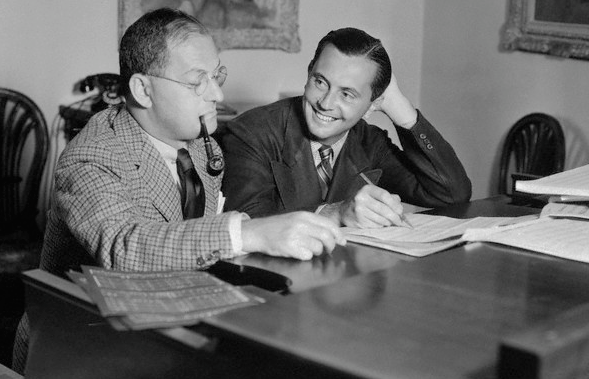
    PHOTO: Duke (right) with Ira Gershwin

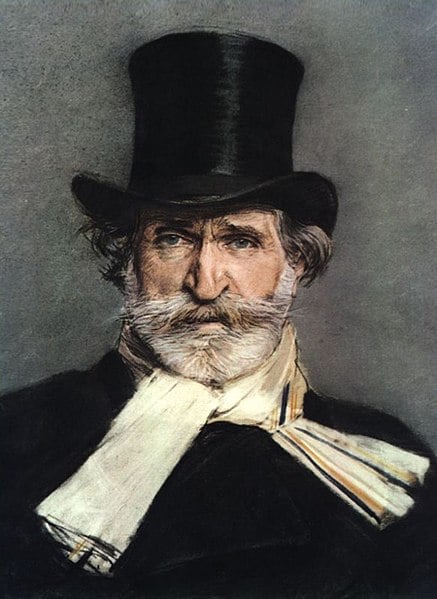
  • Viva VERDI! Italian Music & Unification

    Viva VERDI! Italian Music & Unification

    “Viva VERDI!” – the cry of Italian patriots on the eve of unification.

    Italy of the 1850s was but a conglomerate of individual states, many of them still under foreign rule. The slogan “Viva VERDI!” was coined in 1859, following the premiere of the composer’s politically sensitive opera “Un ballo in maschera.”

    Verdi’s ongoing troubles with the censors are well-known. It’s a safe bet that when he undertook an opera about a political assassination, he had a pretty good idea what to expect. The name VERDI was taken up by firebrands of the Risorgimento as an acronym for “Vittorio Emanuele, Re D’Italia.” King Vittorio Emanuele II of Piedmont was seen by many as the best hope for a free and united Italy.

    This Sunday night on “The Lost Chord,” we’ll refrain for delving too much into Italy’s Second War for Independence, or of Garibaldi’s struggles with the Bourbons. Instead, we’ll enjoy examples of MUSICAL unification – various composers of Italian origin coming together to attempt cohesive works of art.

    There are those who believe the serenata “Andromeda Liberata” may have been composed entirely by Antonio Vivaldi – but perhaps not. The likely impetus for its creation was the return to Rome of one Cardinal Ottobone, who was also a patron of both Arcangelo Corelli and Alessandro Scarlatti.

    The story is that of Perseus and Andromeda. Andromeda has already been rescued from the sea serpent at the start of the piece, which mostly explores the ambiguous feelings of its characters, with a few extraneous love interests tossed into the mix to provide romantic conflict.

    The two-hour entertainment contains in its second part a single aria known definitively to have been composed by Vivaldi. The authorship of the rest remains in doubt. The long-lost manuscript, dating from 1726, was rediscovered as recently as 2002.

    In 1868, Verdi’s great operatic predecessor, the long-retired Gioachino Rossini, died. Rossini had completed his last opera nearly forty years before. Verdi undertook to bring together 12 of his contemporaries, now largely forgotten. The oldest, Carlo Coccia, at age 87, was actually a decade Rossini’s senior!

    Within the year, a collaborative mass was compiled in Rossini’s memory, for which Verdi provided the concluding “Libera me.” In fact, the music looks forward to Verdi’s own masterful Requiem. The completed work doesn’t attain anywhere near the lofty heights of Verdi’s solo run. However, it’s an interesting compendium of contemporary styles, and even the music of lesser talents serves to cast Verdi’s genius in a new light.

    Remarkably, the work lay unperformed in Verdi’s lifetime. Talk about politics! Here was Verdi, a Milanese, trying to kindle some sort of enthusiasm in Bologna (the location of Rossini’s earliest successes), for a project which was to bring together a bunch compositional dinosaurs, to salute a figure who, for all intents and purposes, had retired from public life some four decades earlier. Bologna at the time was in the process of becoming a stronghold of the musical avant-garde.

    All these factors, along with puzzling stipulations, such as the work being locked away after its first performance, to be trotted out only on special occasions, doomed the project virtually from the start. It remained unheard for another 120 years, resurrected only in 1988.

    I hope you’ll join me for “Viva VERDI!” – Italian unification through music – on Verdi’s birthday, this Sunday night at 10:00 EDT, on WWFM – The Classical Network and wwfm.org.

  • Hear Kile Smith’s “Ave Maris Stella” Live

    Hear Kile Smith’s “Ave Maris Stella” Live

    As always, I’m a day late and a dollar short.

    Yesterday, I forgot to mention the world premiere of a new piece by my friend, Kile Smith – “Ave Maris Stella” – to be performed three times this weekend by Piffaro, The Renaissance Band and the vocal ensemble Variant 6. The Center City Philadelphia performance took place last night, but there are still two more chances to hear it live: tonight at 7:30 pm, at the Presbyterian Church of Chestnut Hill (Philadelphia’s “garden district”), and tomorrow at 3 pm, at Sts. Andre and Matthew, 719 N. Shipley St., in Wilmington, DE.

    If these times don’t work for you, a concert video will be made available on-demand from 10/16 to 10/26. Access to the video for ticker holders is free.

    You’ll find more information about the program at the Piffaro website.

    21/22 Concert 1

    PLEASE NOTE: There will be no tickets sold at the door – ADVANCE TICKET SALES ONLY!! So if you intend to go, make your purchases now!

    Kile talks about “Ave Maris Stella”:

    Kile’s earlier Piffaro commission, “Vespers,” is a knock-out. You can sample his setting of Psalm 113 here:

    Want to hear the whole thing? That’s posted too:

    Congratulations, Kile, and best wishes from an absent-minded admirer!

  • Hitchcock Beyond Herrmann Scores Revealed

    Hitchcock Beyond Herrmann Scores Revealed

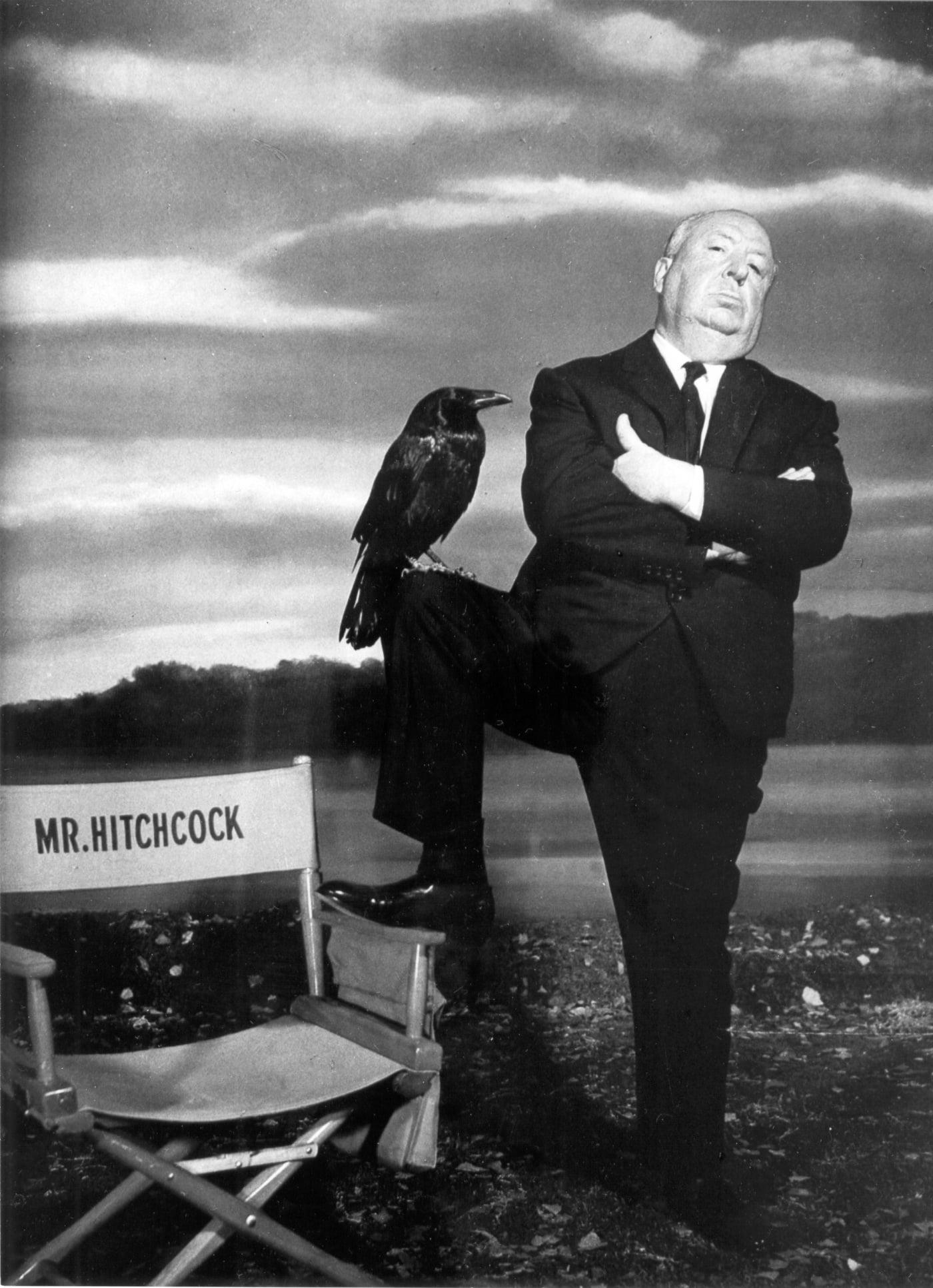
    Alfred Hitchcock’s most celebrated musical collaborator was Bernard Herrmann. Herrmann scored just about every one of Hitch’s films over the span of a decade, enhancing the impact and memorability of such classics as “Vertigo,” “North by Northwest,” and “Psycho.” But Hitchcock also worked with any number of other notable composers.

    This week on “Picture Perfect,” we’ll cast some light into Herrmann’s shadow with selections from “Rebecca” (Franz Waxman), “Strangers on a Train” (Dimitri Tiomkin), “Spellbound” (Miklós Rózsa), and “Family Plot” (John Williams).

    Herrmann goes on hiatus, and the suspense is killing us, on “Picture Perfect,” music for the movies, this Saturday evening at 6:00 EDT, on WWFM – The Classical Network and wwfm.org.

Tag Cloud

Aaron Copland (93) Beethoven (95) Composer (114) Film Music (136) Film Score (143) Film Scores (255) Halloween (94) John Williams (195) KWAX (229) Leonard Bernstein (103) Marlboro Music Festival (125) Movie Music (151) Mozart (88) Opera (207) Philadelphia Orchestra (89) Picture Perfect (174) Princeton Symphony Orchestra (108) Radio (88) Ross Amico (244) Roy's Tie-Dye Sci-Fi Corner (290) The Classical Network (101) The Lost Chord (268) Vaughan Williams (103) WPRB (396) WWFM (881)

DON’T MISS A BEAT

Receive a weekly digest every Sunday at noon by signing up here


RECENT POSTS