A work for amplified Volkswagen, played with flashlights. An opera for eleven dogs. A piano piece in which the performer crawls inside the lid and lets the piano play him.
Move over, Till Eulenspiegel. Today is the birthday of Robert Moran.
Moran, who’s made his home in Philadelphia for more than 40 years, is contemporary music’s merry prankster.
Following studies in Vienna with Hans Erich Apostel, with whom he “learned to count to twelve” (as in twelve-tone music), Moran attended Mills College, where his teachers were Darius Milhaud and Luciano Berio. His classmates at Mills included Steve Reich, Phil Lesh, and Tom Constanten. Lesh and Constanten went on to play for The Grateful Dead. I wonder what ever happened to Reich?
While there, Moran became involved with the whole San Francisco scene. He gained notoriety in the late 1960s and early ‘70s through a series of performance pieces incorporating entire cities, including San Francisco, Bethlehem, PA, and Graz, Austria. These involved tens of thousands of performers.
His many stage works include “Desert of Roses” (after Beauty and the Beast), written for Houston Grand Opera, and “Alice” (after “Alice’s Adventures in Wonderland”), composed for the Scottish Ballet. Maurice Sendak introduced him to the Grimm fairy tale “The Juniper Tree,” which became an operatic collaboration with Philip Glass.
For the occasion of the tenth anniversary of the terrorist attacks on the World Trade Center, Moran was commissioned to write a work for the youth chorus of Trinity Wall Street, the so-called “Ground Zero” church in Lower Manhattan. “Trinity Requiem,” scored for children’s chorus, four cellos, harp and organ, offers a similar brand of solace to that conjured in the 19th century masterwork by Gabriel Fauré.
With Moran, you never know what you’re going to get. In his more puckish moments, he might write for harpsichord and electric frying pan. But then there are times when his natural gift for lyricism will melt your heart. Whether he’s writing for Houston Grand Opera, 39 autos, giant puppets, or electric popcorn popper, his music is always vital and worth getting to know.
Happy birthday, Bob!
———
An aria from “Desert of Roses”
“Trinity Requiem” (its movements posted into a continuous YouTube playlist)
Flying high over Albania
“Obrigado” for Iowa Percussion
“Bank of America Chandelier”
Experimenting with spatial effects in “Solenga”
“Alice” for Scottish Ballet
Looking groovy and introducing his “Lunchbag Opera” for the BBC
“Buddha Goes to Bayreuth”
“Modern Love Waltz” by Philip Glass, arranged by Robert Moran for accordion and cello
I had difficulty accessing my website this morning, from whence I’ve been sending my posts of late. So I’ll save what I wrote for tomorrow, perhaps, lest nobody see it. In its place, here’s a quick acknowledgment of Francis Poulenc’s birthday, by way of a photo of the composer, flanked by tenor Peter Pears and Benjamin Britten.
Britten and Poulenc were friends and knew one another quite well. I read a charming anecdote somewhere that Britten and Pears were present at a recording session of Pierre Bernac singing Poulenc’s songs, and that Britten himself turned the pages – but now I can’t remember where I read it!
Britten did turn pages for Bernac and Poulenc at the Aldeburgh Festival in 1948, when they performed “Le Bestiaire.” The recording at the link was made in London in 1945.
It’s January 6. Epiphany. The Feast of the Three Kings. The Christian feast day that marks, among other things, the Magi’s visit to the Christ Child.
I know I’ve lamented in the past about how so many of the magnificent classical music Christmas works of the past millennium have disappeared from the airwaves. Of the larger works, it seems only Handel’s “Messiah,” Bach’s “Christmas Oratorio,” and of course Tchaikovsky’s (secular) “The Nutcracker” are guaranteed.
Thankfully, I have an enormous record library with at least three shelves devoted exclusively to Christmas music, so I’m able to work through a lot of the forgotten and/or neglected masterworks at home and in the car. But it’s not the same as somebody else pulling and programming the music and knowing that I am part of a unified listening community.
I feel the same way when watching a movie that is broadcast, or actually in a theater, as opposed to playing it from my own collection or streaming it. It’s wonderful to live in an age when these things are possible, but it is just not the same as knowing that I’m a part of a communal experience. (That said, I’m certainly not going to watch “It’s a Wonderful Life” on network television with a thousand commercial breaks!)
I must give a tip of the Ebenezer Scrooge top hat to Yle Klassinen in Helsinki for airing Franz Liszt’s “Christus” complete. That station really is a marvel. Oh how I love my digital radio! Of course, I don’t speak Finnish, but I can usually make out the performers when they are announced and the playlists are posted online.
Anyway, I had already listened to the Dorati recording on my own time. I’ve done so for many, many years. It’s enriched my Christmases ever since I first encountered it on the air, broadcast on Philadelphia’s late, lamented WFLN, back in the early 1980s. Time was, when serious classical Christmas music commenced with Advent. Yes, it was leavened with gems like Victor Hely-Hutchinson’s “Carol Symphony,” the aforementioned “Nutcracker,” and Leopold Mozart’s “A Musical Sleigh-Ride,” in the hilarious recording by the Eduard Melkus Ensemble that includes the neighing horses and barking dogs. I looked forward to hearing that every year. I snapped it up when it was reissued on compact disc and have included it in my own broadcasts for decades.
Those works have their place, but it seems the serious, large-scale choral works are all going away. Commerce, secularism, short attention spans, ignorance, and grievance all work against the simple enjoyment of a lot of masterful music. It’s much safer to play three-minute arrangements of familiar Christmas carols. Over and over and over again.
I grant you, three hours is a lot of radio real estate to give up to Liszt’s “Christus.” But can’t anyone even carve out an hour for Vaughan Williams’ “Hodie?” I suppose I should just shut up and be thankful that RVW’s “Fantasia on Christmas Carols” is still in rotation.
I count myself very fortunate to have been able to share “Christus” many times over the years. I know I’ve played it complete on WXLV, WPRB, and WWFM – once I even preempted the weekly opera broadcast – and excerpted the purely orchestral movements even more frequently, working them into my morning and afternoon playlists. “The March of the Three Holy Kings” is a high point.
I am sorry I don’t have a stretch of air-time during which to play it for you now, but the entire Dorati recording of the oratorio (one of three recordings I own, and still my preferred) is posted on YouTube.
If you want to cut to the chase, here’s the march of the Kings.
Think it sounds an awful lot like Wagner’s Wotan? There’s likely a reason for that. I’ve posted about it before.
I try to be sensitive to other people’s faiths and belief systems, and frankly I am no zealot, but when it comes to music, I am very much a fundamentalist. This is not about pushing Christianity down anyone’s throat as much as a desire to preserve and disseminate the sublime Christmas works, many of them by top-tier composers, presented, like the classic movies on TCM, complete and uncut.
Of course, most of these recordings I’ve played over the years are from my own collection. I was very fortunate to be able to do my own programming, for hours at a time, for the better part of three decades. In such a situation, when a radio host loses his platform, countless hours of repertoire go with him. You’ll still get “Messiah,” but you probably won’t get Josef Rheinberger’s “The Star of Bethlehem” (here posted as a playlist of nine separate videos).
Rutland Boughton’s “Bethlehem” is another Christmas work I’m crazy about. You won’t find it in many record libraries at radio stations here in the U.S. But I’ve got it, and I’ve aired it. Rather than write about it again, I’ll refer you to one of my teasers from a few years ago.
If you’re a Vaughan Williams fan, I think you will find it delightful. For a long time, I was unable to share any of the audio online, due to Hyperion Records’ justifiably Draconian practice of not allowing any its recordings on YouTube. But the company is now in other hands, so here it is, finally, as a playlist – albeit with the tracks posted separately, so prepare to have to skip an occasional ad.
On the Twelfth Day of Christmas, your resident classical music curmudgeon gives to you… three Christmas oratorios. If I splurged for a dozen, this post would be four times the length!
Have yourself a merry “Little Christmas!”
——–
IMAGE: Detail from Edward Burne-Jones’ “Adoration of the Magi”
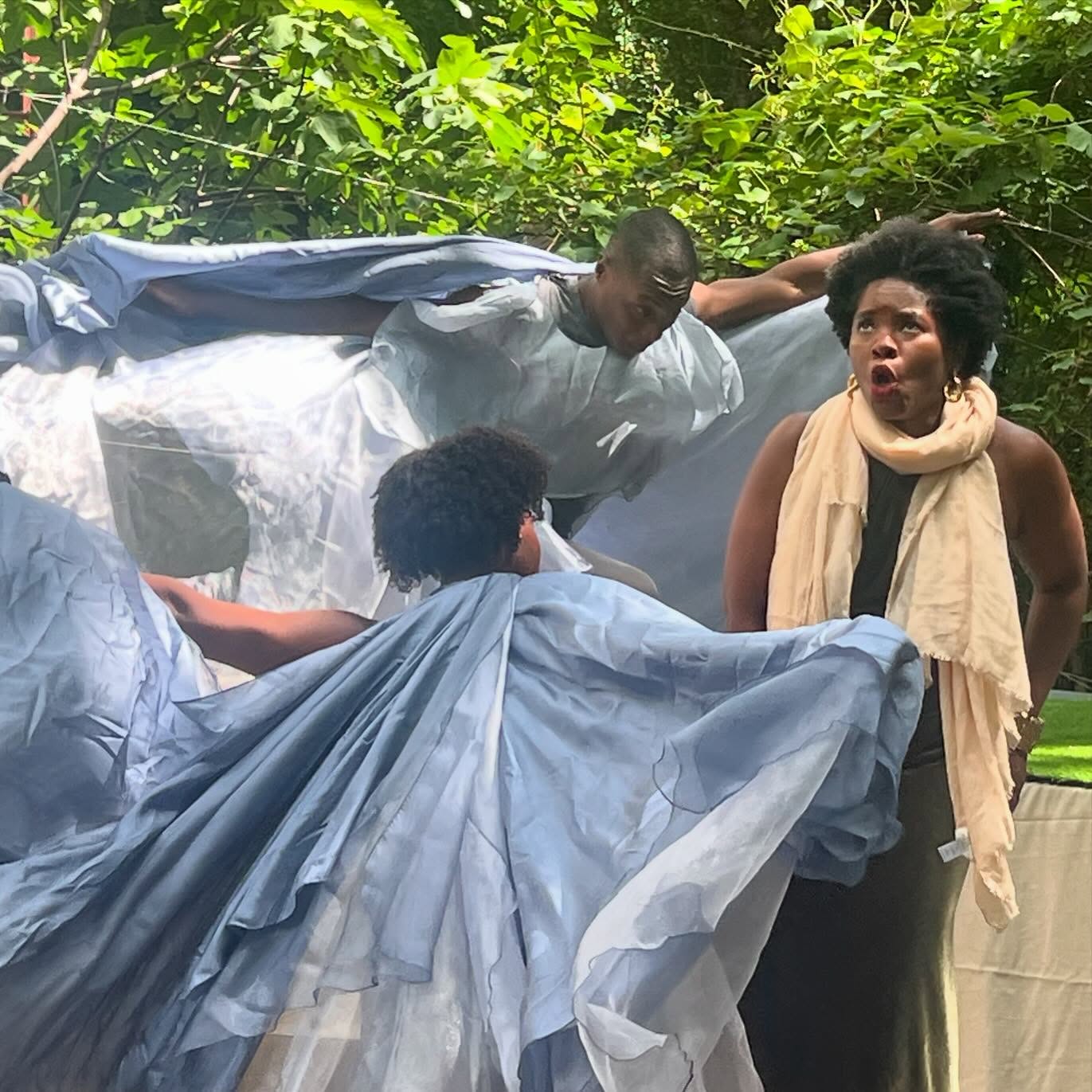
H. Paul Moon wrapped up 2025 by quietly slipping a gift under the tree in the form of a posted film of an Opera Essentia performance of George Frideric Handel’s “Radamisto.” Countertenor Jeffrey Mandelbaum’s distillation of the composer’s 1720 opera seria in three acts manages to get it down to one hour as “The Queen’s Heart.”
I love this sort of quixotic endeavor, presenting tasteful abridgements of rare Handel operas in New York City neighborhoods for free. The productions are no-budget, bare-bones, and beautiful. Watching the wind rustle the leaves during this performance is magical.
Mandelbaum has appeared widely, in both concert hall and opera house, including at the Metropolitan Opera, alongside such singers as Joyce DiDonato and Placido Domingo.
H. Paul Moon’s feature-length documentary “Samuel Barber: Absolute Beauty” aired nationwide on PBS in 2017.
Opera Essentia performs in New York’s gardens, parks, and other neighborhood gathering spaces. “The Queen’s Heart” was filmed at Green Oasis Community Garden on May 24, 2025.
Holy smokes! Now that the holiday “routine” is finally winding down (getting ahead on my radio shows, visiting and hosting family, and generally being festive to the point I have no idea what day of the week it is), I glance at the calendar and realize that I’ve totally, inadvertently crammed next weekend with concerts. And somehow two of those concerts feature the Barber Violin Concerto – on the same day!
How did it happen? I impulsively acquired a seat to Friday afternoon’s Philadelphia Orchestra concert as part of a package deal for deeply-discounted tickets. Of course, I leaped at those programs that really appealed to me, the ones I regarded as must-see (or hear), and then to fill the quota, I picked the Friday concert.
And what’s not to like? The program includes, beside the lovely and moving Barber concerto (with the excellent Augustin Hadelich as soloist), Mahler’s winning Symphony No. 4, and John Adams’ “Short Ride in a Fast Machine” (John Adams for people who think they don’t like John Adams). Furthermore, Dalia Stasevska will be conducting, and I confess I am a little bit in love with her. (The fact that she’s married to Sibelius’ great-grandson further endears her to me.)
What I had forgotten was that I was already holding a ticket to the New Jersey Symphony, which had also lured me at some point with a 50-percent off sale. So I’ll be hearing the Barber concerto again on Friday night in Princeton, this time with Randall Goosby as the soloist. It was an offer I couldn’t refuse, especially with a program that opens with Sibelius’ “Finlandia” and concludes with my personal favorite of the Tchaikovsky symphonies, the Symphony No. 2.
This Second Symphony, which assimilates Ukrainian folk themes, has always been subtitled, in English-speaking countries anyway, as the “Little Russian,” but world events have precipitated a shift toward identifying it as the “Ukrainian.” (I didn’t mention that Stasevska, who moved to Finland with her family at the age of 5, was born in Kyiv – yet another detail that binds the Friday concerts.) In this instance, the NJS’s music director, Xian Zhang, will conduct at Princeton University’s Richardson Auditorium.
Then on Saturday evening, I’ll be back at Richardson for a concert of the Princeton Symphony Orchestra. Yet another violinist, Bella Hristova, will be the soloist for Prokofiev’s Violin Concerto No. 1. On the second half will be the Symphony No. 1 of Dmitri Shostakovich.
The program will open with a recent work by Portuguese composer Andreia Pinto Carreia. “Ciprés” takes its inspiration from a poem by Federico Garcia Lorca. The structure of the piece is said to be influenced by the poem’s imagery of trees and water. I’ll be interested to see (and hear) what that’s all about. PSO music director Rossen Milanov will conduct.
I’ll give my ears a rest on Sunday. I’m certainly not complaining – it will be great to get back to attending concerts – but you’ll understand, I hope, that it is a bit like emerging from the desert and trying not to drink too fast!
——–
PHOTO: Dalia Stasevska in her Chuck Taylors. She’ll remain in Philadelphia to oversee John Williams’ Tuba Concerto, with the orchestra’s principal tubist Carol Jantsch, January 15-17. You know I’ll be there for that too!