Category: Daily Dispatch

  • Ides of March Music from Rome & Ireland

    Ides of March Music from Rome & Ireland

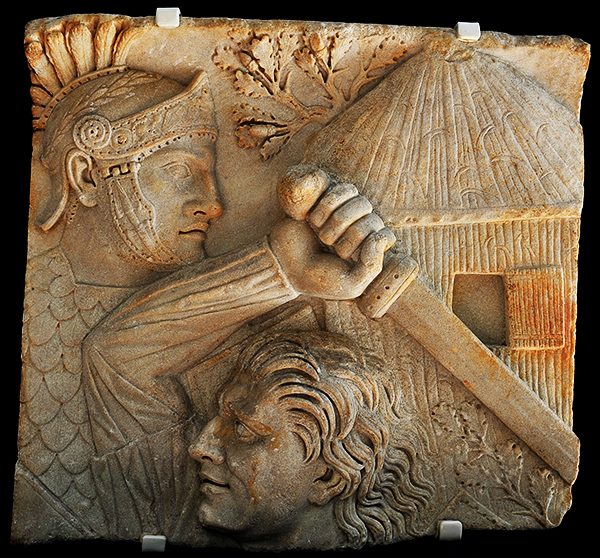
    It is with a mix of revulsion and admiration that Julius Caesar regarded the Celts, whom he referred to as “Galli,” or barbarians. For their savagery in battle, the Britons were a race that demanded a certain level of respect. Ironically, it would be Caesar’s own senate that would murder him on this date in 44 B.C.

    Join me this afternoon on The Classical Network, as the Ides of March meet St. Patrick’s Day. We’ll hear a fair amount of music inspired by Ancient Rome and the Emerald Isle. I’ll also mark the birthdays today of Karl Davidoff, Nicholas Flagello, Johan Halvorsen, Ben Johnston, Colin McPhee, and Eduard Strauss.

    Our Noontime Concert will be devoted to the Guild for Early Music. The Guild will present its 14th annual Early Music Festival at Grounds For Sculpture in Hamilton, NJ, on Sunday, March 24. An afternoon of mini-concerts of Medieval, Renaissance, Baroque, and Early American music will be performed by over a dozen ensembles. The day will include sculpture tours, pop-up performances about the 42-acre grounds, and a “petting zoo” of early instruments. The event is free with paid admission to the park. Learn more at guildforearlymusic.org and groundsforsculpture.org.

    Today’s concert broadcast will feature performances from last year’s festival by Riverview Early Music, Les Agréments de musique, The Practitioners of Musick, and the Gloria Consort. Representatives of the Guild, John Burkhalter and Abigail Chapman, will be my guests, beginning at 12:00.

    All told, I’ll be with you straight through the afternoon. At 6:00, it’s another “Picture Perfect.” For the Ides, the focus will be on music from movies set in the days of the Roman Empire.

    I’ll console myself with the fact that Rome wasn’t built in a day, as I’m chained in the galley from 12 to 7 p.m. EDT, on WWFM – The Classical Network and wwfm.org.


    PHOTO: Legionary vs. Celt, c. AD 98-117

  • Telemann: The Underdog Baroque Master

    Telemann: The Underdog Baroque Master

    Of the three Baroque masters who were born between February 23 (George Frideric Handel) and March 21 (Johann Sebastian Bach), it is too often Georg Philipp Telemann who fulfills the function of Larry Fine.

    Caught between Bach’s contrapuntal face-slaps and eye-pokes and Handel’s melodic-dramatic shoulder-spins, Telemann, as often as not, winds up getting his hair pulled and his violin smashed.

    I thought it only right to point out that Telemann taught himself the flute, oboe, recorder, double bass, etc., all against the wishes of his family. He wrote more music than Bach and Handel combined – over 3000 works – making him one of the most prolific composers of all time. He was also offered the cantorate of the Thomaskirche in Leipzig ahead of Bach.

    Sure, Bach and Handel were his friends, and he was the godfather of Bach’s son, C.P.E., but he also lived too long and lost his eyesight. And his wife ran up horrific gambling debts.

    Anyway, happy birthday, Telemann. You may have written way too much music for your own good, but you were always the funniest of the Baroque stooges.

    Which reminds me: Here at WWFM – The Classical Network, we’re only a week away from Bach’s birthday, and we’re looking to generate enough donations that we, in good conscience, can cancel fundraising on that day, March 21, and celebrate by simply enjoying Bach’s music. We call it the “Bach 500.” Basically, we’re looking for 500 listeners to step up and contribute in any amount. When we reach 500 donations, we stop asking for money and focus exclusively on spinning the discs.

    We are accepting contributions now, at our website, wwfm.org – click on “donate” – or please call us during business hours at 1-888-232-1212. If you have received a renewal request in the mail, get that return envelope back to us ASAP, so that we can include you in the tally before the 21st.

    Again, 500 contributions will cancel the fundraising and open the floodgates on Bach. (Bach, after all, is German for brook.) Thank you for doing your part to make this year’s Bach 500 a success!


    PORTRAITS (left to right): Bach, Telemann, and Handel

    Nyuk nyuk nyuk!

  • Marlboro Music’s Czech Gems & Dvořák Preview

    Marlboro Music’s Czech Gems & Dvořák Preview

    Each summer, the Marlboro Music School and Festival becomes a destination for chamber music performers and enthusiasts. But periodically, throughout the year, Marlboro also takes it show on the road.

    The next Marlboro tour will take place from March 17-24, with stops in Greenwich, CT, New York City (at Carnegie Hall’s Weill Recital Hall), Philadelphia (at the Kimmel Center for the Performing Arts’ Perleman Theater), Washington, DC, and Boston.

    Capping a program of music by Franz Joseph Haydn, Henry Purcell, and Benjamin Britten will be Antonin Dvořák’s String Quintet in A major, Op. 48. On this week’s “Music from Marlboro,” I’ll offer a preview of this attractive work, in the context of an all-Czech hour.

    Dvořák’s sextet was composed largely in May of 1878, making it contemporaneous with the “Slavonic Dances,” Op. 46. It’s hardly surprising, then, that the work betrays a similarly nationalist character. The sextet’s two inner movements, in fact, bear overtly Czech names: dumka and furiant.

    In music, dumka (literally, “thought”) signifies a kind of melancholy introspection. A furiant is a rapid and fiery Czech dance.

    The sextet holds an important place in Dvořák’s development. Thanks to a government subsidy, Dvořák was able to concentrate solely on composition, and he was determined to confirm his worth. The sextet proved to be the first of Dvořák’s works to receive its premiere outside of Bohemia. It was given its first public performance in Berlin, headed up by the famed violinist Joseph Joachim.

    We’ll hear it performed at the Marlboro Music Festival in 2017 by violinists Stephen Tavani and Scott St. John, violists Rosalind Ventris and Rebecca Albers, and cellists Alice Yoo and Judith Serkin. Serkin, the daughter of Marlboro co-founder Rudolf Serkin, will also appear on the Marlboro tour.

    By way of introduction, we’ll have a hell of bonus in the form of Leoš Janáček’s “Concertino,” a chamber concerto of sorts, composed in 1925. Amusingly, the composer added descriptive notes to the program of the piece, comparing the theme of the first movement to a “grumpy hedgehog,” the clarinet in the second movement to a “fidgety squirrel,” the atmosphere of the third movement to “a night owl and other night animals,” and the character of the fourth movement to a “scene from a fairy tale, where everybody is arguing.” It’s worth noting, perhaps, that Janáček had written his opera “The Cunning Little Vixen” between 1921 and 1923.

    We’ll hear a 1982 performance of the “Concertino,” with violinists Elena Barere and Mei-Chen Liao, violinist Steven Tenenbom, clarinetists Cheryl Hill (E-flat) and Steven Jackson (B-flat), bassoonist Stefanie Przybylska, and hornist Robin Graham.

    The pianist is none other than Rudolf Firkušný. Firkušný, born in Moravia in 1912, was a living link to the composer. He also studied with Josef Suk, the pupil and son-in-law of Dvořák, and with Alfred Cortot and Artur Schnabel. That’s quite a pedigree!

    You’re not going to want to miss this one. Czech it out, on the next “Music from Marlboro,” this Wednesday evening at 6:00 EDT, on WWFM – The Classical Network and wwfm.org.

    To learn more about the Marlboro Music School and Festival – its history, its tours, and its summer concerts – visit marlboromusic.org.

    Marlboro School of Music and Festival: Official Page


    PHOTOS (clockwise from left): Dvořák, Janáček, Firkušný, hedgehog

  • Early Music Festival NJ: Serpent & Song

    Early Music Festival NJ: Serpent & Song

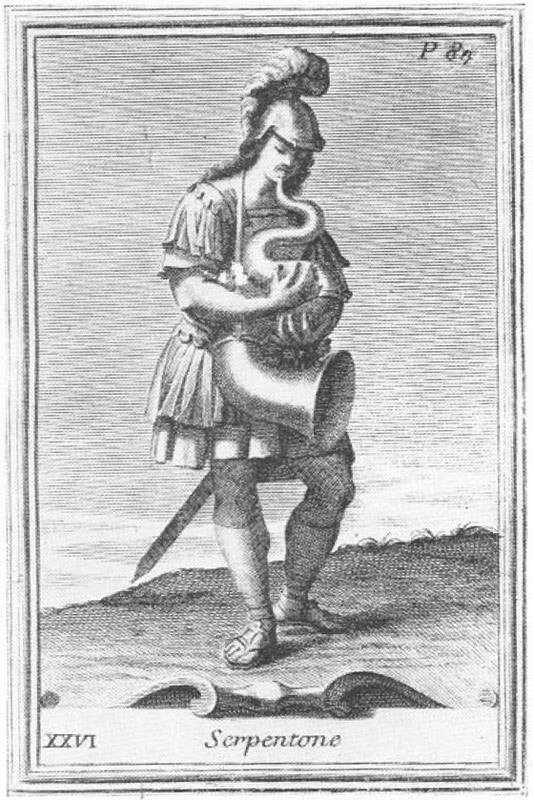
    If the early bird gets the worm, then Early Music gets the “serpent.”

    The Guild for Early Music will present its 14th annual Early Music Festival at Grounds For Sculpture in Hamilton, NJ, on Sunday, March 24. An afternoon of mini-concerts of Medieval, Renaissance, Baroque, and Early American music will be performed by over a dozen ensembles As always, the day will include sculpture tours, pop-up performances about the 42-acre grounds, and a “petting zoo” of early instruments – who knows, perhaps even a serpent (pictured).

    Join me today for the first of two Noontime Concerts on The Classical Network, which will feature representatives of the Guild as my special guests. We’ll hear a selection of madrigals and canzoni performed by Delaware River Consort and La Spirita, Buxtehude and Bach sung by Princeton Pro Musica Chamber Chorus, and Bach and Couperin played by Le Triomphe de l’amour.

    My co-hosts for today’s broadcast will be Judith Klotz and Janet Palumbo; on Friday, I’ll be joined by John Burkhalter and Abigail Chapman.

    The 14th annual Guild for Early Music Festival is free with paid admission to the park. To find out more about the event, look online at guildforearlymusic.org or groundsforsculpture.org; then listen in this Tuesday and Friday at 12 p.m. EDT.

    Following today’s concert broadcast, we’ll continue to honor Early Music Month, in our way, eyes locked in a distant mirror – albeit a bit of a funhouse mirror – as contemporary composers linger in the worlds of courtly dances, madrigals, and hymns.

    At the same time, we’ll be keeping it local, with music for string orchestra inspired by 12th century abbess Hildegard von Bingen, by Philadelphia-born Aaron Jay Kernis; a playful work for guitar, loosely tied to early dance forms, by Princeton University professor emeritus Paul Lansky; an organ processional in the French Baroque style by Philadelphia-based composer Robert Moran; and a Vespers setting by composer, writer, and radio personality Kile Smith – in a recording that brings together The Crossing and Piffaro, The Renaissance Band, no less.

    Everything will be faraway so close, from 12 to 4 p.m. EDT, on WWFM – The Classical Network and wwfm.org.

    Early Music America
    #EarlyMusicMonth

  • Michael Gielen Dies Famed Conductor Was 91

    Michael Gielen Dies Famed Conductor Was 91

    Conductor Michael Gielen has died. Gielen passed on Friday, at the age of 91.

    Best known as one-time music director of the Cincinnati Symphony Orchestra (1980-86), and, especially, the Southwest German Radio Symphony Orchestra (1986-99), he was also a composer, which perhaps explains his special talent for deciphering complex and contemporary scores. He also provided interesting interpretive insights into music of the Romantic era.

    This afternoon on The Classical Network, we’ll remember Gielen through some of his recordings, including that of a Chamber Symphony for 23 Solo Instruments by fin-de-siècle master Franz Schreker.

    We’ll also observe the birthdays today of Catalan composer Xavier Montsalvatge, maestro del tango Astor Piazzolla, Irish composer of Victorian opera William Vincent Wallace, American originals Carl Ruggles, Henry Cowell, and Anthony Philip Heinrich, and vocal artist Bobby McFarren.

    Don’t worry, be happy! It may be the first Monday following a time change, and great artists come and go, but the music will remain vibrant, from 4 to 7 p.m. EDT, on WWFM – The Classical Network and wwfm.org.

Tag Cloud

Aaron Copland (93) Beethoven (95) Composer (114) Film Music (137) Film Score (143) Film Scores (255) Halloween (94) John Williams (195) KWAX (229) Leonard Bernstein (103) Marlboro Music Festival (125) Movie Music (152) Mozart (88) Opera (208) Philadelphia Orchestra (89) Picture Perfect (174) Princeton Symphony Orchestra (108) Radio (88) Ross Amico (244) Roy's Tie-Dye Sci-Fi Corner (290) The Classical Network (101) The Lost Chord (268) Vaughan Williams (103) WPRB (396) WWFM (881)

DON’T MISS A BEAT

Receive a weekly digest every Sunday at noon by signing up here


RECENT POSTS