Väinämöinen is mocked by a salmon, the Sampo is lost at sea, and the Kalevala program did not air last night on “The Lost Chord.” Alas, I must not have loaded it into the playlist properly. Instead my Hanukkah program aired twice in eight days.
Hang on to your stoicism. Lemminkäinen will return. With Christmas and New Year’s fast approaching, it may not be until 2019. Or it could be this Sunday. Whet your sword and watch this space for omens, auguries and portents.
In a week when Finnish conductors are very much in the news (with announcements that Esa-Pekka Salonen is headed to San Francisco in 2020 and that Osmo Vänskä will be stepping down in Minnesota in 2022), we’ll hear music inspired by movers and shakers of the “Kalevala.”
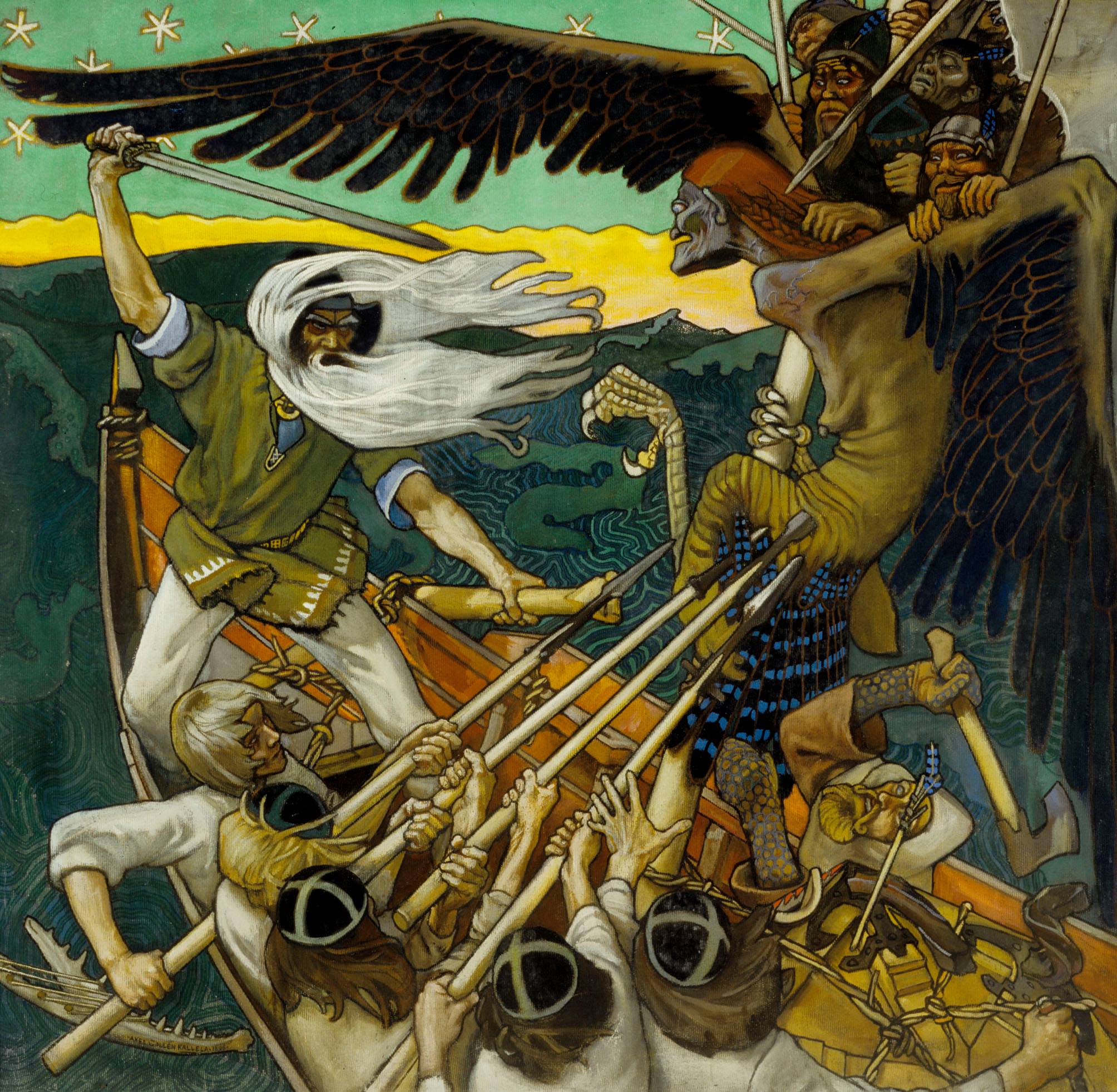
The “Kalevala,” a disparate collection of long narrative poems culled from the oral tradition, is frequently referred to as the Finnish national epic. Its fantastic and heroic tales informed the work of Finland’s greatest artists at a time when the country began to surge toward independence after 700 years of Swedish rule and an additional century as a duchy of the Russian Empire.
In a nod to Finnish endeavor, this Sunday night on “The Lost Chord,” we’ll hear “Aino” by Robert Kajanus. Kajanus was Sibelius’ first great champion, who conducted first performances of many of the composer’s major works and led the Helsinki Philharmonic for 50 years. He also wrote over 200 pieces himself. “Aino” was composed in 1885 for the Kalevala Society, to mark the 50th anniversary of the poem’s publication.
The subject is the wizard Väinämöinen, one of the poems’ heroes, who always seems to be plagued by ill luck. In this particular tale, he wins a singing contest, plunging his rival, Joukahainen, into a swamp. When the latter promises the wizard his sister’s hand in marriage if Väinämöinen will save him from drowning, the sister, Aino, drowns herself rather than submit to this seemingly unbearable fate. She later returns to taunt the grieving Väinämöinen in the form of a salmon.
One of the most important Finnish composers after Sibelius was Uuno Klami. Klami brought a degree of French polish back from his studies in Paris, where he fell under the irreverent sway of Les Six. This led to the composition of an unusually anti-heroic take on the Kalevala legends, “Lemminkäinen’s Island Adventures.” However, in spite of his occasionally Gallic disposition, Klami grew into one of Finland’s most respected composers. Sibelius recognized his talent and even lobbied for a small lifetime income for Klami from the Finnish government.
Klami’s most ambitious Kalevala inspiration is his “Kalevala Suite,” of 1933, which he extensively revised ten years later, when this former “enfant terrible” recognized the importance of his role as an artist in a country at war. Unlike Sibelius’ better-known “Four Legends from the Kalevala,” Klami’s suite scrupulously sidesteps the heroes’ actual adventures. He opts instead to paint on a much broader canvas, with movements titled “The Creation of the Earth,” “The Sprout of Spring,” “Terhenniemi” (replete with the sounds of nature and the sunny bliss of a summer’s day), “Cradle Song for Lemminkäinen” (Lemminkäinen’s mother’s song, sung over his dead body, soon to be resurrected), and “The Forging of the Sampo” (a kind of talisman everyone seems to want).
Of course, no composer had more success drawing on the Kalevala legends than Jean Sibelius. We’ll conclude the hour with a Sibelius rarity, “A Song for Lemminkäinen,” from 1896. This follows on the heels of the composer’s “Lemminkäinen Suite” (also known as “Four Legends from the Kalevala”), written earlier in the decade.
I hope you’ll join me in acquiring some “Epic Finnish,” this Sunday night at 10:00 EST, on WWFM – The Classical Network and wwfm.org.
All hail Finland’s great composer! Happy birthday, Jean Sibelius!
Sibelius wrote a ton of music inspired by the Kalevala, the Finnish national epic. Join me for one of the lesser known of these, tomorrow night on “The Lost Chord,” at 10:00 EST, on WWFM – The Classical Network and wwfm.org. The program will also include works by Robert Kajanus and Uuno Klami.
I was playing this recording when Sibelius’ grandson fortuitously wandered into my bookshop in, I believe, 1998. A formula for instant friendship!
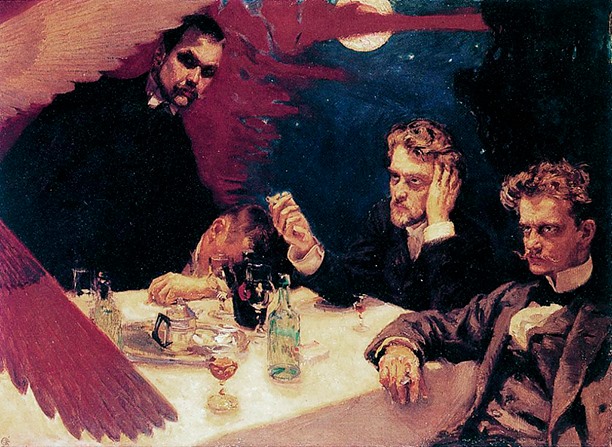
IMAGE: “Kajustaflan,” painted by Akseli Gallén-Kallela. Pictured (from left to right): the artist, composer Oskar Merikanto (blacked out), Robert Kajanus and Jean Sibelius.
More about “The Symposium,” with the original version of Gallén’s painting, here:
It may seem like odd timing to drop a program about war right into the middle of the holidays, but I can’t change the timing of Pearl Harbor.
On the morning December 7, 1941, a Japanese strike force of 353 aircraft strafed and bombed the United States naval base in Hawaii, killing thousands of American servicemen and civilians, and precipitating the country’s entry into World War II.
It seems almost crass that such violence and massive loss of life would inspire so much popular entertainment, but such is the imprint of war, and especially a surprise attack on a nation at peace, on the American psyche.
This week on “Picture Perfect,” we’ll revisit some of John Williams’ music for films set during the war. While none of them take place during the actual attack, two of them are set in the Pacific theater, and one of them is a comedy (!) about mass hysteria gripping the people of Los Angeles and its environs in the days following. We’ll also hear a solemn hymn to those who sacrificed everything for a greater good.
Only six months after Pearl Harbor, America struck back, devastating the Japanese fleet in a battle that is regarded as one of the turning points of the war. “Midway” (1976) was a belated big-screen dramatization of the event, featuring an all-star cast of war movie standbys, including Charlton Heston, Henry Fonda, James Coburn, Glenn Ford, Hal Holbrook, Toshiro Mifune, Robert Mitchum, and Cliff Robertson.
Unfortunately, the cast of old-timers, combined with abundant stock footage from “Tora! Tora! Tora!” and actual period newsreels, may have saddled the film with an all-too-palpable sense of “been there, done that.” Williams does his best to freshen things up with a rousing, patriotic score and a crackerjack victory march. (Fun fact: “Midway” was one of only four films ever to be presented in theater-rumbling Sensurround.)
Days in advance of the birthday of Frank Sinatra (born December 12, 1915), we’ll also hear music written for the Chairman’s only project as a director. “None But the Brave” (1965) – in which he also starred – presents Japanese and American units forced to coexist, and even cooperate, after they are stranded on a Pacific island. The film is also notable for being the first Japanese-American co-production and bears a somewhat forward-looking anti-war message. The music is a fascinating glimpse of Williams’ work from ten years before his mega-success with “Jaws.”
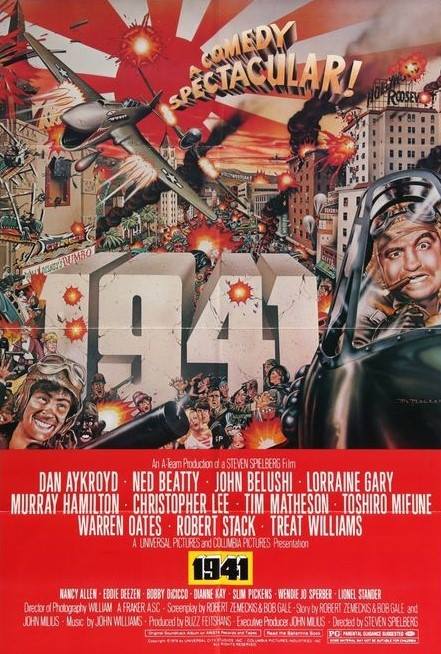
“1941” (1979) is just plain weird. Steven Spielberg’s too-big-to-fail to gamble stumbles pretty badly, following his back-to-back blockbusters, “Jaws” and “Close Encounters of the Third Kind.” The premise – a Japanese u-boat sighting off the coast of California triggering an overabundance of slapstick panic – posits, just because you’re paranoid doesn’t mean they’re not out to get you. It’s a mad, mad, mad, mad war.
“1941” employs an incredible amount of talent, from its behind-the-scenes effects artists, to screenwriters Robert Zemeckis and Bob Gale, to its dream cast pushing as hard as it possibly can. It also features a once-in-a-lifetime opportunity to see Toshiro Mifune and Slim Pickens in the same scene. But for the most part, perhaps unsurprisingly, it fails to deliver the laughs. What it does deliver is the most rousing of John Williams’ neglected scores.
Spielberg actually approached John Wayne about appearing in the film. Wayne was too ill to participate, but offered the following advice: “You know, that was an important war, and you’re making fun of a war that cost thousands of lives at Pearl Harbor. Don’t joke about World War II.” Whether or not audiences agreed, they didn’t exactly queue up as they did for Spielberg’s previous successes.
We’ll strike a more reverent tone with “Hymn to the Fallen” from “Saving Private Ryan” (1998) – not set in the Pacific, granted, but the U.S. may never have gotten to Normandy had it not been for the inexorable events set in motion by December 7, 1941.
Unfortunately, this is not “Star Wars,” but a real war that killed tens of millions and destroyed the lives of countless others. John Williams covers the subject from four different angles this week, on “Picture Perfect” – music for the movies – this Friday evening at 6:00 EST, on WWFM – The Classical Network and wwfm.org.
IMAGE: The Pearl Harbor comedy that will live in infamy
December 6. After all the press I gave Krampus yesterday, it wouldn’t be right to ignore his keeper, Saint Nicholas, on his special day.
Krampus, of course, is the demon who beats wicked children and hurls them into hellfire. Saint Nicholas, on the other hand, rewards the good. He is justly celebrated for his miracles and outstanding generosity. Let us all hoist an eggnog to the jolly old elf! Yay!
Except that – what’s that you say? – the historic Nicholas was not so jolly?
While it would be impossible to deny Saint Nicholas as having done a lot of good in the world, his personality could be a bit, shall we say, problematic. In fact, his modesty could be so extreme as to sometimes verge on the sociopathic. Among other things, he suffered fools grudgingly and became cantankerous if thanked.
Nicholas is one of those rare all-purpose saints, who seems to watch over everyone – sailors, merchants, archers, prostitutes, women seeking husbands, repentant thieves, wrongly condemned prisoners, travelers, pawnbrokers, students, and of course children. Is it any wonder he’s grouchy?
The historic Nicholas served as Bishop of Myra (part of modern day Turkey) in the 4th century. When his parents died, he gave away his inheritance to the poor.
To avoid uncomfortable scenes, he developed a reputation for secret gift-giving. In one famous incident, he rescued three daughters of an unfortunate man who could not afford a proper dowry. In that time and place, it would have made them unmarriageable, and with no opportunity for honest employment, they would have had no alternative but to enter into a life of prostitution.
Nicholas learned of their plight and under the cloak of darkness passed their house three times, each time tossing a purse of gold through a window. Some traditions say he dropped the purses down the chimney; others claim he left coins in stockings left out to dry. When the elated father tried to thank him, Nicholas responded gruffly that it is God he should thank. O-kayyyyy, Nicholas.
On another occasion, during a sea voyage, Nicholas’ ears were assailed by a cacophony of oaths and blasphemies lustily exchanged by the crew. When he tried to get them to mind their language, the sailors laughed and mocked him, and took to swearing with renewed vigor. Nicholas responded by praying for stormy seas, until the sailors dropped to their knees in repentance, effectively scared straight.
He was also wholly intolerant of pagans and heretics. He sent Arius, the father of Arianism, sprawling with a box on the ears, for his assertion that Jesus Christ is subordinate to the entity of God.
The creepiest Nicholas tale concerns the murder of three boys by a butcher during a time of famine. The butcher placed their remains in a barrel to cure, hoping to pass them off as ham(!). Not surprisingly, this didn’t go down well with Nicholas, who resurrected the three children. The episode is recreated most eerily by Benjamin Britten in his cantata, “Saint Nicholas.”
While he’s not a “Bad Santa,” exactly, he’s also not the jolly old elf Clement Moore, Thomas Nast and Coca-Cola would have us believe. He’s just your garden-variety, high-maintenance saint. To me, somehow, this makes him all the more lovable.
But, as was advised in “The Man Who Shot Liberty Valance,” when the legend becomes fact, print the legend. In the Clement Moore/Thomas Nast vein, here’s the “Santa Claus Symphony,” really an ambitious symphonic poem, by the Philadelphia composer William Henry Fry (1813-1864):
If Saint Nick were on Facebook, I am sure I would be flamed so bad right now I’d be wishing for a ride in Krampus’ wicker basket.