Category: Daily Dispatch

  • Black Marble Opera on The Classical Network

    Black Marble Opera on The Classical Network

    Marble is the new black, on today’s Noontime Concert on The Classical Network.

    The violin duo of Jörg-Michael Schwarz and Karen Marie Marmer, collectively known as Black Marble, will perform a program titled “Opera for Two,” consisting of works by Jean-Marie Leclair, William Shield, Emanuele Barbella, and Wolfgang Amadeus Mozart.

    Schwarz and Marmer are co-directors of the popular Baroque ensemble REBEL (pronounced Re-BEL), named for French master Jean-Féry Rebel. “Black Marble” is an amalgam of the performers’ last names (Schwarz is German for “black,” and Marmer is Dutch for “marble”). The duo appears courtesy of the Midtown Concerts series presented by Gotham Early Music Scene (GEMS).

    The concert was recorded on September 21, 2017, at St. Bartholomew’s Church, 50th Street and Park Avenue, in Midtown Manhattan, where free concerts are held every Thursday at 1:15 p.m. This Thursday, Les Soûls d’amour will present a program titled “Love and War,” exploring the many ways in which the trials of war and travails of love intersect and collide. You’ll find a complete schedule of lunchtime performances at midtownconcerts.org.

    In addition, GEMS presents evening concerts. The Boston-based Lorelei Ensemble will perform music spanning the centuries from the Medieval Era to contemporary Americana, this Friday at 7:30 p.m., at the Church of St. Luke in the Fields, 487 Hudson Street (just south of Christopher).

    The Ensemble Origo and UConn Collegium Musicum will perform a program of sacred Bach cantatas, this Saturday at 8, at Good Shepherd-Faith Presbyterian Church, 152 West 66th Street.

    And the Bach Choir of Holy Trinity and Bach Orchestra will perform on Sunday afternoon at 5, at Holy Trinity Lutheran Church, 3 West 65th Street.

    Gotham Early Music Scene is a non-profit corporation that supports and promotes artists and organizations in New York City devoted to early music – music of the Middle Ages, Renaissance, Baroque, and early Classical periods. For more information and GEMS’ events calendar, look online at gemsny.org.

    It’s a concert for all the marbles, with winners guaranteed, this Tuesday at 12:00 EST, on WWFM – The Classical Network and wwfm.org.

    Rebel: Ensemble for Baroque Music

  • Eagles Win Celebrated With Eagle-Inspired Music

    Eagles Win Celebrated With Eagle-Inspired Music

    Fly, Eagles, fly! Celebrate the Eagles’ first Super Bowl victory* with music about – well, eagles, today on The Classical Network.

    Anthony Philip Heinrich, dubbed by one contemporary critic “The Beethoven of America,” was the first full-time American composer to write on a large scale. Incredibly, he didn’t embark on the career that would ensure his lasting notoriety until the age of 36.

    Heinrich was born in Bohemia in 1781. When his uncle’s fortune was wiped out during the Napoleonic Wars, young Heinrich turned to the violin. He immigrated to America and settled for a time in Philadelphia. There, he learned of a job in Pittsburgh. He embarked in high spirits, traveling the 300 miles mostly on foot, but when he arrived he found the job had already been filled. Disconsolate, he wandered southwest into the wilderness of Kentucky.

    At the end of a 700 mile journey, Heinrich awoke from a raging fever to find himself in a log cabin. He set about reinventing himself as a composer, writing music for impractically large forces in an idiom that would have seemed advanced at the time, full of chromaticism and jangling harmonies. He also somehow managed to pull together enough musicians to perform Beethoven’s First Symphony – only its second performance in the United States.

    Later, Heinrich would become a founding member of the New York Philharmonic Society, perform some of his own music before President Tyler, and make several extended trips to Europe. Still, he was not to escape poverty, and he died in neglect in New York City in 1861.

    Hardly surprising for a personal friend of John James Audubon, a number of Heinrich’s works deal with ornithological themes. The most ambitious of these must be “The Ornithological Combat of Kings, or the Condor of the Andes and the Eagle of the Cordilleras” (1847). While it might not be the most polished or compelling work of art, it is the one I think best reflects the scrappy can-do spirit of long-suffering Philadelphia Eagles fans.

    Hear it this afternoon, one of several pieces inspired by eagles – in honor of the Eagles. America’s got talons, between 4 and 7 p.m. EST, on WWFM – The Classical Network and wwfm.org.


    *Just to clarify, the Eagles previously won the NFL championship in 1948, 1949, and 1960 – the first “Super Bowl” did not take place until 1967 – so please don’t tear down my goal post!

  • “Inner Emigration” Composers Under the Nazis

    “Inner Emigration” Composers Under the Nazis

    Is it really “emigration” when you don’t go anywhere?

    This Sunday night on “The Lost Chord,” we’ll have music by flagrantly anti-fascist composers who remained in Germany during the Nazi regime. This type of opposition was described by Thomas Mann as “inner emigration.”

    There were plenty of opportunists who joined the Nazi Party as a means to curry favor, in the hopes of securing prominent posts. Then there were those who, while critical of the Nazis, nevertheless joined the Party to protect their families and to continue working.

    A group which seems to have faded from memory is that made up of composers who remained, opposed the regime, and yet somehow survived. These artists were condemned by the Nazis, their music labeled degenerate and banned from performance. They were either prevented from escape or remained of their own accord. Some justified the decision to stay as an act of social consciousness. Some were active in resistance circles. Others simply withdrew into ostentatious silence.

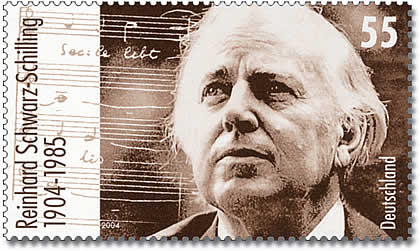
    Reinhard Schwarz-Schilling is not a terribly well-known composer, largely for the reasons I just mentioned. Schwarz-Schilling had been a professor of music at the Berlin Academy of Music. During Hitler’s reign, his family was subjected to frequent interrogations by the Gestapo. Luckily, it was never found out that Schwarz-Schilling’s wife, the concert pianist Dusza von Hakrid, was of Jewish descent. It was only through the beneficence and courage of a sympathetic official who falsified documents that the Schwarz-Schillings escaped arrest.

    Schwarz-Schilling may have survived the Nazis, but following the war, he had to deal with the musical establishment, which had grown hostile to such flagrantly tonal music. Something like his Violin Concerto of 1953 couldn’t be taken seriously. It starts out sounding a bit like Hindemith, but embraces Korngoldian sentiment at its candy core. If you can’t stick around for the whole show, I hope at least you’ll stay tuned for the gorgeous slow movement of this concerto.

    We’ll also hear music by Karl Amadeus Hartmann, regarded in some circles as the most important German symphonist of the mid-20th century, yet is now largely overlooked. In his 30s, Hartmann was viewed as politically undesirable in his homeland. He completely withdrew from musical life during the Nazi era. On the rare occasion any of his works would have been permitted performance, Hartmann would not allow it. Alas, most of his greatest champions were also his contemporaries. Therefore, performances of his music nearly died with them.

    After the war, Hartmann was one of the few prominent surviving anti-fascists in Bavaria whom the Allied Forces could promote to a position of responsibility. Hartmann used that trust to reintroduce the world to music which had been banned since 1933 under National Socialist aesthetic policy. He remained in Munich for the rest of his life, where his administrative duties cut heavily into what would have been his compositional time and energy. He died in 1963. We’ll hear Hartmann’s Symphony No. 6, composed between 1951 and 1953.

    I hope you’ll join me for “Staying Power” – music by anti-fascist composers who remained in Nazi Germany – this Sunday night at 10:00 EST, on WWFM – The Classical Network and wwfm.org.

  • New WPRB Show Sunday Mornings Feedback Wanted

    New WPRB Show Sunday Mornings Feedback Wanted

    Now that I’ve attended to all my end-of-week obligations (and replaced the faulty router I complained about two Saturdays ago), I am again footloose and fancy free in the cyber universe. I just wanted to take a moment to thank all of you who expressed disappointment that my Thursday morning show on WPRB was coming to an end, gratitude for what I managed to achieve there, and anticipation for what may lie in the near future. I intend to respond to all of your comments personally – I was both too busy and too wiped out to do so on Thursday and Friday – so don’t think that I did not appreciate them!

    I want to remind you that the plan is for me to create a new show on WPRB, which will air on Sunday mornings, beginning on February 11 (next week). I am asking you again for your suggestions and your feedback. There are a couple of ideas I would like to bounce off of you, and I’d like to know if they hold any appeal. It took a few weeks, when I first started on Thursdays, to settle into a format, and I expect the same will be the case for Sundays. Nothing is etched in stone!

    One possibility I have been entertaining is to resurrect the dormant tradition of playing a Sunday opera. The strength and also the limitation of my doing so would be that if I were to draw on my personal collection (which is what I always do), the show would definitely be skewed toward unusual and neglected repertoire – which is great if you love English music, Slavic opera, Scandinavian stuff, and forgotten American fare, and horrible if you love Verdi. Also, with opera, if you are in for a penny, you are in for a pound. That means that if you tune in and imagine that you aren’t going to like what I am playing, I’ve lost you for the entire show.

    Another idea is to present a show of light classics. This could involve some degree of music for the stage, including operetta and zarzuela, or selections there from. These would appear in a format that would also allow for a fair amount of British Light Music, light classical, and generally cheery stuff – not “pops” fare, necessarily, but beautiful, tuneful music that has basically dropped off everyone’s radar. I think that could make for a great Sunday morning. But I am also open to other suggestions.

    Of course, I could always just do what I’ve been doing for the past few years, but you’d only get it for three hours (as opposed to five), and I can’t always guarantee that it will be “light.”

    The program would occupy a 7-to-10 slot immediately prior to Jeannie Becker’s “Sunday Jazz.” If I were to tackle a particularly mammoth opera, I could start earlier on a given week, though my preference is to start at 7. Remember, the program will launch next Sunday, so get me your thoughts as soon as you can. Again, thank you for all your words of support, and thank you for following Classic Ross Amico.

  • Wild Movie Soundtracks Picture Perfect

    Wild Movie Soundtracks Picture Perfect

    This week on “Picture Perfect,” as we put our faith in the groundhog and brace ourselves for six more weeks of winter, we defer to the natural wisdom of the wild kingdom.

    We’ll hear selections from John Barry’s music for “Born Free” (1966), based on Joy Adamson’s memoir about the raising of Elsa, an orphaned lion cub who grows to adulthood and is eventually released into the Kenyan wilderness. The music proved a double Academy Award winner for Barry, who was recognized for Best Original Score and Best Original Song.

    Jerome Moross, best known for his music to “The Big Country,” had such a strong personality that his immediately recognizable sound extended even to his work on the National Geographic special, “Grizzly!” (1967), a documentary about a pair of ecologists studying North American bears. “Grizzly!” sports an energetic Americana score that is cut very much from the same cloth.

    The Korda Brothers’ adaptation of Rudyard Kipling’s “The Jungle Book” (1942) stars the charismatic Indian actor Sabu, as Mowgli, raised by wolves, who yearns to reconnect with his human roots. (For the record, Kipling pronounced “Mowgli” so that the first syllable rhymes with “cow.”) Miklós Rózsa wrote the enchanting score.

    And we can’t get through the hour without hearing Henry Mancini’s “Baby Elephant Walk,” from “Hatari!” (1962). So many exclamation points in these wilderness titles! The film was directed by Howard Hawks and starred John Wayne. In case you’re wondering, “Hatari!” is Swahili for “Danger!”

    No danger in treating yourself to this cinematic carnival of the animals. We’re going wild this week on “Picture Perfect,” this Friday evening at 6:00 EST, on WWFM – The Classical Network and wwfm.org.

Tag Cloud

Aaron Copland (93) Beethoven (95) Composer (114) Film Music (137) Film Score (143) Film Scores (255) Halloween (94) John Williams (195) KWAX (229) Leonard Bernstein (103) Marlboro Music Festival (125) Movie Music (152) Mozart (88) Opera (208) Philadelphia Orchestra (89) Picture Perfect (174) Princeton Symphony Orchestra (108) Radio (88) Ross Amico (244) Roy's Tie-Dye Sci-Fi Corner (290) The Classical Network (101) The Lost Chord (268) Vaughan Williams (103) WPRB (396) WWFM (881)

DON’T MISS A BEAT

Receive a weekly digest every Sunday at noon by signing up here


RECENT POSTS