Category: Daily Dispatch

  • Marlboro Music Festival Archive Performances

    Marlboro Music Festival Archive Performances

    With this year’s Marlboro Music Festival poised to enter its final weekend, we’ll continue our exploration of the Marlboro Music archive, with performances of Gioachino Rossini’s String Sonata No. 3 (a 1989 recording featuring violinists Lara St. John and Ivan Chan, cellist Paul Tortelier, and double bassist Timothy Cobb), Max Reger’s Introduction, Passacaglia and Fugue (a 1977 recording with pianists Yefim Bronfman and Luis Btlle), and Richard Wagner’s “Siegfried Idyll” (a 1971 performance led by Alexander Schneider).

    This year’s Marlboro Music Festival runs through August 13. Learn more about this weekend’s events at marlboromusic.org. Then join me for great chamber music and chamber orchestra performances on “Music from Marlboro,” this Wednesday evening at 6:00 EDT, on WWFM – The Classical Network and wwfm.org.

    Marlboro School of Music and Festival: Official Page

  • British Light Music Lost Chord WWFM

    British Light Music Lost Chord WWFM

    Trip the light fantastic. This Sunday night on “The Lost Chord,” we take a nostalgic journey with an hour of British Light Music. I hope you’ll join me for vintage recordings, featuring works by Albert Ketèlbey, Samuel Coleridge-Taylor, Sir Edward Elgar, Richard Addinsell, George Scott-Wood, Haydn Wood, Billy Mayerl and Eric Coates. That’s “Distant Light,” this Sunday night at 10:00 EDT, on WWFM – The Classical Network and wwfm.org.

  • Mount Messiaen Utah’s Musical Mountain

    Mount Messiaen Utah’s Musical Mountain

    If the mountain will not come to Messiaen, then Messiaen must go to the mountain. Unusually, in this instance, both came to pass.

    On this date in 1978, the White Cliffs of southern Utah, formerly known as Lion’s Peak, were renamed by the citizens of Parowan “Mount Messiaen,” in honor of the French composer, who had traveled to Utah in 1973 to lay the groundwork for his sprawling vista in sound, “Des canyons aux étoiles…” (“From the canyons to the stars…”). The work, which spans a good 90 to 100 minutes in performance, had been commissioned for the impending bicentennial of American independence.

    Messiaen was inspired by the natural wonders of the region – its landscape, birdsong and night skies – but most particularly the colorful Bryce Canyon, which played to his sense of synaesthesia (cognitive perception of color in sound). Messiaen regarded it as the most mystical landscape he had ever encountered.

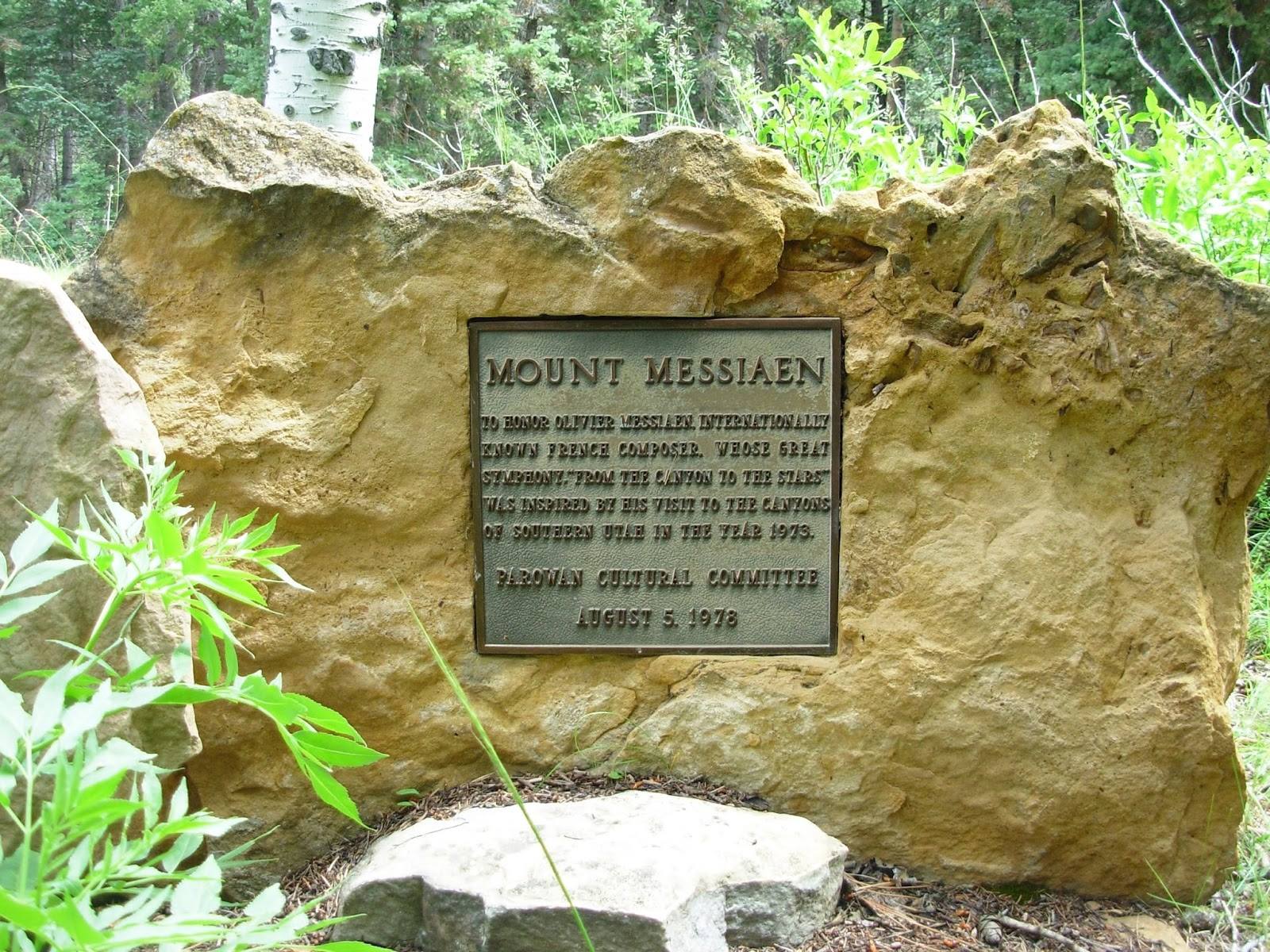
    When asked if it would be all right to dedicate something in his honor, as a token of thanks, the composer thought perhaps a nature trail was in the offing. In the event, a bronze plaque was cast and a sandstone monument erected at the foot of the mountain, and the governor declared August 5 “Olivier Messiaen and the Beauty of Southern Utah Day.” The composer was unable to attend the dedication ceremony and concert. However, he had gone to the mountain, and the mountain had come to him.


    Photos of Mount Messiaen:

    http://kellyricks.blogspot.com/2015/07/mt-messiaen.html

    The music:

    https://www.youtube.com/watch?v=5DjgpPL7RhA

  • Lost Worlds Movie Music Soundtrack

    Lost Worlds Movie Music Soundtrack

    This week on “Picture Perfect,” I invite you to get lost. It’s all music from movies about lost worlds and forgotten civilizations.

    While the concept of the “Lost World” dates at least as far back as Plato’s Atlantis, it wasn’t until the Victorian Era that the idea really blossomed in the public consciousness. At the time, of course, lost civilizations were genuinely being discovered – which might help explain, in part, the incredible of success of “King Solomon’s Mines.” The author, H. Rider Haggard, wrote the book on a bet that he could churn out an adventure story half as good as Robert Louis Stevenson’s “Treasure Island,” which had been published two years earlier.

    “King Solomon’s Mines” became the literary sensation of 1885. Its protagonist, Allen Quatermain, is a direct ancestor of Indiana Jones. The book inspired reams of sequels and at least five film adaptations.

    The two best known starred Stewart Granger, in 1950, and Paul Robeson, in 1937. Robeson, who played Umbopa, a king in disguise, received top billing. The score was by Mischa Spoliansky.

    Haggard achieved another “Lost World” hit with “She,” first issued in book form in 1887 – another adventure about Europeans in Africa, who meet a seemingly immortal white queen known as the all-powerful “She,” or “She-Who-Must-Be-Obeyed.”

    “She” has been adapted to film six times. The 1965 version starred Ursula Andress, Peter Cushing and Christopher Lee. The music was by Hammer Studios house composer, James Bernard. It’s nice to hear Bernard, who mostly wrote horror scores for the likes of Dracula and Frankenstein, provide something a little more nuanced for a change.

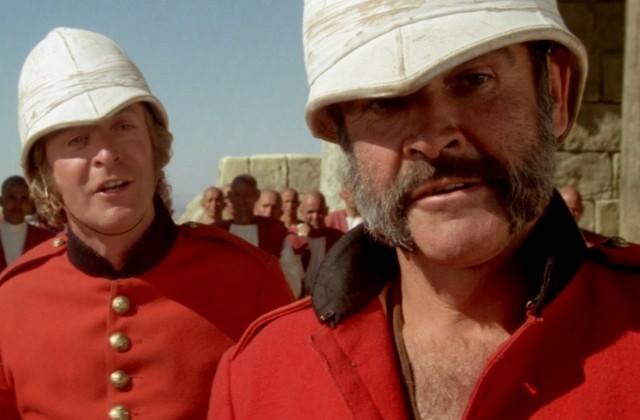
    Rudyard Kipling’s “The Man Who Would Be King,” published in 1888, was clearly influenced by the writings of Haggard. In this case, two British adventurers in India strike out for a remote corner of Afghanistan to set themselves up as kings. The story was made into one of the great adventure films of the 1970s, directed by John Huston, and starring Sean Connery and Michael Caine. That Christopher Plummer appears as Kipling himself is only icing on the cake. Maurice Jarre wrote the rousing score.

    Finally, James Hilton’s “Lost Horizon,” published in 1933, imagines Shangri-La, a Utopian society nestled in a sheltered valley somewhere in the mountains of Tibet. A British diplomat is one of a handful of passengers who survives a plane crash to be taken into the lamasery.

    “Lost Horizon” was made into a film twice. The less said about the 1973 version, a musical with songs by Burt Bacharach, the better. Frank Capra directed the classic 1937 version, which starred Ronald Colman, Jane Wyatt, and outstanding character actors of the day, people like Edward Everett Horton, Thomas Mitchell, Sam Jaffe and H.B. Warner.

    The score, Dimitri Tiomkin’s first major contribution, was also one of his most ambitious. Seldom was it so obvious that he had studied at the St. Petersburg Conservatory under Alexander Glazunov.

    I hope you’ll lose yourself in music for lost civilizations this week, on “Picture Perfect” – music for the movies – this Friday evening at 6:00 EDT, on WWFM – The Classical Network and wwfm.org.


    PHOTO: Connery (right) with the man who would be Caine
  • Schoenberg vs Weill Swimwear

    Schoenberg vs Weill Swimwear

    Classical music swimwear contest: Arnold Schoenberg (left) or Kurt Weill?

    We’re off to the beach this morning, with music inspired by sea and sand. It will be wall-to-wall bathing beauties until 11:00 EDT, on WPRB 103.3 FM and wprb.com.

Tag Cloud

Aaron Copland (93) Beethoven (95) Composer (114) Film Music (139) Film Score (143) Film Scores (255) Halloween (94) John Williams (195) KWAX (229) Leonard Bernstein (103) Marlboro Music Festival (125) Movie Music (154) Mozart (88) Opera (209) Philadelphia Orchestra (89) Picture Perfect (174) Princeton Symphony Orchestra (108) Radio (88) Ross Amico (244) Roy's Tie-Dye Sci-Fi Corner (290) The Classical Network (101) The Lost Chord (268) Vaughan Williams (103) WPRB (396) WWFM (881)

DON’T MISS A BEAT

Receive a weekly digest every Sunday at noon by signing up here


RECENT POSTS