• Youth Music on the Radio This Sunday

    Youth Music on the Radio This Sunday

    by 

    in
    4 responses

    O sweet bird of youth!

    No, it’s not Tennessee Williams. Rather, it’s a full morning of music written especially for young performers.

    We’ll have selections by Benjamin Britten, Aaron Copland, Dmitri Kabalevsky, Zoltán Kodály, Erich Wolfgang Korngold, William Mathias, Sir Peter Maxwell Davies, Robert Moran, Carl Orff, and Grace Williams, among others.

    Furthermore, in the 9:00 hour, Larisa Epps will drop by from the Youth Orchestra of Central Jersey. YOCJ will present two concerts this Sunday at Kendall Hall on the campus of The College of New Jersey in Ewing. She’ll tell us a little bit about the programs and her worthwhile organization. Then at 10:00, we’ll be joined by Hilary Butler of the Princeton Girlchoir, which will appear at McCarter Theatre Center in Princeton on Sunday night.

    I welcome you into my sandbox, this morning from 6 to 11 EST, on WPRB 103.3 FM and at wprb.com. Radio can certainly age you, but the music will keep you young, on Classic Ross Amico.


  • Youthful Music Britten Copland on WPRB

    Youthful Music Britten Copland on WPRB

    by 

    in
    4 responses

    Youth may be wasted on the young, at least according to George Bernard Shaw, but a skillful composer knows how to make the most of youthful talent.

    Join me tomorrow morning on WPRB, as we listen to music written for young musicians, by such composers as Benjamin Britten, Aaron Copland, Dmitri Kabalevsky, Zoltán Kodály, Erich Wolfgang Korngold, Sir Peter Maxwell Davies, Robert Moran, Carl Orff, and Grace Williams.

    We’ll also be visited by representatives of the Youth Orchestra of Central Jersey, which will perform two concerts this Sunday at Kendall Hall on the campus of The College of New Jersey in Ewing, and the Princeton Girlchoir, which will appear at McCarter Theatre Center in Princeton on Sunday night.

    It will be a veritable fountain of youth tomorrow morning from 6 to 11 EST, on WPRB 103.3 FM and at wprb.com. I may be an old soul, but I’m also nothing if not young at heart, on Classic Ross Amico.


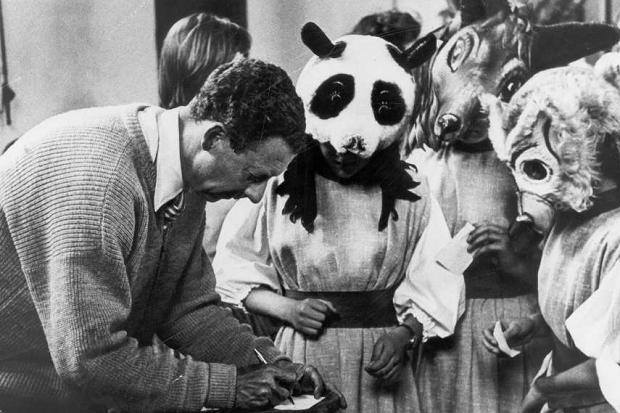
    Benjamin Britten and his menagerie, rehearsing the chamber opera “Noye’s Fludde”


  • César Cui The Forgotten Mighty Handful

    César Cui The Forgotten Mighty Handful

    by 

    in
    4 responses

    Among the followers of Mily Balakirev that collectively came to be known as “The Mighty Handful” or “The Five,” unquestionably the least well-known is César Cui. Nikolai Rimsky-Korsakov, Modest Mussorgsky, and Alexander Borodin all went on to attain a kind of immortality in Russian music, each having left his indelible mark.

    Cui wrote 15 operas, believe it or not – one of them, “William Ratcliff,” earning the highest praise from Franz Liszt – but today, he is remembered, if at all, as a miniaturist, or perhaps as a composer of art song, and at that, the least Russian-sounding of the five.

    He shared in common with the others the fact that for him music was an avocation. He paid his bills as a military engineer. Beyond that, however, he was a bit of an outsider – born in Vilnius (now in Lithuania) to a father who had been a general in Napoleon’s army, who stayed and married a local. In addition to Russian, Cui grew up speaking French, Polish and Lithuanian. Perhaps this broader cultural perspective led to a more cosmopolitan approach to music.

    As a critic, he was prolific, and he could be blistering in his sarcasm. Perhaps most notorious was his reception of Rachmaninoff’s First Symphony:

    “If there were a conservatory in Hell, and if one of its talented students were to compose a program symphony based on the story of the Ten Plagues of Egypt, and if he were to compose a symphony like Mr. Rachmaninoff’s, then he would have fulfilled his task brilliantly and would delight the inhabitants of Hell. To us this music leaves an evil impression with its broken rhythms, obscurity and vagueness of form, meaningless repetition of the same short tricks, the nasal sound of the orchestra, the strained crash of the brass, and above all its sickly perverse harmonization and quasi-melodic outlines, the complete absence of simplicity and naturalness, the complete absence of themes.”

    The assessment plunged Rachmaninoff into a two-year depression, during which he was unable to compose until being lifted out of his funk by hypnotic therapy. Of course, today everyone knows Rachmaninoff’s music (if not his First Symphony). How many, I wonder, know Cui’s?

    Join me this afternoon, on the anniversary of Cui’s birth, when we’ll listen to his “Deux morceaux” for cello and orchestra. We’ll also mark the birthdays of composers Emmanuel Chabrier, Berthold Goldschmidt, and Alfonso Ferrabosco the Elder, as well as conductor János Ferencsik, from 4 to 7:00 EST, on WWFM – The Classical Network and at wwfm.org.


    IMAGE: With so many whiskers in the room, you know you must be in the company of The Five. Center, left to right: Modest Mussorgsky (standing, by the piano), Nikolai Rimsky-Korsakov, Mily Balakirev (seated), César Cui (standing, with spectacles), and Alexander Borodin. I don’t know who the chap is standing in the center.

  • New Chopin Photo Discovered Rare Portrait Found

    New Chopin Photo Discovered Rare Portrait Found

    by 

    in
    2 responses

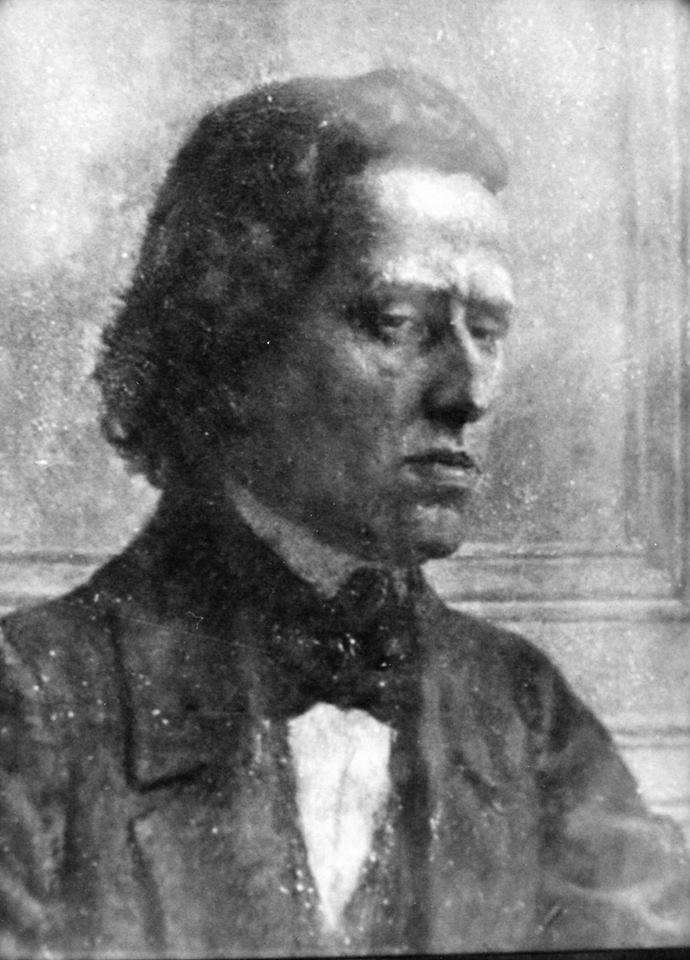
    For those of you creepy Chopin stalkers looking to add to your Chopin shrines (we’re looking at you, George Sand), here’s a newly discovered photographic portrait of the great Polish pianist and composer.

    Until now, there were only two Chopin photos known to be in existence. The second was rediscovered in 1936.

    http://jackgibbons.blogspot.com/2010/03/chopins-photograph.html

    Now pardon me while I do my Buffalo Bill dance.


  • Nordic Sounds on The Classical Network Today

    Nordic Sounds on The Classical Network Today

    by 

    in
    4 responses

    It will be difficult to ignore the Nordic today on The Classical Network.

    Join me at noon for a broadcast concert featuring Mélomanie, the Delaware-based ensemble that specializes in provocative pairings of early and contemporary works. On the program will be sonatas by Swedish baroque composers Johan Helmich Roman and Johan Joachim Agrell, as well as works for electric violin by Icelander Eva Ingolf and American Mark Hagerty. Ingolf’s “Lava Flow” was inspired by the image of an erupting volcano. Hagerty’s “Raven Thoughts” alludes to Odin’s ravens, Huginn (Thought) and Muninn (Memory). The odd man out will be Sergio Roberto de Oliveira, whose “Angico” was inspired by his family vacation home in the Brazilian mountains.

    Mélomanie’s next concert will be held at The German Society of Pennsylvania, 611 Spring Garden Street, in Philadelphia, on January 29 at 3 p.m. To find out more about Mélomanie, visit the ensemble’s website, at melomanie.org.

    Following the broadcast concert, stick around for a major work by Jean Sibelius. I’ll be especially stoic as I quaff my mead today from noon to 4:00 EST, on WWFM – The Classical Network and at wwfm.org.


Tag Cloud

Aaron Copland (93) Beethoven (95) Composer (114) Film Music (144) Film Score (143) Film Scores (255) Halloween (94) John Williams (195) KWAX (229) Leonard Bernstein (104) Marlboro Music Festival (125) Movie Music (159) Mozart (91) Opera (213) Philadelphia Orchestra (89) Picture Perfect (174) Princeton Symphony Orchestra (109) Radio (88) Ross Amico (244) Roy's Tie-Dye Sci-Fi Corner (290) The Classical Network (101) The Lost Chord (269) Vaughan Williams (105) WPRB (397) WWFM (881)

DON’T MISS A BEAT

Receive a weekly digest every Sunday at noon by signing up here


RECENT POSTS