• Florent Schmitt Rediscovered on The Lost Chord

    Florent Schmitt Rediscovered on The Lost Chord

    by 

    in
    5 responses

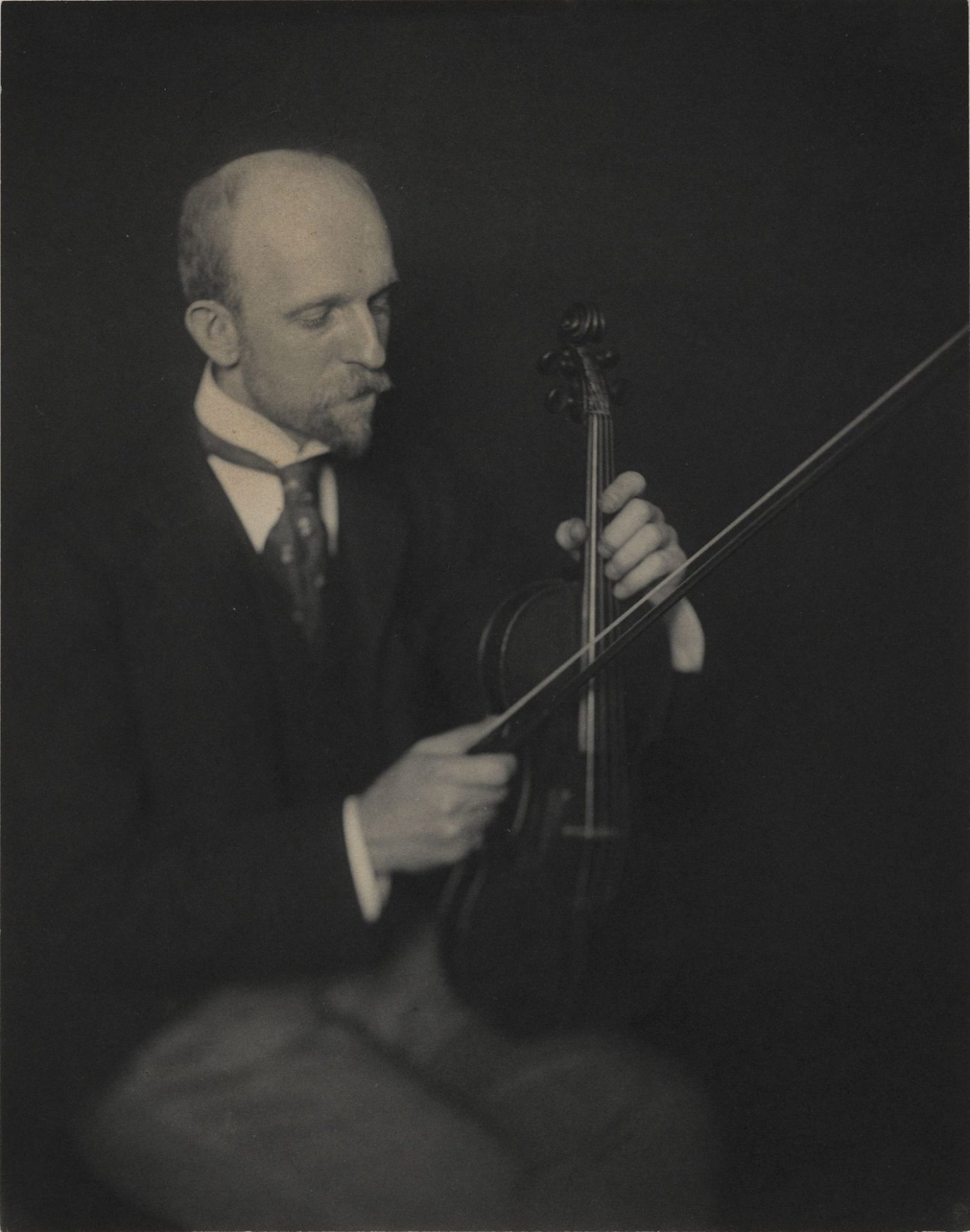
    This Sunday night on “The Lost Chord,” we bask in the opulent Orientalisms of Florent Schmitt.

    Florent Schmitt, who lived from 1870 to 1958, studied at the Paris Conservatory, where Gabriel Fauré, Jules Massenet, and Théodore Dubois were among his teaches. He befriended Frederick Delius while Delius was in Paris and prepared the vocal scores of a number of his operas.

    Schmitt was also a music critic, who attained a degree of notoriety for shouting out his assessments from the audience. As a composer, he was remarkably successfully, his works among the most frequently performed French music during the early decades of the 20th century.

    His reputation plummeted in the years following the Second World War, and it wasn’t really until the past few decades that his music began to be revived in any significant manner, with a number of fine compact disc recordings of his work currently on the market.

    One of the most recent of these was issued on the Naxos label, with the Buffalo Philharmonic, conducted by JoAnn Falletta. The disc features the symphonic etude, “The Haunted Palace,” after Edgar Allan Poe, and incidental music written for a production of Shakespeare’s “Antony and Cleopatra.” We’ll be listening to the first of the two suites.

    Schmitt was a winner of the Prix de Rome in 1900. The later neglect of his music may have been in part due to his willingness to cooperate with the Vichy regime during the Nazi occupation of France, as well as a marked change in musical fashion from the kind of opulence characteristic of his music, with one foot in the world of Debussy and the other in the world of Wagner and Richard Strauss.

    Even so, Stravinsky was an early admirer, saying of Schmitt’s ballet, “The Tragedy of Salome,” that the work gave him greater joy than any he had heard in a long time. Certain elements of the ballet anticipate analogous experiments in Stravinsky’s “The Rite of Spring.”

    One of Schmitt’s most celebrated works is his setting of “Psalm XLVII.” Despite its Biblical source, the work has little to do with ecclesiastical matters. Rather, the composer was chiefly inspired by ceremonial acclamations of the Ottoman Sultan, which he had witnessed himself in Istanbul in 1903. He appropriates, and interprets, the text as an expression of Oriental triumph, in the opening and closing “O Clap your hands all ye people,” and languor, with a soprano soloist singing, “He hath chosen our inheritance for us, the beauty of Jacob whom He loved.” We’ll hear the BBC National Orchestra and Chorus of Wales conducted by Thierry Fischer.

    I hope you’ll join me for “Schmitt Happens” – recordings from the Florent Schmitt revival – this Sunday night at 10 ET, with a repeat Wednesday evening at 6; or that you’ll listen to it later as a webcast at wwfm.org.


    Exhaustive website devoted to all things Florent Schmitt: http://florentschmitt.com/


  • Flu or Cold Surviving a Sick Day on the Air

    Flu or Cold Surviving a Sick Day on the Air

    by 

    in
    3 responses

    So do I have the flu, or just a really bad cold? After a day like yesterday, who cares? All I know is that I felt terrible. But in the worlds of radio and journalism, no one can stay sick for long. So after a full day spent flat on my back, I am once again propped up in front of the microphone. Rolf Charlston is on vacation, so I’ll be at the helm this morning, spinning classical on WRTI from 6 to noon.

    Listen locally, in the Philadelphia area, at 90.1 FM or online at wrti.org. A full list of translators here: http://wrti.org/wrti-coverage-map

    I’ll have plenty of citrus and chicken broth at the ready.

    NOW PLAYING: Sibelius, Incidental music to “King Kristian II”


  • Charles Martin Loeffler: Neglected Composer

    Charles Martin Loeffler: Neglected Composer

    by 

    in
    2 responses

    The honor of “neglected composer du jour” must go to Charles Martin Loeffler. Loeffler was born on this date in 1861; he died in 1935.

    Though he long claimed to be of Alsation birth, Loeffler in actuality was born outside Berlin. The composer turned against Germany after his father died in prison, where he had been sent for his subversive writings, when Loeffler was only 12 years-old.

    Loeffler was a fastidious artist, who cut his teeth in Berlin and Paris, and indeed he is frequently identified as French-American. He settled in Boston in 1881, where he shared the first desk with the concertmaster of the Boston Symphony and became an important figure in the city’s musical life.

    A man of wide culture and refined taste, he founded the Boston Opera Company. In 1887, he left the Symphony to devote himself wholly to composition.

    Tune in this morning to hear Loeffler’s symphonic poem of 1906, titled “A Pagan Poem.” Inspired by the eighth Eclogue of Virgil, in which a maiden of Thessaly, abandoned by her lover, revives his ardor through the use of sorcery.

    The work was first performed by the Boston Symphony, under Karl Muck. It was later championed by Leopold Stokowski, who recorded it for EMI. The piano plays such a prominent role, the piece sounds at times as if it may be a piano concerto. We’ll hear pianist Robert Hunter, and also English hornist William Kosinski. Enjoy it at 11:00 on WRTI 90.1 FM or at wrti.org.

    Happy birthday, Charles Martin Loeffler!


    PHOTO: Loeffler (left) and Stokowski — who’s the true pagan here?


  • Prison Break Movies Picture Perfect

    Prison Break Movies Picture Perfect

    by 

    in
    4 responses

    This week on “Picture Perfect,” we’re bustin’ out of the joint, with an hour of films about prison breaks.

    Indomitable Steve McQueen does hard time on Devil’s Island in “Papillon” (1973), with music by Jerry Goldsmith. Paul Newman sticks it to The Man in “Cool Hand Luke” (1967), with music by Lalo Schifrin. Tim Robbins makes good use of a Rita Hayworth poster in “The Shawshank Redemption” (1994), with music by Thomas Newman. And an all-star cast, led by a barbed-wire hopping McQueen (again), flee their Nazi captors in “The Great Escape” (1963), with music by Elmer Bernstein.

    Face it, nobody looks good in orange. Grab a shank and a file, and join me tonight at 6 ET, with a repeat tomorrow morning at 6; or listen to it later as a webcast at wwfm.org.


  • Flu, Facebook, and Forties Film

    Flu, Facebook, and Forties Film

    by 

    in
    5 responses

    Sadly, I’ve come down with some sort of flu. My sleep was disturbed for most of the night by the recollection of George Lloyd’s Symphony No. 6, which I played yesterday morning on WPRB. It kept repeating incessantly in my head. So anything I post today about the newspaper article or “Picture Perfect” will be all cut-and-paste from the original documents.

    I just wanted to send a quick note, not so much to garner sympathy, but to follow up on my post of a couple of weeks back, in which I complained about not being able to see anyone else’s pages anymore, not even when using the station computers. Well, yesterday, someone must have thrown the lever again, because now I’m back to roaming free on Facebook. Most peculiar.

    Typing this on my back on the couch. Happily, TCM is showing all black-and-white Jean Muir movies from the early ‘30s. The perfect backdrop to a long winter’s snooze.

    PHOTO: Dr. Pretorius throws the leeeever


Tag Cloud

Aaron Copland (93) Beethoven (95) Composer (114) Film Music (144) Film Score (143) Film Scores (255) Halloween (94) John Williams (195) KWAX (229) Leonard Bernstein (104) Marlboro Music Festival (125) Movie Music (159) Mozart (91) Opera (213) Philadelphia Orchestra (89) Picture Perfect (174) Princeton Symphony Orchestra (109) Radio (88) Ross Amico (244) Roy's Tie-Dye Sci-Fi Corner (290) The Classical Network (101) The Lost Chord (269) Vaughan Williams (105) WPRB (397) WWFM (881)

DON’T MISS A BEAT

Receive a weekly digest every Sunday at noon by signing up here


RECENT POSTS