• Moshe Budmor Haifa Symphony Director Dies at 92

    Moshe Budmor Haifa Symphony Director Dies at 92

    by 

    in
    5 responses

    I am sorry to learn of the death of local composer Moshe Budmor. Over a long life filled with notable accomplishments, Budmor was music director of the Haifa Symphony Orchestra, choral director of the 92nd St. Y, professor of music at The College of New Jersey (formerly Trenton State College), and music director of LaShir, the Jewish community choir of Princeton. Budmor died at home on December 4 at the age of 92. As far as I know, he composed prolifically to the very end.

    I had the opportunity to interview him on the eve of his 90th birthday. His was a remarkable spirit.

    Budmor’s obituary on nj.com:
    http://obits.nj.com/obituaries/trenton/obituary.aspx?n=moshe-budmor&pid=176792832&fhid=17127

    Our interview in the Trenton Times:
    http://www.nj.com/times-entertainment/index.ssf/2013/06/moshe_budmor_celebrates_90th_b.html


  • Hanukkah News Maccabees Tombs Mansion Music

    Hanukkah News Maccabees Tombs Mansion Music

    by 

    in
    4 responses

    With this year’s Hanukkah celebrations upon us, here are a couple of links to stories published in recent months – and even weeks – about archaeological inroads into the life and death of the Maccabees.

    Maccabean tombs discovered?
    http://www.timesofisrael.com/the-lost-tombs-of-the-maccabees-is-an-archaeological-mystery-close-to-solution/

    Great. Our house was built atop the Maccabee mansion!
    http://www.israel21c.org/the-magnificent-maccabee-mansion-found-under-a-home/

    Candle-lighting benedictions:
    https://www.youtube.com/watch?v=CrVTDpG1bdg

    Handel’s other midwinter holiday oratorio:
    https://www.youtube.com/watch?v=g2K3Up1bWbQ

    Happy Hanukkah, everyone!


    PHOTO: See, the conqu’ring hero comes!


  • Sibelius Early Recordings & Stories

    Sibelius Early Recordings & Stories

    by 

    in
    4 responses

    Jean Sibelius – Finnish master and a unique voice in 20th century music – was born on December 8, 1865. In our latest contribution to #12DaysOfSibelius, we will honor him tonight on “The Lost Chord” with an hour of early recordings of his music.

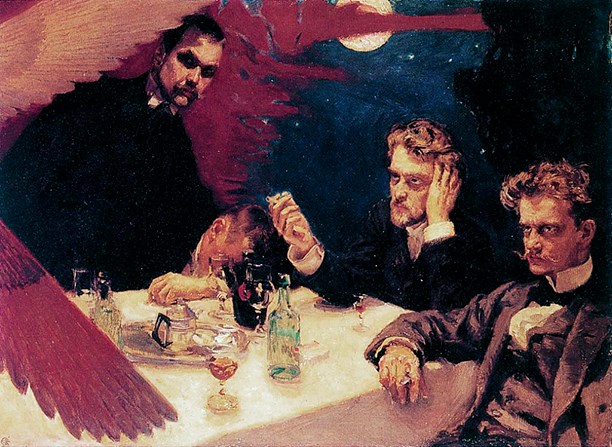
    Robert Kajanus was a good friend of Sibelius, a sometimes rival and a frequent drinking buddy. The two of them were immortalized during one of their infamous binges in a painting by the artist Akseli Gallén-Kallela (see below). Kajanus set down first recordings of a number of Sibelius’ major works, including the underappreciated Symphony No. 3, which will be heard in a 1932 performance, with the London Symphony Orchestra.

    If you’ll allow me a personal anecdote, it was actually this recording that served as an introduction for me to the composers’ grandson. I owned a second-hand book business in Philadelphia for a number of years. I suppose it’s hardly surprising that if anyone ventured into the shop there would be probably an 8-in-10 chance that I would be playing Sibelius.

    Well, on this particular occasion, Anssi wandered in during the Kajanus 3rd, which impressed him sufficiently that he struck up a conversation with me. It turns out he is a documentary filmmaker who was actually living in Philadelphia at the time. By further coincidence, Simon Rattle was coming to town to conduct Sibelius’ 5th Symphony. I was able to get Anssi an introduction to Rattle, who invited us to attend a rehearsal. Somewhere in Vanity Fair’s archives there is a photo of Rattle planting a big kiss on Sibelius’ grandson’s forehead.

    Anssi later returned the favor by introducing me to Einojuhani Rautavaara, who came to Philadelphia for the premiere of his 8th Symphony. I’ve got a snapshot somewhere of me with Rautavaara, and I’m grinning like a Tyrannosaurus rex. If and when I find it, I will be sure to post it.

    Back to tonight’s show: In response to a request from a listener who called during my WPRB tribute this past Thursday, I’ll also include a highly regarded performance of Sibelius’ last major work, the tone poem “Tapiola,” from 1926. The piece takes its name from Tapio, the forest god mentioned throughout the Kalevala, who inhabits the stark pine forests of the wild North. Again, Kajanus gave the piece its first recording, in 1932, but we’ll hear an equally atmospheric, and a times awe-inspiring reading, given seven years later, with the Boston Symphony Orchestra, conducted by Serge Koussevitzky.

    Sibelius would live another 30 years after the completion of “Tapiola.” Though he spent a portion of that time laboring at a highly-anticipated 8th Symphony, with the premiere promised to Koussevitzky, he eventually destroyed the manuscript.

    Koussevitzky’s recording of Sibelius’ 7th Symphony is a knockout. Unfortunately, I didn’t have time to include it on my WPRB playlist. It won’t be heard tonight. However, some might be happy to learn, in response to comments made to me by way of this page, email, and personal interactions in the real world, I’ve decided to devote another five hours to great Sibelius recordings this Thursday, from 6 to 11 ET.

    Speaking of the Kalevala, I’ll give the last word to one of the heroes of that work, the swashbuckling Lemminkainen. Eugene Ormandy was a superb interpreter of Sibelius’ “Four Legends from the Kalevala.” A stereo recording he made with the Philadelphia Orchestra in 1978 must be one of his finest. However, his 1940 recording of the last of the legends, “Lemminkainen’s Return,” is on a whole other level. It surpasses even Sir Thomas Beecham’s legendary account, in terms of sheer virtuosity and visceral excitement. If there’s a more hell-for-leather performance of the piece, I have yet to hear it.

    I hope you’ll join me for “Vintage Sibelius,” tonight at 10 ET, with a repeat Wednesday evening at 6; or that you’ll listen to it later as a webcast at wwfm.org.

    Then join me on Thursday morning, from 6 to 11, at WPRB 103.3 FM, as we continue with #12DaysOfSibelius.

    With thanks to Kenneth Hutchins, for coining the hashtag #12DaysOfSibelius (after #12DaysOfSinatra, of course).


    PHOTO: “Kajustaflan,” painted by Akseli Gallén-Kallela. Pictured (from left to right), the artist, composer Oskar Merikanto, Robert Kajanus and Jean Sibelius.

    More about “The Symposium,” with the original version of Gallén’s painting, here:

    http://www.sibelius.fi/english/elamankaari/sib_symbosion.htm


  • Krampusnacht The Eve of St. Nicholas Day

    Krampusnacht The Eve of St. Nicholas Day

    by 

    in
    8 responses

    December 5. The Eve of St. Nicholas Day. Krampusnacht.

    Centuries before parents reined in children with a gentle reminder that Santa knows whether they’ve been naughty or nice, recalcitrant young ones lay awake in a widening pool of sweat at the sound of distant cowbells, wondering if it was too late to repent.

    On the night of December 5, St. Nicholas’ dark helper, the horned, hairy and horrendously long-tongued Krampus, emerges from his Alpine domain to dole out corporal punishment to deserving youngsters. This comes in the form of a sound beating with a switch and, in more extreme circumstances, the threat of abduction, being carried off in a basket and tossed into hellfire. For under-aged miscreants of yore, the clank of rusty chains and the dull clap of ponderous bells heralded the arrival of a world of pain.

    Besides visiting homes and fulfilling his stern duty, Krampus ran the streets spreading fear amongst the populace and frightening off evil spirits. Perhaps as a backlash against the genial homogenization and commercialization of Christmas, the “Krampuslauf” has been experiencing a healthy revival in recent years, with alcohol-fueled hooligans prowling the streets in full Krampus regalia, often turning on the very crowds that have gathered to support them.

    However, I have to wonder, with the precipitous increase in Krampus merchandise, and now the release of a major motion picture, if Krampus himself doesn’t risk losing his teeth. Can endorsements for Coca-Cola be far behind?


    “A Krampus Carol” (incorporating a stop motion Krampus!):

    Family-friendly segment on the Krampus Renaissance in Bavaria, produced by The New York Times:

    A real, old-fashioned Krampuslauf:

    Pretty good Krampus carol (full text when you click on “show more”):

    Here comes Krampus:

    Nicholas and Krampus play “good cop/bad cop” with Tobias:

    Small child cowers behind door at 1:25:

    Academy Award-winner Christoph Waltz explains Krampus to Jimmy Fallon:

    The commercialization of Krampus:

    Happy holidays!


  • Empire Strikes Back Score A Retrospective

    Empire Strikes Back Score A Retrospective

    by 

    in
    4 responses

    The Force was strong with this one.

    The second installment in our retrospective of the “Star Wars” scores will focus exclusively on music for the first of the sequels, “The Empire Strikes Back,” released in 1980. For many, this is the best in the series so far, the “Godfather Part II” of space fantasy movies.

    Both George Lucas and composer John Williams succeeded in developing and deepening material from the first film, yet managed to avoid becoming too heavy-handed by ramping up the creativity and maintaining a spirit of adventure.

    You could ignore the jargon, let the back story glide over you, and still have fantastic time. Beloved characters from the original film, fun and familiar, were joined by instant “Star Wars” pop cultural icons, Lando Calrissian, Boba Fett, Emperor Palpatine, and of course Yoda.

    How could you take an invasion by elephantine Imperial Walkers, or riding patrol atop stop motion tauntauns too seriously anyway? One of the leads was played by a Muppet with the voice of Miss Piggy, for crying out loud.

    Williams came up with themes or motives for all of these, alongside the first appearance of “The Imperial March” and a love theme for Han and the Princess, arguably managing to top the achievement of his seemingly untoppable original score. His work on “The Empire Strikes Back” earned him his 15th Academy Award nomination.

    Last week, I discussed the merits of the original soundtrack albums, with their re-edited material providing a satisfying home listening experience, versus the current trend of releasing the music note-complete and chronological, as it’s heard in the film.

    With “The Empire Strikes Back,” it’s a very tough call, since of all the scores, this one perhaps holds up the best when heard complete from beginning to end. That said, with less than an hour to touch on the highlights, it’s much easier to accomplish when sampling from the original two-LP set.

    This is a challenge, since only material from one of the two records has ever made it to compact disc, at least in this country (on Polydor 825 298-2, released in 1985). Selections from the other are reconstructed on this week’s show, using the film mix, as it appears on the 4-CD “Star Wars Anthology” (issued as a box set on 20th Century Fox Film Scores 07822-11012-2, released in 1993).

    How fanboy is that? I even tossed on the 20th Century Fox fanfare, for good measure.

    I hope you’ll JOIN ME* for this week’s “Picture Perfect,” tonight at 6 ET, with a repeat tomorrow morning at 6, or that you’ll listen to it later as a webcast at wwfm.org.


Tag Cloud

Aaron Copland (93) Beethoven (95) Composer (114) Film Music (144) Film Score (143) Film Scores (255) Halloween (94) John Williams (195) KWAX (229) Leonard Bernstein (104) Marlboro Music Festival (125) Movie Music (159) Mozart (91) Opera (213) Philadelphia Orchestra (89) Picture Perfect (174) Princeton Symphony Orchestra (109) Radio (88) Ross Amico (244) Roy's Tie-Dye Sci-Fi Corner (290) The Classical Network (101) The Lost Chord (269) Vaughan Williams (105) WPRB (397) WWFM (881)

DON’T MISS A BEAT

Receive a weekly digest every Sunday at noon by signing up here


RECENT POSTS