• Elie Siegmeister’s Western Americana

    Elie Siegmeister’s Western Americana

    by 

    in
    5 responses

    On this date in 1945, Arturo Toscanini conducted the premiere of Elie Siegmeister’s “Western Suite” in a concert broadcast with the NBC Symphony Orchestra. Its cowpoke lyricism and buckaroo high spirits struck a bulls-eye with audiences and critics in a cowboy-mad America. Aaron Copland’s “Billy the Kid” had been given its premiere in 1939 (the same year as John Ford’s “Stagecoach”) and “Rodeo” followed in 1942. Pulp magazines and dime-store novels fed the western craze, and cinemas were teeming with broad vistas and portrayals of the quiet dignity of the cowboy.

    While hardly his most innovative or personal work, the “Western Suite” served to put Siegmeister on the map. According to the composer, he had only a few of his compositions published up until that time. The day after the performance, three publishers were vying for his work. “The piece had a lot of earthy, touchy quality about it,” he said, “which is, I think, one of the characteristics of a great deal of American music. There is a kind of lusty feeling, with sometimes a roughness, a harshness, or whatever you want to call it.”

    Already in 1939, he had formed the American Ballad Singers, hoping to replicate the experience he had had when he first witnessed the English Singers, six touring musicians who introduced the madrigal to New York. It was like an epiphany for Siegmeister, and he determined to bring our native folk tradition alive in a similar fashion for the American public. Americana was at its peak during those years, with folk singers like Burl Ives and, soon after, Woody Guthrie and Pete Seeger very much on the rise. The American Ballad Singers tapped into the zeitgeist and toured the country to enthusiastic reviews.

    Though Siegmeister wrote orchestral works like “American Holiday” (1933), “Abraham Lincoln Walks at Midnight” (1937), the “Ozark Suite” (1943) and “Prairie Legend” (1944), and an opera (he composed eight) called “Night of the Moonspell” (1974-6), which transposed Shakespeare’s “A Midsummer Night’s Dream” to Louisiana, homespun Americana hardly encapsulates the whole of his output.

    True, American jazz was frequently an influence. He also wrote a string quartet on Jewish themes. But there were plenty of abstract pieces, as well, including eight symphonies, a number of concertos and plenty of chamber music.

    In addition, he wrote successful books on music, including “Treasury of American Song” (1940-43), “The Music Lover’s Handbook” (1943, revised in 1973), and “Harmony and Melody” (1985). He helped found the American Composers Alliance, with the aim of publishing and promoting music by American composers, in 1937. Later, he served on the board of directors of ASCAP, from 1977 until his death in 1991.

    By coincidence, Siegmeister’s “American Sonata” (1944) will be performed tonight by pianist Cecile Licad, on a recital hosted by the Philadelphia Chamber Music Society. Also on the program will be sonatas by Alexander Reinagle (who wrote a number of pieces for George Washington), Edward MacDowell and Charles Tomlinson Griffes. The concert will take place at the American Philosophical Society, 427 Chestnut Street, at 8 p.m.

    FUN FACT: The theme from Siegmeister’s only film score, “They Came to Cordura” (1959), is the signature music for my show, “Picture Perfect.” You can hear the passage at 43 seconds into the film.

    https://www.youtube.com/watch?v=XwYWx8gtjBo

    Siegmeister’s “Western Suite”:
    https://www.youtube.com/watch?v=2tzyS1klaRo

    As part of the fascinating Toscanini broadcast, which also features music by Mario Castelnuovo-Tedesco, Vittorio Rieti and Paul Creston (the “Western Suite” begins at the 40 minute mark):
    https://www.youtube.com/watch?v=Ufiigg8_DMI

    Interview with Siegmeister by Bruce Duffie:
    http://www.kcstudio.com/sieg2.html

    Interview with Siegmeister by David Dubal!

    PHOTOS: Elie Siegmeister (right) with pulp western from 1945

  • Debussy’s Clair de lune and André Caplet

    Debussy’s Clair de lune and André Caplet

    by 

    in
    2 responses

    “Clair de lune” – Debussy, right?

    The work began as a piano piece, one of the movements from Debussy’s “Suite bergamasque.” However, the lovely orchestral version was produced by André Caplet.

    One of the reasons superior sorts tend to look down their noses at film music is that the composers frequently work with orchestrators (though the better composers are very meticulous about notating their requirements). However, the practice is not exclusive to Hollywood.

    The Dutch masters were not always responsible for all the elements in the paintings attributed to them. For a famous example, see Rubens’ “Prometheus Bound” (which you can view in person, if you are reading this locally, at the Philadelphia Museum of Art). Similarly, successful authors sometimes set up studios, kind of like architects, with anonymous collaborators doing a lot of the heavy lifting. The practice dates back to at least Alexandre Dumas, who churned out novels at a dizzying rate.

    In classical music, many of the orchestral works of Grieg and Liszt received ample assistance from others (though Liszt gained confidence – and autonomy – as time went on). Charles Koechlin worked behind the scenes with Debussy and Gabriel Fauré.

    Caplet, a winner of the esteemed Prix de Rome, provided orchestrations for Debussy’s “Children’s Corner,” “Clair de lune,” “The Martyrdom of Saint Sebastian” and “La Boiîte à joujoux.”

    He directed the Boston Opera from 1910 to 1914. While serving in the First World War, he was caught in a gas attack, which resulted in the pleurisy that plagued him for the remainder of his short life. Caplet died in 1925, at the age of 44.

    Why is it so important to us, I wonder, that a work of art emerge seemingly from a single source – the “auteur,” as it were? While most of Caplet’s own music languishes in obscurity, his work for Debussy lives on.

    Happy birthday, André Caplet!


    Caplet’s orchestration of “Clair de lune”:

    His own “Septuor” for string quartet and three female voices:

    Rubens’ “Prometheus Unbound”:

    http://www.philamuseum.org/collections/permanent/104468.html

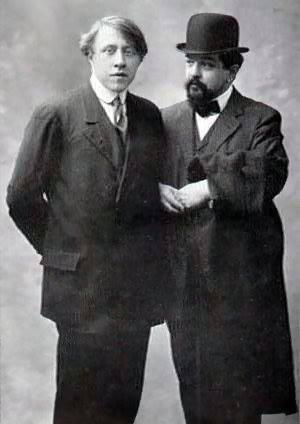
    PHOTO: Caplet (left) with Debussy


  • Ormandy’s Lost American Music Rediscovered

    Ormandy’s Lost American Music Rediscovered

    by 

    in
    One response

    I hope you’ll join me tonight on “The Lost Chord,” as we round out our trilogy of programs featuring rarely-heard recordings of American music by Eugene Ormandy and the Philadelphia Orchestra.

    We’ll hear two songs (originally from a collection of five), after texts of William Blake, by Virgil Thomson; Roy Harris’ underrated Symphony No. 7, in a powerhouse performance; and Louis Gesensway’s “Four Squares of Philadelphia.”

    Gesensway was born in Latvia in 1906. A violin prodigy, he was one of the founders of the Toronto Symphony Orchestra. He came to Philadelphia at the age of 19, where he played in the orchestra under Stokowski and Ormandy.

    In his mid-20s, he took a leave of absence to study composition with Zoltán Kodály. “Four Squares of Philadelphia” was described by the composer as a “symphonic poem for large orchestra, narrator and street criers.”

    The piece opens with a recitation of William Penn’s prayer, then continues with musical evocations of Washington Square (captured in early morning, during Colonial times, with street criers hawking their wares), Rittenhouse Square (on a bright and cheerful afternoon), Logan Square (with its fountains at dusk), and Franklin Square (at night, reflective of noisy bridge traffic, with a side excursion into Chinatown, and interjections from the honky tonk joints located around the square in the 1950s).

    I hope you’ll join me for one more trip to the well, with “All-American Ormandy III,” tonight at 10 ET, or that you’ll listen to it (while you’re sitting in traffic, no doubt) when the show repeats Thanksgiving eve at 6. If your family is stressing you out, you can always catch it later as a webcast at wwfm.org.


    PHOTO: Statue of Penn high atop the city he founded


  • St. Cecilia’s Day: Britten, Rodrigo & Music’s Patron

    St. Cecilia’s Day: Britten, Rodrigo & Music’s Patron

    by 

    in
    6 responses

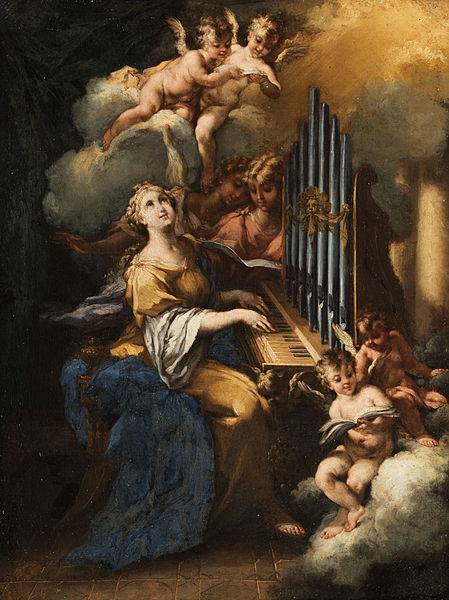
    November 22 is St. Cecilia’s Day. The Patron Saint of Music.

    It is also the birthday of Benjamin Britten (1913-1976), who composed a “Hymn to St. Cecilia,” and Joaquin Rodrigo (1901-1999), who named his daughter after her.

    Britten’s “Hymn to St. Cecilia”:

    Rodrigo’s “El álbum de Cecilia,” subtitled “6 piezas para manos pequeñas” (six pieces for little hands) – in other words, children’s pieces. I hope you get a little enjoyment out of them.


    PHOTOS: Rodrigo and Britten (top to bottom), with the Patron of the Art


  • Malcolm Williamson: The Master Who Changed Music

    Malcolm Williamson: The Master Who Changed Music

    by 

    in
    6 responses

    Thanks to Malcolm Williamson, the appointment of Master of the Queen’s Music (or King’s, as the case may be) is no longer for life. Since the 17th century, musicians have held the post with the expectation of writing music for important milestones in the lives of the Royal Family and for ceremonial occasions.

    When Williamson, an Australian by birth, was named the successor of Sir Arthur Bliss in 1975, there was grumbling among his colleagues. Sir William Walton attributed the choice to the need for “cementing the cracks in the Commonwealth.” He wrote to Sir Malcolm Arnold (who most certainly would have brought his own set of problems) that “they had got the wrong Malcolm.” Arnold, a sporadically brilliant composer, was also a manic depressive (and possibly bipolar) who survived alcoholism and multiple suicide attempts.

    Williamson’s great sin was that he was very bad with deadlines (and for that, he certainly has my sympathy). Most particularly, he failed to complete a symphony in time for the Queen’s Golden Jubilee in 1977. His ambitious “Mass for Christ the King,” also written for the occasion, was also delivered late. Significantly, he was the first Master of the Queen’s (or King’s) Music in over a century not to be knighted.

    After the Jubilee debacle, his output slowed, though he was seldom unproductive. In all, he wrote seven symphonies, concertos for piano, violin, organ, harp and saxophone, and numerous other orchestral, choral, chamber and instrumental works. Like many of his colleagues, he also composed music for the cinema, for films of varying quality. It’s always amusing to find his name in the opening credits of Hammer productions like “The Brides of Dracula” and “The Horror of Frankenstein.”

    Williamson suffered from a series of illnesses in his later years. He too turned to the bottle, and it can only be speculated if depression and the stress of trying to hold his head high as a colonial outsider at the court of England contributed to his decline.

    Williamson was the first non-Briton to hold the post. Following his death in 2003, the parameters of the appointment were revised so that Master of the Queen’s Music is now a ten-year term. Sir Peter Maxwell Davies was the first Master to serve under the new guidelines. He was succeeded in 2015 by Judith Weir, the first woman to hold the post (and yes, she is still referred to as “Master”).

    It seems to be the case that composers’ reputations are at their lowest in the decade or two following their deaths. In the case of Williamson, he seems to be rebounding nicely in the recording studio, though there remain gaping holes in his discography. Still, it’s possible to sample his symphonies, his concertos, his choral and instrumental works, and even his score for the Carol Reed film (starring Alec Guinness) “Our Man in Havana.”

    I know there is at least one other person who visits this page that knows a good deal more about Malcolm Williamson than I, and he is invited to flesh out this account if he so chooses.

    Happy birthday, Malcolm Williamson!


    Malcolm Williamson in conversation with Bruce Duffie:
    http://www.kcstudio.com/williamson2.html

    Williamson performs his attractive Piano Concerto No. 2:

    A rare recording of his Symphony No. 6:

    Theme music for “The Brides of Dracula”:


Tag Cloud

Aaron Copland (93) Beethoven (95) Composer (114) Film Music (144) Film Score (143) Film Scores (255) Halloween (94) John Williams (195) KWAX (229) Leonard Bernstein (104) Marlboro Music Festival (125) Movie Music (159) Mozart (91) Opera (213) Philadelphia Orchestra (89) Picture Perfect (174) Princeton Symphony Orchestra (109) Radio (88) Ross Amico (244) Roy's Tie-Dye Sci-Fi Corner (290) The Classical Network (101) The Lost Chord (269) Vaughan Williams (105) WPRB (397) WWFM (881)

DON’T MISS A BEAT

Receive a weekly digest every Sunday at noon by signing up here


RECENT POSTS