• Hindemith’s Frog He Went a-Courting Surprise

    Hindemith’s Frog He Went a-Courting Surprise

    by 

    in
    9 responses

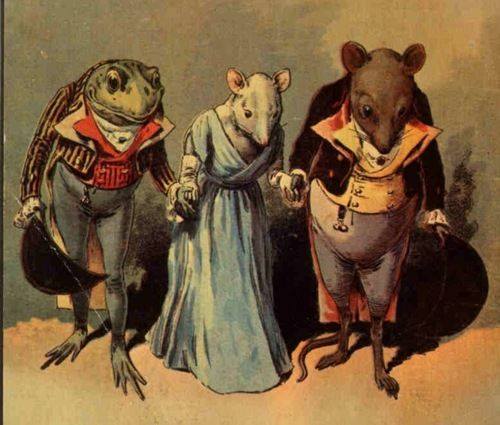
    Anyone who thinks of Paul Hindemith as a dry-as-dust note-spinner should give a listen to his “Variations on ‘A Frog He Went a-Courting’” (1941). The English-language folksong, about the amphibious swashbuckler who woos Miss Mousy (with the consent of her Uncle Rat), dates back to the 16th century. Hindemith uses the tune as the basis for a challenging work-out for cello and piano, while at the same time charming the socks off his listeners.

    Happy birthday, Paul Hindemith, uh huh.

    Additional versions by Burl Ives…

    Elvis….

    and Tom and Jerry.


  • Ormandy’s Lost American Music

    Ormandy’s Lost American Music

    by 

    in
    5 responses

    It’s not so much that I am out of ideas, but it is mighty convenient that I had so much material left over from last week’s show, consisting of rarely-heard recordings of American music performed by Eugene Ormandy and the Philadelphia Orchestra.

    This Sunday night on “The Lost Chord,” I reach for the already conveniently stacked CDs to cue up three more gems.

    Samuel Barber was born in West Chester, Pa., not far from Philly, in 1910. He attended Philadelphia’s Curtis Institute of Music and had his first orchestral work, the “School for Scandal Overture,” performed by the Philadelphia Orchestra in 1931, when he was 21 years-old.

    His “First Essay for Orchestra” was sent to Arturo Toscanini in the same mail as his “Adagio for Strings.” Toscanini performed both works with the NBC Symphony in 1938, but it was Eugene Ormandy who made the first recording of the “Essay,” with the Philadelphians, in 1940.

    Vincent Persichetti was born in Philadelphia in 1915, and he died there in 1987. In between, he attended Combs College of Music, the Curtis Institute (where he studied conducting with Fritz Reiner) and the Philadelphia Conservatory. He taught at Combs and the Philly Conservatory. Then he received an invitation from William Schuman (some of whose music we heard last week) to take up a professorship at Juilliard.

    Persichetti was one of our great composers, but to this day he remains underappreciated, more respected than loved. His Symphony No 4 of 1951 must be one of his most immediately attractive works.

    Finally, John Vincent may be the most undeservedly neglected composer in Ormandy’s entire discography. Ormandy described his recording of Vincent’s Symphony in D (“A Festival Piece in One Movement”) as “one of the best we have ever done,” and the piece itself as “one of the finest compositions created by an American composer in the past decade.” The 1954 work sounds at times like Sibelius gone to the rodeo, but my, is it good stuff!

    I hope you’ll join me for “All-American Ormandy II,” rarely-heard recordings of Barber, Persichetti and Vincent, on “The Lost Chord,” this Sunday night at 10 ET, with a repeat Wednesday evening at 6; or that you’ll listen to it later as a webcast at wwfm.org.

    To help get you in the mood, here’s an in-depth interview with Persichetti by Bruce Duffie:

    http://www.bruceduffie.com/persichetti.html


  • Copland Cat Photo Americas Composer Birthday

    Copland Cat Photo Americas Composer Birthday

    by 

    in
    7 responses

    I bought me a cat!

    Aaron Copland shares a candid moment with a lounging, four-legged friend.

    Happy birthday to America’s great composer!


  • Writers on Film Behind the Screen

    Writers on Film Behind the Screen

    by 

    in
    6 responses

    Words on the printed page captivate us so completely that it’s natural to assume that the lives of writers must be very rich, full of incident, and dramatic indeed. Surely that is sometimes the case. Who among us could keep up with a Byron or a Pushkin or a Poe?

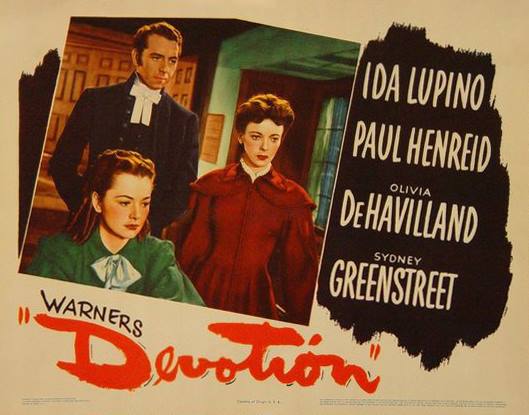
    Yet even with the most outlandish writers, Hollywood, for some reason, often feels the need to fabricate. How else to explain “Devotion” (1943), Warner Brothers’ salute to the Brontës? Then again, the temptation must be strong to characterize the sisters who penned “Jane Eyre” and “Wuthering Heights” as tortured Romantics.

    Ida Lupino plays Emily, the creator of Cathy and Heathcliff, and Olivia de Havilland, Charlotte, who conceived Jane and Rochester. Nancy Coleman is their sister Anne, who wrote “The Tenant of Wildfell Hall,” and Arthur Kennedy, their dissolute brother Branwell. The film also features Sidney Greenstreet, as William Makepeace Thackeray, Paul Henreid as an Irish priest, and – well, you get the idea. The casting, at times, strains credibility.

    However, the music by Erich Wolfgang Korngold is up to the composer’s usual high standard. Korngold himself became so enamored of one of its themes that he recycled it for use in the first movement of his Violin Concerto.

    The behind-the-scenes drama on “Devotion” is nearly as colorful as anything that made it to the screen. De Havilland had originally been cast to play Emily, and her real-life sister, Joan Fontaine, was to play Charlotte. De Havilland and Fontaine had an uneasy relationship, at best, their entire lives. At times they competed for the same men (Howard Hughes) and the same roles (Melanie in “Gone With the Wind” and the “second Mrs. De Winter” in Alfred Hitchcock’s “Rebecca”). In 1942, they were both in contention for the Academy Award for Best Actress. Fontaine won. De Havilland wouldn’t win her first Oscar until 1946. To say that the two were competitive is putting it mildly.

    Fortunately for everyone on the set, an offer had come through for Fontaine to play Charlotte Brontë’s most famous creation, Jane Eyre, opposite Orson Welles’ Rochester, over at 20th Century Fox. So De Havilland assumed the part vacated by Fontaine.

    After shooting wrapped, “Devotion” actually sat on the shelf for three years, as De Havilland successfully sued Warner Brothers to terminate her contract without her having to make up the six months she had been kept on “suspension.” Until then, actors under contract to the major studios had been considered “suspended” between jobs, thereby extending their obligation to their employers, so that, for instance, a seven year contract was spread out over a much longer period, fulfilled only during the time an actor was actually working. The legal victory became informally known as the De Havilland Law.

    In addition to Korngold’s take on the Brontës, we’ll have music from movies inspired by Iris Murdoch (“Iris,” with music by James Horner), the Bard of Avon (“Shakespeare in Love,” with an Academy Award-winning score by Stephen Warbeck), and Samuel Clemens (“The Adventures of Mark Twain,” by Max Steiner).

    I hope you’ll join me for real-life writers who appeared as characters in the movies, on “Picture Perfect,” this evening at 6 ET, with a repeat tomorrow morning at 6; or that you’ll listen to it later as a webcast at wwfm.org.

  • Princeton Vocal Arts Abound This Week

    Princeton Vocal Arts Abound This Week

    by 

    in
    3 responses

    If you are an admirer of the vocal arts, there is much to enjoy over the next nine days, with concerts being given by the Capital Singers of Trenton (tonight at 7:30, at St. Paul’s Roman Catholic Church in Princeton), Princeton Girlchoir (a benefit concert at Nassau Presbyterian Church in Princeton, tomorrow at 5), Westminster Williamson Voices (at Westminster Choir College’s Bristol Chapel, tomorrow at 8 p.m.), Westminster Choir (also at Bristol Chapel, Sunday at 3), Westminster Kantorei (at Bristol on 11/20 at 8), The Dryden Ensemble (an all-Purcell program at Princeton Theological Seminary’s Miller Chapel, on 11/21 at 7:30, and Trinity Episcopal Church in Solebury, Pa., on 11/22 at 3), and Westminster Jubilee Singers (at Bristol, on 11/22 at 7).

    The Princeton Girlchoir will join The Princeton Singers for the New Jersey premiere of Steven Sametz’s “A Child’s Requiem,” written in response to the Sandy Hook Elementary School shootings. On the same program will be Vaughan Williams’ poignant “Serenade to Music” (at Princeton Meadow Church and Event Center, on 11/21 at 8 p.m.).

    It’s a lot to take in. Find out more about it in my article in today’s Trenton Times:

    http://www.nj.com/times-entertainment/index.ssf/2015/11/classical_music_bevy_of_concer.html


Tag Cloud

Aaron Copland (93) Beethoven (95) Composer (114) Film Music (144) Film Score (143) Film Scores (255) Halloween (94) John Williams (195) KWAX (229) Leonard Bernstein (104) Marlboro Music Festival (125) Movie Music (159) Mozart (91) Opera (213) Philadelphia Orchestra (89) Picture Perfect (174) Princeton Symphony Orchestra (109) Radio (88) Ross Amico (244) Roy's Tie-Dye Sci-Fi Corner (290) The Classical Network (101) The Lost Chord (269) Vaughan Williams (105) WPRB (397) WWFM (881)

DON’T MISS A BEAT

Receive a weekly digest every Sunday at noon by signing up here


RECENT POSTS