With a weather forecast of mostly sunny skies for Princeton and highs in the mid-upper 70s, it would seem that Mother Nature would prefer Indian summer; but from deep within my windowless bunker beneath Bloomberg Hall this morning, I’ll be celebrating autumn.
Tune in to WPRB, and you’ll hear seasonal selections by any of the following (and probably a few others): Cécile Chaminade, Vernon Duke, Gerald Finzi, Morton Gould, Jennifer Higdon, Peter Erasmus Lange-Müller, Rued Langgaard, Billy Mayerl, Joachim Raff, Einojuhani Rautavaara, Ottorino Respighi, Tomáš Svoboda, Virgil Thomson, and Peter Warlock.
I’ll be wearing a sweater and sipping hot tea in defiance of the elements from 6 to 11 ET, at WPRB 103.3 FM or online at wprb.com. Of course, it’s always autumn in my heart on Classic Ross Amico.
This is a textbook example of grasping for low-hanging fruit – or perhaps radiant leaves would be more appropriate. Be that as it may, who doesn’t love autumn? The combination of crisp, Jack Frost exhilaration and pie-induced coziness is hard to beat.
I hope you’ll join me this Thursday morning on WPRB as we celebrate the glorious season of autumn. I know, we’re already a month into it, but autumn doesn’t become truly autumn until October is ripe on the vine.
We’ll enjoy seasonal works by Cécile Chaminade, Vernon Duke, Gerald Finzi, Billy Mayerl, Einojuhani Rautavaara, Ottorino Respighi, Tomáš Svoboda, Virgil Thomson, Peter Warlock, and many, many others, as well as non-seasonal works that for some reason hold for me seasonal associations. Also, I would be remiss not to toss in a piece or two by Franz Liszt, one of the great musical minds of the 19th century – and a great person to boot – on the occasion of his 204th birthday anniversary.
I had an eager listener phone in on September 23, the Autumnal Equinox, to request music to celebrate the season. I was sorry to have to say, “Too soon!” Now that the pledge drive is over, we can all drink deep, like Dionysus at Keats’ “cyder press.” Let the rustic dances begin!
Sincere thanks to all of you who did your part last week to support independent radio. (Kenneth Hutchins, you are now the Patron Saint of Classic Ross Amico.) For those of you who weren’t listening or were unable to pledge, remember, you may do so at any time, at wprb.com. You’ll be doing me a personal kindness if you send along a line or two to let them know how much you enjoy the show.
We’ll be offering up a tray full of apples and Spiced Wafers tomorrow morning, from 6 to 11 ET, at WPRB 103.3 FM, or online at wprb.com. It will be more fun than a five-hour leaf fight on Classic Ross Amico.
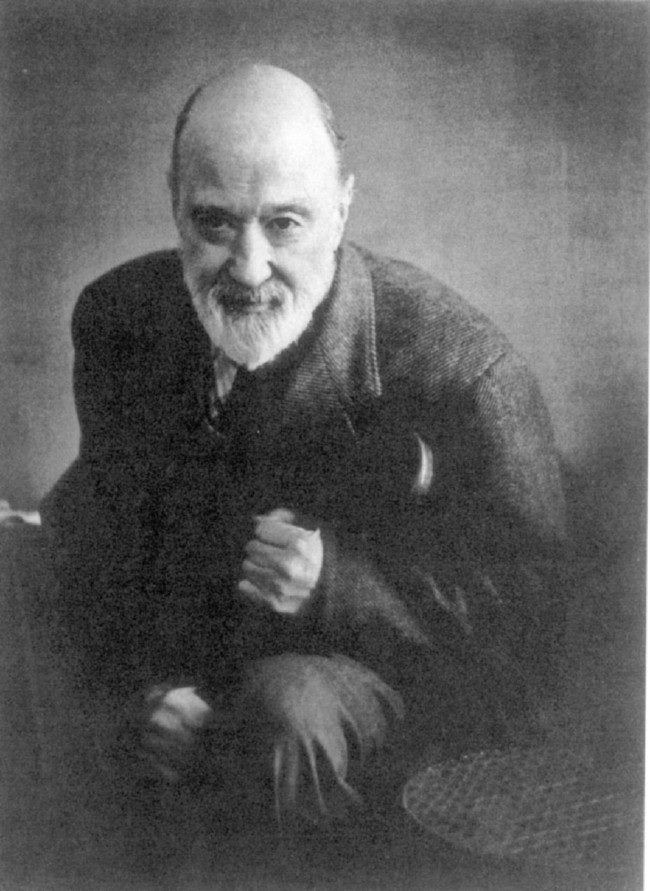
Today is the birthday of Charles Ives, an American original. Ives wrote the kind of music he wanted to write, stitching hymns and fiddle tunes of his youth into a brilliant crazy quilt of the American experience.
His father had been something of an original himself, a bandmaster during the Civil War. He taught Ives to sing in one key as he played in another. This instilled in his son, perhaps, the receptivity to recognize, when standing on a street corner during a parade, the natural dissonances and rhythmic complexities that resulted from the clash of sounds as marching bands wrapped around the block.
He was very successful at his day job in the insurance business (some of his work in the financial field laid the groundwork for modern practices in estate planning). While this would be a claim on his time, it allowed him to pursue his idiosyncratic muse. Ives composed in the evenings, on weekends, and during holidays. For a few years, in the 1890s, he was also an organist and choirmaster at a couple of New York churches.
He retired in 1930, which finally permitted him to devote himself wholeheartedly to music. Ironically, by then, he found he was no longer able to compose. His wife recalled a day in 1927 when he came downstairs with tears in his eyes and confessed that everything sounded wrong to him. Instead he worked at revision and publication.
By the time his works began to gain recognition, he had already stopped writing for 20 years. At the time of his death, in 1954, he was still widely misunderstood and much of his music remained unperformed. Nevertheless, he had some important champions. He was a recipient of the Pulitzer Prize for Music in 1947, for his Symphony No. 3, “The Camp Meeting,” a work he composed in 1904. The symphony was given its belated premiere, under Lou Harrison’s direction, in 1946.
Arnold Schoenberg regarded Ives as a paragon of artistic integrity. After Schoenberg’s death, his widow found the following among his papers: “There is a great Man living in this Country – a composer. He has solved the problem of how to preserve one’s self-esteem and to learn. He responds to negligence by contempt. He is not forced to accept praise or blame. His name is Ives.”
Here is Ives, in all his patriotic, profane glory, singing “They Are There,” from 1943. Originally written in 1917, for the Great War, the song employs an updated text.
Ives draws on the lesson of the wrap-around marching bands for “The Fourth of July” – and dig the climactic rocket explosion fading away into sparks!
Finally, the work that won Ives his Pulitzer, the Symphony No. 3, “The Camp Meeting”:
Ives’ characteristically gruff reaction: “Prizes are for boys. I’m grown up.” In private, though, he proudly hung the certificate on his wall.
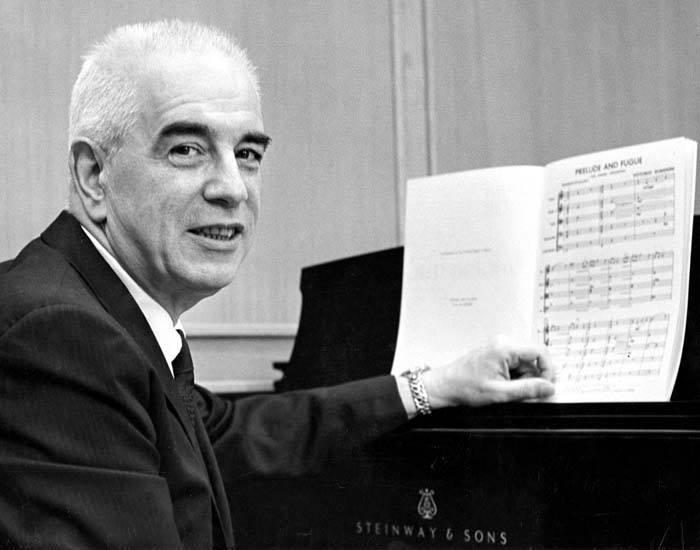
My newspaper duties have kept me off Facebook for most of the day, thereby frustrating my desire to send a shout-out to Philadelphia composer Vittorio Giannini on the occasion of his birthday anniversary.
Giannini was born in Philadelphia in 1903. He studied at the Milan Conservatory, after which he earned his graduate degree from Juilliard. He then taught at Juilliard, the Manhattan School of Music and the Curtis Institute.
Arguably his most important contribution as an educator was the foundation in 1965 of the North Carolina School of the Arts, which he envisioned as a Juilliard of the South. The school attracted to its faculty such luminaries as Ruggiero Ricci and Janos Starker. Giannini died the year after it opened, in 1966.
He was from a family of opera singers. His father founded the Verdi Opera House in Philadelphia. One sister taught voice at the Curtis Institute of Music and the other sang at the Metropolitan Opera. Giannini himself composed 14 operas, including “Lucedia,” “The Scarlet Letter,” “The Taming of the Shrew,” and one for radio, “Beauty and the Beast.” Two, “Casanova” and “Christus,” remain unperformed.
Not surprisingly, then, in his day he was known largely for his vocal music, but his Symphony No. 3 for wind band has fared best on disc. There are seven recordings in the current catalogue, from the classic release directed by A. Clyde Roller on the Mercury label to one of the later-in-life, digital recordings of Frederick Fennell.
Daniel Spalding, music director of the New Jersey Capital Philharmonic, recorded the Symphony No. 4 with the Bournemouth Symphony, for Naxos. The companion piece is Giannini’s Piano Concerto, with Gabriela Imreh, the soloist.
Spalding will conduct the New Jersey Capital Philharmonic Orchestra this Saturday, Oct. 24, at the Trenton War Memorial. The program will include Philip Glass’ “Concerto Fantasy for Two Timpanists and Orchestra” and Tchaikovsky’s Symphony No. 5. You can read all about it in the Friday edition of the Trenton Times.
As you may know, WWFM is in the middle of its “Around the World in 80 Hours” pledge drive. On Wednesday, Rachel Katz and I were given one hour in Ukraine, which is hardly enough time to scratch the surface of such a rich musical heritage. It’s especially frustrating in the context of a pledge drive, when all of the selections need to be short and preferably upbeat.
This Sunday night on “The Lost Chord,” I attempt to assuage some of the frustration by revisiting Ukraine and programming lengthier pieces by two important omissions.
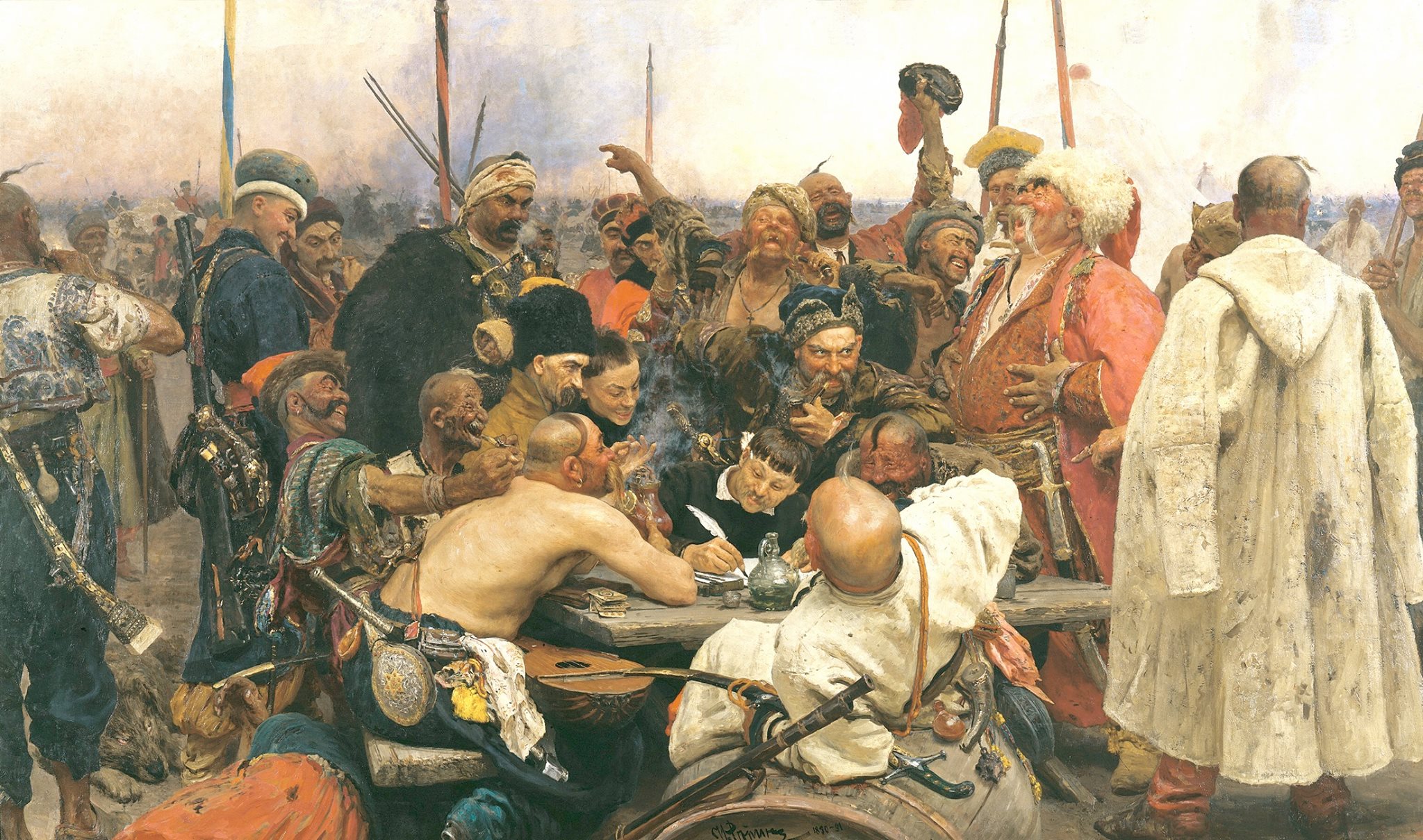
Reinhold Glière, best known for his ballet “The Red Poppy,” with its ubiquitous “Russian Sailor’s Dance,” and perhaps for his Symphony No. 3, “Ilya Muromets,” was born in Kiev in 1875. Among his works steeped specifically in Ukrainian lore is the symphonic poem/ballet “The Zaporozhy Cossacks,” based on the famous canvas by Ilya Repin.
In 1913, Glière attained an appointment to the school of music in Kiev, which was raised to the status of conservatory shortly thereafter. Glière served as director of the conservatory from 1914 to 1920.
Among his pupils there was Boris Lyatoshinsky, who lived from 1895 to 1968. Lyatoshinsky was a student at the conservatory at the start. The first movement of his Symphony No. 1 was written as a graduation work. The other two movements followed in 1919.
The first performance of the piece took place under Glière’s direction in 1923. If you get all sweaty listening to the orchestral works of Alexander Scriabin, you certainly won’t want to miss this, an opulent work by a young man determined to impress.
I hope you’ll join me for “Steppe Lively” – classical music from Ukraine – tonight at 10 ET. PLEASE NOTE: because of the pledge drive, the show will not be repeated on Wednesday. However, if you miss it tonight, you can listen to it later as a webcast – and pledge online – at wwfm.org.
PHOTO: Ilya Repin’s “Reply of the Zaporozhian Cossacks”


3 responses