• Sunday Morning Opera on WPRB

    Sunday Morning Opera on WPRB

    by 

    in
    3 responses

    If you are an opera fan, this is worth checking out and supporting. Sandy is presenting a potpourri of the great singers this morning until 10 ET, at WPRB 103.3 FM or online at wprb.com. Call (609) 258-1033 or go to pledge.wprb.com.

    SUNDAY MORNING OPERA WITH SANDY

    Description:

    This program is heard from 5:30-10AM on WPRB in Princeton, New Jersey, 103.3 FM. There is a complete opera each week,and after the opera, if there is time remaining, we celebrate the birthday of a composer or singer. You can also listen online at http://www.wprb.com/

    The host and producer is Sandy Steiglitz

    Posted on October 16 at 8:01am:

    I hope that you will join me for Sunday Morning Opera on October 18th. It’s membership drive time on WPRB. This Sunday morning is our annual membership drive show and we’ll be broadcasting segments devoted to artists that you suggested:Jussi Bjoerling, Jon Vickers, Mirella Freni, Sherrill Milnes, Grace Bumbry, Renata Scotto, Mario Sereni, Hermann Prey, and many others.

    Tune in, enjoy, and call with your pledge. A contribution in any amount helps to support WPRB, a unique and diverse outlet that
    gives its volunteer hosts complete artistic freedom, and allows me to present a complete, uncut opera every week throughout the year. We’ll have 12 special opera thank-you gifts, first-come first-served, plus a schedule of premiums at various levels. I’ll be looking forward to hearing from you!

    The phone number is (609) 258-1033. You can pledge online at pledge.wprb.com. I’ll be starting the program at 5:30 AM ET.
    THANKS!!

    #wprb75

  • Auschwitz Composers: Music, Loss, and Remembrance

    Auschwitz Composers: Music, Loss, and Remembrance

    by 

    in
    5 responses

    It was on this date in 1944 that three of the most promising composers of their generation were snuffed out in the gas chambers at Auschwitz. Pavel Haas, Hans Krása and Viktor Ullmann were all transported from Theresienstadt (Terezin), the Nazi propaganda camp, three days after their final concert on October 14. With them was the famed conductor Karel Ančerl, who had led the performances.

    Immediately upon arrival, Krása, Ullmann and Ančerl were marked for death by Josef Mengele, while Haas was selected to join the forced laborers. Then all at once Haas began to cough. Ančerl was passed over and Haas was sent to be gassed in his place.

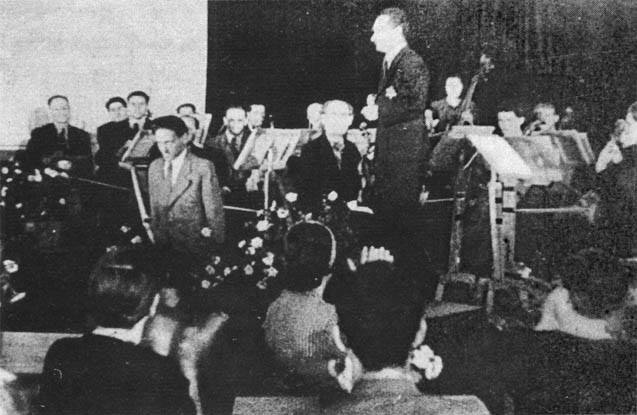
    In the propaganda film “Theresienstadt,” Haas is shown taking a bow after a performance in Terezin of his “Study for String Orchestra,” a work he had written in the camp. Ančerl can be seen on the podium.

    In the same film, children sing a selection from Krása’s opera “Brundibár.” When filming wrapped, having served their purpose, 18,000 prisoners, Haas and the children included, were deported to Auschwitz. By a large margin, most did not survive.

    Haas had been despondent upon his arrival in Terezin. It was fellow composer Gideon Klein who urged him to continue to create. (Klein would die under unclear circumstances in 1945.) Haas wrote at least eight compositions during his internment. His “Study for String Orchestra,” rescued by Ančerl after the liberation of the camp, would become his best known music. Haas was at work on a large-scale symphony at the time of his deportation. The surviving turso of the piece was orchestrated by Zdeněk Zouhar in 1994.

    It was Ančerl himself who related the circumstances of Haas’ death to the composer’s brother after the war. Ančerl had lost his own family, his wife and a young son. He himself went on to a bright future. He became artistic director of the Czech Philharmonic in 1950, in which capacity he championed the great Czech composers and helped to foster a distinctly Czech sound in orchestral performance.

    After the Warsaw Pact invasion, he left Czechoslovakia for Toronto, Canada, where he served as music director of the Toronto Symphony Orchestra until his death in 1973. None of it would have happened, if not for a quirk of fate.

    Thirty years after his death, the music of Haas and his colleagues began to be performed with much more frequency. Much of it is now available in recordings. Listening to it, one can’t help but marvel at the will to create and to survive, even under the most horrific of circumstances, and lament at how history, musical and otherwise, might have been very different had those interned been allowed to live out their natural lives.

    Here’s a clip of “Brundibár,” particularly affecting when we realize that few of the children survived:

    Also, Haas’ “Study for String Orchestra”:


    PHOTO: Pavel Haas, inadvertent savior of Karel Ančerl, takes his final bow


  • Early Music Fest at Grounds For Sculpture

    Early Music Fest at Grounds For Sculpture

    by 

    in
    5 responses

    It looks like the Guild for Early Music has taken care to make the appropriate sacrifices to Apollo, since the Sun God will again be smiling on the annual Early Music Festival at Grounds For Sculpture on Sunday (with mostly sunny skies in the forecast and highs in the lower 50s).

    The concerts will be held indoors in two galleries at the Seward Johnson Center for the Arts, but the nice weather ensures that recorder players will stroll the grounds and that visitors will be able to take in the sculpture tours, luxuriate in a glorious autumn day, and receive inquiring looks from the peacocks, always on the alert for a potential handout.

    14 Early Music groups will present music of the Middle Ages, Renaissance, Baroque and Colonial Eras. The event will take place from 12:30 to 5 p.m. Grounds For Sculpture is located in Hamilton, on the site of the former New Jersey State Fairgounds. You’ll know you’re close when you start to encounter surreal roadside attractions like the 15-foot tooth and the sidewalk bicyclist.

    Read more about it in my article in today’s Trenton Times:

    http://www.nj.com/times-entertainment/index.ssf/2015/10/11th_annual_early_music_festiv.html


  • Giant Movie Monsters Music from Godzilla to Kong

    Giant Movie Monsters Music from Godzilla to Kong

    by 

    in
    8 responses

    Super size me!

    We’re thinking big this week, on “Picture Perfect,” with outsized thrills from movies featuring gargantuan creatures.

    We’ll begin with “Godzilla” (2014), the most recent incarnation of the pop-cultural icon, originally a metaphor for the destructive power of nuclear weapons, but now seemingly more of a jack-of-all-trades restorer of natural balance. Either way, it’s generally man’s overweening pride that brings on the destruction. The composer for this latest version was Alexandre Desplat.

    Then we’ll take a storm-swept hot air balloon to “Mysterious Island” (1961). Jules Verne’s novel becomes the framework for a series of battles between a band of castaways and giant creatures at an uncharted locale in the South Pacific. The great Ray Harryhausen provided the special effects – including giant bees, birds and crabs – and Bernard Herrmann underscored the outlandish situations to perfection.

    Henry Mancini gained world-fame for his breezy melodies for “Breakfast at Tiffany’s” and the “Pink Panther” films, but he got his start writing for B-movies of the 1950s. In “Tarantula” (1955), scientists conduct experiments on animals in order to develop a super food nutrient, as a preemptive strike against future overpopulation and world hunger. However, as the countryside becomes littered with cattle carcasses and pools of arachnid venom, clearly something has gone awry. Mancini collaborated on the score with 1950s science fiction maestro Herman Stein. Don’t go into it expecting “Moon River.”

    Finally, we’ll hear selections from literally the 800-pound gorilla of giant monster movies, “King Kong” (1933). Oscar Levant memorably described “Kong” as “a symphony accompanied by a movie.” The music was certainly a great part of the film’s initial – and enduring – success.

    Max Steiner’s concept and execution of the music for “Kong” was really the first of their kind. Thanks to “Kong” and other early efforts by Franz Waxman and Erich Wolfgang Korngold, a prototype of the Hollywood sound was formed, and the spectacular images onscreen, especially those characteristic of the fantasy and adventure genres, were expected to be accompanied by equally lavish and outlandish orchestras.

    No doubt, Hollywood would have figured it out eventually, yet it’s very gratifying to say, if it weren’t for “Kong,” there would be no “Ben-Hur,” there would be no “Star Wars,” there would be no “The Lord of the Rings.” At any rate, “Kong” got there first.

    I hope you’ll join me for these outsized musical adventures this week, on “Picture Perfect,” tonight at 6 ET, with a repeat tomorrow morning at 6; or that you’ll listen to it later as a webcast at wwfm.org.


  • Support Ross Amico’s WPRB Show Now! #wprb75

    Support Ross Amico’s WPRB Show Now! #wprb75

    by 

    in
    6 responses

    A call out to the Classic Ross Amico Cavalry!

    For all of you who follow me here on Facebook and delight in my radio programs, today is the one and only opportunity for you to support my Thursday morning show at WPRB 103.3 FM or wprb.com. I’m here until 11:00 this morning. I hope you’ll call before then to make a pledge. Pick up a nice “thank you” gift, as a token of my appreciation, for only $45. See my earlier morning Facebook post for details. Call 609-258-1033. Hope to hear from you! Thanks!

    #wprb75


Tag Cloud

Aaron Copland (93) Beethoven (95) Composer (114) Film Music (144) Film Score (143) Film Scores (255) Halloween (94) John Williams (195) KWAX (229) Leonard Bernstein (104) Marlboro Music Festival (125) Movie Music (159) Mozart (91) Opera (213) Philadelphia Orchestra (89) Picture Perfect (174) Princeton Symphony Orchestra (109) Radio (88) Ross Amico (244) Roy's Tie-Dye Sci-Fi Corner (290) The Classical Network (101) The Lost Chord (269) Vaughan Williams (105) WPRB (397) WWFM (881)

DON’T MISS A BEAT

Receive a weekly digest every Sunday at noon by signing up here


RECENT POSTS