Another day in the Philadelphia-Princeton area projected to be in the mid-90s. So when does September start?
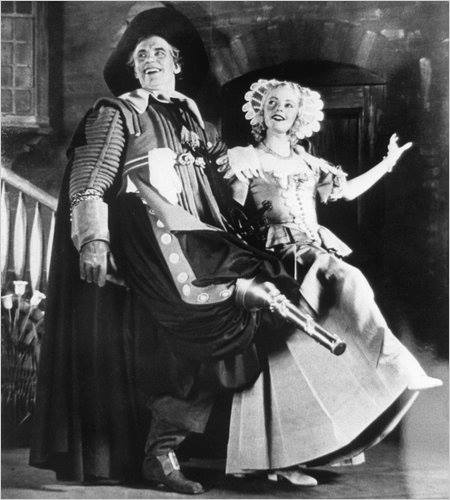
Walter Huston introduced “September Song,” in the Kurt Weill-Maxwell Anderson musical “Knickerbocker Holiday,” in 1938.
by
Another day in the Philadelphia-Princeton area projected to be in the mid-90s. So when does September start?
Walter Huston introduced “September Song,” in the Kurt Weill-Maxwell Anderson musical “Knickerbocker Holiday,” in 1938.

by
A metaphor that continues to resonate. For all you John Henrys…
Paul Robeson:
Aaron Copland:
Happy Labor Day.
by
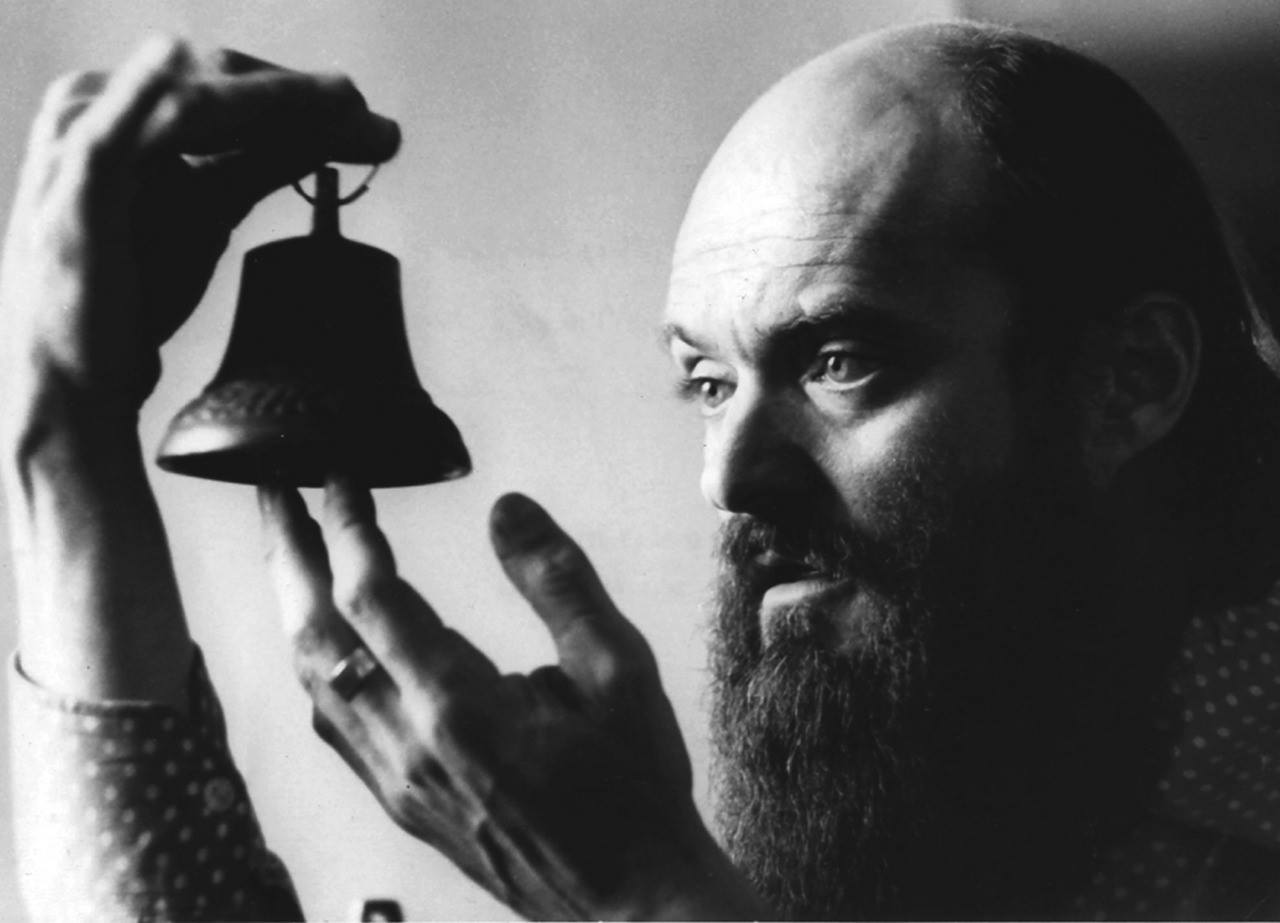
This Sunday night on “The Lost Chord,” we ring in the 80th birthday of Arvo Pärt.
Pärt was born on September 11, 1935.
His early works were touched by neo-classicism, but by the 1960s he began to experiment with serial techniques. This put him into conflict with the Soviet authorities who were displeased with an Estonian writing in a cacophonous, cosmopolitan style. His works were banned, which had the effect of driving him into creative silence.
Finding it impossible to compose, he immersed himself in the study of early church music. He emerged from this period with a new respect for plainsong, Gregorian chant, and polyphony, eschewing complexity, and in its place embracing serenity and beauty. It was a decision that certainly resonated with listeners, and Pärt went on to become one of the most performed of contemporary composers.
According to conductor Neeme Järvi, “The music of Arvo Pärt contains a message which appeals to the deepest spiritual needs of our time.”
Järvi is the dedicatee of Pärt’s Symphony No. 3, written in 1971. Though a transitional work, it shows that the composer was already very much on his way to a new simplicity in music.
In his rejection of radical ideas, Pärt became, in a sense, more radical than the radicals. His soul-searching, study, and artistic silence led to the creation of a steady stream of works for which he is probably best known: “Fratres” in 1976; “Cantus in Memoriam Benjamin Britten,” “Tabula Rasa” and “Summa” in 1977, and “Spiegel Im Spiegel” in 1978.
What makes Pärt’s works so fascinating is the tension between that apparent simplicity, the often intricate nature of his works’ underlying organization, and rests that speak as eloquently as any of the actual notes. These have the remarkable effect of manipulating one’s perception of time and drawing the listener inward.
At the core of Pärt’s mature style is a technique he calls “tintinnabuli” (from the Latin “tintinnabulum,” meaning “bell”), where voices – instrumental or otherwise – arpeggiate the tonic triad, in a bell-like manner, while other voices weave diatonic melody through the midst of it.
Pärt described it thus: “Tintinnabulation is an area I sometimes wander into when I am searching for answers – in my life, my music, my work. In my dark hours, I have the certain feeling that everything outside this one thing has no meaning. The complex and many-faceted only confuses me, and I must search for unity. What is it, this one thing, and how do I find my way to it? Traces of this perfect thing appear in many guises – and everything that is unimportant falls away. Tintinnabulation is like this. . . . The three notes of a triad are like bells.”
The work that definitively signaled the arrival of Pärt’s mature style – the acorn from which sprang “tintinnabuli” – was a modest piano piece, titled “Für Alina,” from 1976. The piece is dedicated to the 18 year-old daughter of a friend, who had gone to study in London. A brief but introspective work, silence plays an important role, and, yes, the individual notes are reminiscent of bells.
Of course, the larger part of Pärt’s output involves actual human voices, the texts usually on sacred themes. A good example is “Litany,” from 1994. Set to prayers by St. John Chrysostom, one for each hour of the day or night, the saint’s asceticism seemingly imbues the work.
I hope you’ll join me for “Wholly Pärt” – Arvo Pärt’s tintinnabular journey – tonight at 10 ET, with a repeat Wednesday evening at 6; or that you’ll listen to it later as a webcast at wwfm.org.
by
It’s ironic that a man named Cage would be all about freedom.
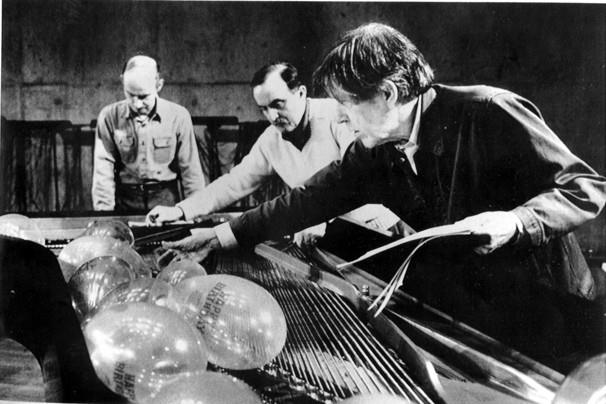
A pioneer of aleotory or chance-controlled music, electroacoustic music, nonstandard use of musical instruments (such as the prepared piano), making music with found objects, and finding the music in everyday sounds, John Cage was a giant of 20th century music.
It’s possible to not know a single work he ever “wrote,” or at any rate conceived, and still be exposed to his influence constantly. Cage taught us new ways to think about sound and the nature of music, literally opening up new worlds for exploration. His genius lay in recognizing what had always been invisible before our eyes and silent to our ears.
To honor him on his birthday, I might insert objects between the caps lock and shift key of my laptop, or roll dice to determine which letters or combinations of letters to hit, or allow my cat to walk across the keyboard or spill a cup of coffee across the keys.
Or I could write nothing at all and allow the peripheral impressions you receive from your own environment determine how you experience my blank post.
Happy birthday, John Cage (1912-1992). There are plenty who would scoff at the Emperor’s New Clothes, but you were one hell of a tailor.
“I can’t understand why people are frightened of new ideas. I’m frightened of the old ones.” – John Cage
“Discovery consists of seeing what everybody else has seen and thinking what nobody has thought.” – Albert Szent-Györgyi
Cage performs “Water Walk” on national television:
https://www.youtube.com/watch?v=Yybn6iKmYdQ
Cage for people who don’t like Cage:
PHOTO: What’s a birthday without balloons?

by
It’s nice to be able to look forward to a three-day weekend, when nobody expects you to get your butt in gear. Unless you’re Charlie Chaplin.
This week on “Picture Perfect,” we’ll have music from films about working class heroes, for Labor Day.
“The Molly Maguires” (1970), set in and around the anthracite mines of Pennsylvania, details the unfair labor practices imposed on immigrant workers there, which led to violent strikes and acts of sabotage. Sean Connery is the ringleader, and Richard Harris the Pinkerton detective brought on to infiltrate the gang.
The film was directed by Martin Ritt, a number of whose projects deal with labor, intimidation, and corruption, and his own experiences living through the era of the Hollywood blacklist. Among these: “Edge of the City,” “The Front,” and “Norma Rae.”
The music is by Henry Mancini, a far cry from his work on “The Pink Panther,” “Peter Gunn,” and “Breakfast at Tiffany’s,” with a decidedly Celtic lilt.
Charlie Chaplin was a brilliant comedian, of course, but his perfectionism could lead to uncomfortably close supervision at times on every aspect of his films. The young David Raksin found this out the hard way, when he accepted the job of assisting Chaplin in the writing of the score to “Modern Times” (1936).
Chaplin, a violinist and cellist himself, would whistle tunes and then stand over Raksin’s shoulder as he figured out how to make them fit the action. Alfred Newman, a much more seasoned hand, stormed out of the recording sessions. Raksin was actually fired once, after only a week and a half, though quickly rehired. Despite the creative friction, the two men became friends, and Raksin recollected his work on “Modern Times” as some of the happiest days of his life.
The film begins with an iconic scene in a factory, with Chaplin working an assembly line, at an increasingly hectic pace, and then being put through the gears of the machinery. He suffers a breakdown, goes berserk, and throws the entire mechanized dystopia into chaos.
At the time Aaron Copland wrote the music for “Of Mice and Men” (1939), John Steinbeck’s tragic tale of two migrant ranch workers, he was at the height of his populist period. He had just written “El Salon Mexico” and “Billy the Kid,” and most of his best-loved music – “Fanfare for the Common Man,” “A Lincoln Portrait,” “Rodeo” and “Appalachian Spring” – would be composed within the next few years.
Copland would only write music for five films in all. That for one of them, “The Heiress,” was honored with an Academy Award. So a complete recording of this, his first film score, would seem to be an important venture. Unfortunately, due to copyright entanglements, it was made available for only a very brief time, and that as a download. Catch it while you can, because it’s as scarce as hair on a mole rat.
Rarer still, until last year, were the original recording sessions for “On the Waterfront” (1954). Long believed lost, the acetate discs were rediscovered during the restoration process in preparation for the film’s release on Blu-ray. Recognizing the importance of the find, the enterprising Intrada label issued the music on compact disc.
Leonard Bernstein’s concert suite is fairly well-known, but the suite doesn’t tell the whole story. The Intrada release features moving music written for the famous cab scene, when Brando as Terry Malloy pours out his heart to his brother (“I coulda been a contender”), and the dead pigeon scene. On the film’s soundtrack, Morris Stoloff conducts the Columbia Pictures Studio Orchestra.
“On the Waterfront” would be Bernstein’s only original film score (as distinguished from film adaptations made by other hands of his musical theater works). He found the experience somewhat dispiriting, in that his music was edited and dialed down to suit the overall needs of the film. What remains is a powerful statement, and one of the great film scores.
I hope you’ll join me for music from films featuring working class heroes for Labor Day this week. Listen Friday evening at 6 ET, Saturday morning at 6, or later, at your leisure, as a webcast, at wwfm.org
Aaron Copland (93) Beethoven (95) Composer (114) Film Music (144) Film Score (143) Film Scores (255) Halloween (94) John Williams (195) KWAX (229) Leonard Bernstein (104) Marlboro Music Festival (125) Movie Music (159) Mozart (91) Opera (212) Philadelphia Orchestra (89) Picture Perfect (174) Princeton Symphony Orchestra (109) Radio (88) Ross Amico (244) Roy's Tie-Dye Sci-Fi Corner (290) The Classical Network (101) The Lost Chord (269) Vaughan Williams (105) WPRB (397) WWFM (881)
3 responses