• Honegger’s Summer Pastoral Alps Serenity

    Honegger’s Summer Pastoral Alps Serenity

    by 

    in
    4 responses

    Here’s a late summer treat courtesy of Arthur Honegger – his “Pastorale d’été” (“Summer Pastoral”), a musical souvenir of a morning in the Swiss Alps. The work is one of Honegger’s most attractive pieces, alternately languorous and lively in its serene, eight minute span, with plenty of sunshine, gentle breezes, and bird song. Note the allusions to Beethoven’s “Pastoral Symphony.”

    I hope you’ll join me tonight for more Honegger on “The Lost Chord,” when we listen to a very different work – his ballet “Sémiramis” – as part of a salute to the dancer Ida Rubinstein. (You can read more about it in yesterday’s post.) That’s “Ida Danced All Night.” Enjoy it at 10 ET, with a rebroadcast Wednesday evening at 6; or listen to it later as a webcast at wwfm.org.

    PHOTO: Idyllic Alps


  • Ida Rubinstein: Scandalous Muse & Lost Masterpieces

    Ida Rubinstein: Scandalous Muse & Lost Masterpieces

    by 

    in
    2 responses

    The actor and dancer Ida Rubinstein specialized in strong, often sultry heroines. A remarkable figure, this sugar heiress from a family of Ukrainian Orthodox Jews essentially willed herself onto the Parisian stage, where her acting ability and natural magnetism more than compensated for her limited ability as a dancer.

    She was welcomed into the Ballets Russes in 1909, where she assumed the roles of Cleopatra and Scheherazade. Later, for her own company, she introduced Ravel’s “Bolero” and Stravinsky’s “Le Baiser de la fée” (“The Fairy’s Kiss”).

    She gained notoriety for her often racy sensuality, stripping naked in the “Dance of the Seven Veils” in a production of Oscar Wilde’s “Salome” in 1908. As a woman and a Jew, she scandalized for assuming the title role in Gabriele d’Annunzio and Claude Debussy’s “The Martyrdom of Saint Sebastian” in 1911.

    This Sunday night on “The Lost Chord,” we salute Rubinstein with music that supported two of her lesser-known characterizations.

    In 1924, she appropriated the symphonic variations “Istar,” by Vincent d’Indy. Originally composed in 1896, the subject was a natural fit for the Rubinstein image, with the Assyrian goddess of love and war descending into the underworld to rescue her lover. Along the way, she passes through seven doors. At each door, she removes a piece of jewelry or an article of clothing, until, as she passes through the last, she stands unadorned. So does the music arrive finally at a complete statement of the theme, turning the usual structure of theme and variations on its head to suit the narrative.

    We’ll also hear “Sémiramis,” from 1934. This time Rubinstein is an Assyrian queen with insatiable carnal appetites. The music was by Arthur Honegger, and the instrumentation is quite striking: female narrator, vocal soloists, five-part mixed chorus, with orchestra including double bass clarinet, saxophone, two harps, two pianos, celesta, and two ondes Martenot – electronic keyboard instruments sounding very much like a couple of theremins.

    This was the fifth commission the composer was to receive from Rubinstein. The sixth and last brought forth his magnum opus, “Jeanne d’Arc au Bûcher” (“Joan of Arc at the Stake”).

    “Sémiramis” was not a success, and the work remained unpublished during Honegger’s lifetime. In particular, a 15 minute monologue toward the climax, written by Paul Valéry, took all the air out of the room. This spoken interlude has been omitted from the recording we’ll hear of the piece’s first modern performance in 1992.

    I hope you’ll join me as we celebrate Ida Rubinstein – “Ida Danced All Night” – this Sunday night at 10 ET, with a repeat Wednesday evening at 6; or that you’ll listen to it later as a webcast at wwfm.org.

    PHOTO: Diaphanous dancer Ida Rubinstein as Semiramis


  • Villa-Lobos in Hollywood’s “Green Mansions”

    Villa-Lobos in Hollywood’s “Green Mansions”

    by 

    in
    6 responses

    When Heitor Villa-Lobos was contracted by M-G-M to write music for a big screen adaptation of W.H. Hudson’s novel “Green Mansions” (1959), expectations ran high on both sides. The Brazilian master began immediately, diving into the project with characteristic gusto. After all, he had been writing music inspired by the rain forest for his entire career.

    Unfortunately, he had very little affinity for the practicality of the filmmaking process, turning in musical impressions of scenes from the book. The studio was befuddled. Since Villa-Lobos was unable to adapt to the customary way of doing things, he was replaced by MGM house composer Branislau Kaper, who used the Villa-Lobos material as a springboard for his own dramatic conception. The result is part Villa-Lobos, part Kaper, and all MGM gloss.

    Villa-Lobos was a little embittered by his Hollywood experience. He promptly assembled a multi-movement symphonic poem, “Forest of the Amazon” (1958), some 75 minutes in length, which employed his rejected sketches. He made a recording of 45 minutes of the music in 1959, for which the soprano Bidu Sayao came out of retirement.

    This week on “Picture Perfect,” we’ll have selections from both versions of “Green Mansions,” as well as from the Mayan adventure “Kings of the Sun” (1963), composed by Elmer Bernstein, and “The Night of the Mayas” (1939), by Mexican composer Silvestre Revueltas.

    I hope you’ll join me for cinematic evocations of the indigenous peoples of Latin America, tomorrow evening at 6 ET, with a repeat Saturday morning at 6; or that you’ll listen to it later as a webcast at wwfm.org.

    PHOTO: The project that left Villa-Lobos feeling green around the gills


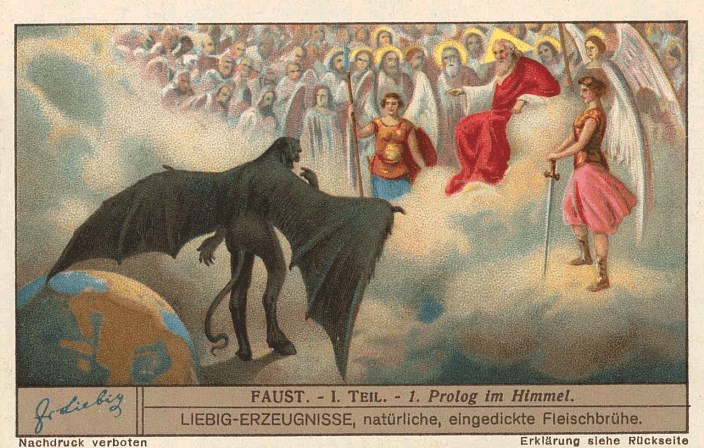
  • WPRB Celebrates Goethe with Faust & Mefistofele

    WPRB Celebrates Goethe with Faust & Mefistofele

    by 

    in
    2 responses

    Right now, we’re enjoying music by the Polish violin virtuoso Henryk Wieniawski on themes from Gounod’s “Faust.”

    Coming up in the next hour, we’ll have highlights from Arrigo Boito’s opera “Mefistofele.” Perhaps better known as the outstanding librettist for Verdi’s “Otello” and “Falstaff,” Boito could be quite the composer himself.

    We’re celebrating Goethe until 11:00 this morning on WPRB 103.3 FM and at wprb.com.


  • Schumann’s Faust on WPRB Now

    Schumann’s Faust on WPRB Now

    by 

    in
    4 responses

    Have you tuned in since 7:00 and thought, “What the hell is he playing?” It’s Robert Schumann’s rarely heard quasi-oratorio “Scenes from Goethe’s ‘Faust.’” We’re celebrating Goethe until 11 ET, on WPRB 103.3 FM or at wprb.com.

    I hope you’ll stick around. Coming up in the 9:00 hour, it’s “The Sorcerer’s Apprentice” by Paul Dukas, with the Philadelphia Orchestra conducted by Leopold Stokowski. Don’t sue me, Disney!


Tag Cloud

Aaron Copland (93) Beethoven (95) Composer (114) Film Music (144) Film Score (143) Film Scores (255) Halloween (94) John Williams (195) KWAX (229) Leonard Bernstein (104) Marlboro Music Festival (125) Movie Music (159) Mozart (91) Opera (212) Philadelphia Orchestra (89) Picture Perfect (174) Princeton Symphony Orchestra (109) Radio (88) Ross Amico (244) Roy's Tie-Dye Sci-Fi Corner (290) The Classical Network (101) The Lost Chord (269) Vaughan Williams (105) WPRB (397) WWFM (881)

DON’T MISS A BEAT

Receive a weekly digest every Sunday at noon by signing up here


RECENT POSTS