This week on “Picture Perfect,” we’ll have an hour of English documentary scores.
In England, unlike in the United States, there is no delineation between “film composer” and “concert composer.” What is often regarded here as “hack work,” there is seen as just another aspect of what it means to be a working artist. There is no disgrace in a composer earning a living, and some of the nation’s greatest musicians – including those in the employ of the Royal Family – have contributed finely-crafted works to its body of cinema.
We’ll hear music by Ralph Vaughan Williams, from “The People’s Land,” Benjamin Britten, from “The King’s Stamp,” William Alwyn, from “The Green Girdle,” and Sir Arthur Bliss, from “The Royal Palaces of Britain.” All four films are patriotic utterances on distinctly English themes.
You may not have seen any of the movies, but the music is beautiful. I hope you’ll join me for selections from English documentaries, this Friday evening at 6 ET, with a repeat Saturday morning at 6; or that you’ll listen to it later, at your convenience, as a webcast, at http://www.wwfm.org.
The complete documentary short, “The Green Girdle,” is posted on YouTube:
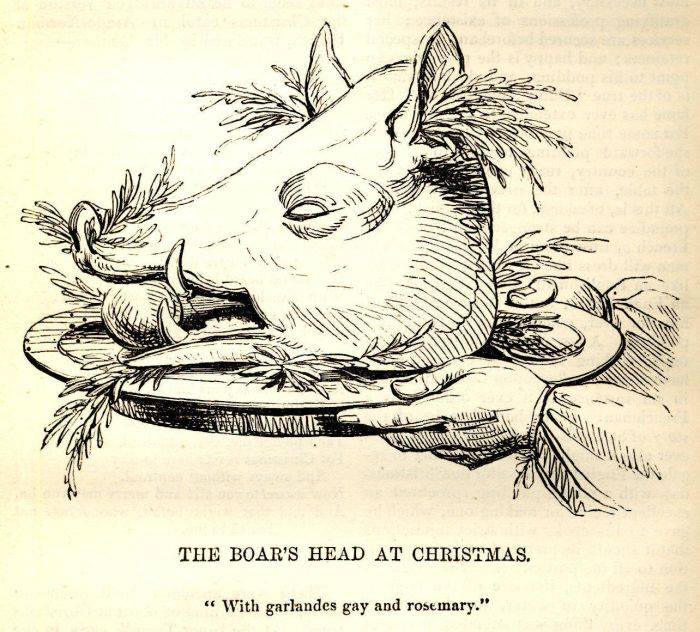
What’s my favorite Christmas carol? There are several, certainly, but near the top of the list must be “The Boar’s Head Carol.” Why? Because what’s more festive than a steaming head of boar? I also love the fact that half of the thing is in Latin, so I have no idea what I am singing about.
The carol dates from the 15th century and grew out of the ancient custom of sacrificing a boar for the Yuletide feast. Like so many of the arcane Christmas traditions, it can be traced to the Northern folk, who sacrificed a boar to Freyr, the god of virility and prosperity, to bless the New Year.
With the advent of Christianity, St. Stephen stepped up as the deliverer of boar to the Yuletide banquet, and Christmas ham has been with us ever since. The presentation of the boar’s head has become symbolic of the Christ Child’s triumph over sin.
The carol also has academic associations, not only because of the refrains (which are sung in Latin), but because of an enduring ceremony at Oxford, among other institutions of higher learning.
Tradition holds that an Oxford student was out strolling in the forest one day, immersed in Aristotle, when he was set upon by a wild boar. Thinking quickly, the student thrust the volume into the boar’s mouth and cried, “Græcum est!” (“With compliments of the Greeks!”), there at the boar was choked to death.
A celebratory feast held at Queen’s College involves three chefs bearing the boar’s head into the hall, with a solo singer accompanied by torch bearers and choir. During each of the verses the procession halts, then proceeds again with the chorus. At the high table, the Provost distributes the dish’s herbs to the choir and bestows an orange, which is held in the boar’s jaw, to the solo singer.
The carol goes something like this:
The boar’s head in hand bear I,
Bedeck’d with bays and rosemary.
And I pray you, my masters, be merry
Quot estis in convivio (Translation: As many as are in the feast)
CHORUS
Caput apri defero (Translation: The boar’s head I offer)
Reddens laudes Domino (Translation: Giving praises to the Lord)
The boar’s head, as I understand,
Is the rarest dish in all this land,
Which thus bedeck’d with a gay garland
Let us servire cantico. (Translation: Let us serve with a song)
CHORUS
Our steward hath provided this
In honor of the King of Bliss;
Which on this day to be servèd is
In Reginesi atrio. (Translation: In the hall of Queen’s [College, Oxford])
CHORUS
Here it is, in an early version known as “The Borys Hede”:
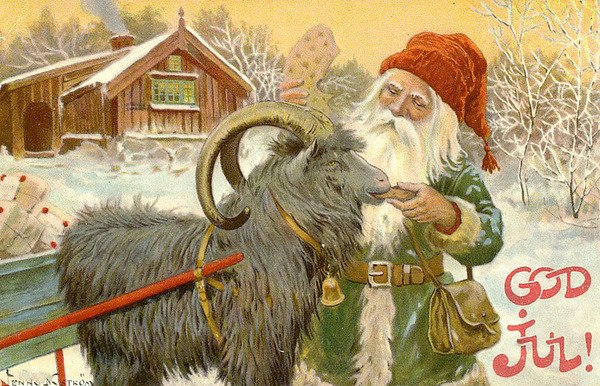
December 3. Have you started constructing your Yule Goat yet?
One of Northern Europe’s wackier Christmas traditions (no doubt with pagan roots), the Yule Goat may have derived from the worship of Thor. The God of Thunder’s chariot was drawn by two goats. The Christmas version is led about by Saint Nicholas, possibly as a symbol of the subjugation of evil.
Whatever the goat’s function, it goes way back. For hundreds of years, rowdy young men in costumes would go door to door enacting plays and demanding gifts. One of these, naturally, was the ornery Yule Goat. Scandinavians sometimes refer to the practice of wassailing as “going Yule Goat.”
In the 19th century, the Goat’s role was transformed into a giver of gifts. Though the Goat has since been replaced by a humanoid Father Christmas, in Finland he is still referred to by the name Joulupukki (you guessed it, Yule Goat).
Nowadays, the goat is mostly seen in its incarnation as a miniature tree ornament, made of straw and bound by red ribbon. A notable exception is the Gävle Goat, a 40-foot version of the traditional Swedish Yule Goat. The Gävle Goat is constructed over a period of two days in time for Advent.
Then begins an unsanctioned game of cat-and-mouse, with the authorities attempting to guard the Goat, while everyone else attempts to light it off. Yes, you read that correctly. If the Goat is burnt to the ground before December 13 (the feast day of St. Lucy), it is rebuilt.
For more information and a complete history of the Goat’s destruction, go here:
Today is the 100th birthday of Irving Fine. Who? Well, if you’ve sung in a chorus for any length of time, you may already know. Among Fine’s best-known works are arrangements of Copland’s “Old American Songs” and settings of texts from “Alice in Wonderland.”
He also wrote a woodwind quintet that gets recorded from time to time and certainly deserves more exposure. His “Serious Song,” for string orchestra, is another among his most frequently recorded works.
He was an American composer of the “Stravinsky school,” one of the so-called “Boston Six” (which also included Arthur Berger, Copland, Leonard Bernstein, Lukas Foss and Harold Shapero).
In some of his later works he experimented with serial techniques, though he never wholly abandoned tonality. On the other hand, in his early pieces he never shied away from dissonance. His was a tart brand of graceful neo-classicism that occasionally bubbled over into romanticism, as in the “Serious Song” and his “Notturno for Strings and Harp.” No matter what language he embraced, he was always an elegant and attractive composer.
Fine died of heart disease in 1962. He was only 47 years-old.
This Sunday night on “The Lost Chord,” we’ll offer a slightly belated salute to this unjustly neglected figure. The program, titled “Everything’s Fine,” will air at 10 ET, with a repeat next Wednesday at 6. You can listen to it at http://www.wwfm.org. I’ll post more about it over the weekend.
In the meantime, here’s a listing of Fine celebrations around the country:
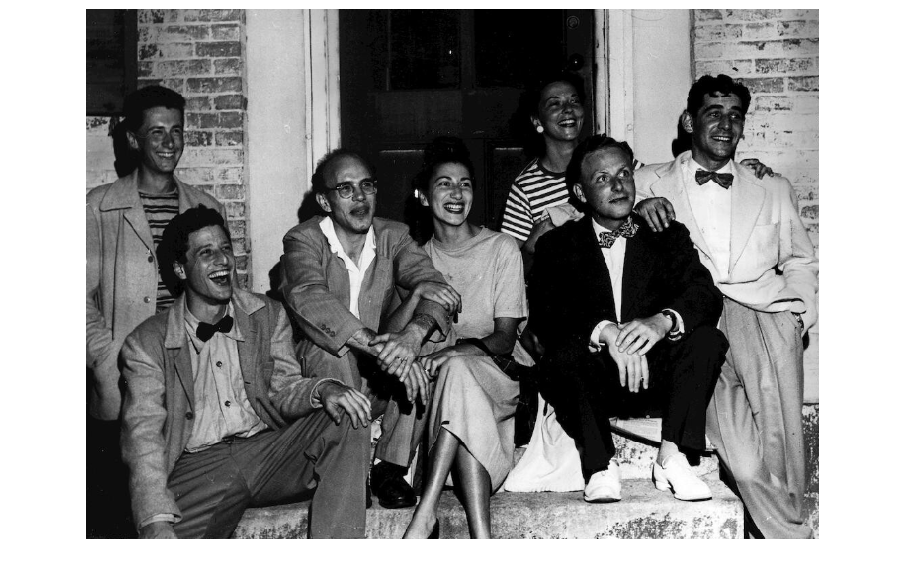
PHOTO: Irving Fine (second from right) with (left to right) Claudio Spies, Lukas Foss, Harold Shapero, Esther Geller, Verna Fine and Leonard Bernstein, Tanglewood, 1946
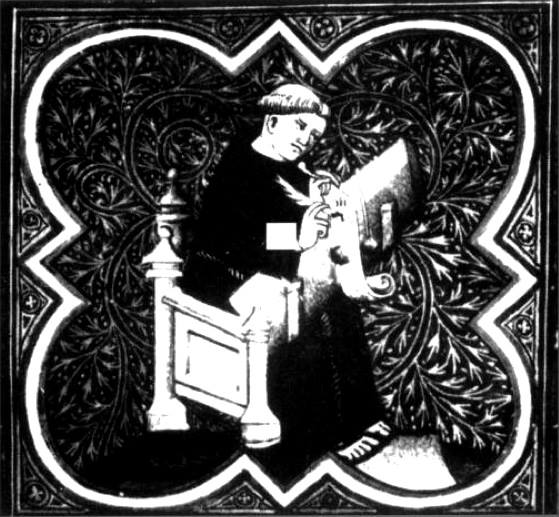
Here’s “Da entstünde ein Engel” (“There Appeared an Angel”) by the unpredictable Robert Moran. You may recall that I featured Bob’s most recent recording, which highlights his arrangement of the medieval mystery play, “Game of the Antichrist,” a few weeks back on “The Lost Chord.”
This one is taken from a text by Meister Eckhart. It’s performed by Munich’s Chrismos Ensemble.

3 responses