Harry T. Burleigh is one of the great unsung figures in American music – which is ironic, since it was his singing that changed the course of history.
Burleigh was a student at the National Conservatory of Music in New York, where he studied with, among others, Rubin Goldmark, the conservative pedagogue who later gave lessons to Copland and Gershwin. It just so happens that his attendance there coincided with the tenure of Antonin Dvořák as the conservatory’s director. Dvořák overheard young Burleigh singing African American spirituals and was transfixed. Burleigh frequently sang spirituals for Dvořák and worked for him as a copyist beginning in 1893.
Spirituals, of course, became an important part of the “New World” Symphony’s DNA. Since Dvořák’s masterwork was intended, in part, as instructional, leading American composers by example to a distinctively national sound, the significance of Burleigh’s influence becomes inescapable.
Burleigh also served as a double-bassist and timpanist in the school’s orchestra, which Dvořák conducted. He was born in Stamford, CT, on this date in 1866.
I had a deadline this morning, and car trouble, and a funeral, so I’m a little late posting today, but I hope the anticipation makes it all the more special.
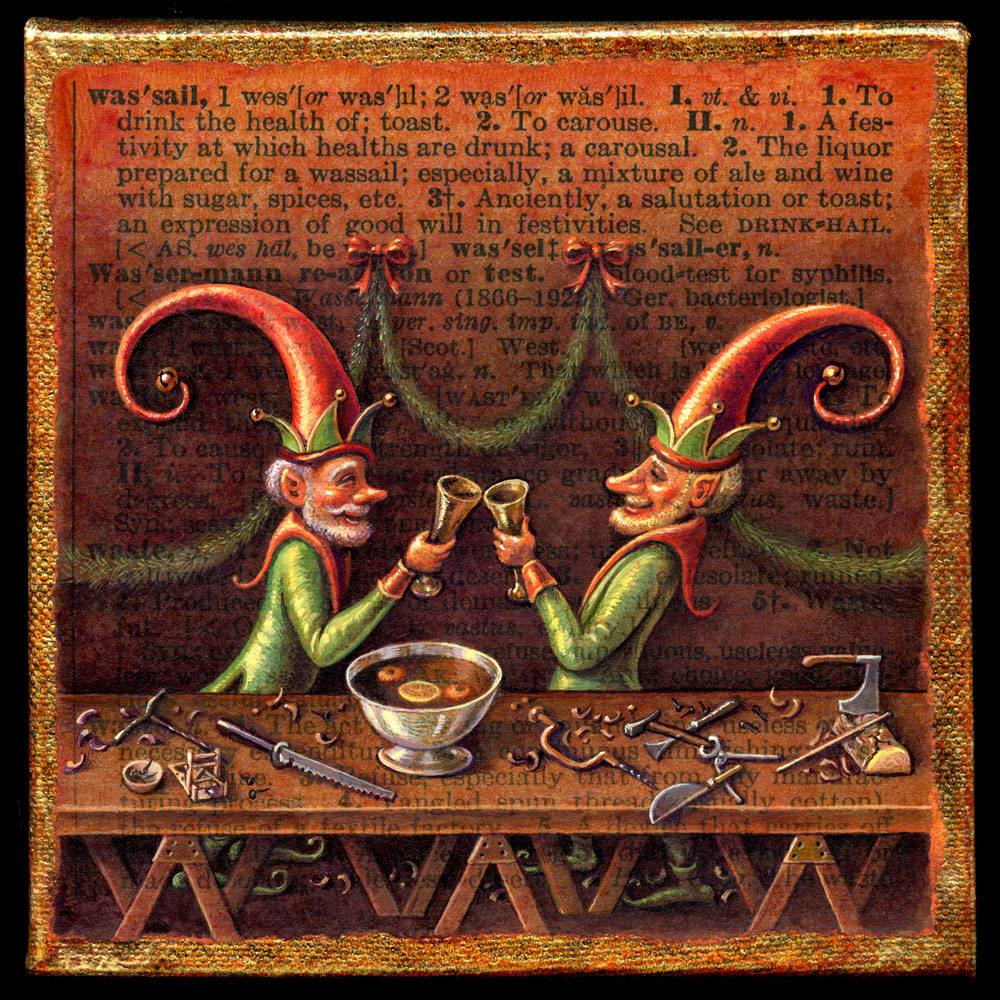
For me, the Christmas carol that best heralds the season is Ralph Vaughan Williams’ setting of this Wassail Song, native (like the composer) to Gloucestershire. Interesting that I would always associate it with the advent of Christmas, since apparently wassailing is tied in some traditions to Twelfth Night celebrations, which actually conclude the celebration of Christmas on January 6.
I found this video of Father Christmas himself directing a Cleveland ensemble in the work. They can’t spell “choir,” but they sure can sing.
Here’s a wassail recipe, if you’re interested. You also get a bit of history – including the origins of the custom we call toasting.
Since it appears I am no longer doing live air shifts at WWFM, other than the odd pledge drive – and therefore have no outlet for my love of Christmas music, beyond the limited scope of my specialty shows – I thought I would make the most of Facebook and, this being the first day of Advent, initiate kind of a musical Advent calendar.
Every day through Christmas, I will try to offer something seasonal, if not in the body of my regular post, then as a special “Advent calendar” supplement.
I’ll kick things off with music of Sergei Lyapunov. After all, today is his birthday (see my main post). Here is his “Fêtes de Noël” (“Christmas Festival”), Op.41:
It falls into four tableaux:
No. 1 “Nuit de Noël” (“Christmas Night”)
No. 2 “Cortège de mages” (“Procession of the Magi”)
No. 3 “Chanteurs de Noël” (“Christmas Carolers”)
No. 4 “Chant de Noël” (“Christmas Carol”)
And since my guest tonight on “The Lost Chord” is Peter Schickele, here is P.D.Q. Bach’s “Consort of Christmas Carols.”
No. 1 “Throw the Yule Log On, Uncle John”
No. 2 “O Little Town of Hackensack”
No. 3 “Good King Kong Looked Out”
The “Consort of Christmas Carols” will be among the works performed on Dec. 5, when Schickele appears at The College of New Jersey in Ewing. “The Lost Chord” can be heard at 10 p.m. ET, with a repeat Wednesday evening at 6, at http://www.wwfm.org.
As a longtime listener to “The Lost Chord,” perhaps you recognize this music:
The composer is Sergei Lyapunov. The first of Lyapunov’s “Transcendental Etudes,” the “Berceuse,” has served as the theme music for “The Lost Chord,” since the program’s debut in January of 2003. The pianist, as in the clip, is Louis Kenter, though I use a later recording, the one that was once available on Turnabout. Kenter recorded the work on at least two previous occasions.
Lyapunov was born on this date in 1859. He enrolled in the Moscow Conservatory at the personal invitation of its director, Nikolai Rubinstein. There he studied with Karl Klindworth (a pupil of Liszt) and Sergei Taneyev (a pupil of Tchaikovsky).
Since Lyapunov gravitated more toward the Russian Nationalist movement than to the more cosmopolitan approach of Tchaikovsky and his followers, he made it his mission to set out in search of Mily Balakirev, who had been the guiding force behind the group known as “The Mighty Handful,” or “The Russian Five” (which, with Balakirev, consisted of Rimsky-Korsakov, Mussorgsky, Borodin, and César Cui).
Lyapunov became the most important of Balakirev’s latter-day disciples, with master overseeing pupil as diligently as he had the composers of the 1860s. Together, Lyapunov and Balakirev went on folksong collecting expeditions, amassing some 300 songs.
Lyapunov succeeded Rimsky-Korsakov as the assistant director of the Imperial Chapel. He became head of the Free School and a professor of music at the St. Petersburg Conservatory. After the Revolution, he emigrated to Paris in 1923, where he directed a school for Russian émigrés. He died of a heart attack the following year, in 1924.
Lyapunov enjoyed a successful career as a touring pianist. The “Transcendental Etudes” are central to his output for the keyboard. He modeled the collection of 24 major and minor key movements on a plan devised by Liszt (though Liszt never completed his). He concluded the cycle with an elegy in memory of Liszt, and in fact dedicated the whole to the legendary keyboard master.
Each etude bears a descriptive title:
“Berceuse” (”Lullaby”) in F♯ Major;
“Ronde des Fantômes” (“Ghosts’ dance”) in D♯ Minor;
“Carillon” in B Major; “Térek” (“The River Terek”) in G♯ Minor;
“Nuit d’été” (“Summer Night”) in E Major;
Tempête (“Tempest”) in C♯ Minor;
“Idylle” in A Major;
“Chant épique” (“Epic Song”) in F♯ Minor;
“Harpes éoliennes”(“Aeolian Harps”) in D Major;
“Lesghinka” in B Minor;
“Ronde des sylphs” (“Dance of the Sylphs”) in G Major;
and “Elégie en mémoire de François Liszt” (“Elegy in Memory of Liszt”) in E Minor.
Happy Birthday, Sergei Lyapunov. Thanks for the great theme music!
As a bonus, here’s his beautiful “Rhapsody on Ukrainian Themes:
PHOTOS: Sergei Lyapunov, pioneer of the chia beard
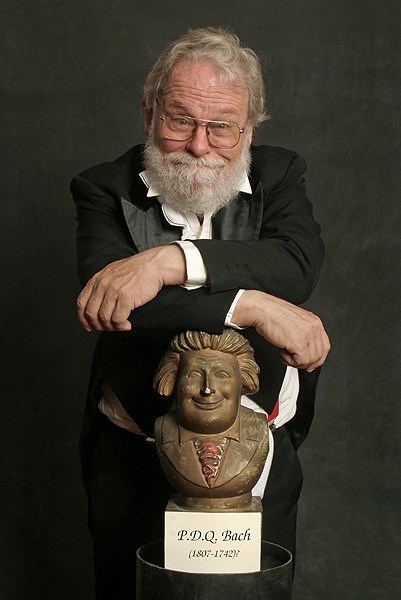
As detailed in my article in yesterday’s Trenton Times (http://www.nj.com/times-entertainment/index.ssf/2014/11/classical_music_choral_shenani.html), composer and humorist Peter Schickele will be in Ewing on Dec. 5 for a concert at The College of New Jersey. The concert, titled “Choral Shenanigans and Other Musical Hijinks,” will include a number of works published under his own name and some attributed to his famous pseudonym, P.D.Q. Bach.
Schickele’s “discovery” of this oddest of Johann Sebastian Bach’s twenty odd children has provided him with a comic persona (or perhaps two, since his “Professor Peter Schickele” is an equally amusing, unreliable source) through which he has entertained for decades with a mix of freewheeling parody, excruciating puns and outright, pie-in-the-face slapstick.
It should be stressed that Friday’s event is not a standard P.D.Q. Bach concert. As flabbergasting as it may seem, Schickele is now 79. So there will be no swinging to the stage on a rope, as he once did at Carnegie Hall. Instead, he will oversee the proceedings like something of a dignified lion – though I’m guessing a wry lion – introducing his pieces through brief and informal conversations with Wayne Heisler, TCNJ Associate Professor of Historical and Cultural Studies in Music.
The event will feature performances by the TCNJ Chorale, College Choir, and Wind Ensemble.
Schickele will be my guest this Sunday night on “The Lost Chord.” He’ll talk a bit about his career, the evolution of P.D.Q. Bach, and his upcoming appearance at TCNJ.
I’ve always admired Schickele’s non-P.D.Q. concert music. We’ll get to sample some of it, with of course a few comedy classics thrown into the mix.
Join me for “Schickele, P.D.Q.,” this Sunday night at 10 ET, with a repeat Wednesday evening at 6; or listen to it later as a webcast at http://www.wwfm.org.



2 responses