I guess the Philadelphia critics weren’t the only ones with their claws out for Eschenbach.
-
Eschenbach Film Critic Controversy
by
-
Remembering André Watts Philadelphia’s Piano Icon

by
3 responses
I am very sorry to learn that André Watts has died. Watts was a familiar presence in Philadelphia for decades. Indeed, he was the soloist on the first Philadelphia Orchestra concert I ever saw, playing the Rachmaninoff Piano Concerto No. 2, at the Mann Center for the Performing Arts in Fairmount Park, on July 16, 1984, with Michael Tilson Thomas conducting.
An army brat born in Nuremberg, Germany, to a Hungarian mother (a pianist) and an African American father (a non-commissioned officer), Watts moved to Philadelphia with his family at the age of 8. Prior to that, he had studied violin in Europe. His mom gave him his first piano lessons.
Like most children, he disliked practicing. She captured his imagination by telling him about the young Franz Liszt and what he was able to achieve by applying himself and practicing faithfully.
Watts would continue to find inspiration in Liszt throughout his career. He was a great champion of the composer. In fact, it was as soloist in Liszt’s Piano Concerto No. 1 that he rocketed to fame after a performance with the New York Philharmonic conducted by Leonard Bernstein, televised as part of one the orchestra’s Young People’s Concerts, in January 1963. Watts was 16-years-old.
Later in the month, Glenn Gould fell ill, and Watts was invited back to play the Liszt concerto on an actual subscription concert. The performance generated such electricity that the hardboiled musicians of the Philharmonic joined the audience in a standing ovation. The performance was recorded and released on Columbia Masterworks, the thrill of the occasion preserved for posterity, as “The Exciting Debut of André Watts.”
Watts studied at the Philadelphia Musical Academy (now part of the University of the Arts), and then at the Peabody Institute in Baltimore under Leon Fleisher. In the meantime, his dance card was filling up fast. By 1969, his concerts were being booked three years in advance. He signed an exclusive recording contract with Columbia on his 21st birthday.
Alas, in more recent years, Watts suffered his share of health difficulties. In 2002, he underwent emergency surgery for a subdural hematoma. In 2004, a ruptured disc affected the use of his left hand. In 2019, he underwent surgery for further nerve damage.
An inveterate cigar smoker, he was diagnosed with (possibly unrelated?) prostate cancer in 2016. The cancer went into remission in 2017, but would return to claim him.
Despite his medical setbacks, Watts continued to perform. Personal illness did nothing to dampen his passion for playing in public, but the pandemic threw up some pretty steep barriers.
For certain, with half a century of performances and recordings behind him, and a National Medal of the Arts, among other honors, Watts had nothing more to prove. But he was determined to do what he loved for as long as he possibly could.
In an interview, he claimed that early on, what he really wanted to be was a writer. For Watts, communication with an audience – storytelling, if you will – was key.
He will be missed. R.I.P.
Introduced by Leonard Bernstein, then playing the stuffing out of Liszt
Visiting “Mr. Rogers’ Neighborhood”
Playing Mendelssohn with John Williams and the Boston Pops
Rachmaninoff in New York
Liszt’s etude after Paganini’s “La Campanella”
-
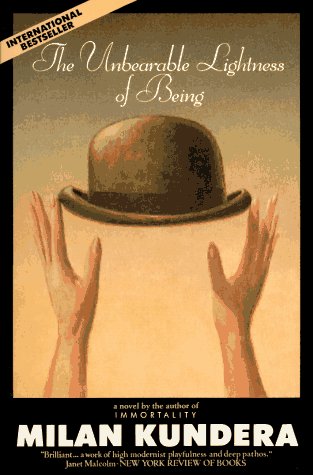
Milan Kundera Dies Author of *Unbearable Lightness*
by
4 responses
The Czech writer Milan Kundera has died. His father was concert pianist and musicologist Ludvik Kundera, a colleague of Leoš Janáček. Ludvik headed the Janáček Music Academy in Brno from 1948 to 1961.
Milan himself had considered a career in music, but instead gravitated toward literature. After he was busted down by the Communist Party for his subversive views, he supplemented his income as a jazz musician. He eventually fled Czechoslovakia in 1975 to make Paris his home.
There was plenty of Janáček on the soundtrack of Philip Kaufman’s film adaptation of Kundera’s most famous novel, “The Unbearable Lightness of Being,” which starred Daniel Day Lewis, Juliette Binoche, and Lena Olin. Kundera described his novels as polyphonic symphonies, and he likened “The Book of Laughter and Forgetting” to a set of Beethoven variations.
For a time, he taught film theory at Prague’s Academy of Performing Arts. Among his students was Miloš Forman, who would go on to direct the Academy Award winning adaptation of Peter Schaffer’s play, “Amadeus.”
“They [human lives] are composed like music,” Kundera observes in “The Unbearable Lightness of Being.” “Guided by his sense of beauty, an individual transforms a fortuitous occurrence (Beethoven’s music, death under a train) into a motif, which then assumes a permanent place in the composition of the individual’s life. Anna could have chosen another way to take her life. But the motif of death and the railway station, unforgettably bound to the birth of love, enticed her in her hour of despair with its dark beauty. Without realizing it, the individual composes his life according to the laws of beauty even in times of greatest distress.
“It is wrong, then, to chide the novel for being fascinated by mysterious coincidences (like the meeting of Anna, Vronsky, the railway station, and death or the meeting of Beethoven, Tomas, Tereza, and the cognac), but it is right to chide man for being blind to such coincidences in his daily life. For he thereby deprives his life of a dimension of beauty.”
At the time of his death, Kundera was 94-years-old.
Kundera’s obituary in the New York Times
https://www.nytimes.com/2023/07/12/world/europe/milan-kundera-dead.html
Trailer for “The Unbearable Lightness of Being”
The soundtrack
Once again, I neglected to observe Janáček’s birthday this year. (Janáček was born on July 3, 1854.) Here I celebrate in 2019:
-
Yul Brynner More Than The King
by
4 responses
It seems there’s nothing Yul Brynner could not do.
Trapeze acrobat. Bare-knuckle brawler. Radio commentator. Nude model. Honorary president of the International Romani Union.
As if his life weren’t fanciful enough, numerous legends were perpetuated about him by reporters, publicists, and even Brynner himself.
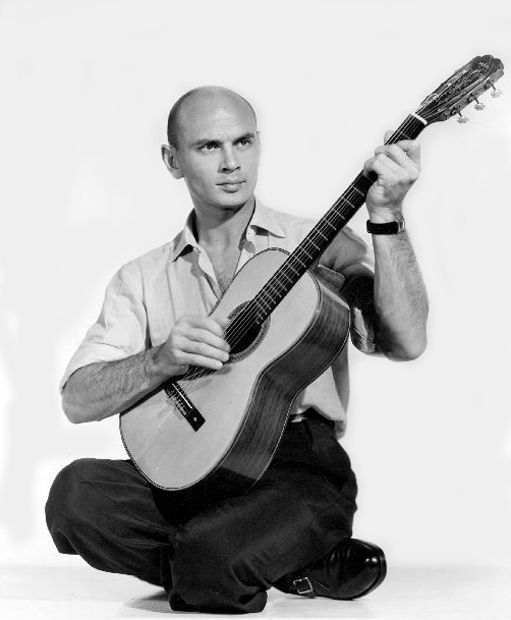
On his tenth birthday, his father gave him an acoustic guitar. In quintessential Yul Brynner fashion, that guitar became a challenge to be mastered. Not only did Yul study classical and contemporary music, the skills he acquired, exercising his curiosity, creativity, and imagination, left their lasting stamp on every aspect of his professional life.
Brynner continued to study music with his sister, Vera, a professional opera singer. Vera, who spelled her name “Bryner” (Yul added a second “n”), sang roles at New York City Opera, “Carmen” on NBC television, and the soprano lead in Gian Carlo Menotti’s “The Consul” on Broadway. “The Consul” earned Menotti the 1950 Pulitzer Prize for Music.
Beginning at 14, Yul played and sang Gypsy songs in Parisian nightclubs. He teamed with Aliosha Dimitrievitch, with whom, in 1967, he released an album, “The Gypsy and I” (Vanguard VSD 79265).
Of course, Brynner’s most celebrated role was the King of Siam in Rodger’s and Hammerstein’s “The King and I.” He was recognized for his magnetic performances of the part with two Tony Awards and an Oscar. In all, he played the King 4,625 times.
Et cetera, et cetera, et cetera!
Happy birthday, Yul Brynner!
Yul sings Gypsy songs
On “The Ed Sullivan Show”
Vera Bryner sings
Yul also spoke 11 languages. Evidently, he was fluent in French.
“Shall We Dance?”
-
Remembering Peter Nero Philly Pops Legend
by
3 responses
This Nero didn’t play as Philly burned.
Peter Nero, who conducted the Philly Pops for 34 years, is dead. At the orchestra’s founding in 1979, it was Nero’s intention to take on Arthur Fiedler and the Boston Pops. For decades, Boston had been ensconced as the very model of a modern major pops orchestra. With a touch of hubris, Nero stated at the time, “I’d like to beat the pants off them.” Granted, by then, Fiedler was tottering into the homestretch of a 50-year career as Boston’s music director. Nevertheless, the pants stayed on. Nero left the Philly Pops in 2013, when the orchestra could no longer afford his salary.
A multifaceted musician, Nero started out as a piano prodigy. He earned the respect of no less than Vladimir Horowitz, and Roy Charles would cite him as one of his favorite pianists, alongside Art Tatum.
It was hearing Tatum that changed the course of Nero’s life. He fell in love with jazz and determined not to be pigeonholed, instead embracing and often combining music from a variety of genres. His enthusiasms would carry him from piano competitions to smoky jazz clubs to posh concert halls to open-air band stands before audiences numbering in the thousands.
He performed “Rhapsody in Blue” with Paul Whiteman, who had introduced the piece with George Gershwin at the piano. Nero was celebrated as a premier interpreter of Gershwin’s music.
His first album for RCA, “Piano Forte” (1961), was a hit, earning him a Grammy for Best New Artist. The next year, he would garner another, for Best Performance by an Orchestra or Instrumentalist with Orchestra – Primarily Not Jazz or for Dancing (what a cumbersomely named category!), for “The Colorful Peter Nero.” He would be nominated ten more times.
In all, he released 67 albums. His instrumental version of Michel Legrand’s “Summer of ‘42” became a million best seller. He appeared on “The Ed Sullivan Show” 11 times, and made numerous appearances on “The Tonight Show” with Johnny Carson. He also worked with Frank Sinatra, Mel Tormé, Andy Williams, Dizzy Gillespie, Diane Schuur, Johnny Mathis, Roger Kellaway, Elton John, and his bête noire, Arthur Fiedler.
In the 1970s, Nero’s focus shifted to conducting and composing. He performed up to a hundred concerts a year, often at the piano, playing with one hand, while conducting the orchestra with the other.
He wrote a cantata after Anne Frank’s “The Diary of a Young Girl.” It’s said to have been the first musical treatment of the material, and the work embraced rock, symphonic, and traditional Jewish music. He conducted the piece in several cities, including with the Greater Trenton Symphony in 1973.
During his decades with the Philly Pops, Nero made his home in Media, PA. The orchestra’s repertoire was a mix of orchestral arrangements of popular jazz, swing, Broadway, and blues, with a smattering of light classical.
His departure from Philly was not an amicable one. Even then, in 2013, the Philly Pops was experiencing choppy waters. The orchestra filed for bankruptcy and asked Nero to take a salary cut. Nero declined.
The orchestra continues to struggle. The 2022-23 season was a particularly dramatic chapter in its turbulent history. But that’s for another post, one I don’t particularly feel like writing!
Intriguingly, following the death of Marvin Hamlisch in 2012, it was revealed that the latter was poised to take over the orchestra’s reins. David Charles Abell was named principal conductor and music director in 2020.
In the 1990s, Nero served concurrently as Pops Music Director of the Florida Philharmonic Orchestra. He also played with his jazz trio. Post-Philly, Nero returned to concertizing with his longtime bassist, Michael Barnett.
At the time of his death, he was 89-years-old. R.I.P.
Nero plays “Rhapsody in Blue” with Fielder and the Boston Pops
“Fiddler of the Roof” on “The Ed Sullivan Show”
“Tea for Two” (for three)
Million-selling “Summer of ’42”
“Rocky” at Independence Hall
“Rhapsody in Blue” in Philly
Tag Cloud
Aaron Copland (93) Beethoven (95) Composer (114) Film Music (144) Film Score (143) Film Scores (255) Halloween (94) John Williams (195) KWAX (229) Leonard Bernstein (104) Marlboro Music Festival (125) Movie Music (159) Mozart (91) Opera (213) Philadelphia Orchestra (89) Picture Perfect (174) Princeton Symphony Orchestra (109) Radio (88) Ross Amico (244) Roy's Tie-Dye Sci-Fi Corner (290) The Classical Network (101) The Lost Chord (269) Vaughan Williams (105) WPRB (397) WWFM (881)
3 responses