A venerable orchestra, celebrating 100 years this season, will strike a balance with some-things-old and something new, when the @[100046173663486:2048:New Jersey Symphony] returns to Princeton University’s Richardson Auditorium this Friday at 8 p.m.
Established classics by Wolfgang Amadeus Mozart and Anton Bruckner will flank a world premiere by Princeton composer Steven Mackey. Vocal soloists and the Princeton University Glee Club will join the orchestra, led by music director Xian Zhang.
The program will be repeated at the New Jersey Performing Arts Center (NJPAC) in Newark on Saturday at 8 p.m. and at the State Theatre New Brunswick on Sunday at 3:00.
Find out more about the concerts and a little bit of the orchestra’s colorful history in my article in this week’s @[100063792690234:2048:U.S. 1 Newspaper – PrincetonInfo], in area vending machines and local business, or online now.
Sir John Eliot Gardiner has a reputation for being a bit prickly, but when I had the privilege to interview him in 2014, he was nothing of the sort. On the contrary, he was nothing if not patient and gentlemanly. I found this Gardiner’s plot to be wholly devoid of cacti.
And he’s a man who knows a thing or two about agriculture. As of the time we spoke, he was still running an organic farm inherited from his great-uncle, the conductor and composer Balfour Gardiner.
Today, Sir John turns 80. For 59 years, his cultivation has been of a different sort, as director of the Monteverdi Choir, the ensemble he found in 1964.
Surely a high point of their collaboration was in 2000, when, for the 250th anniversary of the death of Johann Sebastian Bach, Gardiner and his choristers undertook an extensive Bach Cantata Pilgrimage, performing and recording most of the cantatas in 60 historic churches.
In 2017, he and his musicians toured widely with its Monteverdi 450 project. They performed all three of Monteverdi’s surviving operas, to mark the 450th anniversary of the composer’s birth.
In between, Gardiner and his Monteverdians came to Princeton for two concerts at Richardson Auditorum: of Bach’s cantata “Christ lag in Todesbanden” and his motet “Singet dem Herrn ein neues Lied” and Handel’s “Dixit Dominus,” in 2014; and Monteverdi’s “Orfeo,” in 2015. Both were among the most memorable of my concertgoing career.
The Princeton concerts were made possible through the munificence of the late philanthropist William H. Scheide. I wrote more about Gardiner’s connection to Princeton and Mr. Scheide, through a certain Bach portrait, in an article that appeared in the Trenton Times.
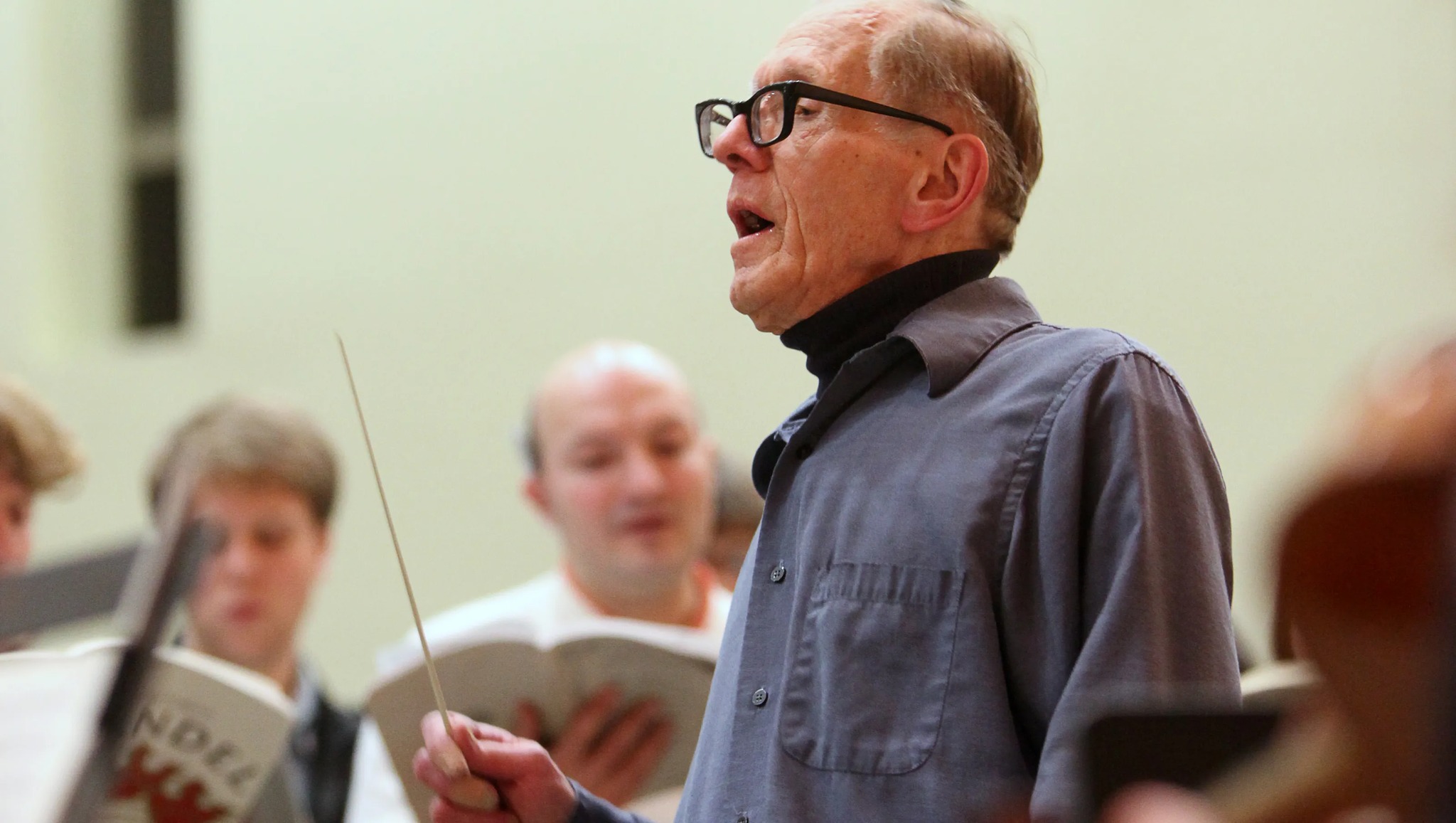
David Fetler, alleged to be America’s longest-serving music director of an orchestra, has died. Fetler directed the Rochester Chamber Orchestra for over 50 years, surpassing Arthur Fiedler’s record of 49 with the Boston Pops. (On the world stage, there have been longer.)
Fetler was born in Riga, Latvia, the tenth of a family of thirteen children. He came to the United States at the age of 12. He studied at Juilliard, Westminster Choir College in Princeton, and the Eastman School of Music in Rochester, NY, as well as with conductors Pierre Monteux and Leopold Stokowski.
His available recordings are few, but I recognized his named immediately from a lovely album of Howard Hanson’s music. Fetler conducted the premiere of Hanson’s ballet “Nymphs and Satyr” (1979). I’ve always been especially fond of the infectious scherzo, based on a melody the composer whistled to his Irish terrier, Molly, while feeding her biscuits. Hanson, best known for his Symphony No. 2, the “Romantic,” served as the Eastman School’s director for 40 years, beginning in 1924.
From the same album, here’s Fetler’s recording of Hanson’s Concerto for Organ, Harp and Strings (1926):
It was Hanson who invited Fetler to join the conducting faculty in Rochester. In that capacity, Fetler presented a wide variety of instrumental and choral music with the Eastman Collegium Chamber Orchestra and Singers. Fetler’s programs frequently juxtaposed composers from different eras and included plenty of new music.
He founded the Rochester Chamber Orchestra with musicians from the Rochester Philharmonic. Also written for the group was David Diamond’s “Lilac Festival Overture.”
He also founded and conducted Rochester’s Greece Symphony Orchestra. For many years, he was choral director at St. Paul’s Episcopal Church.
In his lifetime, he was as recognized as – well, as Mickey Mouse.
With his wild hair, dove-like hands, and faux middle-European accent, Leopold Stokowski was familiar to anyone who went to the movies.
In the latter decades of the 20th century, kids were still emulating Looney Tunes’ cries of “LEOPOLD!,” thanks to television reruns of Bugs Bunny.
Once upon a time, before classical music became marginalized…
I’ll pass on asking the rhetorical question of what the hell happened to my country, and instead channel my energy into projecting happy birthday wishes to the beyond for Leopold Stokowski!
Conducting Tchaikovsky in the film “Carnegie Hall” (1947)
Shaking hands with Mickey Mouse in “Fantasia” (1940)
Parodied in “Long-Haired Hair” (1949)
Introduced by Burns & Allen in “The Big Broadcast of 1937”
Introduced in a snood around the 3:30 mark in “Hollywood Steps Out” (1941)
Can you spare ten minutes to soak up some Golden Age greatness? Check out this wonderful medley of some of his classic film scores.
I had a blast picking out the films without looking at the images. I own recordings of all of them, of course.
One of my personal favorites, not in the medley, is “Lust for Life” (1956), in which Kirk Douglas plays Vincent Van Gogh. The composer softens up the edges of his brawny Hungarian sound by dipping into the hazy palette of the French Impressionists.
In a similar mold is this concert work, “The Vintner’s Daughter,” twelve variations inspired by a poem by Juste Olivier, in which a maiden drifts off to sleep in the sun at harvest time and dreams of the arrival of three Hungarian knights. Originally composed for piano in 1953, it was orchestrated two years later at the request of Eugene Ormandy.
The original piano version
For orchestra
Rózsa conducts the Pittsburgh Symphony in his most celebrated music, for “Ben-Hur” (1959)
Jascha Heifetz plays the Violin Concerto (1953; subsequently adapted for use in the 1970 film “The Private Life of Sherlock Holmes”)
They just don’t make ‘em like Miklós anymore.
PHOTOS: Rózsa and (top to bottom) “Ben-Hur,” “Lust for Life,” and preparing the Violin Concerto with Jascha Heifetz and Walter Hendl



3 responses