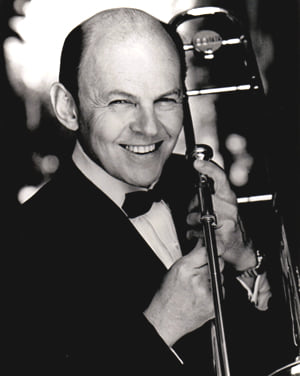
It’s sobering to note how someone’s long and varied career can be distilled to a single credit – the father on “Mork & Mindy.”
Conrad Janis has died at the age of 94.
On “Mork & Mindy,” the television series that launched Robin Williams and co-starred Pam Dawber, Janis played Mindy’s dad, the owner of a music shop in Boulder, CO (and eventually conductor of the Boulder Symphony Orchestra). If I remember correctly, he had a marked preference for Igor Stravinsky.
In real life, in addition to being a prolific actor for stage and screens (big and small), Janis was a jazz trombonist. In that capacity, he recorded, he appeared on “The Tonight Show,” and he played Carnegie Hall.
I always found it most fascinating that he once assembled a team of jazz legends, all the way back in 1949, that included New Brunswick’s own James P. Johnson. Johnson, a pioneer of stride piano, composed what essential became the anthem of the 1920s, the “Charleston.” How short is history, anyway?
If you want to get a taste of Janis the musician, here’s a great interview:
James P. Johnson plays the “Charleston” in 1923 (presumably from a piano roll)
PHOTOS: Conrad Janis, with (center right) Jonathan Winters on “Mork & Mindy” and (bottom right) Henry Goodwin on trumpet, Edmond Hall on clarinet, James P. Johnson on piano, and Pops Foster on bass
It’s International Women’s Day. The global holiday, established to celebrate the cultural, political, and socioeconomic achievements of women, has its roots in the universal female suffrage movement.
Perhaps the composer most frequently associated with the movement was Dame Ethel Smyth (1858-1944). I am reminded of Sir Thomas Beecham’s recollection of Smyth, already in her 50s, conducting an impromptu chorus of women, gathered in a prison courtyard for exercise, by waving her toothbrush between the bars of her cell.
Smyth was incarcerated for two months for smashing out the windows of politicians who opposed the female vote. Her “March of the Women” became the anthem of the women’s suffrage movement in England.
But Smyth was more than just a political firebrand. Unusual for a woman of the time, she was also a composer of some renown. Her opera, “Der Wald” (“The Forest”), would be the only work by a female composer produced at New York’s Metropolitan Opera for over a century. That was in 1903.
Anticipating the assertion that well-behaved women seldom make history, Smyth was driven to act up from the start. And who could blame her?
She managed to outmaneuver her father, a major general in the Royal Artillery. When he objected to her pursuit of a career in music, she took the initiative to study privately. An all-out war of wills ensued. Ethel’s stomach proved stronger than her dad’s. In the end, he allowed her to attend the Leipzig Conservatory.
When the conservatory didn’t measure up to Smyth’s expectations, she sought out Heinrich von Herzogenberg for further polish. Her travels also brought her into contact with Dvořák, Grieg, Tchaikovsky, Clara Schumann, and Herzogenberg’s friend, Johannes Brahms.
It was at a private performance of Brahms’ Piano Quintet, with the composer in attendance, that Smyth’s St. Bernard mix, Marco, burst through a door, toppling the cellist’s music stand, which, much to everyone’s relief, the notoriously prickly Brahms found hilarious. Later, when Tchaikovsky wrote to Smyth, he never failed to ask after Marco.
Her first piece to be played in public was her String Quintet in E major (1884).
Her first orchestral work, the Serenade in D (1889) – written with the encouragement of Tchaikovsky – is better than just about anything composed by Sir Hubert Parry (whose music I happen to enjoy) and much more compelling than the symphonies of Sir Charles Villiers Stanford. Smyth’s serenade is a symphony in all but name, with some pretty good tunes.
Even so, it was only in 1893, after her Mass in D was favorably received by George Bernard Shaw – he declared the Mass “magnificent” – that her father finally warmed to her chosen career.
While she met with considerable success in her lifetime, as a woman, she was still often marginalized and had to push for almost everything. In her mid-50s, she began to lose her hearing. Undeterred, she commenced a second career as a writer, producing ten books. She was made a Dame Commander of the Order of the British Empire in 1922.
The next time a music director is looking for an alternative to Elgar (himself not exactly overplayed in this U.S.), he or she could do worse than to consider Ethel Smyth. The overture to “The Wreckers” (1906) would make for a dynamic curtain-raiser.
Beecham considered “The Wreckers” to be Smyth’s masterpiece. In 2015, the opera was presented at Bard College, in a series of performances under the direction of Leon Botstein. Botstein led a concert performance of the piece at Carnegie Hall in 2007. Happily, the Bard production was filmed.
Smyth herself conducts the overture here, in a 1930 recording.
Finally, here’s “March of the Women” (1910), sung with more polish than it would have been in a prison courtyard.
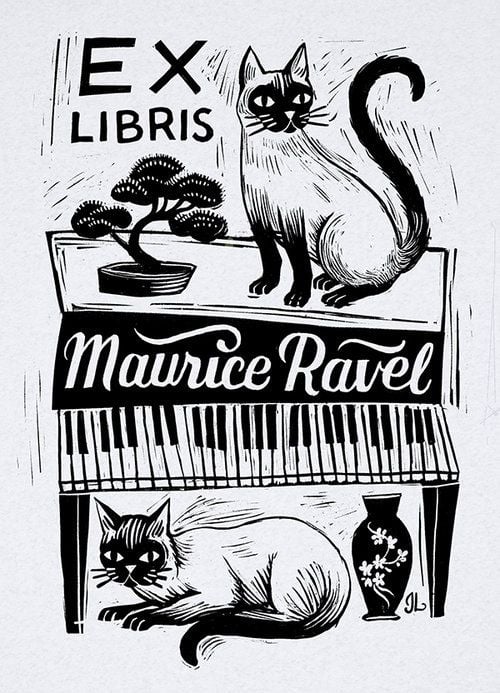
How much did Maurice Ravel love cats? Quite a lot, actually.
He had a particular fondness for Siamese cats. In 1921, he moved to a modest villa outside Paris, which he shared with a feline family. It’s unclear how many cats there were, exactly. Sources vary as to whether there were two, three, or six. One was named Mouni and another Jazz. At some point, there was a litter of kittens. Suffice it to say, there were a number of them, and Ravel adored them. They were with him when he worked. He played with them even as he wrote letters to his friends, documenting their antics. He mused on their intelligence and devotion, likening it to the “Basque temperament.” He even claimed to be able to speak to them in their own language.
Among the works he composed there was his one-act opera “L’enfant et les sortilèges.” (“The Child and the Enchantments”). The opera relates the transformation of a naughty, rampaging child – who terrorizes animals and wreaks destruction upon numerous household items, until they all rise up against him – into a more mature, compassionate human being, signified by his redemptive ministrations to an injured squirrel.
Here’s the barely safe-for-work “Cat Duet”
The entire opera was later choreographed as a ballet by Jiří Kylián. It’s much worth watching. If you want to get right to the singing cats, they’re at the 31-minute mark, but they are present, if silent, from the start.
Ravel was born in the Basque town of Ciboure on this date in 1875. He had difficulty finding intimacy with humans, claiming the only love affair he ever had was with music, but the companionship of cats he deemed purrfect.
I’m happy to note that in the past several years the idea of month-long celebrations devoted to “Women’s history” or “Black history” has started to seem almost old-fashioned, as the programming of concerts and radio broadcasts has become more and more diverse, so that it’s no longer unusual to encounter music by “minority” composers, with increasing regularity, year-round.
I feel the historic shift most keenly as I reach back into the “Lost Chord” archive to 2010, when I believe the show that will air this evening was probably already a repeat. (I began the series in 2003.) Time was when one really had to scratch around in order to find enough material to fill out an hour’s theme. Looking back now, over a decade later, recordings have yielded an embarrassment of riches.
I hope you’ll join me tonight as we revisit some of the selections available in the early years of the 21st century, for a program of music by women composers of Philadelphia.
Andrea Clearfield (born 1960) was raised in Bala Cynwyd. She studied at Muhlenberg College in Allentown, PA (where, by the way, this particular broadcaster got his start in community radio in 1986). At Muhlenberg, she was mentored by Margaret Garwood. She then studied at Philadelphia College of the Performing Arts (now the University of the Arts) and at Temple University, where among her teachers was Maurice Wright.
Clearfield herself taught at the University of the Arts from 1986 to 2011 (after this show was recorded, so some of the info may be a little out of date). She is well-known in Center City for a long-running, monthly, multidisciplinary salon held at her studio, located not far from the Kimmel Center for the Performing Arts. Since the pandemic, this has been a virtual event, but the salon has run, more or less uninterrupted, since its inception in 1986.
Clearfield’s recorded discography has expanded considerably since 2010, but for tonight we’ll sample her work for oboe and piano, “Unremembered Wings,” written in 2001.
Then we’ll turn to Jennifer Higdon (born in 1962), whose career by this time had already taken off like a rocket. She would be awarded the Pulitzer Prize for Music for her Violin Concerto in 2010. Again, assuming the show was recorded before February of that year, it would have been at least a few months before the honor was bestowed in May.
Higdon, born in Brooklyn to an artistic family, grew up in Atlanta and Seymour, TN. She studied flute at Bowling Green State University, where she was encouraged to pursue composition. This led her to the Curtis Institute of Music in Philadelphia, where her teachers included David Loeb and Ned Rorem. She also received a Master of Arts and PhD in composition from the University of Pennsylvania, where she studied with George Crumb.
Parenthetically, we were practically neighbors during my final decade in Philadelphia. Even so, it was only through the station that I finally met her, and I interviewed her for the paper a few years ago.
Tonight, we’ll hear her “Concerto for Orchestra,” written for the hometown band – the Philadelphia Orchestra – but recorded by the Atlanta Symphony, under the direction of her old friend from Bowling Green, Robert Spano.
Finally, we’ll turn to Evelyn Simpson-Curenton (born in 1953). Now based in Washington DC, she is music director of the Washington Performing Arts Men and Women of the Gospel and an associate of the Smithsonian Institute. After graduating from Germantown High School, she earned a BM in Music Education and Voice from Temple University. She’s received commissions from George Shirley and Duke Ellington, among others, and provided arrangements of spirituals for Jessye Norman and Kathleen Battle.
We’ll listen to Simpson-Curenton’s setting of Psalm 91, “My Soul Hath Found Refuge in Thee,” in a performance by the ensemble VocalEssence under the direction of Philip Brunelle.
Philadelphia is our sister city tonight, on “Sisters of Brotherly Love” – selections for hopefully soon-to-be-outmoded Women’s History Month – this Sunday night at 10:00 EST, on WWFM – The Classical Network and wwfm.org.
PHOTOS (clockwise from left): Higdon, Clearfield, and Simpson-Curenton
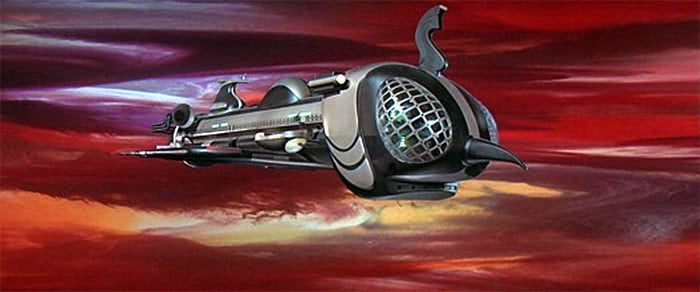
When “Flash Gordon” was released in 1980, many were inclined to view it as a “Star Wars” cash-grab. George Lucas’ interstellar success may have made a feature length “Flash Gordon” possible, but in no way is “Flash” attempting to track the Millennium Falcon through hyperspace.
On the contrary, the film revels in its comic strip origins, as a gaudy spectacle that is all about elevating camp production design and celebrating its own proto-pop pulpiness. Like the overripe performances of the actors themselves, “Flash” knows just what it is all about, with a deliberate tongue-in-cheek vibe and a subversive, foreign film sensibility – a surreal blend of high and low style, go-for-broke fashion, Mediterranean sensuality, and kink.
The heightened artificiality and lightness of touch make the film seem like one big party, underscored by Queen’s giddy, hilarious soundtrack. FLASH! AH AHHHHHHHHH!!
Clearly, there’s a lot to say about Flash Gordon – wholly befitting of the savoir of the universe. Enjoy last night’s overstuffed conversation, with special guest Jon Haag – and collectibles – here:
Join Roy tomorrow at a special time, as he welcomes authors David Hirsch and Robert E. Wood, who will talk about their new release, “To Everything That Might Have Been: The Lost Universes of ‘Space: 1999.’” The book draws on recently-discovered documentation and correspondence regarding the early days and development of the cult-favorite TV series, shedding new light on how exactly “Space: 1999” came to be.
“Space: 1999” fans will be over the moon for the next Roy’s Tie-Dye Sci-Fi Corner. Bring your Eagles to roost in the comments section, when they livestream on Facebook, THIS SUNDAY AFTERNOON AT 3:00 EST!


5 responses