• Malcolm Arnold Tormented Genius

    Malcolm Arnold Tormented Genius

    by 

    in
    6 responses

    “…[T]hou was a skellum,/A blethering, blustering, drunken blellum;/That frae November till October,/Ae market-dae thou was na sober.”

    Rabbie Burns wrote those lines about Tam O’Shanter. But they just as well could have applied to Sir Malcolm Arnold. Both men were, more or less, fond of the bottle, and both were driven by demons.

    Arnold, born 100 years ago today, began his professional career as a trumpeter with the London Philharmonic Orchestra. He was appointed its principal in 1943.

    During World War II, he registered as a conscientious objector. However, following the death of his brother, a pilot in the RAF, he was moved to enlist. At least for a time. While he never saw actual combat, serving instead in a military band, he quite literally shot himself in the foot so that he could return to civilian life.

    In 1948, he retired from orchestral playing to devote himself exclusively to composition. He possessed a rare melodic gift, which served him well in his light music and film scores. He won an Academy Award in 1957 for his work on “The Bridge on the River Kwai.”

    However, Arnold also had his dark side, as can be detected in certain passages of his symphonies. He was frequently cantankerous, often inebriated, and also highly promiscuous. He attempted suicide at least twice. He was treated for depression and alcoholism, rising above both, but in the early 1980s was given only a year to live. He actually lasted another 22, during which he completed his Symphony No. 9, among other works.

    Arnold died in 2006, one month shy of his 85th birthday. He was a brilliant composer, of great facility. When Malcolm Williamson was named Master of the Queen’s Music in 1975, Sir William Walton quipped that they had given the job to the wrong Malcolm. For a man with so many personal demons, Arnold wrote reams of perfectly delightful music.

    A good example, and one of my favorite Halloween pieces, is the programmatic overture “Tam O’Shanter” (1955). On market day, Burns’ antihero tarries at a pub, in defiance of his wife, then staggers out into the night. Under ominous skies, he detects the sound of bagpipes emanating from the ruins of an old church. Pressing his face to a chink in the mortar he espies “Auld Nick,” the Devil himself, “in shape o’ beast,” presiding over a coven of high-stepping witches and warlocks. When a particularly comely witch catches Tam’s eye, in his drunkenness, he roars, “Weel done, Cutty-sark!” (a reference to her short skirt). This brings the forces of darkness down up him, and there is a hell-for-leather sprint by horseback for a nearby river, since spirits are said not be able to cross running water.

    If you’re interested in the rest, you can read it for yourself here:

    http://loki.stockton.edu/~kinsellt/litresources/ayr/tam.html

    Then listen to Arnold’s musical response:

    Also, “Four Scottish Dances” (1957):

    From the film “The Belles of St. Trinian’s” (1954), in concert:

    On a more serious note, the Symphony No. 4 (1960), a plea for tolerance following the Notting Hill race riots of 1958:

    The Guitar Concerto (1959), played by Julian Bream:

    “Three Sea Shanties” (1943) for wind quintet:

    An interview by Bruce Duffie:

    http://www.bruceduffie.com/arnold2.html

    Happy centenary, Sir Malcolm Arnold, you tormented genius!


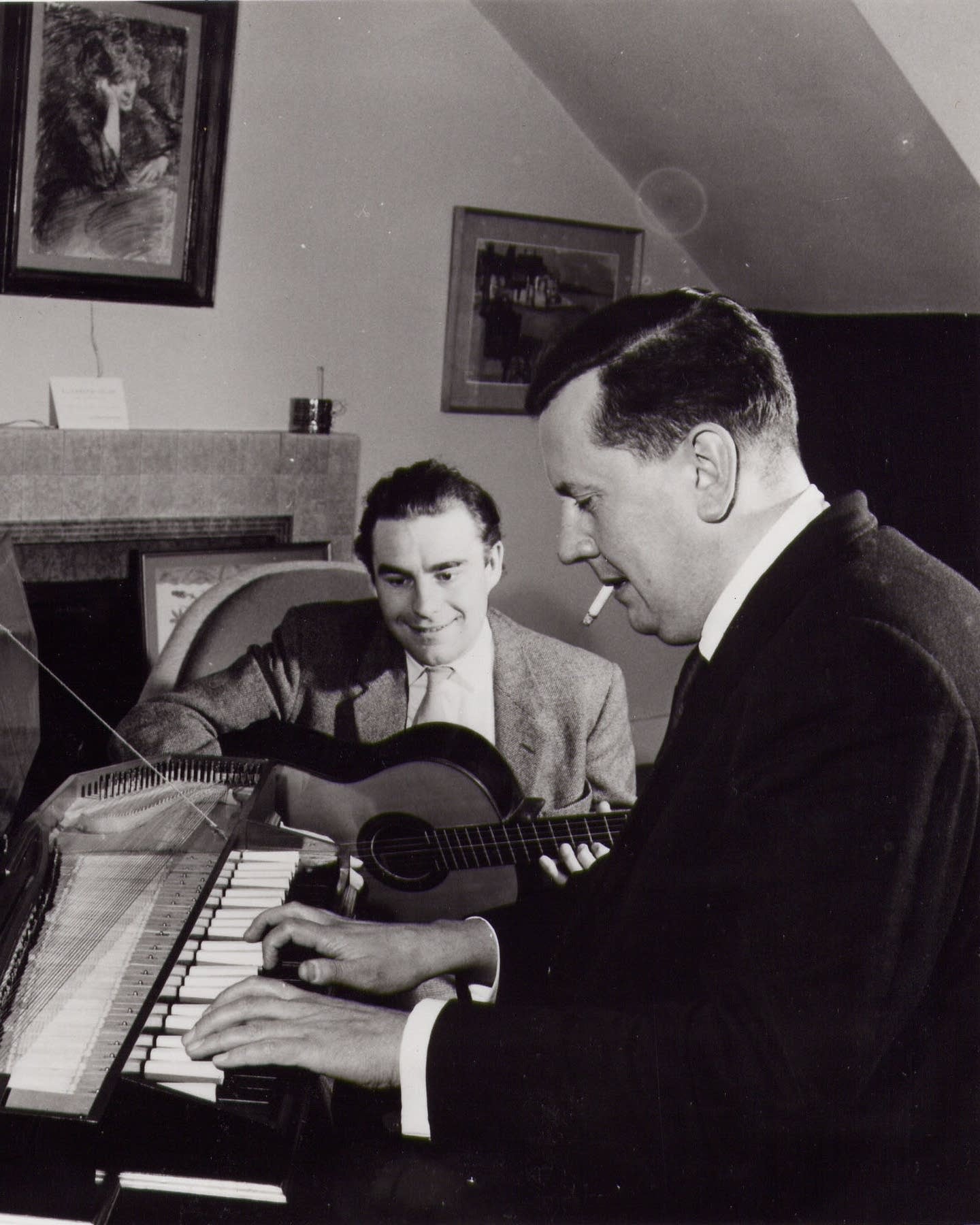
    PHOTO: Malcolm Arnold and Julian Bream


  • Charles Ives: An American Original

    Charles Ives: An American Original

    by 

    in
    5 responses

    With the birthday of Connecticut cranky Yankee, Charles Ives, the autumn of my content deepens, as golden leaves find parallel in the Golden Age of American music and a run of composer birthdays that stretch clear into early December (Howard Hanson, Aaron Copland, Virgil Thomson, Irving Fine, Morton Gould, etc.). As a radio programmer of so many years, I am sensitive to these types of patterns!

    Ives, born on this date in 1874, was the first of our modern giants, and his influence has been the furthest reaching. While piling up acorns in the insurance business, he had the freedom to pursue his idiosyncratic muse. He composed in the evenings, on weekends, and on holidays, creating works of all stripes, tonalities, and quasi-tonalities, even atonality, navigating with remarkable certainty for some 30 years. And he did so in the relative isolation of a prophet, with very few performances to affirm his chosen course.

    Ives retired in 1930, which allowed him to devote himself wholeheartedly to music. Ironically, by then, he found he was no longer able to compose. His wife recalled a day in 1927 when he came downstairs with tears in his eyes and confessed that everything sounded wrong to him. After that, he labored mostly at revision and publication.

    By the time his works finally began to gain recognition, it had already been 20 years since he had stopped composing. At the time of his death, in 1954, he was still widely misunderstood and much of his music remained unperformed. Nevertheless, he had some important champions. He was a recipient of the Pulitzer Prize for Music in 1947, for his Symphony No. 3, “The Camp Meeting,” a work he had written in 1904. His reaction? “Prizes are for boys, and I’m all grown up.” He gave away the prize money, half of it to Lou Harrison, who had conducted the belated premiere.

    Even in the 1960s, the world was still grappling with Ives. In 1965, Leopold Stokowski gave the first performance of the Symphony No. 4. At the time, the work’s complex, kaleidoscopic tempos and layered, shifting meters required multiple conductors, and Stokowski enlisted the aid of David Katz and a young Jose Serebrier. The performance took place at Carnegie Hall with the American Symphony Orchestra and the Schola Cantorum of New York.

    The piece was composed between 1910 and the mid-1920s. The first two movements had been performed by members of the New York Philharmonic under the direction of Eugene Goossens in 1927. This was the only occasion on which Ives would hear any of the music performed live by an orchestra. (He died in 1954.)

    Bernard Herrmann conducted an arrangement of the lovely third movement, the simplest and most conservative of the four (why, then, the need for an arrangement?), in 1933. The music as Ives wrote it was not heard until Stokowski’s complete performance.

    The composer’s biographer, Jan Swafford, describes the work as “Ives’ climactic masterpiece.”

    Stokowski recorded the symphony a few days after the premiere and led a televised studio performance, which can be seen here:

    Stoky kicks off twenty minutes of spoken introductory material (including commentary from producer John McClure) at the 4:30 mark. The symphony proper begins 25 minutes in.

    When’s the last time you saw anything like this on television?

    Marveling at how out of step with musical convention his own compositions could be, Ives once famously remarked, “Are my ears on wrong?” Musicians are still scrambling to address this “unanswered question.”

    Happy birthday, Charles Ives!


    Ives’ “Hallowe’en” for string quartet and piano – watch out for that big drum!

    Leonard Bernstein on the Symphony No. 2:

    My preferred recording of the symphony, so beautiful (though not always entirely accurate, in regard to Ives’ intentions), with Bernstein and the New York Philharmonic in 1958:

    The Yale-Princeton Football Game:

    Ives sings!


  • Leona Anderson Horrible Singer Haunted Hill

    Leona Anderson Horrible Singer Haunted Hill

    by 

    in
    4 responses

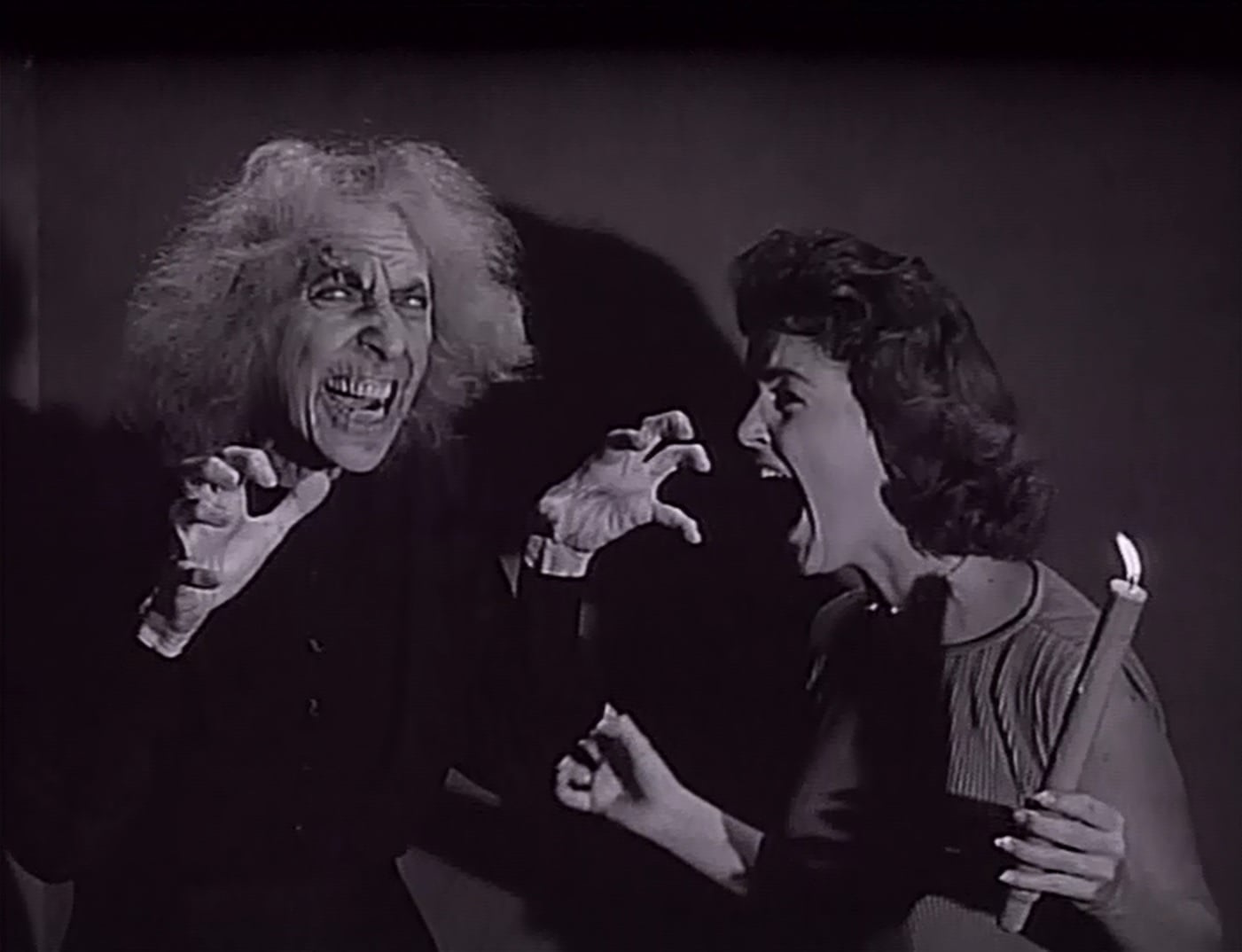
    As an addendum to Roy and my discussion about the Vincent Price classic, “House on Haunted Hill,” on last Friday’s Roy’s Tie-Dye Sci-Fi Corner, I submit the strange case of Leona Anderson. Anderson, born in 1885, plays the blind hag who glides through the basement of said house. Not a terribly flattering role to be offered, one would think. But it turns out Anderson had quite the batty sense of humor.

    Not quite so cringy as Florence Foster Jenkins, Anderson harbored no illusions about the extent of her vocal talent. I mean, come on, the title of her album is “Music to Suffer By.” A favorite guest of Ernie Kovacs, she billed herself as “the world’s most horrible singer.”

    Anderson actually began her career in silent movies. Charlie Chaplin was among her costars. If only she had pioneered silent records!

    Habanera from “Carmen”

    “Limburger Lover”

    Her breakout single, “Fish”

    With Chaplin in the silent short “In the Park” (1915). I believe that’s her on the park bench with “the count,” beginning around a minute in.

    Her last film, “House on Haunted Hill” (1959).

    Anderson died in 1973 at the age of 88.


  • Wynton Marsalis at 60 A Jazz Icon Reflects

    Wynton Marsalis at 60 A Jazz Icon Reflects

    by 

    in
    4 responses

    Holy smokes! Wynton Marsalis is 60????????????

    Granted, I suppose it was a long time ago that I took the shrink wrap off his brilliantly played classical debut album of the Haydn Trumpet Concerto, a treasured gift from a high school girlfriend, on the recommendation of her wise and knowledgeable father.

    Marsalis, of course, has made his biggest mark as a jazz artist. He holds the influential positions of artistic director of Jazz at Lincoln Center and music director of the Jazz at Lincoln Center Orchestra. Marsalis founded the summer concert series in 1987, and he’s been directing the orchestra since 1996.

    Although he hails from an illustrious New Orleans family of jazz musicians – his father was Ellis, and among his brothers are Branford, Delfeayo, and Jason Marsalis – it had originally been the plan for Wynton to pursue a career in classical music. He moved to New York City to attend Juilliard, but then he fell in with Art Blakey and toured Europe as one of Blakey’s Jazz Messengers. That was followed by a tour with Herbie Hancock. In 1982, he began forming his own ensembles.

    In 1997, Marsalis’ “Blood on the Fields” became the first jazz work to be awarded the Pulitzer Prize for Music. Controversially, Duke Ellington had been denied a special citation in 1965. He was finally recognized in 1999 – a full quarter century after his death.

    Marsalis is the only musician ever to be awarded a Grammy in the classical and jazz categories in the same year – in 1983, for the aforementioned Haydn Trumpet Concerto and for his jazz album “Think of One.” Just to show it was no accident, he did it again in 1984, winning for an album of Baroque trumpet works, with soprano Edita Gruberova, and for “Hot House Flowers.” In all, he’s been recognized by the Grammys nine times.

    I haven’t seen that girlfriend in 35 years, probably, but I’m still listening to Marsalis’ Haydn.

    Happy birthday, Wynton Marsalis.


    A selection from “Blood on the Fields”

    “Hellbound Highball” from String Quartet No. 1 “At the Octoroon Balls”

    The family that plays together stays together

    https://www.youtube.com/watch?v=dkRqpslgh_k

    Happiness is Haydn


  • Edita Gruberová Legendary Soprano RIP

    Edita Gruberová Legendary Soprano RIP

    by 

    in
    7 responses

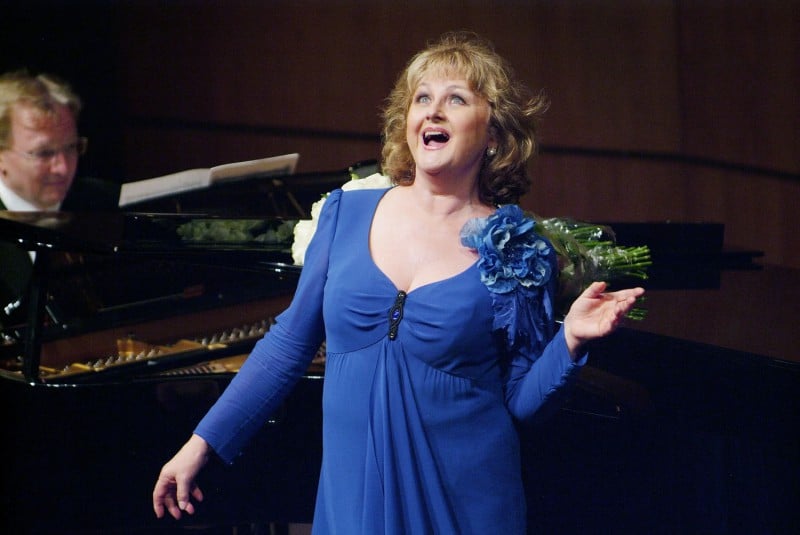
    Eerie. I only just mentioned the Slovak soprano Edita Gruberová in my birthday salute to Wynton Marsalis this morning. Now I learn she is dead at the age of 74.

    Early on, Gruberová was celebrated for her Queen of the Night (“The Magic Flute”) and Zerbinetta (“Ariadne auf Naxos”). Later, she graduated to heavier, bel canto roles, like Lucia di Lammermoor and Elvira (“I puritani”). Her last operatic appearance, in March 2019, was as another specialty, Elisabetta I (“Roberto Devereux”).

    Further performances had been scheduled through 2020, but these were cancelled due to the COVID-19 pandemic. Gruberová sang in concert for the last time in December 2019.

    Here she is in music by Purcell, from the Grammy Award winning album mentioned in my post this morning:

    As the Queen of the Night:

    As Zerbinetta:

    More about Gruberová here:

    Obituary: Legendary Soprano Edita Gruberová Dies at 74

    R.I.P.


Tag Cloud

Aaron Copland (93) Beethoven (95) Composer (114) Film Music (145) Film Score (143) Film Scores (255) Halloween (94) John Williams (195) KWAX (229) Leonard Bernstein (104) Marlboro Music Festival (125) Movie Music (160) Mozart (91) Opera (213) Philadelphia Orchestra (89) Picture Perfect (174) Princeton Symphony Orchestra (109) Radio (88) Ross Amico (244) Roy's Tie-Dye Sci-Fi Corner (290) The Classical Network (101) The Lost Chord (269) Vaughan Williams (105) WPRB (397) WWFM (881)

DON’T MISS A BEAT

Receive a weekly digest every Sunday at noon by signing up here


RECENT POSTS