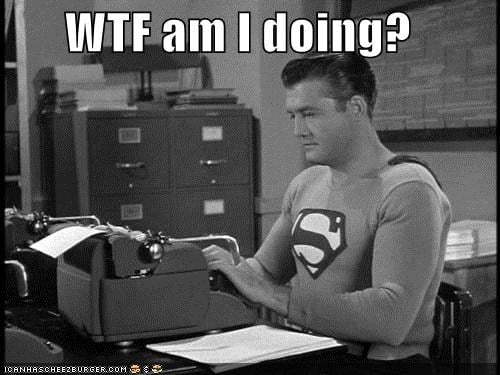
It occurred to me today, as I raced to meet my first newspaper deadline in 17 months, that one of the most difficult aspects of writing is going over what you’ve done and looking for all the instances that might reveal to perceptive readers that, in reality, you’re a total idiot.
These include grammatical slips, factual errors, and unfortunate bursts of giddiness resulting in overly florid metaphors. Also, star-crossed wording that leads to inadvertent offense.
Often with a big subject, it’s difficult to ingest, or digest. And since your name will appear in the byline, the last thing you want is to come across as is the fool you are. This is why it especially smarts, after such hard and careful work (14 hours in the chair today), if an editorial hand slips in at the last moment to swap out a carefully chosen word or alter the meaning of sentence. (It’s been done.)
But it is, after all, just ephemera, little of it of consequence, beyond the moment. Nonetheless, I hope I’ve been successful in preserving the illusion.
Of course regular followers of this page are probably well-aware of my idiocy by now. But mayhap they also find it a little endearing?
In the words of Wilde’s Lord Henry, there is only one thing in the world worse than being talked about, and that is not being talked about.
While it might be true there’s no such thing as bad publicity, it would be nice if Antonio Salieri could transcend his notoriety – as the alleged murderer of Mozart and a second-rate hack – to be recognized for some of his actual achievements. Especially since none of the charges leveled against him happen to be true!
I like “Amadeus” as much as the next guy, and while I am very happy it has served to keep Salieri’s name alive, and perhaps lent a greater degree of commercial viability to subsequent recordings of his music, it is worthwhile to examine the historical facts.
In reality, Salieri was a generous teacher, who fostered Beethoven, Schubert, Liszt, and even Franz Xaver Mozart, his rival’s son, who was born a little more than four months before his father’s death.
Salieri himself was a prolific and successful composer. He wrote 37 operas, in addition to orchestral works, concertos, chamber music, and sacred pieces. While he was no Mozart – who was? – his music is finely crafted and often quite enjoyable, certainly no worse than that of a majority of his contemporaries.
Yes, Mozart believed Salieri and the Italian faction ensconced at the Viennese court (including future Mozart librettist Lorenzo Da Ponte) were against him. And there may have been something to it at first. However, beyond a rivalry pertaining to certain specific jobs, Mozart and Salieri appear often to have been better than cordial acquaintances.
The two even collaborated on a cantata, “Per la ricuperata salute di Ofelia” (“For the recovered health of Ophelia”), rediscovered in 2016, a joint venture apparently entered into voluntarily (in contrast to an earlier contest, in which two one-act operas were juxtaposed, purely for the edification of the emperor). The cantata was written in 1785, to celebrate the recently-convalesced soprano Nancy Storace, who would soon create the role of Mozart’s Susanna in “The Marriage of Figaro.”
When Salieri was appointed Kapellmeister in 1788, his first act was to revive “Figaro.” He was also responsible for arranging first performances of Mozart’s Piano Concerto No. 22 (K. 482), the Clarinet Quintet, and the Symphony No. 40. He was full of praise for “The Magic Flute.” And as I said, he took it upon himself to educate Mozart’s son.
Sadly, Salieri’s enormous compositional output gradually faded from memory already during the latter years of his life. Ironically, it is the scandalmongers who kept his name alive.
Rumors of Salieri’s involvement in Mozart’s death were codified by Alexander Pushkin in 1831, a few years after Salieri himself had passed, in the poetic drama “Mozart and Salieri.” This was later set as an opera, in 1898, by Nikolai Rimsky-Korsakov.
Peter Schaffer picked up the thread in 1979, when he wrote the play “Amadeus,” which of course was adapted into the Academy Award-winning film in 1984.
As the compact disc era progressed, more and more of Salieri’s output became available for first-hand assessment – and guess what? A lot of it is quite good!
Happy birthday, Patron Saint of Mediocrity!
Russian film version of Rimsky’s “Mozart and Salieri” (without subtitles):
In English, if a bit fuzzy:
Salieri’s Concerto for Flute, Oboe and Orchestra:
Overture to “Les Horaces”
“Das Lob der Musik” (“The Praise of Music”)
A Mozart and Salieri collaborative effort, the cantata “Per la ricuperata salute di Ofelia”
The weekend has been a costly one for the world of art music. Two estimable composers – England’s Hugh Wood and Canada’s R. Murray Schafer – have gone silent.
Though Wood earned much of his daily bread as a teacher of composition, at Cambridge and elsewhere, he yet managed to complete something in the ballpark of 65 pieces.
Given that much of his music reflects his interest in the 12-tone school of Arnold Schoenberg, I am astonished – and delighted – to have discovered this, his last completed work, which at times sounds positively Waltonian (as in William Walton). I wonder if he ever before composed such an “English”-sounding piece?
“Epithalamion” is a setting of John Donne’s 1613 “marriage song,” written for the wedding of Princess Elizabeth Stuart, daughter of King James I, and Frederick V, Elector Palatine of the Rhine in the Holy Roman Empire (1610 to 1623) and “winter king” of Bohemia (1619 to 1620).
Wood first conceived the work in 1955, but carried it through to completion only in 2014. This recording is from a performance at the BBC Proms in 2015.
Wood’s Cello Concerto, composed between 1965 and 1969, is much more characteristic. He once claimed he was less interested in serial technique than in the philosophy behind it.
An interview with Hugh Wood on the occasion of his 70th birthday:
Sadly, we’ve also lost the grand old man of Canadian music. R. Murray Schafer died on Saturday at the age of 88. Schafer developed some fascinating ideas about, and interesting insights into, the relation of sound and music to the environment. His is not music for the morning rush hour, perhaps, but it is undeniably stimulating.
The composer walks us around his property, plays with our heads a little bit, and directs us to listen:
“Mimiwanka” (1971), employing American Indian texts, is meant to reflect on the various states of water. This video is particularly interesting in that it also displays Schafer’s unique style of graphic notation.
A selection from “Music for Wilderness Lake” (1979)
“Bird calls” infuse his String Quartet No. 8 (2000-01)
This obituary and appreciation, assembled by the CBC, encompasses the man and the artist much more satisfyingly than I ever could.
This Sunday night on “The Lost Chord,” our ears will burn from the haughty and profane response of the Zaporozhy Cossacks to an ultimatum from Sultan Mehmad IV. The Sultan demanded the peaceful surrender of the Cossacks, after they had scored a glorious defeat against his Ottoman forces. To his giddy and inebriated foes, he was not exactly negotiating from a position of power.
Among Reinhold Glière’s works steeped specifically in Ukrainian lore is the symphonic poem/ballet “The Zaporozhy Cossacks,” based on the famous canvas by Ilya Repin. Glière, born in Kiev in 1875, is best known for his ballet “The Red Poppy,” with its ubiquitous “Russian Sailor’s Dance,” and perhaps for his Symphony No. 3, “Ilya Muromets.”
In 1913, Glière attained an appointment to the school of music in Kiev, which was raised to the status of conservatory shortly thereafter. Glière served as director of the conservatory from 1914 to 1920.
One of his pupils there was Boris Lyatoshinsky, who lived from 1895 to 1968. Lyatoshinsky was a student at the conservatory at the start. The first movement of his Symphony No. 1 was written as a graduation work. The other two movements followed in 1919.
The first performance of the piece took place under Glière’s direction in 1923. If you get all sweaty listening to the orchestral works of Alexander Scriabin, you certainly won’t want to miss this, an opulent work by a young man determined to impress.
I hope you’ll join me for “Steppe Lively” – classical music from Ukraine – this Sunday night at 10:00 EDT, on WWFM – The Classical Network and wwfm.org.
IMAGE: Ilya Repin’s “Reply of the Zaporozhian Cossacks” (1880-1891)
If you aren’t too squeamish, you can read more about it, with a rough (and I do mean rough) translation of the Cossacks’ reply, here:
This week on “Picture Perfect,” it’s an hour of cinematic shell-games. We’ll have musical selections from films about confidence men, charlatans, and hucksters.
In “The Magician” (1958), also known as “The Face,” Ingmar Bergman explores the idea of theatre as both confidence game and beautiful mystery. Max von Sydow stars as a traveling illusionist whose troupe of strolling entertainers, The Magnetic Healing Theatre, is put to test before being granted permission to perform at the royal court. The score, by Erik Nordgren, is sparse, made up of a dozen very short pieces for harp and two guitars, some movements for brass band, and in the main title, the addition of percussion.
George C. Scott plays Mordecai Jones, a confidence man who defrauds the populace of the American South through various means, with a specialty in rigged punchboards, in “The Flim-Flam Man” (1967). The film, shot on location in Kentucky by director Irvin Kershner, features a gallery of colorful character actors, including Jack Albertson, Slim Pickens, Strother Martin and Harry Morgan. The happy-go-lucky score, by Jerry Goldsmith, makes use of harmonica, banjo, and freewheeling honky-tonk piano.
Steven Spielberg’s “Catch Me If You Can” (2002) is based on the real-life exploits of the chameleonic Frank Abagnale, who, before his 19th birthday, manages to successfully pull a series of cons worth millions of dollars. Along the way, he poses convincingly as a lawyer, a doctor, and a pilot. Leonardo DiCaprio plays Abagnale, and Tom Hanks, the bank fraud agent who develops an unusual relationship with him, as the light-hearted cat-and-mouse thriller unfolds. John Williams wrote the intimate and jazzy score, a throwback to the musical syntax of caper films of the 1960s, but also to the composer’s own jazz roots (when he still went by “Johnny Williams”).
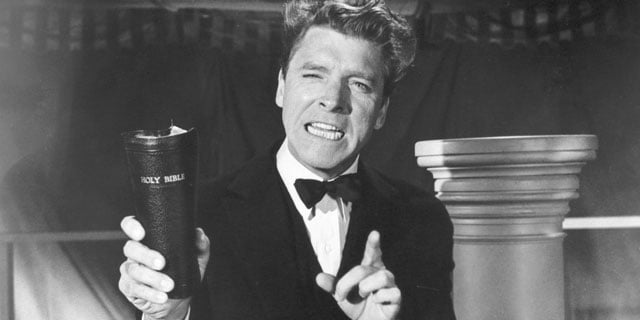
Finally, we’ll hear music from that classic of religious hucksterism, “Elmer Gantry” (1960). Burt Lancaster plays the hard-drinking, fast-talking salesman-turned-revivalist, in one of the great movie performances. Lancaster was recognized with a much-deserved Academy Award for Best Actor. Shirley Jones, of “The Partridge Family” fame, won Best Supporting Actress for playing one of Gantry’s shady ladies. The film’s brilliant score was by none other than André Previn.
You can listen with “confidence” to “Picture Perfect,” music for the movies, this Saturday evening at 6:00 EDT, on WWFM – The Classical Network and wwfm.org.



2 responses