• Arthurian Art The Lost Chord’s Musical Knights

    Arthurian Art The Lost Chord’s Musical Knights

    by 

    in
    5 responses

    King Lot, Lancelot, Camelot – that’s a lot of “lots.”

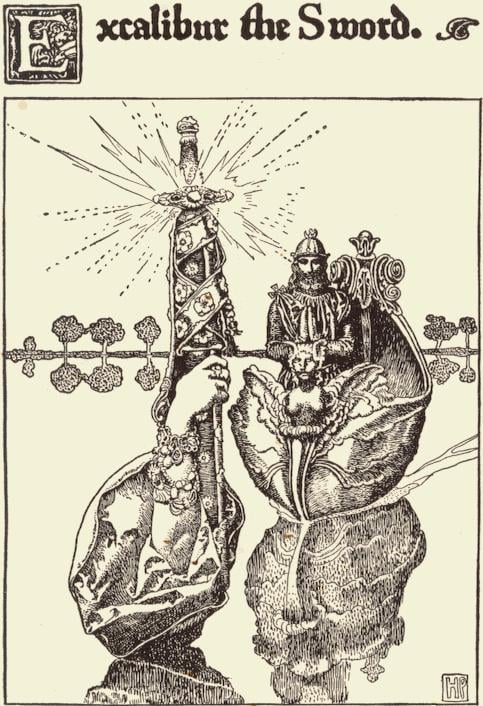
    This Sunday night on “The Lost Chord,” we put the “art” in “Arthur” with musical treatments of the Arthurian legends by two peripatetic American Romantics,

    We’ll hear “Excalibur,” a symphonic poem after Arthur’s enchanted sword, by Louis Coerne (pronounced “Kern”). Coerne was born in Newark, NJ, in 1870. As was the custom at the time, he studied abroad, in France and Germany, then closer to home with John Knowles Paine. In Munich, he pursued organ and composition studies with Josef Rheinberger.

    After that, it was back and forth to Germany, between church and conducting appointments in the United States, and then the assumption of a series of academic posts throughout the American Northeast and Midwest. Despite all the worn shoe leather, in his 52 years he managed to produce 500 works.

    The remainder of the hour will be devoted to the Straussian tone poem “Le Roi Arthur,” a work in three movements, by George Templeton Strong, son of the famous Civil War diarist, born in 1856. Strong Jr. studied at the Leipzig Conservatory, where Joachim Raff was among his teachers. For a time, he played viola in the Gewandhaus Orchestra. He rubbed shoulders with Liszt and Wagner, then was lured back to the United States by the offer of a teaching position (by former European transplant Edward MacDowell) at the New England Conservatory.

    However, in part because the work didn’t agree with him, and in part because of health issues, Strong soon took off for Switzerland, where he settled on the banks of Lake Geneva. There, he dedicated the remainder of his life to painting watercolors and composing. Even after musical fashion had changed, he continued to play an active role in Geneva’s musical life.

    I hope you’ll join me for “Kinetic Yankees in King Arthur’s Court.” Break a lance for Arthur, this Sunday night at 10:00 EDT, on WWFM – The Classical Network and wwfm.org.


    BONUS! Wholly by coincidence, this year’s opera at Bard Summerscape is Ernest Chausson’s rarely-staged “Le Roi Arthus.” I can’t speak for the production, not having seen it, but Bard generally does a fine job with anything they put their musical minds to. You can make it a full Arthurian evening by enjoying the livestream tonight at 6:30 pm. The running time of the opera is 3 ½ hours, so it should end just in time for the start of “The Lost Chord.”

    https://fishercenter.bard.edu/events/king-arthur/


  • Shatner, Bond, and Voyage! Sci-Fi Talk

    by 

    in
    6 responses

    Watch the show William Shatner may have watched (for two seconds). Roy and I discuss “The Spy Who Loved Me.”

    We’re off next week, but we’ll be back on August 6th at 7:30 pm EDT to talk about “Voyage to the Bottom of the Sea” (1961) – the movie, not the SUB-sequent TV series. (See what I did there?) Note the special start time!

    We had originally scheduled “Voyage” for last night, only to discover it had apparently dropped off of all streaming services. So a big thank you to Alan Wendt, who was kind enough to share this link.

    https://archive.org/details/voyagetothebottomoftheseaaction1961engsubs720ph264mp4

    It is also scheduled to air on FXM this Monday, beginning at 11:25 am.

    In the meantime, I’ll be on a “see food” diet. Leave your crab cakes in the comments section, on the next Roy’s Tie-Dye Sci-Fi Corner. We livestream on Facebook, August 6th – Friday after next – at 7:30 pm!

    https://www.facebook.com/roystiedyescificorner


  • Olympic Music at Picture Perfect WWFM

    Olympic Music at Picture Perfect WWFM

    by 

    in
    5 responses

    Citius! Altius! Fortius!

    This week on “Picture Perfect,” to coincide with the Summer Games in Tokyo, we’ll get the blood pumping, with selections from Olympic opening ceremonies and television broadcasts.

    Featured composers with include Leo Arnaud (a Ravel pupil, who worked on “The Wizard of Oz” and went on to write THE classic Olympic theme), Angelo Badalamenti (David Lynch’s composer of choice), Basil Poledouris (composer of “Conan the Barbarian” and “The Hunt for Red October”), and John Williams (‘nuff said).

    In addition, there will be a suite from the Olympic documentary “16 Days of Glory,” by Lee Holdridge (recipient of seven Emmys and a Grammy),

    We’ll be downing our Wheaties and going for the gold, on “Picture Perfect,” this Saturday evening at 6:00 EDT, on WWFM – The Classical Network and wwfm.org!

    FUN FACT: Today is also Arnaud’s birthday!


  • Bond’s The Spy Who Loved Me A Sci-Fi Deep Dive

    Bond’s The Spy Who Loved Me A Sci-Fi Deep Dive

    by 

    in
    6 responses

    All attempts to view “Voyage of the Bottom of the Sea” (the 1961 movie, not the TV series) have floundered. Currently, it doesn’t seem to be streaming anywhere. A search on Hulu reveals that it will be showing on FXM on Monday, July 26, at 11:25 a.m. So set your recorders! Due to the film’s unexpected scarcity, Roy and I will be postponing our discussion about it until Friday, August 6.

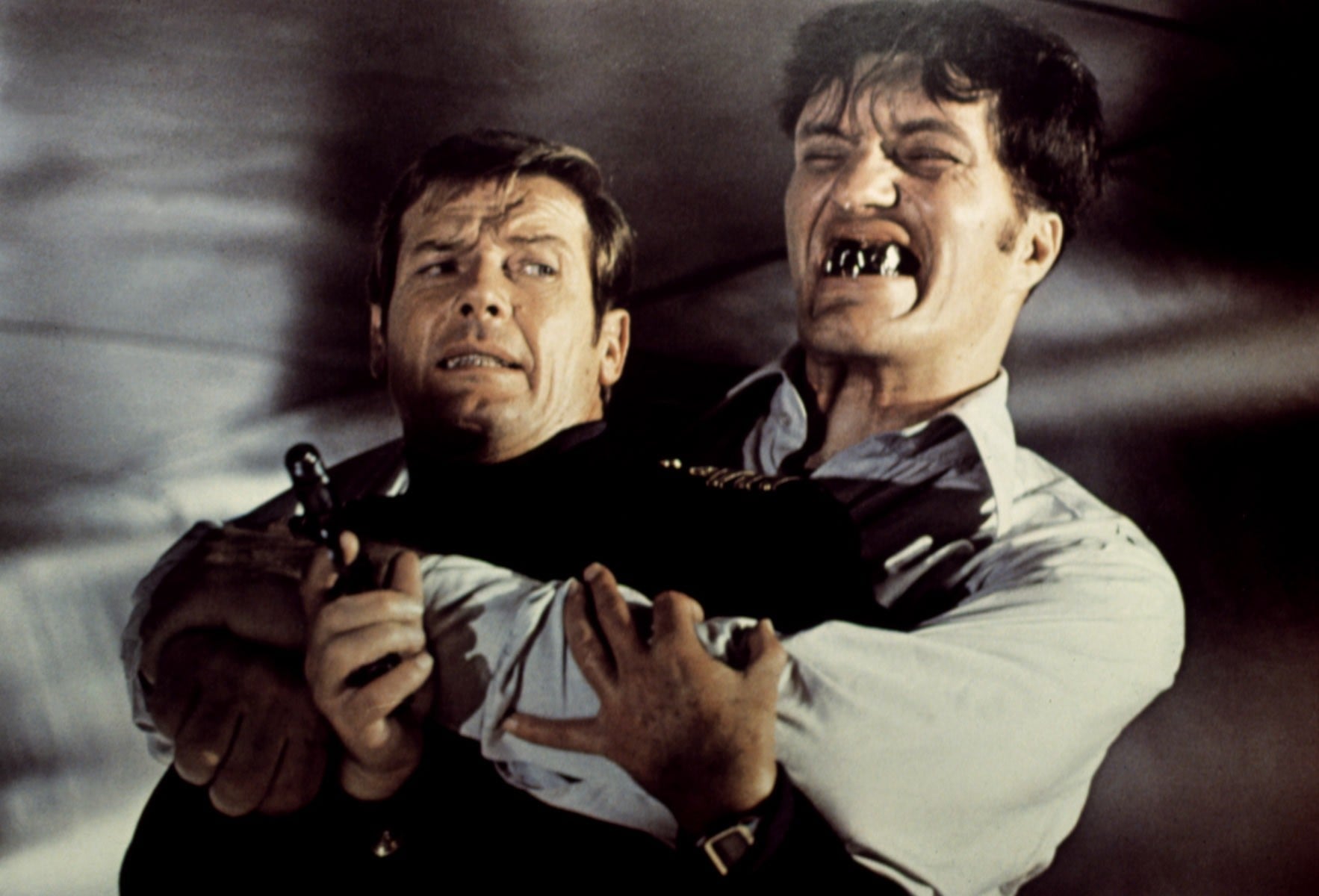
    In the meantime, since it’s already fairly late in the week, we decided we had better choose a topic about which just about everyone has a passing familiarity – James Bond. To act as a kind of bridge from our last film, Steven Spielberg’s “Jaws,” to the upcoming chat about “Voyage,” we’ve selected “The Spy Who Loved Me” (1977), in which Richard Kiel plays one of the most memorable “Bond” henchmen – also named Jaws – and in which, in common with “Voyage,” submarines play a major role.

    For those of us of a certain age, this aired in heavy rotation on television – in common with all the Bond films – as part of the “ABC Sunday Night Movie” (whenever they weren’t showing Clint Eastwood’s “The Gauntlet”). So even if you haven’t seen it recently, I’m fairly confident you’ll still get a charge out of our depth and be able to sink your teeth into the comments section.

    It’s a nostalgic trip to the unflappable Roger Moore era, with plenty of quips, camp, and Carly Simon, on the next Roy’s Tie-Dye Sci-Fi Corner. Nobody does it better, as we livestream on Facebook, this Friday evening at 7:00 EDT.

    https://www.facebook.com/roystiedyescificorner


    Back in the day, on ABC:


  • Maelzel’s Metronome The Turk & Philly Mystery

    Maelzel’s Metronome The Turk & Philly Mystery

    by 

    in
    5 responses

    Perhaps in your haste to escape Philadelphia by way of South 5th Street, en route to the Ben Franklin Bridge, you may have glimpsed the Johann Nepomuk Maelzel commemorative marker at the corner of 5th and St. James, just below Walnut Street.

    Maelzel died in the extraordinary act of actually trying to get back to Philadelphia. On the 21st of July, 1838, he was found dead in the berth of a brig returning from the Caribbean. Whether he died of yellow fever or alcohol poisoning is a matter of ambiguity. Maelzel was consigned to a watery grave somewhere off the coast of Charleston, South Carolina.

    In his lifetime, Maelzel was a renowned inventor of mechanical wonders. He created machines that could play works of Haydn and Mozart. No doubt his most ambitious achievement in this regard was the panharmonicon, a kind of mechanical orchestra, for which Beethoven composed “Wellington’s Victory.”

    Beethoven and Maelzel would quarrel over the division of spoils, and Beethoven would re-orchestrate the work for human performers of a conventional symphony orchestra. Maelzel, seemingly always in debt, would exhibit his creations in his own museum in Vienna, and on tours throughout the United States and the West Indies.

    He achieved notoriety for his work with automatons, most notably a mysterious humanoid engine called “The Turk.” The Turk was marketed as a thinking machine that could outmaneuver opponents in a game of chess. And the Turk almost always delivered on his promise. The device captivated figures from Edgar Allan Poe (a skeptic) to S. Weir Mitchell (haunted by it as a child).

    Some felt Maelzel had set foot into some pretty murky ethical territory, with arguments prefiguring some in our own day regarding artificial intelligence. This was the era, after all, of Mary Shelley’s “Frankenstein.” Sensible folk speculated it was all humbug and that there was a man hidden somewhere in the vicinity of The Turk. Others thought Maelzel was dabbling in matters best left to God. Maelzel was mum on the subject, and The Turk was destroyed by fire in 1854.

    Though no doubt there was a whiff of charlatanism about Maelzel, who schooled no less a figure than P.T. Barnum in the effective use of the press, he had a remarkable talent for finessing and perfecting the ideas of others.

    His most enduring legacy is the metronome, which he patented in 1815. Beethoven wrote glowingly of the device and declared that henceforth he would stop using traditional tempo indications in his scores in favor of metronome markings. We all know how well that served him. Seemingly as with anything influenced by Maelzel, Beethoven’s choices of metronome markings continue to be a source of controversy.


Tag Cloud

Aaron Copland (93) Beethoven (95) Composer (114) Film Music (145) Film Score (143) Film Scores (255) Halloween (94) John Williams (195) KWAX (229) Leonard Bernstein (104) Marlboro Music Festival (125) Movie Music (160) Mozart (91) Opera (213) Philadelphia Orchestra (89) Picture Perfect (174) Princeton Symphony Orchestra (109) Radio (88) Ross Amico (244) Roy's Tie-Dye Sci-Fi Corner (290) The Classical Network (101) The Lost Chord (269) Vaughan Williams (105) WPRB (397) WWFM (881)

DON’T MISS A BEAT

Receive a weekly digest every Sunday at noon by signing up here


RECENT POSTS