All systems are “go” for this year’s Raritan River Music Festival. The festival will proceed with its 32nd season, this year offering the options of outdoor, under-cover seating or live, at-home streaming.
Concerts will take place at Blue Army Shrine in Asbury (NOT to be confused with Asbury Park), nestled in the rolling hills of West-Central New Jersey.
Performers will include the Poorwill Lane Duo (May 8), harpist Bridget Kibbey (May 15), duoJalal (May 22), and the Newman & Oltman Guitar Duo (May 29).
The programs will begin, rain or shine, at 4 pm. Protective face masks will be worn and social distancing is assured.
Take a step a toward normalcy by enjoying live outdoor concerts in the month of May, courtesy of the Raritan River Music Festival. For details, visit raritanrivermusic.org.
In yet another demonstration of history becoming shorter as I grow older, at 54 I look back to realize I was born only 54 years after the tragedy of the HMS Titanic.
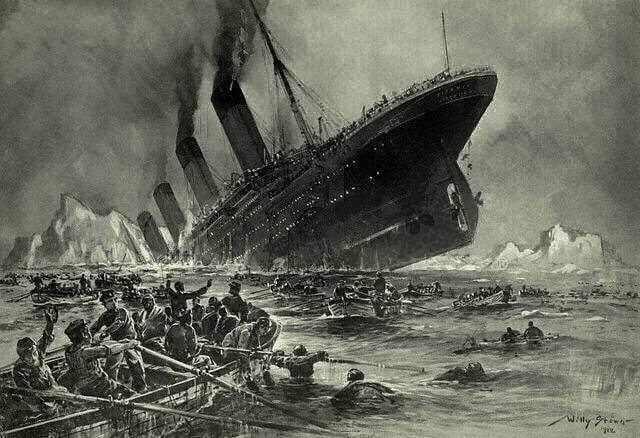
On this date in 1912, the Titanic sank off the coast of Newfoundland at 2:27 a.m. Over 1,500 souls were lost. But the band played on.
A number of composers wrote music to commemorate the disaster. Cyril Scott, the prolific English composer – absurdly remembered, if at all, for a piano miniature, “Lotus Land” (1905) – wrote a piece called “Disaster at Sea” (1933), a work directly related to the Titanic sinking, which he revised as “Neptune” (1935). Its large orchestra includes a wind machine and an organ. Atmospheric sea music increases in menace, until the ship is consumed in a kind of arctic wasteland.
Apparently, for Danish master Carl Nielsen, there was no such thing as “too soon.” The wreckage had scarcely settled on the ocean floor, when he embarked on a paraphrase for wind band on “Nearer, My God, to Thee” (1912). The well-known hymn is alleged to have been the last music played by the Titanic band. Essentially, Nielsen’s work turns out to be a three-minute tone poem. Stay sharp for the violent iceberg collision, or you might just spill your coffee.
The musicians of the Titanic, of course, are legendary for having gone down with the ship, playing for as long as possible, in an attempt to keep calm among the passengers. The eight-member ensemble was led by Wallace Henry Hartley, who drew on selections from The White Star Line Songbook. The White Star Line repertoire included 341 items, including light overtures, intermezzi, waltzes, marches, arias, sacred music, and potpourris. Here’s a complete catalogue:
According to an eyewitness, “Many brave things were done that night, but none were more brave than those done by men playing minute after minute as the ship settled quietly lower and lower in the sea. The music they played served alike as their own immortal requiem and their right to be recalled on the scrolls of undying fame.“
I Salonisti portrayed the ship’s band in the 1997 film “Titanic.”
I am now as far away from my birth as my birth was from the Titanic. Talk about a sinking feeling! Gentlemen, it’s been a privilege playing with you…
“The Sinking of the Titanic,” iconic illustration for the newspaper “Die Gartenlaube,” by Willy Stöwer (1912)
Nearly a decade before Bill Murray, Dan Aykroyd, and Harold Ramis strapped on their proton packs in “Ghostbusters” (1984), “F-Troop” alumni Forrest Tucker and Larry Storch embraced their inner Bowery Boys to deliver plenty of warmed-over schtick and slapstick as “The Ghost Busters” (1975).
This relic of Saturday morning television will be our topic this week, on the next Roy’s Tie-Dye Sci-Fi Corner, as our special guest will be Roy’s son, Ryan. Roy and I will offer our personal recollections of the era, wallowing in a morass of boyhood nostalgia, while a no-doubt-befuddled Ryan will lend a more clear-eyed perspective, having come to the episodes for the very first time.
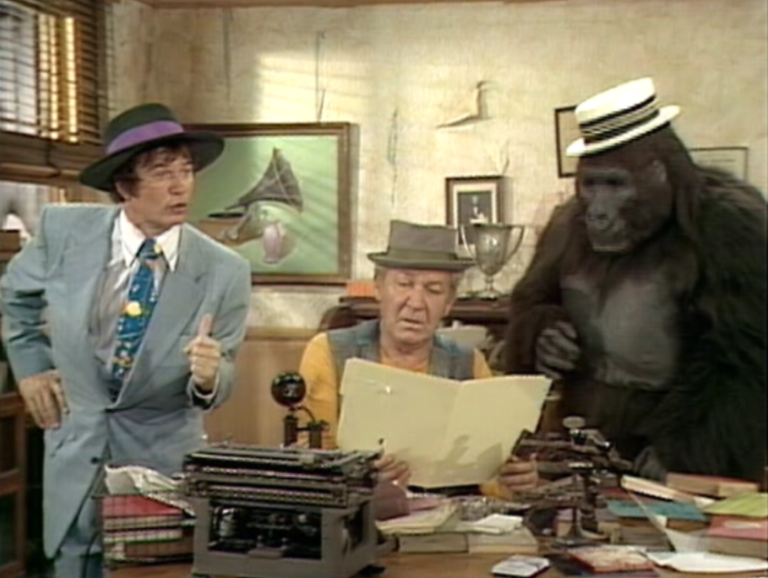
Spencer (Storch), Tracy – a “trained” gorilla (actually Bob Burns in a fur suit) – and Kong (Tucker) tackle a different supernatural menace each week. These range from the obvious (Count Dracula, a mummy, and a werewolf) to the fairly offbeat (the Flying Dutchman, Morgan le Fay, Erik the Red and Brunhilde, and the Canterville Ghost).
Make no mistake, this is print-the-first-take comedy, with Tucker occasionally fumbling his lines, but anchoring all the business with his straight man authority and exasperation. Storch, in particular, demonstrates that he can polish even the stalest joke and serve it up on a velvet pillow. But it’s Tracy the Gorilla who gets all the surreal, Harpo Marx bits, putting on funny hats and doling out the prop comedy. At its worst, the show is like live-action, low-budget Scooby-Doo. At its best, it’s latter-day Vaudeville.
Guest stars include Carl Ballantine, Billy Barty, Johnny Brown, Bernie Kopell, Ted Knight, Jim Backus, Joe E. Ross, and proto-Bowery Boy Huntz Hall, along with a rogues’ gallery of familiar faces from sitcoms, movies, and television commercials of the 1960s and ‘70s.
If you’re of an age that you remember Charles Nelson Reilly as a Bic Banana or Timer hankering for a hunk of cheese, you’ll want to be on hand for the next “Roy’s Tie Dye Sci Fi Corner.” Bring your Count Chocula to the comments section. We’ll be chasing the ghosts of our childhood, as we livestream on Facebook ,this Friday evening at 7:00 EDT!
Among its multifarious attractions, Czech Center New York always seems to have something interesting musical going on.
I remember traveling in to have a look at the original manuscript of Dvořák’s “New World” Symphony, brought back to the U.S. for the first time since the composer returned home with it to Bohemia in 1895. The Czech Center reception followed a performance of the piece by the Czech Philharmonic at Carnegie Hall, the venue at which the symphony received its world premiere, by the New York Philharmonic, in 1893. At the time, Dvořák was serving as director of the National Conservatory of Music of America, then located at 47-49 West 25th Street.
It certainly was a memorable evening, as afterward I got to meet Jiri Bělohlávek, the orchestra’s chief conductor, and Véronique Firkušný, daughter of the late pianist Rudolf Firkušný. Furthermore, I actually shook hands with the composer’s grandson, who spoke no English but was his spitting image.
This year, the Czech Center has shifted its focus to composer Bohuslav Martinů and the 80th anniversary of his arrival in New York. Martinů – still the sleeping giant of Czech music, when compared to Dvořák, Smetana, or even Janáček – arrived here from France, which he fled just ahead of the Nazi occupation. Rudolf Firkušný was one of the musicians who came to Martinů’s aid in the U.S. No doubt in gratitude, Martinů dedicated this Third and Fourth Piano Concertos to him.
The commemoration is being marked by concerts, commentary, masterclasses, and online exhibitions. Here’s what’s been posted so far.
I’ve been a Martinů nut since I first heard his “Rhapsody-Concerto” for Viola and Orchestra played by Joseph de Pasquale and the Philadelphia Orchestra back in the 1980s. It’s a puzzle to me why he is not more frequently performed here in the U.S. For anyone who loves Dvořák, there is much to enjoy in Martinů’s music. He’s Dvořák for a mechanized age. I think Dvořák himself, being so fond of trains, would have admired it.
If nothing else, check out this stylish video – complete with double-breasted suits, booze, and cigarettes – an invigorating performance of Martinů’s “Bergerettes,” courtesy of Czech Center New York.
FUN FACT: Martinů taught at Princeton University, commuting from New York, from 1948 to 1951.


3 responses