• Gävle Goat The Burning Christmas Tradition

    Gävle Goat The Burning Christmas Tradition

    by 

    in
    3 responses

    I’ve been following the Gävle Goat’s Twitter feed, half dreading, half hoping for disaster, since Thanksgiving. I kid you not.

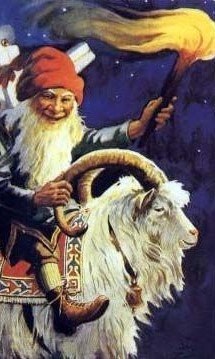
    One of Northern Europe’s wackier Christmas traditions – no doubt with pagan roots – the Yule Goat may have derived from the worship of Thor. After all, the God of Thunder’s chariot was drawn by two goats. The Christmas version of the goat is led about by Saint Nicholas, possibly as a symbol of the subjugation of evil.

    Whatever the goat’s function, it goes way back. For hundreds of years, rowdy young men in costumes would go door to door to enact plays and demand gifts. One of these, naturally, was the ornery Yule Goat. Scandinavians sometimes refer to the practice of wassailing as “going Yule Goat.”

    In the 19th century, the Goat’s role was transformed into a giver of gifts. Though the Goat has since been replaced by a humanoid Father Christmas, in Finland he is still referred to by the name Joulupukki (need I say, Yule Goat?).

    Nowadays, the Goat is mostly seen in its incarnation as a miniature tree ornament, made of straw and bound by red ribbon. A notable exception is the Gävle Goat – erected annually in Castle Square, Gävle, Sweden – which is basically that ornament, only on the grandest of scales (i.e. 40-feet tall). The Gävle Goat is constructed over a period of two days, just in time for Advent.

    Then begins an unsanctioned game of cat-and-mouse, with the authorities attempting to guard the Goat, while everyone else attempts to light it off. Yes, you read that correctly. If the Goat is burned to the ground before December 13 (St. Lucia’s Day), it is rebuilt.

    Over the years, the Goat has been rammed by a Volvo, damaged by fireworks, stomped to pieces, fired upon with flaming arrows (launched by vandals dressed as Santa and gingerbread men), and torched by a hapless American who was talked into using his lighter by Swedes who convinced him it was a perfectly legal holiday tradition. (It’s not.) In 2010, there was even a failed plot to abduct the goat by helicopter.

    2016 was the last year the goat went up in flames, set ablaze within hours of construction. The catastrophe was timed to coincide with a security guard’s bathroom break. The most recent attempt was in 2018, but the Goat sustained only minor damage to its front left leg.

    But there is also a smaller, companion goat, in the same park, which stands only about 7-feet tall. In 2019, just after I stopped checking, apparently the “kid” got singed. Nevertheless, this is the first time the larger Goat survived for more than two years in a row.

    You’ll find more information and a complete history of the Gävle Goat’s destruction here:

    http://en.wikipedia.org/wiki/G%C3%A4vle_goat

    Excellent time-lapse burning of the Goat:

    Yule Got Your Goat

    Follow the Goat’s twitter feed:

    https://twitter.com/Gavlebocken…

    View the live webcam:

    https://www.visitgavle.se/en/gavlebocken

    And to keep it musical, here’s a Christmas song by Swedish composer Hugo Alfvén:

    Anyone care to start a pool?


  • Kenneth Alwyn Film Music Conductor Dies at 95

    Kenneth Alwyn Film Music Conductor Dies at 95

    by 

    in
    5 responses

    Oh my goodness! The conductor Kenneth Alwyn has died.

    Alwyn recorded many popular classics and much film music. I remember the thrill of discovering his first, extensive digital recordings of music from “The Bride of Frankenstein” and “The Quiet Man” – two of my desert island film scores – in the bins at Tower Records.

    He also conducted Decca’s first stereophonic recording of the “1812 Overture” and several albums devoted to the works of Richard Addinsell, including, of course, the ubiquitous “Warsaw Concerto.”

    He was an experienced ballet and musical theater conductor. He held posts at the Sadler’s Wells Theatre Ballet and the Royal Ballet, Covent Garden. He served as musical director at the English premieres of many British and Broadway musicals. He recorded ballet music by Lord Berners. He made at least two very fine recordings of works by Samuel Coleridge-Taylor, including the complete oratorio, “The Song of Hiawatha.”

    Some of Alwyn’s other memorable records include albums devoted to Max Steiner, a selection of music from Ealing Studios comedies, and orchestral highlights from classic British film scores by Vaughan Williams, Sir Arthur Bliss, and others. For Silva records, he led collections devoted to Alfred Newman, Miklós Rózsa, and Ennio Morricone, as well as any number of thematically-organized anthologies.

    In 1992, he toured with the BBC Concert Orchestra, with his friend, Dudley Moore, at the piano.

    Alwyn died yesterday at the age of 95. By coincidence, I happened to include his recording of Sir Arnold Bax’s “Oliver Twist” on last night’s broadcast of “Picture Perfect,” and on Friday, shipped his recording of Paul Ben-Haim’s Symphony No. 2, as part of a Christmas mailing to a friend.

    R.I.P. Kenneth Alwyn.


  • Beethoven Handel & Hanukkah Music

    Beethoven Handel & Hanukkah Music

    by 

    in
    8 responses

    Remember when 2020 was supposed to be the big Beethoven year? To mark the 250th anniversary of his birth, I mean? How did that work out?

    Small compensation, I know, but how about a week’s worth of posts about Beethoven, to mark his actual birthday, commonly observed on December 16?

    On the fourth evening of Hanukkah, the obvious choice is Beethoven’s “Variations on ‘See the conquering hero comes,’” from Handel’s “Judas Maccabaeus.” Here’s a performance I’ve got all cued up from a recording of the complete cello sonatas:

    Beethoven was a great admirer of Handel’s music. “Handel is the greatest composer who ever lived,” he said. “I would uncover my head and kneel down on his tomb.” On his deathbed, he indicated an edition of Handel’s works and said, “There is the truth.”

    Handel’s influence can also be heard in Beethoven’s “Consecration of the House Overture” (which has nothing at all to do with the Maccabees). Note the stately intro of the piece, the fanfares, and the magnificent fugal passages:

    If you’ve got a long evening ahead of you, why not give Handel’s “other” holiday oratorio a whirl?

    If you want to skip right to the big tune, here it is:

    Then I hope you’ll join me for an hour of Hanukkah music by Michael Isaacson, Leon Stein, and Ofer Ben-Amots, on “Pieces of Eight,” on “The Lost Chord,” this Sunday night at 10:00 EST, on WWFM – The Classical Network and wwfm.org.


    Judah Maccabee, 18th century style


  • Iceland’s Terrifying Yule Lads & Christmas Monsters

    Iceland’s Terrifying Yule Lads & Christmas Monsters

    by 

    in
    One response

    Before people started to pretty much anesthetize themselves with electronics, there must have been little else to fill their time, as the days grew shorter, beyond getting all liquored up and terrorizing the kids. How else to explain the Icelandic Yule Lads?

    Not the modern-day bevy of affable, ersatz Santas, mind you – the ones who reward the good with welcome gifts and penalize the naughty with rotten potatoes – but rather the amoral pranksters and homicidal trolls who devour children.

    According to Icelandic lore, the Lads are thirteen in number. Mostly they harass and steal from Icelandic farmers. They descend from the mountains, staggering their arrivals and departures, beginning thirteen nights before Christmas. For those who can’t be bothered to do the math, that would be December 12.

    Each has his own exasperating speciality, whether it be harassing sheep, stealing milk, eating crust out of pans, licking spoons, stealing leftovers, licking bowls, slamming doors, eating skyr (a kind of Icelandic yogurt), stealing sausages, peeping through windows, sniffing for bread, stealing meat with a hook, or eating candles.

    For Tolkien fans, surely the Lads are the basis for the thirteen Dwarves [sic] who visit Bilbo Baggins, in the process eating him out of house and home and imperiling his dishes.

    Their mother is the ogress Grýla, who seeks children to boil in her cauldron. If you happen to find yourself in her gnarled claws, remember, she has to release you if you repent!

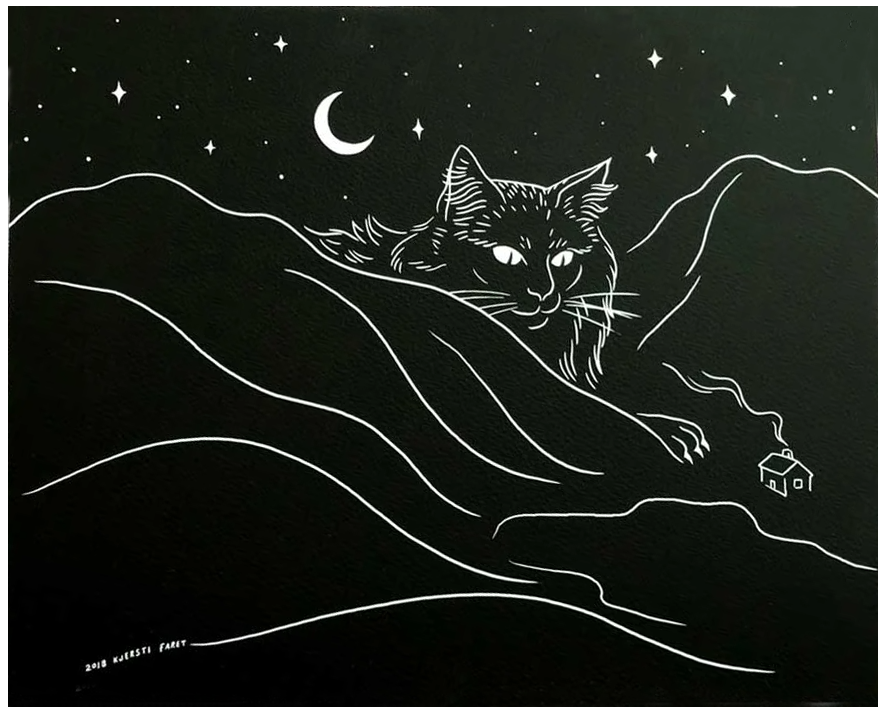
    The Yule Lads are frequently accompanied by the Yule Cat. The cat eats those who don’t receive new clothes before Christmas. This is tied in to the Icelandic work ethic. In the old days, if farm hands processed their autumn wool in a timely fashion, they were rewarded with new garments. If not, they received nothing, thereby leaving them vulnerable to the Yule Cat. Better sheer them sheep!

    In 1746, the practice of parents tormenting their children with Christmas monster stories was officially banned.

    Get festive in the way only Icelanders can, with these “Icelandic Folk Dances” by Jón Leifs.

    And remember – only 13 days of folklore and paganism until Christmas!


  • Dickens Movie Music on Picture Perfect

    Dickens Movie Music on Picture Perfect

    by 

    in
    5 responses

    God bless us, every one!

    This week on “Picture Perfect,” it’s music from movies inspired by the writings of Charles Dickens. Tune in for selections from “Nicholas Nickleby” (1947) by Lord Berners, “Oliver Twist” (1948) by Sir Arnold Bax, “David Copperfield” (1969) by Sir Malcolm Arnold, and “A Christmas Carol” (1951) by Richard Addinsell.

    If I had my way, every fool who goes around with “Merry Christmas” on his lips should be boiled in his own pudding and buried with a stake of holly in his heart!

    But this isn’t all about me. Take your pick of Dickens, on “Picture Perfect,” music for the movies, this Saturday evening at 6:00 EST, on WWFM – The Classical Network and wwfm.org.


Tag Cloud

Aaron Copland (93) Beethoven (95) Composer (114) Film Music (145) Film Score (143) Film Scores (255) Halloween (94) John Williams (195) KWAX (229) Leonard Bernstein (104) Marlboro Music Festival (125) Movie Music (160) Mozart (91) Opera (213) Philadelphia Orchestra (89) Picture Perfect (174) Princeton Symphony Orchestra (109) Radio (88) Ross Amico (244) Roy's Tie-Dye Sci-Fi Corner (290) The Classical Network (101) The Lost Chord (269) Vaughan Williams (105) WPRB (397) WWFM (881)

DON’T MISS A BEAT

Receive a weekly digest every Sunday at noon by signing up here


RECENT POSTS