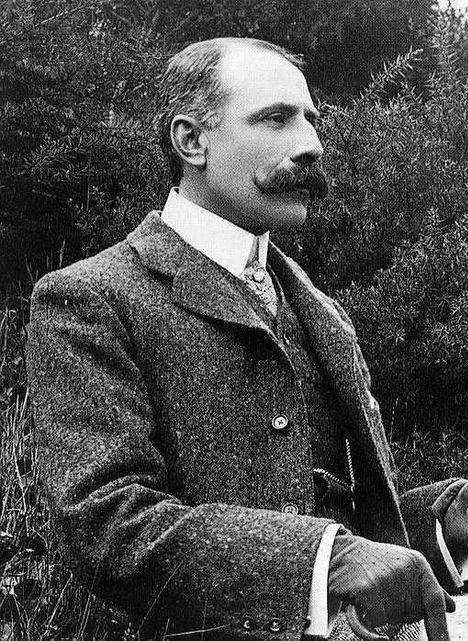
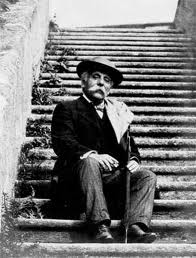
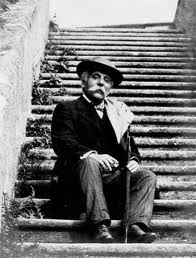
On Gabriel Fauré’s birthday, I am fascinated to learn that the composer was not only hugely popular in England, having visited there many times, he was also greatly admired by Sir Edward Elgar.
Fauré was staying the month with Elgar’s friend, Frank Schuster, prior to the London premiere of Elgar’s Symphony No. 1, in 1908. Following a rehearsal, the two attended a dinner party held by Schuster in their honor.
What did the two of them talk about? Their moustaches, I hope.
Today is the anniversary of the births of two outstanding French composers: Jules Massenet (1842-1912) and Gabriel Fauré (1845-1924).
Massenet’s fluency and emotionally direct style made him the most successful French opera composer of his generation. Fauré was the more progressive of the two. He wrote meticulously-crafted music of great nuance, with a harmonic sense that seemed to yearn for the 20th century. As an administrator, he blew the dust off the Paris Conservatory and ushered in an era of unprecedented reform.
Here are two absorbing interpretations of music by these very different French masters.
Joan Sutherland sings a selection from Massenet’s medieval romance “Esclarmonde”:
Germaine Thyssens-Valentin, a Fauré pupil, plays his Nocturne No. 6 in D-flat:
Today is the anniversary of the births of two outstanding French composers: Jules Massenet (1842-1912) and Gabriel Fauré (1845-1924).
Massenet’s fluency and emotionally direct style made him the most successful French opera composer of his generation. Fauré was the more progressive of the two. He wrote meticulously-crafted music of great nuance, with a harmonic sense that seemed to yearn for the 20th century. As an administrator, he blew the dust off the Paris Conservatory and ushered in an era of unprecedented reform.
Here are two absorbing interpretations of music by these very different French masters.
Joan Sutherland sings a selection from Massenet’s medieval romance “Esclarmonde”:
Germaine Thyssens-Valentin, a Fauré pupil, plays his Nocturne No. 6 in D-flat:
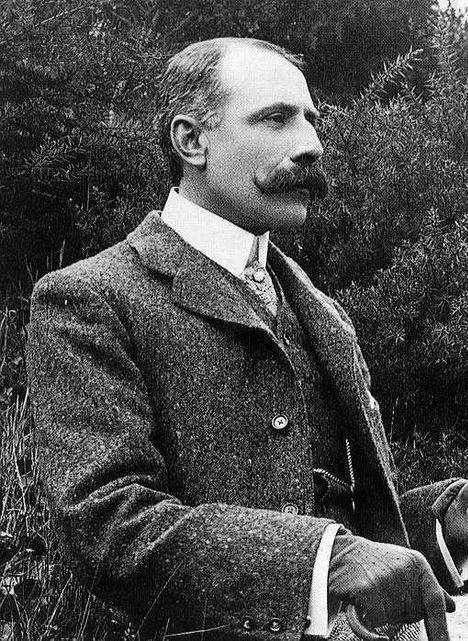
On Gabriel Fauré’s birthday, I am fascinated to learn that the composer was not only hugely popular in England, having visited there many times, he was also greatly admired by Sir Edward Elgar.
Fauré was staying the month with Elgar’s friend, Frank Schuster, prior to the London premiere of Elgar’s Symphony No. 1, in 1908. Following a rehearsal, the two attended a dinner party held by Schuster in their honor.
What did the two of them talk about? Their moustaches, I hope.
Today is the birthday of Sir Arthur Sullivan (1842-1900). Sullivan, of course, is best known as one half of the evergreen partnership, with Sir William Schwenck Gilbert, of Gilbert & Sullivan, creators of the successful series of still frequently performed, emulated, and parodied comic operas. Of course, Sullivan wrote much else besides, often chafing at being hitched to Gilbert and the obligations of Savoy opera (though admittedly lucrative), which he felt limited him as a serious composer.
I’ve long known about the cylinder of Sullivan speaking at a dinner party in 1888 (on which he makes some perspicacious remarks about the future of recorded music), but there is plenty else here that is new to me – 17 minutes of astonishing recordings and footage from Sullivan’s world. As someone points out in the comments section, the dinner party took place only five days after the double murders of Elizabeth Stride and Catherine Eddowes by Jack the Ripper.
Documents like these really make history come alive. People born in this era still walked the earth when I was a boy.
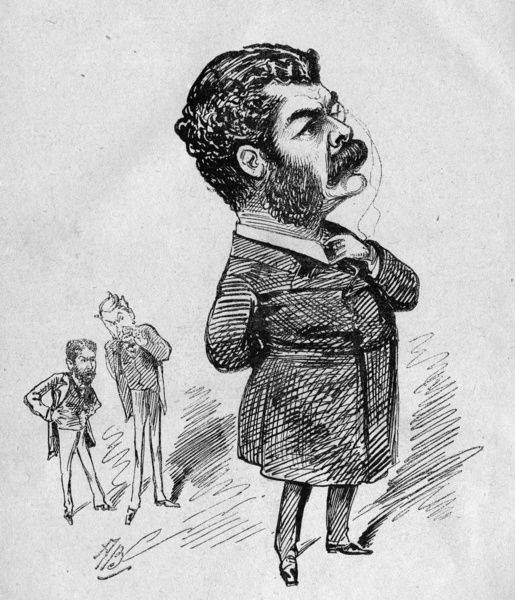
Caricature of Sullivan, with impresario Richard D’Oyly Carte and William S. Gilbert
7 responses