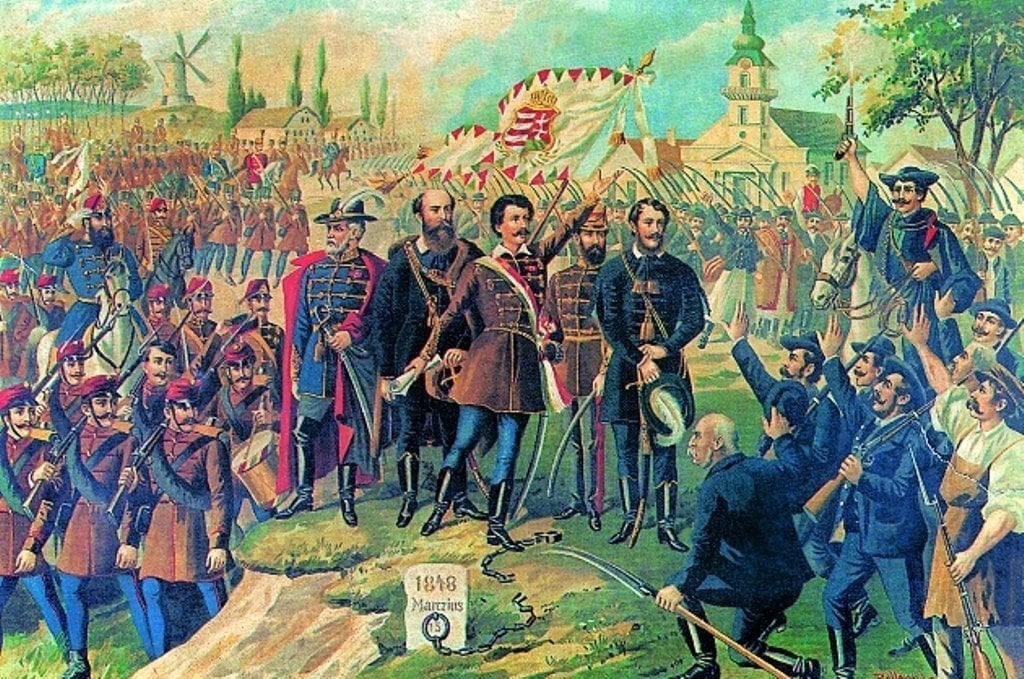
March 15 may not have worked out so well for Julius Caesar, but it is a festive day in Hungary. It is the day Hungarians mark the Revolution of 1848 and the subsequent War of Independence from Austrian-Habsburg rule. It is one of the most prominent of Hungarian national holidays, though this year, because of coronavirus concerns, public celebration is understandably muted.
The uprising began as a peaceful demonstration in Pest-Buda. It wasn’t until autumn that armies clashed. Official secession didn’t take place until March 1849, when Franz Joseph moved to subdivide the Kingdom of Hungary. In April, an independent government was formed, with firebrand Lajos Kossuth elected as governor and president. Unfortunately, the new government would be short-lived.
Here’s Liszt’s symphonic poem “Hungaria.” While Liszt offered no overt program to the piece, its patriotic intent is right there in the title. Listeners at its first performance would have associated the funeral march, based on the work’s B-theme, to the defeat of Kossuth’s revolt. Liszt conducted the piece for the first time at the Hungarian National Theater in what is now Budapest in 1856. At the end, he reported, the audience was in tears.
Béla Bartók began his symphonic poem “Kossuth,” his first mature orchestral work, in 1903. He had only just attended the Budapest premiere of Richard Strauss’ “Also sprach Zarathustra,” which he found electrifying.
Broadly speaking, the difference between Liszt’s “symphonic poems” and Strauss’ “tone poems” is that Liszt more often than not attempts to convey the ideas behind the music’s inspiration, while Strauss frequently ties moments in his scores to specific actions. At his best, Strauss can be understood without knowing the program. At his worst (and I still love him at his worst), his music is so closely tied to the action that his tone poems are like precursors to movie music.
Here is Bartók’s stab at the Straussian tone poem. The work begins with a character portrait of its subject. The Austrian national anthem is parodied to convey the approach of enemy troops. Then comes the battle and Hungarian defeat. In common with Liszt, toward the end, there is a funeral march. Again, the work caused a stir when it was given its first performance by the Budapest Philharmonic Society in 1904.
Despite the funereal overtones, Kossuth himself escaped. He toured Britain and the United States where he was received as a revolutionary hero, though there were some who bristled at his perceived arrogance and ambition. He died in Turin in 1894. His body was sent home to Pest, where it was interred, amid national mourning, and a bronze statue erected in his honor.
It’s so easy to accept music, even music that has meant so much to so many, with a degree of complacency, as an abstraction, or as mere entertainment. A broad awareness of the back story to pieces such as these imbues them with something extramusical. It allows a listener to leap across time and distance to truly empathize with the dreams, struggles, and spirit of the Hungarian people.