Tag: 1980s Movies

  • The Competition 1980 Dreyfuss Irving Movie

    The Competition 1980 Dreyfuss Irving Movie

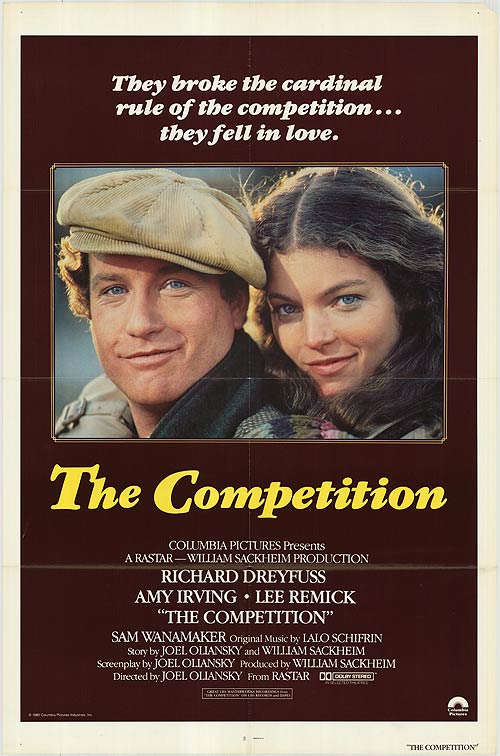
    Anybody else remember this piece of corn? I saw it in the theater back in 1980. Two pianists (Richard Dreyfuss and Amy Irving) improbably fall in love while preparing for the biggest competition of their lives.

    Of course, I enjoyed “The Competition,” even if it was preposterous, but it gained an awful lot from Prokofiev’s Piano Concerto No. 3 – a mid-performance substitute for a Mozart concerto (!) – and those creepy trees that were so memorably featured in the remake of “Invasion of the Body Snatchers.” Sam Wanamaker makes a good caricature of a Bernstein-type conductor.

    The whole thing is an eyeball-rolling throwback to the kind of classical music melodramas once overseen by middlebrow movie moguls in the 1940s. Was the always-pugnacious Dreyfuss the John Garfield of his day?

    Limp trailer employing Lalo Schifrin’s love theme

    More compelling TV ads using the Prokofiev 3rd

    What’s the last Hollywood movie that gave us something like this?

  • 80s Sword & Sandal Film Scores Unleashed

    80s Sword & Sandal Film Scores Unleashed

    “…To crush your enemies… to see them driven before you… and to hear the lamentations of their women!”

    This week on “Picture Perfect,” we venture very far from Turner Classic Movies territory with an hour of guilty pleasures, as we listen to music from sword and sandal flicks from the 1980s.

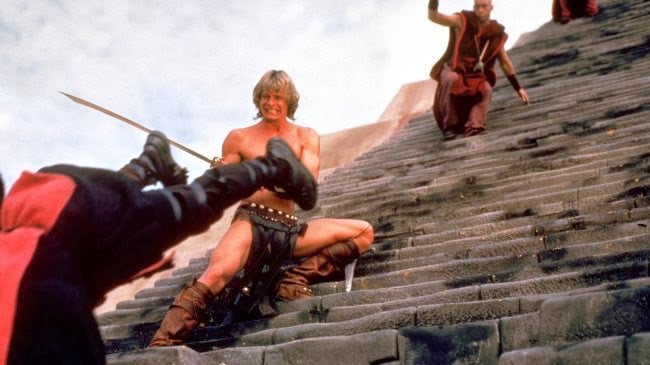
    These include “The Beastmaster” (1982), a film that was once so pervasive on cable that comedian Dennis Miller branded HBO as “Hey, Beastmaster’s On!” and TBS was known in some circles as “The Beastmaster Station.” I still haven’t seen it, believe it or not, but I know it has something to do with swords, sandals, two ferrets, and Tanya Roberts.

    The music by Lee Holdridge is given the royal treatment, in a performance conducted by Charles Gerhardt, of RCA’s legendary “Classic Film Scores” series, on an album produced by George Korngold (son of Erich Wolfgang Korngold).

    To prove that I have no reason to lie to you about not having seen “The Beastmaster,” I enthusiastically embrace the fact that, as a 15 year-old, I totally lapped up “The Sword and the Sorcerer” (1982). And since I still love everything now that I did when I was 15, you can draw your own conclusions.

    A pre-“Matt Houston” Lee Horsley stars as Talon, a mercenary-warrior of royal blood, who wields an improbable sword with three blades that can be projected, by unexplained means, like lethal rockets. There’s also a hideous wizard played by Richard Moll, who went on to play Bull on television’s “Night Court,” king of the B-movie villains Richard Lynch, and George Maharis.

    This is the best example I can think of of a really trashy movie with a fantastic score. Revisiting the music for “The Sword and the Sorcerer” merely affirms what I’ve known for a long time – that 1982 was a kind of second Golden Age for film scores, when even the terrible movies had fabulous music. The first Golden Age, of course, was roughly 40 years earlier – though the movies were generally better.

    English composer David Whitaker, a veteran of 1970s Hammer Films, relates in the album’s liner notes that he wrote and orchestrated 75 minutes of music at white heat. The result sounds like one of the great scores of three or four decades earlier. If you like Korngold, John Williams, or Vaughan Williams, for that matter, definitely check this one out.

    “Clash of the Titans” (1981) had a much more distinguished pedigree. It was the last film of stop-motion special effects genius Ray Harryhausen before his retirement. Harryhausen was responsible in large part for such classic films as “Mighty Joe Young,” “It Came from Beneath the Sea,” “Earth Versus the Flying Saucers,” “Jason and the Argonauts,” and any number of Sinbad movies.

    The supporting cast employed Sir Laurence Olivier as Zeus, Claire Bloom as Hera, Maggie Smith as Thetis, and Ursula Andress as Aphrodite, alongside Burgess Meredith and Flora Robson in her final film appearance. It was also the film that introduced Harry Hamlin, as Perseus. Hamlin went on to success on television’s “L.A. Law.”

    Laurence Rosenthal, who studied at the Eastman School and with Nadia Boulanger in Paris, wrote the score. Rosenthal was responsible for the music for, among others, “A Raisin in the Sun,” “The Miracle Worker,” and “Becket.” This one actually does turn up on TCM from time to time.
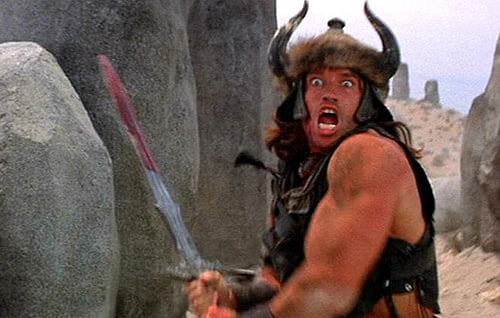
    While “The Clash of the Titans” was an end of an era of sorts, the success of “Conan the Barbarian” (1982) sparked a sword and sandal resurgence. Of course, most of the imitators it spawned were low-budget affairs that nobody ever saw. “Conan” proved a high-water mark of its kind. It also made Arnold Schwarzenegger one of the biggest stars in Hollywood.

    It sports unquestionably the best-loved score of its composer, Basil Poledouris. The music is regarded in soundtrack collector’s circles as a classic. The original soundtrack was revived in a lavish 3-CD set on the Intrada label, featuring all the available music, with alternate takes.

    If this hour serves to illustrate anything, it’s that the overall quality of a film (or lack thereof) need not hinder a composer. At least back then. If you decide to stick with it, I think you’ll be pleasantly surprised.

    Release the Kraken! Then slip on your man-flops for an hour of ‘80s sword and sandal flicks, on “Picture Perfect,” music for the movies, this Saturday evening at 6:00 EDT, on WWFM – The Classical Network and wwfm.org.
  • Conan’s Musical Might 80s Film Scores

    Conan’s Musical Might 80s Film Scores

    In the film “Conan the Destroyer” (1984), one of Conan’s companions speculates, “I suppose nothing hurts you.”

    To which Conan responds, philosophically, “Only pain.”

    Discriminating viewers may feel a little pain themselves, watching these silly, cheesy, violent films, all of which were inspired by the writings of pulp master Robert E. Howard. Howard created the warrior Conan in 1932. The character became the center of a series of lucrative stories first published in “Weird Tales” magazine.

    It would be a half century before Conan made the leap to the big screen, under the direction of John Milius. “Conan the Barbarian” (1982) propelled Arnold Schwarzenegger, already a legend in the field of bodybuilding, to international superstardom. While “Conan” isn’t exactly “Citizen Kane,” it does have its pleasures. The intensity of the violence can be a little disturbing, but the ponderous tone is a blast. “Conan” is a film that takes itself just seriously enough to make it occasionally hilarious.

    Another thing “Conan” has going for it is the fact that it was made on a blockbuster budget. The first-rate production values extend to the music by Basil Poledouris, who employs a full symphony orchestra to impressive ends. In fact, the “Conan” score was one of the strongest of the decade. It’s amazing that anyone would find so much inspiration in such a mediocre film, but Poledouris’ music intersperses Borodin-style Central Asia lyricism with brawny, thrilling action music.

    Sadly, the sequel, “Conan the Destroyer,” betrays signs of penny-pinching, so that it often winds up feeling like a direct-to-video effort. Poledouris was forced to make do with a smaller orchestra, which sounds a bit too much like a television ensemble. Still, he gave it his all, and there’s something to be said for the fact that it is an original score, rather than a mere retread of the original.

    Another one of Howard’s creations, Kull of Atlantis, was given the big screen treatment as “Kull the Conqueror” (1997). Kevin Sorbo, TV’s Hercules, plays the title role. The composer, Joel Goldsmith (son of Jerry Goldsmith), was asked to incorporate heavy metal riffs into his orchestral underscore. I haven’t actually seen this one, but for some reason I don’t feel like I’m missing anything.

    The astoundingly prolific Ennio Morricone – with more than 500 motion picture and television scores to his name – had an uncanny knack for spinning garbage into gold. His music for “Red Sonja” (1985) lends the film an aura of ‘80s cheese ball fun, perhaps more so than it deserves. This is the film that introduced Brigitte Nielsen as the chain-mailed barbarian beauty. Schwarzenegger appears in the supporting role of Lord Kalidor.

    In the ‘80s, even bad films had great scores. I hope you’ll give “Conan the Barbarian” a shot this week, on “Picture Perfect,” music for movies, this Saturday evening at 6:00 EDT, on WWFM – The Classical Network and wwfm.org!

  • Howard’s Barbarians Great Movie Music

    Howard’s Barbarians Great Movie Music

    In “Conan the Destroyer” (1984), one of Conan’s companions speculates, “I suppose nothing hurts you.”

    To which Conan replies, “Only pain.”

    Discriminating viewers may feel a little pain themselves watching these silly, cheesy, violent films, all of which were inspired by the writings of pulp master Robert E. Howard. Howard created the warrior Conan in 1932. The character became the center of a series of lucrative stories first published in “Weird Tales” magazine.

    It would be a half century before Conan made the leap to the big screen, under the direction of John Milius. “Conan the Barbarian” (1982) propelled Arnold Schwarzenegger, already a legend in the field of bodybuilding, to international superstardom. While “Conan” isn’t exactly “Citizen Kane,” it does have its pleasures. The intensity of the violence can be a little disturbing, but the ponderous tone is a blast. “Conan” is a film that takes itself just seriously enough to make it occasionally hilarious.

    Another thing “Conan” has going for it is the fact that it was made on a blockbuster budget. The first-rate production values extend to the music by Basil Poledouris, who employs a full symphony orchestra to impressive ends. In fact, the “Conan” score was one of the strongest of the decade. It’s amazing that anyone would find so much inspiration in such a mediocre film, but Poledouris’ music intersperses Borodin-style Central Asia lyricism with brawny, thrilling action music.

    Sadly, the sequel, “Conan the Destroyer,” betrays signs of penny-pinching, so that it often winds up feeling like a direct-to-video effort. Poledouris was forced to make do with a smaller orchestra, which sounds a bit too much like a television ensemble. Still, he gave it his all, and there’s something to be said for the fact that it is an original score, rather than a mere retread of the original.

    Another one of Howard’s creations, Kull of Atlantis, was given the big screen treatment as “Kull the Conqueror” (1997). Kevin Sorbo, TV’s Hercules, plays the title role. The composer, Joel Goldsmith (son of Jerry Goldsmith), was asked to incorporate heavy metal riffs into his orchestral underscore. I haven’t actually seen this one, but for some reason I don’t feel like I’m missing anything.

    The astoundingly prolific Ennio Morricone – who has more than 500 motion picture and television scores to his name – has an uncanny knack for spinning garbage into gold. His music for “Red Sonja” (1985) lends the film an aura of ‘80s cheese ball fun, perhaps more so than it deserves. This is the film that introduced Brigitte Nielsen as the chain-mailed barbarian beauty. Schwarzenegger appears in the supporting role of Lord Kalidor.

    In the ‘80s, even bad films had great scores. I hope you’ll give “Conan the Barbarian” a chance this week, on “Picture Perfect” – music for movies inspired by the writings of Robert E. Howard – this Friday evening at 6:00 EDT, on WWFM – The Classical Network and wwfm.org.

    BONUS! Tune in a little early (before 6) to hear selections from a virtuoso organ transcription of “Conan the Barbarian” by Philipp Pelster!

  • Altman’s Popeye Robin Williams’ Lost Gem?

    Altman’s Popeye Robin Williams’ Lost Gem?

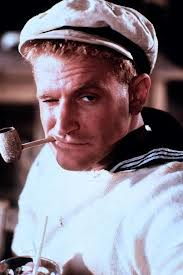
    What happens when Robert Altman directs Mork from Ork? Well, “Popeye,” I’m afraid.

    I always had a soft spot for this 1980 film, generally cited as Robin Williams’ first (earlier he had appeared in “Can I Do It ‘Til Need Glasses?”), though it received mostly tepid reviews. The film made $60 million worldwide – a respectable gross for the time – but it was a financial disappointment in light of the studio’s blockbuster expectations. Overall, “Popeye’s” reputation took a pretty sound drubbing.

    The film was written by Jules Feiffer, with a marvelous assemblage of talent in all the character roles – Paul Dooley, Linda Hunt, Bill Irwin, Paul L. Smith (best known as the unforgettable warden Hamidou in “Midnight Express”) as Bluto, and Ray Walston as the definitive Poopdeck Pappy. And of course, Shelley Duvall was born to play Olive Oyl. The film had the added interest of being shot on the island of Malta. The songs, which were generally regarded as pretty weak, were by Harry Nilsson.

    Hard to believe the producer originally wanted Dustin Hoffman for the lead (this was before it became the vogue for big actors to play comic strip characters, and Hoffman was at the peak of his career), opposite Altman regular Lily Tomlin as Olive (which could have been an interesting choice).

    Williams made a lot of bad films in his career, much worse than this one, but scanning his filmography I can say with confidence that he left behind his share of good ones, or at least ones that connected with the public. He was nominated for three Academy Awards, and took home an Oscar for his role in “Good Will Hunting.” He was certainly never hurting for work. His television series may have been cancelled, but allegedly there are four more films in the pipeline.

    Of course his genius was best displayed in front of a live audience, where his freewheeling free association could scale manic, surreal heights. I had the privilege to see his act once in Philadelphia, back in the mid-‘80s. He was unrelenting under the best of circumstances, but when someone dropped a drink into the crowd from the balcony, it sent him into overdrive. You did not want to make yourself the target of Robin Williams.

    It’s always sad when a comedian gets old, but it’s even sadder when one dies. Comedy is vitality, and Williams was nothing if not vital. It really bothers me that he’s gone. I don’t know about you, but I need all the laughter I can get.

    PHOTO: I yam what I yam!

Tag Cloud

Aaron Copland (92) Beethoven (95) Composer (114) Film Music (123) Film Score (143) Film Scores (255) Halloween (94) John Williams (187) KWAX (229) Leonard Bernstein (101) Marlboro Music Festival (125) Movie Music (138) Opera (202) Philadelphia Orchestra (89) Picture Perfect (174) Princeton Symphony Orchestra (106) Radio (87) Ralph Vaughan Williams (85) Ross Amico (244) Roy's Tie-Dye Sci-Fi Corner (290) The Classical Network (101) The Lost Chord (268) Vaughan Williams (103) WPRB (396) WWFM (881)

DON’T MISS A BEAT

Receive a weekly digest every Sunday at noon by signing up here


RECENT POSTS