Tag: Aaron Copland

  • Labor Day Music on Sweetness and Light

    Labor Day Music on Sweetness and Light

    How laborious it was to put together this morning’s “Sweetness and Light!” Which I suppose is only appropriate, since today’s theme is music for Labor Day.

    It’s not uncommon when producing a show that the running time can come up a little long. I try to avoid it, but when it happens, it’s usually remedied with a few snips. But this week I was a full 90 seconds over, which meant trimming my commentary to the bone. It can take a while to whittle it all down.

    In the end, I was still 30 seconds over. The rock was high and Classic Amico was so small!

    So I had to swap out Aaron Copland’s rarely-heard “John Henry” (at 4 minutes) for something decidedly more “Common” (at about 3:30). If you’re at all familiar with the composer and his output, I think you can deduce what that is.

    Another casualty was my fine encapsulation of the essence of John Alden Carpenter’s construction worker ballet “Skyscrapers.” There’s an awful lot of color in that score to convey a few sentences!

    “The scenario involves workers in overalls, who struggle to bring order to a confusion of girders and flashing red lights; all around them the hustle and bustle of the city. Eventually the whistle blows. There’s a diverting side-trip to a Coney Island-type amusement park, with its crowds and attractions and popular dance rhythms. Again the whistle blows, and the laborers return to work.”

    The music is still there, but I wind up basically saying “here it is.”

    Life is full of frustration, folks, but it still beats digging ditches.

    I hope you’ll join me for a program that will also include works by George Frideric Handel, Nikolai Medtner, Michael Torke, and Eric Coates, with Princeton’s own Paul Robeson singing Earl Robinson’s labor classic “Joe Hill.” How that’s sweet OR light, I have no idea, but I’m playing it.

    As always, I earn my bread by the sweat of my brow. Just in time for breakfast, I’ll be bringing home the bacon, on “Sweetness and Light,” this Saturday morning at 11:00 EDT/8:00 PDT, exclusively on KWAX, the radio station of the University of Oregon!

    Stream it wherever you are at the link:

    https://kwax.uoregon.edu/


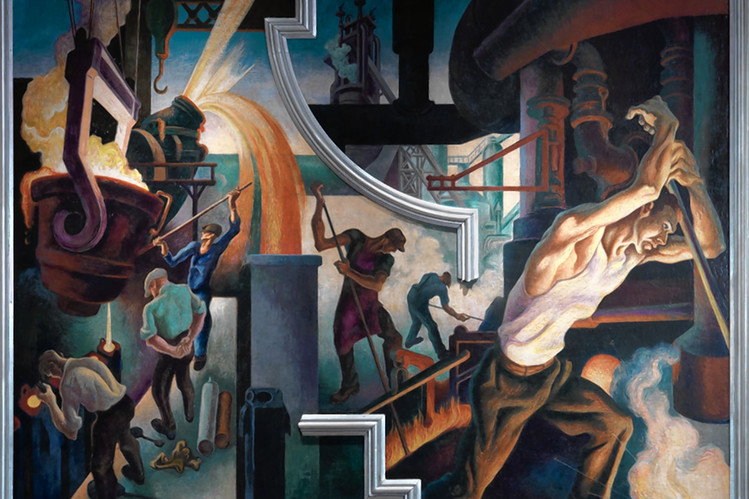
    IMAGE: One of ten dynamic panels from Thomas Hart Benton’s mural, “America Today” (1930-31). You can click through thumbnails of all of them here:

    https://www.metmuseum.org/art/collection/search/499559

  • Carlos Chávez Birthday & Rediscovered Gems

    Carlos Chávez Birthday & Rediscovered Gems

    Today is the birthday of Mexico’s multitalented Carlos Chávez. I just wrote about Chávez last month, in relation to a set of his complete recordings made for Columbia Records, now reissued on Sony Classical. Gringo that I am, I posted about it on Cinco de Mayo, a holiday that I understand is a much bigger deal here than it is in Mexico. Anyway, here again are my thoughts, if you’re interested. (More below.)

    In posting about the set, I remark upon Chávez’s late, atonal, wholly wackadoodle, but undeniably fascinating ballet “Pirámide” (1968). But in doing so, I neglect to mention his earlier, indigenous ballet, “Los Cuatro Soles” (“The Four Suns”), from 1925. The latter treats another “primitivist” subject (all the rage after Stravinsky’s “The Rite of Spring”), with four catastrophes ending a different epoch (symbolized by each of the four suns) in the history of the Nahua people. Listen to that drum at 10:23!

    Poised somewhere between the artifice of Stravinsky and the spirit of Villa-Lobos, the work is unmistakably Chávez. It’s not going to make anybody’s hit parade, but you can tell it’s the same guy who went on to write “Sinfonía India” (1935-36).

    And as I noted before, the latter work pointed the way for Aaron Copland’s western ballets. Copland was at work on “El Salón México” at the same time. Chávez would conduct the world premiere of Copland’s watershed piece in Mexico City. He also gave the first performance of Copland’s “Short Symphony,” after it was declared unplayable (because of its complexity) by Leopold Stokowski, Serge Koussevitzky, and others.

    Chávez was an important musician in so many ways. Without him, art music in the United States might have developed very differently.

    You’ll find links to “Sinfonía India” and ““Pirámide” at the bottom of my original post.

    ¡Feliz cumpleaños, Carlos Chávez!

  • Remembering War Memorial Day Music

    Remembering War Memorial Day Music

    To a great many, Memorial Day is the unofficial start of summer, a time for picnics and trips to the shore, for Hollywood to flood the multiplexes with soulless blockbusters, a signifier of the end of school, and the beginning of three long, lazy months of way too much daylight.

    But it didn’t always bear those associations. The precursor of Memorial Day was Decoration Day, first widely observed in 1868, to honor and remember those who died in the Civil War. It was a time for decorating graves, making solemn speeches, and marching in parades. These customs metamorphosed to the point where, after World War I, Memorial Day was seen as an occasion to honor those who died in ALL American wars.

    Regardless of how one may perceive armed conflict, of whether any given war may be called just or unjust, it is not war itself or conflict in general that is being celebrated. Rather, it is the sacrifice of those who died in defense of a larger cause, and ostensibly that cause has been for the common good.

    One would think, were one an idealist, that by this stage of our collective development, when any disruption in the global fabric obviously effects all of us, that wars would be considered obsolete. But sadly, human nature being what it is, there will probably always be reasons to remember.

    This week on “The Lost Chord,” we’ll salute those who made the ultimate sacrifice, by listening to three works commemorating the dead of World War II, including “For the Fallen,” a berceuse for orchestra by Bernard Herrmann; Aaron Copland’s Violin Sonata, dedicated to Lt. Larry H. Dunham, who was killed in the Pacific in 1943; and the peace cantata “A Time for Remembrance,” by John Duffy.

    Duffy himself was a World War II veteran, who lied about his age when enlisting. He became part of the Amphibious Scouts and Raiders, forerunners to the Navy SEALs, before deploying on the USS Hopping, a destroyer escort in the Pacific. His duties included detonating Japanese mines by shooting them from ship deck. When his ship took fire from shore batteries at Okinawa, the sailor standing next to him was killed. Duffy had to stand guard over the dead man’s body until burial at sea in the morning. That night watch determined the course of his life. “Since our time is so fleeting and unpredictable,” he later commented, “I knew I had to dedicate my life to music.”

    War is no picnic. I hope you’ll join me for “Requiescat in pace,” on “The Lost Chord,” now in syndication on KWAX, the radio station of the University of Oregon.


    Here, for your convenience, are the start times for all three of my recorded shows:

    PICTURE PERFECT, the movie music show – Friday at 8:00 PM EDT/5:00 PM PDT

    SWEETNESS AND LIGHT, the light music program – ALL NEW! – Saturday at 11:00 AM EDT/8:00 AM PDT

    THE LOST CHORD, unusual and neglected rep – Saturday at 7:00 PM EDT/4:00 PM PDT

    Stream them, wherever you are, at the link:

    https://kwax.uoregon.edu/


    John Duffy on his war experiences and his decision to become a composer:

  • Copland Sorey Pulitzer Music Victory

    Copland Sorey Pulitzer Music Victory

    It was on V-E Day, marking Allied victory in Europe on this date in 1945, that Aaron Copland became the recipient of the Pulitzer Prize for Music for his ballet “Appalachian Spring.” It remains one of the most successful of Pulitzer Prize winners, very few of which have remained in the active repertoire.

    This is a good opportunity for me to acknowledge the fact, only slightly belatedly, that this year’s honoree is Tyshawn Sorey, who was awarded the prize on Monday for “Adagio (For Wadada Leo Smith),” a 20-minute work for alto saxophone and orchestra. Sorey describes the piece, which was co-commissioned by the Atlanta Symphony Orchestra and Lucerne Festival, as an “anti-concerto,” designed to “provide a respite from the chaos and intrusiveness on modern life.”

    I was able to locate an audio file here:

    https://soundcloud.com/tyshawn-sorey/adagio-for-wadada-leo-smith

    In 2020, Sorey joined the faculty of the University of Pennsylvania. Belated congratulations to him for this year’s Pulitzer recognition.

    https://www.tyshawnsorey.com/

  • Semi-Documentary Film Scores Copland Thomson Kay

    Semi-Documentary Film Scores Copland Thomson Kay

    A “semi-documentary” is documentary-like, but allows staged or fictional elements, sometimes recreations or reenactments, sometimes flat-out embellishments, often with non-actors playing most of the roles. This week on “Picture Perfect,” enjoy music from four acclaimed examples.

    Aaron Copland, one of America’s most respected composers, was more active in film than most people realize. He even won an Academy Award in 1950, for his score to “The Heiress.”

    During World War II, Copland was approached by the Office of War Information to score a brief film about the resettlement of European refugees in a rural Massachusetts town. The film was called “The Cummington Story” (1945). The music is rather interesting in that, having been written at the height of Copland’s “populist” phase, he employs melodies which were later fleshed out into more familiar concert works, such as the Clarinet Concerto and “Down a Country Lane.”

    Director Robert Flaherty’s “Louisiana Story” (1948) is often misidentified as a straight documentary. (Flaherty made the first commercially-successfully, feature-length documentary, “Nanook of the North,” in 1922 – itself later revealed to have been more of a docudrama.) However, the plot is entirely fictional, an idealized story of a Cajun family that reaps the rewards of oil drilling that takes place in an inlet behind its house. The film was shot on location in bayou country, using Cajun locals as actors, giving it a certain verisimilitude.

    Although it was selected for preservation in the United States film registry by the Library of Congress as being “culturally, historically or aesthetically significant,” and its script was nominated for an Academy Award, “Louisiana Story” acts as a kind of time capsule in its naiveté. Perhaps the most interesting aspect of the entire project is the film’s score, by American composer and revered critic of the New York Herald Tribune, Virgil Thomson. So far, it is the only film score ever to be awarded the Pulitzer Prize for Music.

    Like Copland and Thomson, Ulysses Kay is associated more with his works for the concert hall. Nevertheless, he wrote music for numerous television shows and documentaries in the late 1950s and early ‘60s. His first scoring assignment was for an experimental quasi-documentary called “The Quiet One” (1948), a film about an abused African American child and his subsequent coming of age. The film received an Oscar nomination for Best Story and Screenplay, and was listed as one of the ten best movies of the year by the New York Times and the National Board of Review. Kay, a long-time resident of Teaneck, NJ, was a rarity in the world film scoring, a composer of color.

    Finally, we’ll turn to Morton Gould and “Windjammer” (1958), the only film ever to be shot in the widescreen “Cinemiracle” format. “Windjammer” depicts the training cruise of a fully-rigged sailing ship, from Oslo, across the Atlantic, to the Caribbean, New York, and back home again. Its dreamy theme music is full of the romance of the high seas.

    Artistic truth is based on fact this week. I hope you’ll join me for an hour of selections from semi-documentaries on “Picture Perfect,” music for the movies, now in syndication on KWAX, the radio station of the University of Oregon!


    Remember, KWAX is on the West Coast, so there’s a three-hour difference for those of you listening in the East. Here are the respective air-times for all three of my recorded shows (with East Coast conversions in parentheses):

    PICTURE PERFECT, the movie music show – Friday on KWAX at 5:00 PM PACIFIC TIME (8:00 PM EST)

    SWEETNESS AND LIGHT, the light music program – ALL NEW! – Saturday on KWAX at 8:00 AM PACIFIC TIME (11:00 AM EST)

    THE LOST CHORD, unusual and neglected rep – Saturday on KWAX at 4:00 PM PACIFIC TIME (7:00 PM EST)

    Stream all three, at the times indicated, by following the link!

    https://kwax.uoregon.edu/

Tag Cloud

Aaron Copland (92) Beethoven (94) Composer (114) Film Music (116) Film Score (143) Film Scores (255) Halloween (94) John Williams (185) KWAX (228) Leonard Bernstein (99) Marlboro Music Festival (125) Movie Music (131) Opera (197) Philadelphia Orchestra (86) Picture Perfect (174) Princeton Symphony Orchestra (106) Radio (86) Ralph Vaughan Williams (85) Ross Amico (244) Roy's Tie-Dye Sci-Fi Corner (290) The Classical Network (101) The Lost Chord (268) Vaughan Williams (99) WPRB (396) WWFM (881)

DON’T MISS A BEAT

Receive a weekly digest every Sunday at noon by signing up here


RECENT POSTS