Tag: Aaron Copland

  • Remembering Ned Rorem A Composer’s Legacy

    Remembering Ned Rorem A Composer’s Legacy

    After writing up a little salute to Ned Rorem the other week, on the occasion of his 99th birthday, I happened to read an interview he gave with Bruce Duffie, in which he confessed that it was important to him that his music will be remembered. It made me recollect how, upon hearing of the death of Aaron Copland, I wished I had written him a letter to let him know how much his music meant to me. I easily could have. Copland died in 1990.

    Similarly, Rorem’s remark made me think maybe I should send him a note. But I let the moment pass. In truth, his music never occupied the same kind of place in my heart as does Copland’s, but I am certainly grateful for it.

    Rorem died yesterday at the age of 99. Here’s a sampler of his music, with links to the Duffie interview and my write-up, in case you missed it.

    Leon Fleisher plays “3 Barcarolles” (1949)

    With Thanksgiving right around the corner, here’s a piece for string orchestra, called “Pilgrims” (1958). The composer hastens to point out that it has nothing to do with Plymouth Rock. Rather, it was inspired by a novel of Julien Green called “Le voyageur sur la terre.” The title in turn is borrowed from the Book of Hebrews: “These also died in faith, not having received the promises, but having seen them afar off… and confessed that they were strangers and pilgrims on the earth…” (Hebrews 11:13). Rorem points out that the music is less programmatic than it is a mood of remembrance.

    Typical of many of Rorem’s larger works, his Violin Concerto (1984) eschews a classical three-movement structure in favor of a suite of shorter movements, generally becoming lovelier and more heart-felt the closer you get to the center. In this case, there’s also a programmatic element, in that the movements are supposed to mirror a dusk-to-dawn progression.

    Bernstein conducts the world premiere of Rorem’s Symphony No. 3 at Carnegie Hall (1959)

    Anyone who’s ever read Rorem’s writings knows he definitely had his saucy side. He confessed he was shocked at having been awarded the Pulitzer Prize (for “Air Music” in 1976), since he figured the establishment would prefer to punish him for being such a naughty boy. “But it sort of gives you a certain authority,” he reflected. “My name is now always preceded by ‘Pulitzer Prize-winning composer.’ So if I die in a whorehouse, at least the obit will say ‘Pulitzer Prize-Winning Composer Ned Rorem Dies in Whorehouse.’”

    “Air Music” can be heard at the link, as part of a collection recorded by the Louisville Orchestra. The opening work, “Design for Orchestra” (1953), is certainly attractive.

    Rorem was always most highly-regarded for his art songs. He himself thought his song cycle “Evidence of Things Not Seen” (1998) – 36 songs for voice and piano – his finest work. Here are just a few selections.

    Rorem’s interview with Bruce Duffie

    http://www.bruceduffie.com/rorem.html

    My salute on October 23, with personal recollections of the composer

  • Copland Ballets Rodeo Appalachian Spring Videos

    Copland Ballets Rodeo Appalachian Spring Videos

    I’m not sure that this will win any new friends to Copland’s music – the definition on the 49-year-old video tape is pretty poor – but it should still be of interest to anyone familiar with the oft-performed concert suite. Here’s the first 12 minutes of the ballet “Rodeo,” with the original Agnes DeMille choreography. DeMille herself is interviewed at the end of the segment. The ballet’s premiere in 1942 was attended by Rodgers and Hammerstein, who invited DeMille to provide the choreography for “Oklahoma!” Supposedly “Rodeo” was the first ballet to employ tap dance. I have to say, it’s great storytelling. The action fits the music like a leather work glove.

    Unfortunately, the excerpt above does not contain the work’s most famous music, so here’s Copland himself to conduct the “Hoe-Down.” I guess it’s beef for dinner.

    BONUS: Martha Graham and company perform “Appalachian Spring,” complete, in pristine footage!

  • Copland and Pollack Share the Gift to Be Simple

    Copland and Pollack Share the Gift to Be Simple

    Aaron Copland once observed, “If a literary man puts together two words about music, one of them will be wrong.” Lord only knows what he would have made of some of my posts.

    But I would hope that I could have conjured the occasional toothy smile with a felicitous turn of phrase, or a chuckle at some weird juxtaposition or saucy irreverence.

    According to Howard Pollack, in his biography, “Aaron Copland: The Life and Work of an Uncommon Man,” Copland chuckled and even giggled quite a bit. He could also be quite wry and ironic in his observations. No doubt it helped him to maintain his even temper in the face of the absurd, his coolness under pressure, and a palpable sense of dignity.

    Copland is one of my very favorite composers, so it is difficult to believe I am only just getting around to taking Pollack’s book down off the shelf. I bought it new, from Borders in Philadelphia – at its original Rittenhouse Square location – in hardcover in 1999 (publisher Henry Holt and Company), then priced $33.75 (discounted from $37.50). Now very affordable copies can be had secondhand. I have to say, my copy still looks brand new.

    The book runs close to 700 pages, with the last 150 devoted to appendix, notes, and index. I don’t know that Pollack is a literary man, necessarily, but he is a respected and prolific author. To his credit are biographies of Walter Piston, John Alden Carpenter, George Gershwin, and Mark Blitzstein, alongside innumerable articles and the Copland entry in the “New Grove Dictionary of Music and Musicians.” He is a two-time Deems Taylor Award recipient, both for this book and for his tome (at 884 pages) on Gershwin.

    His own musical credentials are unimpeachable, with studies in piano, musicology, and composition, and decades of teaching experience at the university level. He currently serves on the faculty of the Moores School of Music at the University of Houston.

    Judging from the Copland book, his style is that of a popular biographer. His writing is accessible to the layman, he doesn’t burden the reader with a lot of unnecessary jargon, and there are no musical examples. Still, there are some things in the book, passing connections drawn and names dropped, that may glide over the heads of many, though nothing that should cause any lasting frustration to anyone.

    I’m about a quarter of the way through it, and I actually found myself pausing at a point to reflect how lucky I am in being able to fully grasp just about everything I am reading, primed by a lifetime of rabid record collecting and omnivorous listening, through an unprecedented era when so much recorded music has been available. Even in college, I recall the admiration – or envy? – of some of my teachers, since in many cases I had a broader grasp of the repertoire than they did. I would always tell them, without false modesty, that I simply had more leisure; that they were actively teaching and performing, so they didn’t have the same opportunities to actually be able to explore and listen as widely as I did.

    I hasten to emphasize that Pollack’s is not an arcane book. The writing is accessible and rolls along in a pleasant enough manner. You know my writing: all cluttered up with parenthetical phrases and superfluous commas and dashes. Pollack doesn’t do that. But I have the added advantage of knowing a lot of the music of just about everyone he mentions, and a broader grasp of the arts in general, especially of that era.

    Of course, it also helps that I happen to adore Copland. Even if you’ve read the two-volume autobiography – more of an oral history – Copland put together with Vivian Perlis, this is still worth reading, as it draws from letters, diaries, sketches, and photographs in the Copland Collection at the Library of Congress, as well as the most recent (as of 1999) Copland scholarship, and fresh interviews conducted by the author with the composer’s relatives, colleagues, friends, and love interests. Copland was a very private man, and I’m happy to report, though Pollack occasionally touches on aspects of the composer’s life about which he himself would have been particularly reticent, he does so with taste and without sensationalism. Copland emerges as a more rounded, though no less admirable individual, a decent human being, and a likeable man.

    I don’t know why, but reading the book really gives me a sense, for the first time, of just how brave, yet self-assured Copland was, in regard to his determination to earn his bread as a composer – as opposed to having to devote most of his time to teaching or performing – though he did those things for limited periods, as well as lectured and published many articles.

    What also strikes me is the realization that he spent most of his life living on very meager earnings. Even as he reached middle age, though widely-acknowledged as America’s foremost composer, he still wasn’t making any real money. But he caught enough breaks and had enough connections – most importantly, he had enough talent – that his persistence eventually started to pay off. He may not have been affluent, but he always did exactly as he pleased, and the support was always there – the commissions, shelter, and food would always turn up somehow – and it was purely in pursuit of music that he lived.

    He was not an extravagant man, though once he finally achieved eminence, and cut some canny deals with his publishers, he was able to treat himself to a fine car and a remote house with an enviable view. Even so, everything he did, whether in terms of expression or expenditure, he did so with economy and grace. Let it be said that Aaron Copland truly did have the gift to be simple.

    Born in Brooklyn in 1900, into a Jewish immigrant family that flourished in the United States, Aaron Copland was a 20th century success story. He lived 90 years, through two world wars, the Great Depression, McCarthyism, serialism, the tumultuous ‘60s, and the Reagan era. Along the way, he knew seemingly everyone. And for most of his long life, he was regarded as the Dean of American Composers.

    Pollack’s biography accomplishes the important business of making the reader want to go back and revisit the music, including a lot of the lesser known and neglected works. I’ll be doing my wildlife deliveries this morning to the austere strains of “Symphonic Ode” and other underplayed music of the 1920s. The average listener may prefer “Rodeo” and “Appalachian Spring” and “Lincoln Portrait.” But Copland is very definitely detectable as Copland in everything he did. American music’s “Dean” had the uncommon ability to reach the common man.

    Happy birthday, Aaron Copland!

  • Copland’s Lost “Miracle at Verdun” Score

    Copland’s Lost “Miracle at Verdun” Score

    On the 11th hour of the 11th day of the 11th month in 1918 (Paris time), the Armistice went into effect that formalized Allied victory and the end of World War I.

    In 1954, at the urging of U.S. veterans, Armistice Day was renamed Veterans Day. Though the intent of the holiday is frequently confused with that of Memorial Day, Veterans Day is a time to honor ALL military veterans, not just those who died in service to their country.

    While the content of today’s post would certainly be appropriate for Memorial Day, all too many veterans, I’m sure, could relate to the experience of returning home and having difficulty reassimilating, making others feel uncomfortable, and perhaps even feeling unwanted themselves.

    Hans Chlumberg’s 1930 drama, “Miracle at Verdun,” follows an international brigade of dead soldiers of the Great War who rise from their graves only to find themselves irritants to their wives who have taken new husbands, to the workers who have replaced them at their jobs, and to powerful captains of finance and government. In the end, the veterans are ordered back to their graves.

    I was very interested to discover that the first U.S. production of the play featured incidental music by none other than Aaron Copland. It was first presented in New York by The Theatre Guild on March 16, 1931. Among the cast was a young Claude Rains.

    Critic Brooks Atkinson characterized it as a “ghoulish war play.” “…[T]he fantastic idea of bringing all the war dead to life again, and then measuring their sacrifice against the brazen greed of the world that has climbed up on their broken bodies is certainly a startling theme for a play, and certainly ought to harrow us,” he observed.

    Sadly, he was less than enthused about the production, which incorporated three motion picture screens and ear-shattering amplified sound. He was impressed with Rains, though. “Claude Rains, as the Prime Minister of Belgium, makes himself heard above the general din, and gives a splendid, potent performance,” he wrote.

    Dorothy Parker declared the whole “pompous, pretentious, pseudo-artistic, and stuffy.”

    The production closed after 49 performances.

    Prior to its arrival in America, “Miracle at Verdun” caused a sensation at its debut in Leipzig and circulated throughout Europe on stage and radio. It was the last anti-war play permitted in German theaters during the early 1930s. Of course, it wouldn’t be long before the world would be plunged into war all over again. Tellingly, the action is set in 1934.

    No doubt the gathering clouds were the impetus for Chlumberg writing the play in the first place. Chlumberg, who was Austrian, experienced the horrors of the Great War first-hand as a teenager, while serving as a cavalry officer on the Italian front.

    The enormous casualties suffered during the ten-month Battle of Verdun – two million took part; 700,000 died, with no perceptible gain – made it an enduring symbol of the futility and senselessness of war.

    Ironically, Chlumberg would die from injuries sustained in a fall into the orchestra pit during the dress rehearsal for the play’s premiere.

    “Miracle at Verdun” combines elements of expressionism and realism. By its very nature, the play invites experimental stagings. While the content itself is unsettling, its reception varied from country to country, depending on the local political situation. Compared to its electric opening in Germany, for instance, the U.S. debut was met with relative complacency.

    Copland’s music remains unpublished. Scored for chamber orchestra and chorus, it includes a grim funeral march for the rising of the dead, quotations from Gregorian chant, the “Marseillaise,” and the German soldier’s song “Morgenrot,” and for its more satiric moments, recycled material from some of the composer’s works of the 1920s, including “Ukulele Serenade.”

    It’s one of several plays for which Copland wrote incidental music (including Orson Welles’ “The Five Kings,” adapted from Shakespeare), the best-known of which – thanks to Copland’s concert arrangement – is Irwin Shaw’s “Quiet City,” a play that never even opened.

    There should be plenty of material for an interesting concert and potentially concept album for anyone who cares to pursue it. You could even throw Copland’s World’s Fair puppet-play music, “From Sorcery to Science,” into the bargain. Just be sure to comp me in or send me a promotional copy, please!

  • Copland’s Vampire Ballet Secret

    Copland’s Vampire Ballet Secret

    I would venture to guess that most admirers of Aaron Copland are unaware that, as a young man in Paris, he wrote a vampire ballet.

    That’s right, the composer of “Billy the Kid” and “Rodeo,” who basically codified the sound of the American West, first tipped a toe into the world of dance by way of the undead.

    It was Copland’s teacher, Nadia Boulanger, who suggested he undertake a ballet to cash in on the success – or notoriety – of recent Ballets Russes premieres like the riot-inducing “The Rite of Spring.”

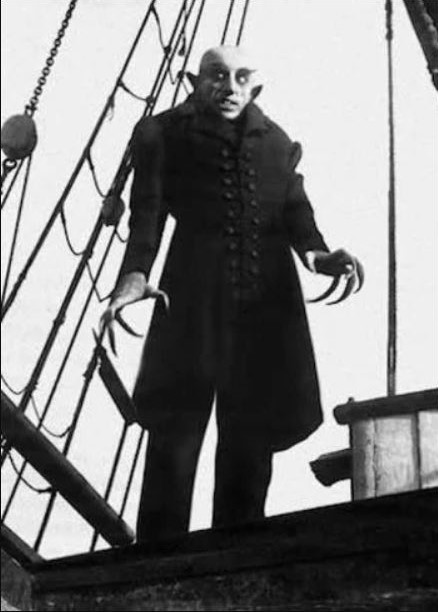
    It was F.W. Murnau’s new film, “Nosferatu,” freely based on Bram Stoker’s “Dracula,” that provided just the inspiration he was looking for. Just as Murnau tweaked Stoker’s novel – enough, he thought, to skirt the possibility of a lawsuit from the author’s estate (he was wrong) – Copland and his scenarist, Harold Clurman, jettisoned most of Murnau, but hung on to the Expressionist elements and some of the Gothic iconography.

    It’s been observed that the ballet’s narrative shares more in common with another German Expressionist classic, “The Cabinet of Dr. Caligari.” Either way, Copland’s first ballet is very far away from high-kicking buckaroos and Appalachian springs.

    Copland and Clurman created as their antihero Grohg, a necromancer, a “sorcerer who loves the dead and vainly seeks affection among them. He can make them dance in so far as he does not touch them.”

    Like Nosferatu, he bears a hooked nose and bulging eyes. He is a figure of desperate yearning. The four dead he calls forth to dance for him are an adolescent, an opium-eater, a streetwalker, and a beautiful young girl.

    When he loses control and gently kisses the latter, she awakens from her trance and repulses him, and he’s set upon by his servitors. Grohg hurls the streetwalker into the mob and then wanders into the shadows gloomily. It seems like a scenario that Béla Bartók would have loved. (Bartók was already at work on “The Miraculous Mandarin,” but his ballet would not receive its premiere until 1926.)

    Copland’s ballet, composed between 1922 and 1925, was never produced. He and Boulanger played through the score at the piano, and he cannibalized portions of the music for other works (including the even more obscure ballet “Hear Ye! Hear Ye!”).

    Eventually, the score was lost, and the only bits that could be heard were those recycled in Copland’s concert pieces “Cortège macabre” (1923), which the composer withdrew, and the “Dance Symphony” (1929). “Grohg” was finally rediscovered, miscatalogued at the Library of Congress, and given its first performance in 1992, two years after the composer’s death.

    The original title of the piece was “Le Nécromancien.” According to Copland, the spelling “Grohg,” with the peculiar inclusion of an “h,” was “to avoid an alcoholic connotation.”

    So the first orchestral work by a figure who came to be known as the “Dean of American Composers” was inspired by a vampire movie released 100 years ago.

    This year, for its centennial, special showings of “Nosferatu” abound. This weekend, organist Brett Miller will accompany a screening at The Colonial Theatre in Phoenixville, Pennsylvania.

    The Colonial gained notoriety for its use in the 1958 film “The Blob,” when the title menace oozes into the theater, setting off a panic, which is reenacted every summer during Phoenixville’s Blobfest. (FUN FACT: the film-within-a-film, shown during that sequence, is “Daughter of Horror,” also known as “Dementia,” which features a demented film score by Trenton’s own George Antheil.)

    The Phoenixville showing of “Nosferatu” will take place this Sunday at 2 p.m. On Saturday, Miller will accompany a showing of the film at the United Palace, 4140 Broadway, in Washington Heights, New York City, at 5:56 p.m. (sundown!).

    For more information, follow the links.

    In NYC

    https://unitedpalace.boletosexpress.com/nosferatu/66149/

    In Phoenixville

    https://thecolonialtheatre.com/events/theatre-organ-performances/nosferatu-1922-with-live-theatre-organ-accompaniment/

    Aaron Copland’s “Grohg”

    Happy 100th, “Nosferatu”!

Tag Cloud

Aaron Copland (94) Beethoven (95) Composer (114) Film Music (148) Film Score (143) Film Scores (255) Halloween (97) John Williams (196) KWAX (232) Leonard Bernstein (105) Marlboro Music Festival (125) Movie Music (163) Mozart (91) Opera (215) Philadelphia Orchestra (90) Picture Perfect (174) Princeton Symphony Orchestra (110) Radio (90) Ross Amico (244) Roy's Tie-Dye Sci-Fi Corner (290) The Classical Network (101) The Lost Chord (269) Vaughan Williams (107) WPRB (397) WWFM (881)

DON’T MISS A BEAT

Receive a weekly digest every Sunday at noon by signing up here


RECENT POSTS