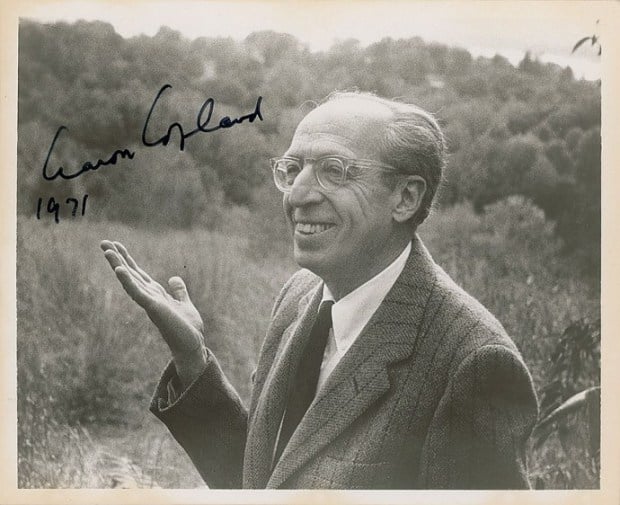
The world was a better place with Aaron Copland in it. How fortunate that one of our greatest composers lived through an era when so much could be documented on film. With Thanksgiving right around the corner, here’s a Copland cornucopia, for his birthday.
Copland plays his Piano Concerto, with Bernstein conducting
Copland conducts “Appalachian Spring” in D.C. on his 80th
Copland’s 80th birthday concert (complete), hosted by Hal Holbrook; conducted by Rostropovich, Bernstein, and Copland himself. Just listening to the composer’s opening remarks… we don’t have people like this anymore.
Copland interviewed and playing the coda of “Appalachian Spring” at the piano in his studio
“Appalachian Spring,” complete 1958 television broadcast with Martha Graham
“Aaron Copland: A Self Portrait”
Seiji Ozawa conducts Copland’s arrangement of “Happy Birthday” for Bernstein’s 70th
A “semi-documentary” is documentary-like, but allows staged or fictional elements, sometimes recreations or reenactments, sometimes flat-out embellishments, often with non-actors playing most of the roles. This week on “Picture Perfect,” enjoy music from four acclaimed examples.
Aaron Copland, one of America’s most respected composers, was more active in film than most people realize. He even won an Academy Award in 1950, for his score to “The Heiress.”
During the World War II, Copland was approached by the Office of War Information to score a brief film about the resettlement of European refugees in a rural Massachusetts town. The film was called “The Cummington Story” (1945). The music is rather interesting in that, having been written at the height of Copland’s “populist” phase, he employs melodies which were later fleshed out into more familiar concert works, such as the Clarinet Concerto and “Down a Country Lane.”
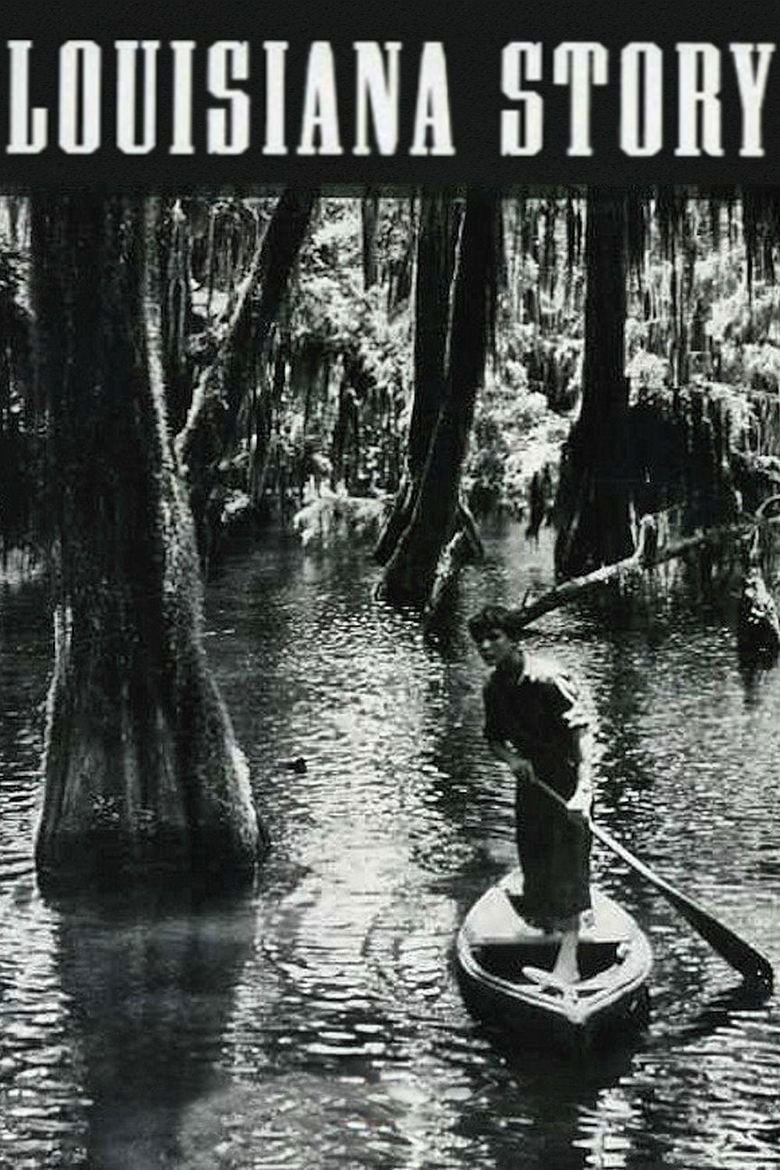
Director Robert Flaherty’s “Louisiana Story” (1948) is often misidentified as a straight documentary. (Flaherty made the first commercially-successfully, feature-length documentary, “Nanook of the North,” in 1922 – itself later revealed to have been more of a docudrama.) However, the plot is entirely fictional, an idealized story of a Cajun family that reaps the rewards of oil drilling that takes place in an inlet behind its house. The film was shot on location in bayou country, using Cajun locals as actors, giving it a certain verisimilitude.
Although it was selected for preservation in the United States film registry by the Library of Congress as being “culturally, historically or aesthetically significant,” and its script was nominated for an Academy Award, “Louisiana Story” acts as a kind of time capsule in its naiveté. Perhaps the most interesting aspect of the entire project is the film’s score, by American composer and revered critic of the New York Herald Tribune, Virgil Thomson. So far, it is the only film score ever to be awarded the Pulitzer Prize for Music.
Like Copland and Thomson, Ulysses Kay is associated more with his works for the concert hall. Nevertheless, he wrote music for numerous television shows and documentaries in the late 1950s and early ‘60s. His first scoring assignment was for an experimental quasi-documentary called “The Quiet One” (1948), a film about an abused African American child and his subsequent coming of age. The film received an Oscar nomination for Best Story and Screenplay, and was listed as one of the ten best movies of the year by the New York Times and the National Board of Review. Kay, a long-time resident of Teaneck, NJ, was a rarity in the world film scoring, a composer of color.
Finally, we’ll turn to Morton Gould and “Windjammer” (1958), the only film ever to be shot in the widescreen “Cinemiracle” format. “Windjammer” depicts the training cruise of a fully-rigged sailing ship, from Oslo, across the Atlantic, to the Caribbean, New York, and back home again. Its dreamy theme music is full of the romance of the high seas.
Artistic truth is based on fact this week. I hope you’ll join me for an hour of selections from semi-documentaries on “Picture Perfect,” music for the movies, this Saturday evening at 6:00 EST, on WWFM – The Classical Network and wwfm.org.
Enjoy a lovingly-curated Bernstein playlist (below).
“Rhapsody in Blue” from the keyboard, with the fearless Stanley Drucker on clarinet
Bernstein conducts “Prelude, Fugue and Riffs” on “Omnibus” in 1955
Bernstein and Aaron Copland create demo record of “Fancy Free” for Jerome Robbins. Stick around for commentary at the end, with self-incriminating interjection by Copland!
Bernstein’s sensational eleventh-hour debut with the New York Philharmonic, at 25, in 1943
An entire playlist of Bernstein rarities!
Conducting Haydn – with his face
Lauren Bacall sings “The Saga of Lenny,” lyrics by Stephen Sondheim (with apologies to Kurt Weill), for Bernstein’s 70th birthday celebration.
Bernstein’s death reported on ABC News in 1990.
Bernstein conducts his recently-composed “Candide Overture” on a televised Young People’s Concert in 1960
Bernstein conducts Mahler’s “Resurrection Symphony” as a memorial tribute, broadcast live, two days after the assassination of President Kennedy in 1963.
Leo Smit was born in Philadelphia 100 years ago today.
Not to be confused with the Dutch composer of the same name (born in 1900), Smit was the son of Russian immigrants. His father was a violinist who performed with Leopold Stokowski in Philadelphia, Fritz Reiner in Cincinnati, and Arturo Toscanini in New York (with the NBC Symphony).
A child prodigy, Leo took to the piano by the age of 5. When he was about 8, his mother took him to Moscow, where he studied for a year with composer Dmitri Kabalevsky.
Back home, he was accepted into the Curtis Institute of Music. He was taught there by Isabella Vengerova. Vengerova was a Leschetizky pupil. Her other students included Gary Graffman, Gilbert Kalish, Leonard Pennario, Menahem Pressler, and Abbey Simon.
Smit also learned from José Iturbi, the Spanish conductor, pianist, and harpsichordist, who achieved wider recognition in Hollywood films of the 1940s. Iturbi stood in for Cornel Wilde on the soundtrack to the Chopin biopic “A Song to Remember.”
He received further instruction in composition from Nicolas Nabokov, who was the first cousin of Vladimir Nabokov.
At 15 or 16, Smit became a rehearsal pianist for George Balanchine. He first worked with Igor Stravinsky while preparing for the world premiere of “Jeu de Cartes.” He was a devoted champion of the music of Aaron Copland, all of whose works for the keyboard he recorded. He once had the opportunity to play privately for Béla Bartók, for whom he turned pages at Carnegie Hall. Following the Carnegie concert, Copland introduced him to Leonard Bernstein. Smit also did much to revive the reputation of boogie-woogie master Pete Johnson.
In 1951, the Boston Symphony Orchestra performed Smit’s First Symphony. He also composed two operas, “The Alchemy of Love,” on a libretto by British astronomer Fred Hoyle (who also provided the text for an oratorio about Copernicus), and “Magic Water.” Among his other compositions was a collection of 100 songs after poems of Emily Dickinson. His works were programmed by Bernstein, Stokowski, and Serge Koussevitzky.
For three decades, he made his home in Buffalo, where he served on the faculty of the State University of New York. Earlier, he taught at Sarah Lawrence College and the University of California. As a photographer, he captured images of some of the era’s most notable musicians. He sometimes performed recitals to curated slide shows of his work.
Smit died in 1999 at the age of 78.
Leo Smit, Symphony No. 1:
Interesting interview with Bruce Duffie, including a great recollection of Stravinsky:
With Thanksgiving right around the corner, it’s hardly surprising our thoughts, memories, and desires would be full of home. It’s a good time then to listen to John Fitz Rogers’ “Magna Mysteria.”
This Sunday night on “The Lost Chord,” we’ll hear this 2010 work, which weaves together Latin biblical texts and poetic verse of the 6th century philosopher Boethius, to elevate the idea of home – and the seeking of home – to a metaphorical or spiritual realm. If you have a fondness for the choral music of Morten Lauridsen or Stephen Paulus, I think you’ll really enjoy this, though Rogers is very much his own man. The music is tonal, melodic, and quite lovely.
Also on the program will be Aaron Copland’s “Letter from Home,” from 1943-44. The work was commissioned by Paul Whiteman for his Radio Hall of Fame Orchestra, and suggests the emotions of an American soldier, as he experiences a bittersweet reprieve, if only for a few moments, while savoring a letter from his family.
In a year when reunions may be difficult to achieve, home is in our hearts. I hope you’ll join me for “Homebodies,” this Sunday night at 10:00 EST, on WWFM – The Classical Network and wwfm.org.