Tag: Adagio for Strings

  • Samuel Barber Rediscovered New Music

    Samuel Barber Rediscovered New Music

    I’m only perhaps one sitting away from completing Howard Pollack’s biographical doorstop (at some 700 pages) “Samuel Barber: His Life & Legacy,” issued last month by University of Illinois Press. Barber was one of America’s greatest concert composers. Surely, you recognize him, at the very least, for his ubiquitous “Adagio for Strings.”

    Pollack’s book is praiseworthy for a number of reasons, not least of which is that it kindles a desire in the reader to listen to Barber’s music, but also to revisit those pieces one may not have encountered in a very long time. Furthermore, it exposes even a fairly conversant Barberophile like myself to a number of works I never even knew existed.

    One of these is the “Chorale for Ascension Day,” which Barber composed between “Antony and Cleopatra,” the opera that opened the Met at its new location in Lincoln Center in 1966, and “The Lovers,” his choral settings of poems by Pablo Neruda, given its premiere by the Philadelphia Orchestra in 1970.

    The chorale may not stand as one of Barber’s major works, but since I only just discovered it in time for Ascension Day, today, I figured I’d take the opportunity to give another plug to Pollack’s book, which goes into exhaustive detail about virtually everything Barber ever wrote, and to share a link to this, for me, until-now unknown music.

    The work was originally composed for brass choir for the dedication of the new Gloria in Excelsis Tower at the Washington National Cathedral in 1964. The cathedral’s organist and choral director, Paul Callaway, had premiered Barber’s “Toccata Festiva” with the Philadelphia Orchestra to inaugurate the Academy of Music’s new Aeolian-Skinner organ in 1960.

    Callaway likely saw to it that new works for the tower dedication were also commissioned from the likes of Lee Hoiby, John LaMontaine, Ned Rorem, and Stanley Hollingsworth. Soon after the premiere of Barber’s brass chorale, the composer provided Callaway with a setting of the piece for chorus, in this case employing a text by Robert Pack Browning.

    The piece is also sometimes identified as “Easter Chorale.” On the basis of what I can find on YouTube, it appears that the choral version is much more common. All the brass ensembles, it seems, would rather play arrangements of “Adagio for Strings!”


    “Chorale for Ascension Day”

    Dedication of the Gloria in Excelsis Tower

    1964 Dedication of the Gloria in Excelsis Tower

    “Toccata Festiva”

    “Adagio for Strings”

    Learn more about Pollack’s book here:
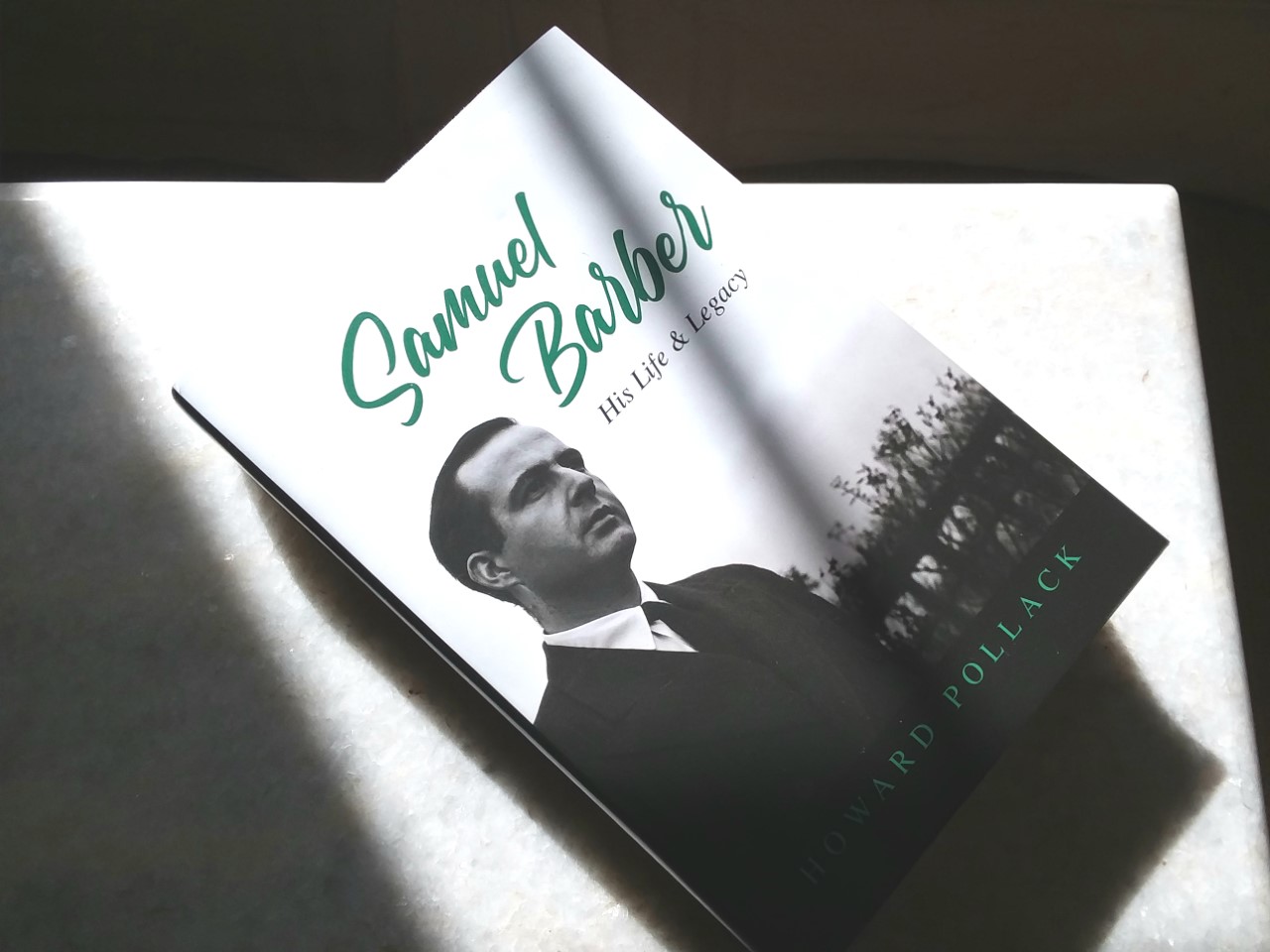
    https://www.press.uillinois.edu/books/?id=c044908&fbclid=IwAR1fG43rZrI31sNgSwMb7PJO05xooQ-Rke4YODIe1M2_xgTiFF7lVxA6k80

  • Samuel Barber: A Composer’s Humorous Side

    Samuel Barber: A Composer’s Humorous Side

    I’ve been reading Howard Pollack’s absorbing biography, “Samuel Barber: His Life and Legacy,” in advance of its release on Tuesday by University of Illinois Press.

    Barber is one of our great American composers. You’ll probably recognize his “Adagio for Strings,” at the very least, from its use in so many movies (“Platoon,” “The Elephant Man,” “Lorenzo’s Oil,” “Amélie”) and on occasions of national mourning (such as the deaths of presidents and the terrorist attacks of 9-11).

    I must say, Pollack is doing a fabulous job of shedding light on the composer’s multifaceted character. Barber’s manner could be reserved – some would say aloof – and his patrician demeanor and assumed mid-Atlantic accent, rooted in an upper-middle-class upbringing in West Chester, Pennsylvania, and his close identification with his New England forebears, may now seem like affectations from a bygone world.

    But he also had a sense of humor, offering the occasional sardonic, or even barbed observation. Once in while, he even teetered over into the downright zany. From the passage below, you’ll see he was a very capable practical joker. I thought it only appropriate to share it with you for this April Fool’s Day.


    Barber had moreover what his cousin Katharine Homer Fryer called, in reference to the Beatty side of the family, a “Beatty sense of humor,” meaning, explained Barbara Heyman, “a love of the ridiculous.” As an example, one might cite Barber’s remark to [Nathan] Broder, apropos for his fondness for soups, “I would like to be buried with a sprinkling of croutons over my coffin.” Barber showed a proclivity for childish stunts and mischievous pranks, whether in his student years interrupting a tedious concert by noisily spilling coins on a dare from [Gian Carlo] Menotti, or in later years pretending to topple down a flight of stairs spewing manuscript pages to the amusement of his sister and her children. Planning a visit home while at the American Academy in Rome in the mid-1930s, he hatched a particularly elaborate ruse, telling his parents that he was sending them a portrait of himself and arranging for Menotti, then in New York, to bring a life-size frame to West Chester. “So I brought this empty frame to West Chester,” recalled Menotti, “and I said [to Barber’s parents], ‘Now you all get out of the room because I want to unveil it.’ So then Sam sneaked into the house and he sat inside the frame and then I unveiled the thing and there was Sam who said ‘Hello.’ Poor Mrs. Barber almost fainted!”


    “Samuel Barber: His Life & Legacy” is scheduled for release on April 4. I haven’t finished it yet, but if you think it’s the kind of thing that might interest you, it’s a great read. I’ll have a more complete report by the end of the book. In the meantime, you’ll find more about it here:

    https://www.press.uillinois.edu/books/?id=c044908

  • Samuel Barber Birthday Tribute & Music

    Samuel Barber Birthday Tribute & Music

    Since last March, when Covid broke across New Jersey, the only Barber I’ve visited is Samuel Barber. The composer of the ubiquitous “Adagio for Strings” was born in West Chester, Pa., on this date in 1910.

    My favorite Barber pieces? The Violin Concerto. The Symphony No. 1. The Second Essay for Orchestra. “Souvenirs” (in the version for piano four hands). Okay, and the Adagio.

    If its passionate, elegiac character seems out of step with such a lovely day, here’s something with a lighter, carefree disposition, from his set of piano pieces titled “Excursions.”

    Also, one of his most charming songs, “The Monk and His Cat.”

    Here’s a real gem: an interview with Barber in his NYC apartment, to celebrate his 67th birthday. Barber plays the piano, displays his conversational wit, and shares his recording of “Dover Beach,” on which he appears as baritone. Stay tuned for the birthday cake at the end!

    His music may do nothing for the length of my beard, but it keeps my soul limber.

    Happy birthday, Sam.


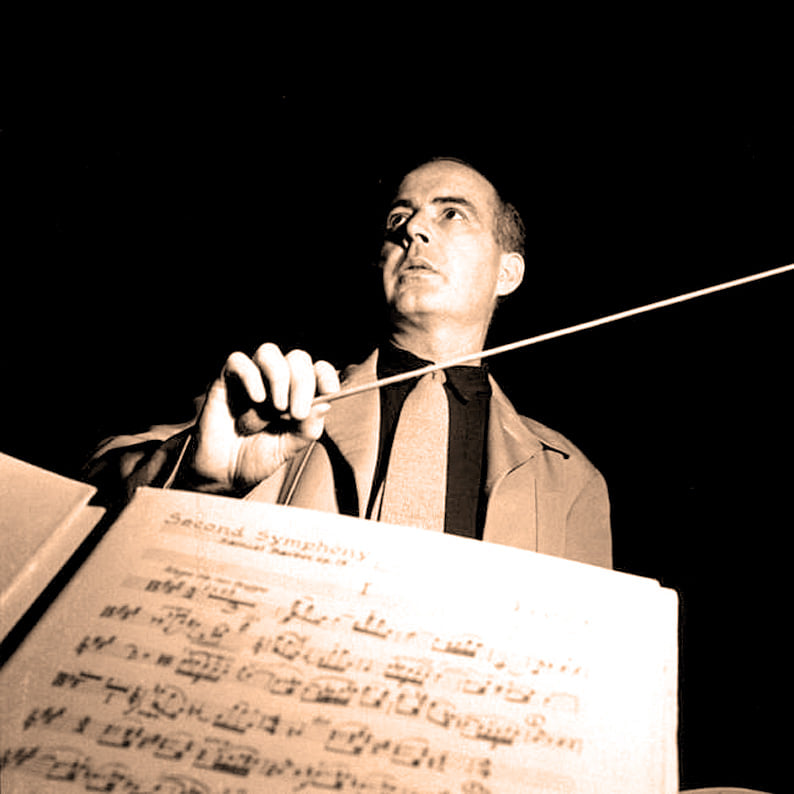
    PHOTO: Barber, dressed like Sky Masterson, conducting his Second Symphony. Ironically, Barber disliked the work. He disliked it so much, he tried to destroy it. In 1984, three years after his death, the symphony was revived when a set of parts turned up in an English warehouse.

    Hear Barber rehearse the work here:

  • Samuel Barber Doc Premieres Tonight

    Samuel Barber Doc Premieres Tonight

    This documentary about the great American composer Samuel Barber airs tonight at 8 on WHYY Philadelphia, with a repeat on 7/21 at noon. This will mark the world broadcast premiere, and the coverage area includes the composer’s hometown of West Chester, PA. Barber studied composition at the Curtis Institute of Music in Philadelphia. His “Adagio for Strings,” recognized the world over, is one of the most famous pieces written by an American composer, the introspective flip side of “The Stars and Stripes Forever.” Like so much of Barber’s music, it is revealing not only of the American character, but the broader human condition.

    You can also view the documentary here, on demand:

    Thanks again to filmmaker H. Paul Moon for making the trip in to WWFM – The Classical Network yesterday to share some of his insights into the composer and his experiences in the undertaking of this worthy project, “Samuel Barber: Absolute Beauty.”

  • Happy Birthday Samuel Barber His Best Music

    Happy Birthday Samuel Barber His Best Music

    March 9. Time for a trip to the Barber. Samuel Barber, that is.

    Happy birthday, Sam (born in West Chester, Pa., on this date in 1910).

    My favorite Barber pieces? The Violin Concerto. The Symphony No. 1. The Second Essay for Orchestra. “Souvenirs” (in the version for four-hand piano). Okay, and the Adagio.

    Sing it, Lenny.

    If you’re feeling a little on the bleak side, here’s some happy music to counterbalance the Adagio. It’s from his set of piano pieces titled “Excursions.”

    PHOTO: What you doin’ with that black shirt and baton, Sammy? Ironically, he disliked his Second Symphony. He disliked it so much, he tried to destroy it.

Tag Cloud

Aaron Copland (92) Beethoven (95) Composer (114) Film Music (123) Film Score (143) Film Scores (255) Halloween (94) John Williams (187) KWAX (229) Leonard Bernstein (101) Marlboro Music Festival (125) Movie Music (138) Opera (202) Philadelphia Orchestra (89) Picture Perfect (174) Princeton Symphony Orchestra (106) Radio (87) Ralph Vaughan Williams (85) Ross Amico (244) Roy's Tie-Dye Sci-Fi Corner (290) The Classical Network (101) The Lost Chord (268) Vaughan Williams (103) WPRB (396) WWFM (881)

DON’T MISS A BEAT

Receive a weekly digest every Sunday at noon by signing up here


RECENT POSTS