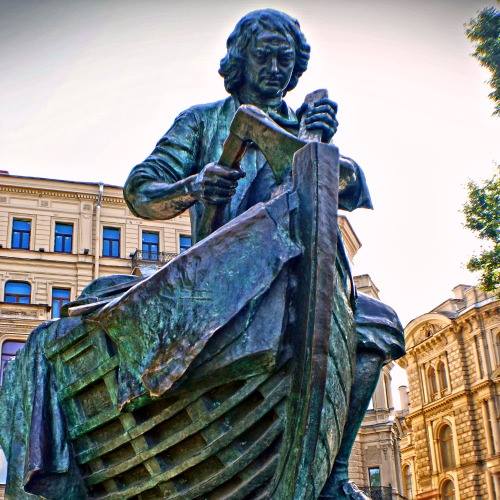
Peter the Great goes slumming in the comic opera “Zar und Zimmermann” (Tsar and Carpenter). Apropos of the title, the Russian Tsar goes undercover as a common laborer in a Dutch shipyard in order to learn shipbuilding techniques to fulfill his dream of making Russia a maritime power.
The opera is one of the most enduring of Albert Lortzing (1801-1951). Lortzing himself sang the role of “the carpenter” during the work’s premiere. We’ll celebrate Lortzing’s birthday today, as well as that of American composer Ned Rorem, from 4 to 7 p.m. EDT, on WWFM – The Classical Network and wwfm.org.
PHOTO: Monument of Peter the Great building a boat in St. Petersburg
I wonder if someone will write an opera about me 300 years after my death?
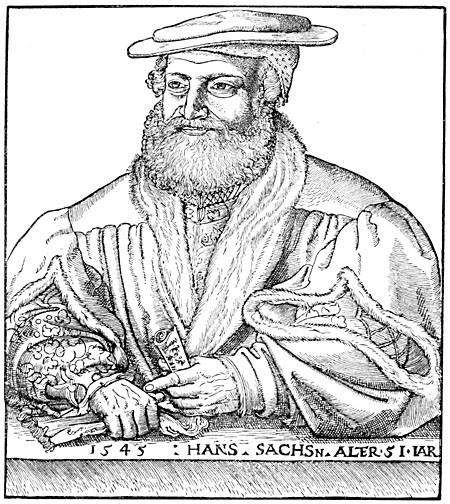
That’s what happened to the humble cobbler Hans Sachs, when Richard Wagner cast him as the wise, avuncular protagonist of his comedy “Die Meistersinger von Nürnberg.” In the opera, Sachs, the most famous of the historical Master Singers, is crowned with a laurel wreath and lionized by his peers.
The real-life Sachs was the product of a versifying mania which swept through Germany, beginning in the 14th century, and had the effect of transforming blacksmiths into bards, and bricklayers into balladists. Companies of these poet-tradesmen organized themselves in guilds.
Sachs composed some 4000 master songs, in addition to 2000 poetical works, 200 of which were verse dramas. He suffered a fair amount of tragedy, including the loss of seven children and his first wife. However, a second marriage late in life (at the age of 66) was a happy one. With his own death, he slipped into obscurity only to be rediscovered two centuries later by Goethe.
Today is anniversary of Sachs’ birth (b. 1494). By the way, he was also the subject of an earlier opera, “Hans Sachs,” by Albert Lortzing, who scooped Wagner by nearly 30 years!
Albert Lortzing’s “Hans Sachs” Overture:
Thomas Stewart sings “Wahn! Wahn! Überall Wahn!” (Madness! Madness! Everywhere Madness!) from Wagner’s version: