November 11. On the 11th hour of the 11th day of the 11th month in 1918 (Paris time), the Armistice went into effect that formalized Allied victory and the end of WWI.
In 1954, at the urging of U.S. veterans, Armistice Day was renamed Veterans Day. Though the intent of the holiday is frequently confused with that of Memorial Day, Veterans Day is a time to honor ALL military veterans, not just those who died in service to their country.
Last year I put together a photo gallery of American composers who served in the U.S. armed forces. Some of you suggested a few more, which I have now added. Thank you!
It’s easier to turn up photos of European composers who served (Vaughan Williams, Maurice Ravel, and Arnold Schoenberg, to name a few), and there are certainly plenty of lists of popular singers, but not so many of American composers, which is a shame, since a good number of them also served.
Thank you, veterans. Hoping for peace in these turbulent times.
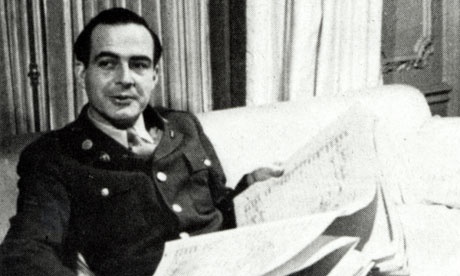
PHOTOS: (counterclockwise from top) Corporal Samuel Barber, U.S. Army Air Force; John Philip Sousa in his Marine Band uniform; Sergeant Romeo Cascarino conducting an Army orchestra; and William Grant Still, U.S. Navy. More, when you click through the gallery…
This Sunday night on “The Lost Chord,” lend a little color to your weekend, with seasonal evocations by two American composers.
Henry Hadley (1871-1937) studied at home with George Whitefield Chadwick and in Vienna with Eusebius Mandyczewski. In Europe, he befriended Richard Strauss and conducted the Berlin Philharmonic in his own Symphony No. 3. He was assistant conductor at the Mainz Opera, later music director of the Seattle Symphony, and became the first conductor of the San Francisco Symphony. One of his operas, “Cleopatra’s Night,” was performed at New York’s Metropolitan Opera. He served a stint as assistant conductor of the New York Philharmonic, he founded the National Association of Composers and Conductors, and he was instrumental in establishing the Berkshire Music Festival at Tanglewood. He guest conducted orchestras from Buenos Aires to Tokyo. Why then do so few remember him?
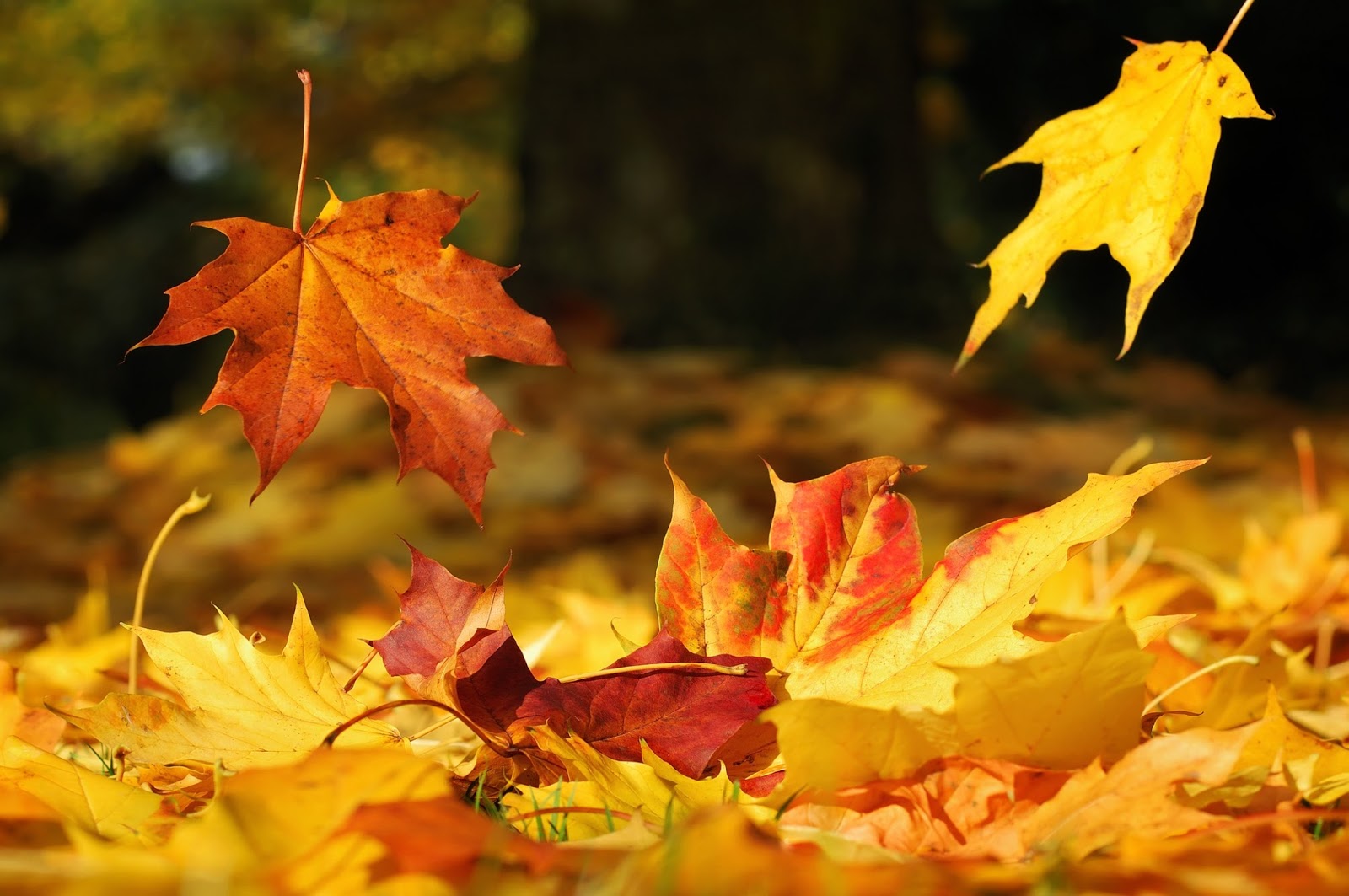
We’ll dig deep into the leaf pile of music history to revive Hadley’s Symphony No. 2, from 1901, subtitled “The Four Seasons.” The work begins with an evocation of a turbulent winter storm, followed by “Spring,” then “Summer.” The symphony concludes with a melancholy portrait of autumn, enlivened by the appearance of some rollicking hunting horns.
Toward the end of the hour, we’ll have just enough time for music by Leo Sowerby (1895-1968), sometimes called “the Dean of American Church Music.” Sowerby was awarded the Pulitzer Prize for Music in 1946 for his cantata “Canticle to the Sun.” As antidote to the reflective nature of Hadley’s “Autumn,” we’ll conclude with the exuberant “Comes Autumn Time,” an uplifting work for solo organ.
I hope you’ll join me for “Well-Seasoned” – American composers of experience celebrate autumn – this Sunday night at 10:00 EDT, on WWFM – The Classical Network and wwfm.org.
The composers Leroy Anderson and Bernard Herrmann rose to prominence, in their respective ways, through their invaluable contributions to American popular culture.
Anderson (1908-1975), whose fluency in foreign languages (especially those of Scandinavia) made him an asset to the U.S. Army during the Second World War, was more or less staff composer for the Boston Pops.
His early work for the Pops was as an arranger. It was Arthur Fiedler who recognized his talent and began requesting original work. Good call. Anderson turned out to be the Irving Berlin of American light orchestral music, producing hit after hit after hit: “Blue Tango,” “The Typewriter,” and “Plink! Plank! Plunk!” among them. Johnny Mathis scored a gargantuan success with his vocal rendition of “Sleigh-Ride,” for over half a century a holiday staple. Anderson’s “The Syncopated Clock,” a favorite from the start, became further entrenched in the popular consciousness as the theme music for “The Late Show,” a showcase for the CBS late night movie.
Herrmann (1911-1975) was staff conductor for CBS radio. In this role, he introduced American audiences to an impressive array of comparatively arcane music for the era, including works by Charles Ives, Nikolai Myaskovsky, Gian Francesco Malipiero, Edmund Rubbra, and Richard Arnell.
He fell in with Orson Welles, with whom he worked on radio shows like “Mercury Theatre on the Air” (including Welles’ notorious adaptation of “War of the Worlds”). When Welles went to Hollywood, Herrmann went with him, to write the music for “Citizen Kane.” This would be the first of decades worth of finely-crafted film scores, always orchestrated by Herrmann himself (an unusual practice in Hollywood) and always perfectly suited to the images on screen, or their psychological underpinnings.
Of course, Herrmann is best-known for his collaborations with Alfred Hitchcock (including “Vertigo,” “North by Northwest,” and “Psycho”), but he also wrote top-notch, ear-opening scores for producer Charles Schneer and special effects artist Ray Harryhausen (most notably “Jason and the Argonauts”). Amazingly, he won only a single Oscar, for his work on “The Devil and Daniel Webster,” in 1941. Herrmann died of a heart attack shortly after completing the recording sessions for Martin Scorsese’s “Taxi Driver,” in 1975.
Happy birthday, gentlemen! Thanks for all the music.
This Sunday night on “The Lost Chord,” it’s one more trip to the well, with well-played works of American composers rendered by Eugene Ormandy and the Philadelphia Orchestra.
Slake your thirst with selections from “Five Songs of William Blake” by Virgil Thomson, the Symphony No. 7 by Roy Harris, and “Four Squares of Philadelphia” by Louis Gesensway.
Gesensway was born in Latvia in 1906. A violin prodigy, he was one of the founders of the Toronto Symphony Orchestra. He came to Philadelphia at the age of 19, where he played under both Stokowski and Ormandy.
In his mid-20s, he took a leave of absence to study composition with Zoltán Kodály. “Four Squares of Philadelphia” was described by the composer as a “symphonic poem for large orchestra, narrator and street criers.”
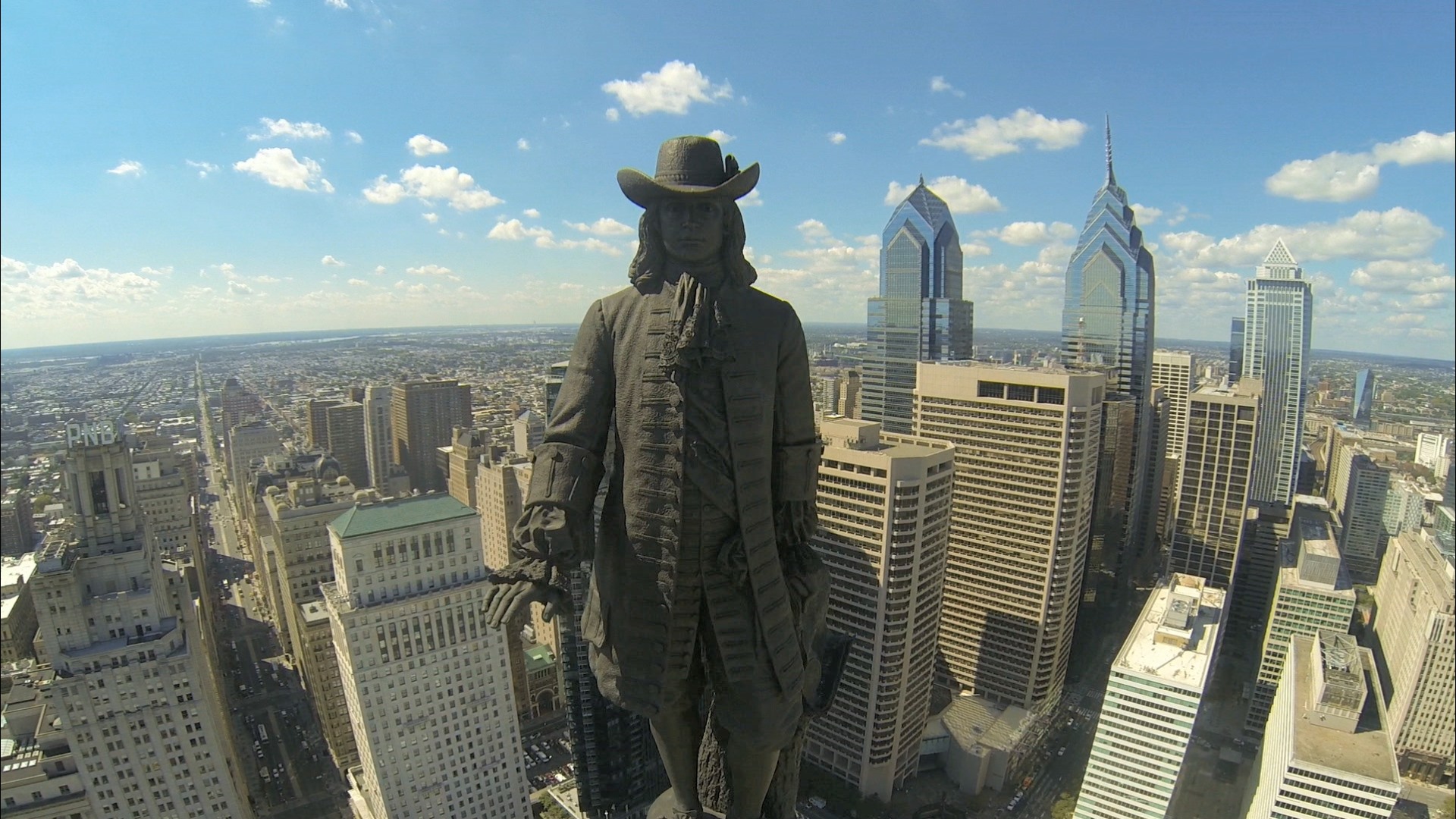
The piece opens with a recitation of William Penn’s prayer, then continues with musical evocations of Washington Square (in early morning, during Colonial times, with street criers hawking their wares), Rittenhouse Square (on a bright and cheerful afternoon), Logan Square (with its fountains at dusk), and Franklin Square (at night, evocative of noisy bridge traffic, a side excursion into Chinatown, and musical interjections from the honky tonk joints located around the square in the 1950s).
Be there or be square. Eugene Ormandy serves up the last of the Thanksgiving leftovers. I hope you’ll join me for “All-American Ormandy III,” this Sunday night at 10:00 EST, on WWFM – The Classical Network and wwfm.org.
PHOTO: Statue of Penn, high atop the city he founded
It’s not so much that I am out of ideas, but it is mighty convenient that I have so much material left over from last week’s show. Even now, I run my eye down the stack of CDs with the warm satisfaction of an acquisitive magpie.
This Sunday night on “The Lost Chord,” it’s the second installment in what is shaping up to be a three-part series of Eugene Ormandy conducting the Philadelphia Orchestra in rarely-heard recordings of American music.
Samuel Barber was born in West Chester, Pa., not far from Philly, in 1910. He attended Philadelphia’s Curtis Institute of Music and had his first orchestral work, the “School for Scandal Overture,” performed by the Philadelphia Orchestra in 1931, when he was 21 years-old.
His “First Essay for Orchestra” was sent to Arturo Toscanini in the same mail as his “Adagio for Strings.” Toscanini performed both works with the NBC Symphony in 1938, but it was Eugene Ormandy who made the first recording of “Essay,” with the Philadelphians, in 1940.
Vincent Persichetti was born in Philadelphia in 1915, and he died there in 1987. In between, he attended Combs College of Music, the Curtis Institute (where he studied conducting with Fritz Reiner) and the Philadelphia Conservatory. He taught at Combs and the Philly Conservatory. Then he received an invitation from William Schuman (some of whose music we heard last week) to take up a professorship at Juilliard.
Persichetti was one of our great composers, but to this day he remains underappreciated, more respected than loved. His Symphony No 4 of 1951 must be one of his most immediately attractive works.
Finally, John Vincent may be the most undeservedly neglected composer in Ormandy’s entire discography. Ormandy described his recording of Vincent’s Symphony in D (“A Festival Piece in One Movement”) as “one of the best we have ever done,” and the piece itself as “one of the finest compositions created by an American composer in the past decade.” The 1954 work sounds at times like Sibelius gone to the rodeo, but my, is it good stuff!
I hope you’ll join me for “All-American Ormandy II.” Ormandy recommends a visit to the Barber (pictured), then convinces with the Vincents, this Sunday night at 10:00 EST, on WWFM – The Classical Network and wwfm.org.