
Tag: American Composers

  • Summer Road Trip Music Labor Day Special

    Summer Road Trip Music Labor Day Special

    It may be the First of September, but there’s still time for one last summer road trip.

    This Sunday night on “The Lost Chord,” it’s an hour of quintessentially American music about travel by car.

    Frederick Shepherd Converse’s “Flivver Ten Million” traces the Ford Motor Company’s affordable assembly line automobile, from its creation in a Detroit factory to the manifest destiny of America’s roadways.

    John Adams’ “Road Movies” has nothing at all to do with Bob Hope and Bing Crosby, alas. What it is, however, is a violin sonata written firmly within the American tradition, with a special affinity at its core with Aaron Copland’s Violin Sonata.

    Virgil Thomson’s “Filling Station,” written for Leon Kirstein’s Ballet Caravan, may have the distinction of being the only ballet set at a gas station. The work’s success gave Copland the confidence to follow through on another Caravan commission, which resulted in “Billy the Kid.”

    Finally, we’ll hear one of Michael Daughtery’s most performed works, the exuberant “Route 66,” inspired by the storied “Main Street of America.”

    Put the pedal to the metal. American composers hit the road for Labor Day, on “The Last Roads of Summer,” this Sunday night at 10:00 EDT, on WWFM – The Classical Network and wwfm.org.
  • Gershwin’s Death & Lost Comedy Duo

    Gershwin’s Death & Lost Comedy Duo

    It was on this date in 1937 that George Gershwin died after undergoing surgery to remove a brain tumor. The composer collapsed on July 9, when he tried to stand up, and slipped into a coma. Needless to say, it was an abrupt and shocking end to one of the most vital figures in American music.

    Here’s footage of Gerswhin playing “I Got Rhythm:”

    Gershwin speaks (a comparative rarity) and plays “Strike Up the Band.”

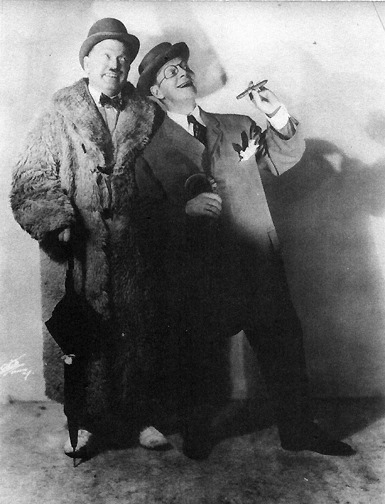
    The comedians are Clark and McCullough. Bobby Clark was the fast-talking wisecracker and Paul McCullough his laid-back sidekick. Like so many other comedy teams that graced stage and screen in the ‘20s and ‘30s, Clark and McCullough came up through vaudeville, and before that the circus(!).

    The cigar-smoking wise-acre was a real thing back then. Without the titles, I would have pegged the duo for Bert Wheeler and Robert Woolsey. More enduring examples of the stogie-wielding funnyman include George Burns, Milton Berle, and of course Groucho Marx. Groucho had his greasepaint mustache, and Clark had his painted-on glasses.

    Clark and McCullough made about three dozen film shorts and appeared in at least two features (one, “Two Flaming Youths,” with W.C. Fields). Their Broadway hit “The Ramblers” was filmed for Hollywood by Wheeler and Woolsey and released as “The Cuckoos.” Today, they are virtually forgotten.

    Clark and McCullough in “Odor in the Court:”

  • Copland Bernstein Foss Fine Discuss American Music

    Copland Bernstein Foss Fine Discuss American Music

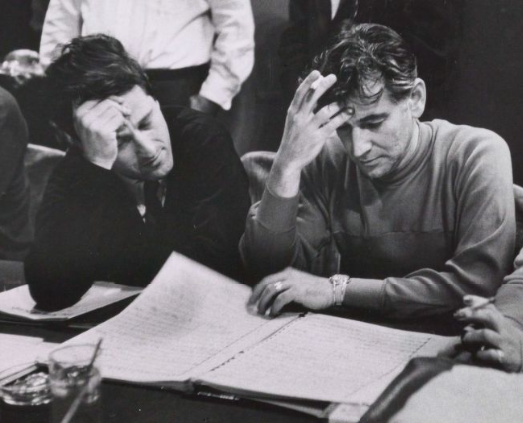
    I found this the other day, on Aaron Copland’s birthday, but I thought I would save it for the weekend, when you might have time to actually listen to it. It’s a fascinating document of four insanely talented composers – Copland, Leonard Bernstein, Lukas Foss, and Irving Fine – gathered around a piano and engaged in a bull session about the state of American music.

    https://www.wnyc.org/story/217199-what-american-music/


    PHOTOS: (top) Foss and Bernstein; (bottom) Copland and Fine

  • Veterans Day Music & Borodin Birthday

    As federal offices lag behind on their observances of Veterans Day (which was yesterday, thank you very much), we’ll listen to works by American composers who served in the U.S. Armed Forces. Join me in the 5:00 hour for music by Romeo Cascarino, Samuel Barber, William Grant Still, and a new release on Navona Records/PARMA Recordings by Samuel A. Livingston of The Blawenburg Band.

    We’ll also mark the birthday, beginning at 4:00, of everyone’s favorite chemist-composer, Alexander Borodin, with some of his music, as well as that of his colleagues of the Mighty Handful, or the Russian Five.

    Finally, we’ll remember Slovak soprano Lucia Popp on the anniversary of her birth.

    It’s a late afternoon and early evening of musical and military veterans, from 4 to 7 p.m. EST, on WWFM – The Classical Network and wwfm.org.

  • Celebrating Autumn with American Composers

    Celebrating Autumn with American Composers

    After one last dose of tropical miserableness, coquettish Summer decided to show us what she could do yesterday with a glorious afternoon in the Princeton area that really was more like Autumn. It turns out she was holding back all along, the big tease. Well, good riddance, baby!

    We all know that Summer is high maintenance and that Autumn has the better disposition anyway. Why fight all the time with Summer, when it’s so much easier to get along with Autumn? The riot of colors, the crunching leaves underfoot, the comfy sweaters, hot beverages savored, used book fairs, classic horror movies, infinite night skies, and Thanksgiving. Welcome, O Happy Season!

    This Sunday night on “The Lost Chord,” we’ll celebrate the first full day of autumn with musical evocations by two American composers.

    Henry Hadley (1871-1937) studied at home with George Whitefield Chadwick and in Vienna with Eusebius Mandyczewski. In Europe, he befriended Richard Strauss and conducted the Berlin Philharmonic in his own Symphony No. 3. He was assistant conductor at the Mainz Opera, later music director of the Seattle Symphony, and became the first conductor of the San Francisco Symphony. One of his operas, “Cleopatra’s Night,” was performed at New York’s Metropolitan Opera. He served a stint as assistant conductor of the New York Philharmonic, he founded the National Association of Composers and Conductors, and he was instrumental in establishing the Berkshire Music Festival at Tanglewood. He guest conducted orchestras from Buenos Aires to Tokyo. Why then do so few remember him?

    We’ll dig deep into the leaf pile of music history to revive Hadley’s Symphony No. 2, from 1901, subtitled “The Four Seasons.” The work begins with an evocation of a turbulent winter storm, followed by “Spring,” then “Summer.” The symphony concludes with a melancholy portrait of autumn, enlivened by the appearance of some rollicking hunting horns.

    Toward the end of the hour, we’ll have just enough time for music by Leo Sowerby (1895-1968), sometimes called “the Dean of American Church Music.” Sowerby was awarded the Pulitzer Prize for Music in 1946 for his cantata “Canticle to the Sun.” As antidote to the reflective nature of Hadley’s “Autumn,” we’ll conclude with the exuberant “Comes Autumn Time,” an uplifting work for solo organ.

    I hope you’ll join me for “Well-Seasoned” – American composers of experience celebrate autumn – this Sunday night at 10:00 EDT, on WWFM – The Classical Network and wwfm.org.

Tag Cloud

Aaron Copland (92) Beethoven (95) Composer (114) Film Music (120) Film Score (143) Film Scores (255) Halloween (94) John Williams (185) KWAX (229) Leonard Bernstein (100) Marlboro Music Festival (125) Movie Music (135) Opera (198) Philadelphia Orchestra (88) Picture Perfect (174) Princeton Symphony Orchestra (106) Radio (87) Ralph Vaughan Williams (85) Ross Amico (244) Roy's Tie-Dye Sci-Fi Corner (290) The Classical Network (101) The Lost Chord (268) Vaughan Williams (103) WPRB (396) WWFM (881)

DON’T MISS A BEAT

Receive a weekly digest every Sunday at noon by signing up here


RECENT POSTS