Tag: American Music

  • Atlanta Symphony’s Thanksgiving: American Music

    Atlanta Symphony’s Thanksgiving: American Music

    Thanksgiving is always a good excuse to play American music, and this year, in light of all the organization has been through recently, I thought I’d devote an hour to recordings of the Atlanta Symphony Orchestra.

    The musicians and management recently reached an agreement, with the help of outside federal mediators, after ten months of contract negotiations that culminated in a two-month player lockout. The two sides arrived at a four-year deal, and the orchestra is back to work. As the major symphonic organization in the Southeastern United States, this is indeed a cause for thanksgiving.

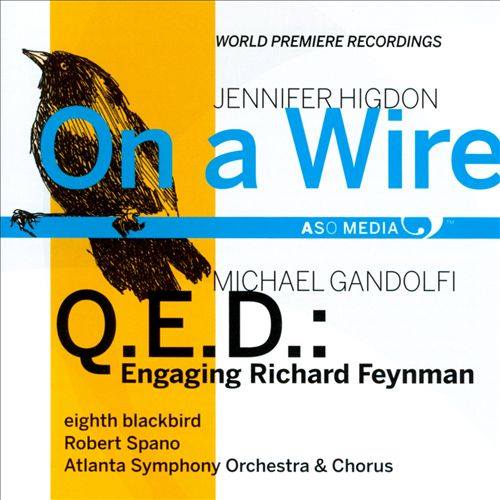
    This Sunday night on “The Lost Chord,” we’ll hear two works co-commissioned by the symphony from representatives of the so-called “Atlanta School,” composers frequently championed and recorded by the orchestra and its music director, Robert Spano.

    Jennifer Higdon, now one of the most successful of American composers, a Pulitzer Prize winner who teaches at the Curtis Institute of Music, studied conducting with Spano at Bowling Green. She wrote a concerto grosso of sorts for the New Music sextet eighth blackbird (which identifies itself, modestly, in the lower case). The group performs with the symphony in “On a Wire.” The composer asks the listener to imagine six blackbirds, sitting on a wire.

    Birds also play a role in Michael Gandolfi’s “Q.E.D.: Engaging Richard Feynman,” inspired by the Nobel Prize-winning physicist.

    Gandolfi’s piece doesn’t focus on scientific inquiry. Rather it takes as its starting point two anecdotes shared by Feynman in interviews with the BBC, which the composer discovered on YouTube.

    The first concerns a challenge put by an artist friend of Feynman suggesting that as a scientist he cannot truly appreciate the beauty of a flower. Feynman counters that scientific knowledge, a greater understanding of the flower, only adds to its beauty, rather than detracts.

    The second grows out of an anecdote concerning Feynman’s boyhood ignorance of the name of a certain kind of bird, a brown-throated thrush, and his realization that a name tells nothing about the bird, but rather something about the people who named the bird. He concludes, “Now, let’s look at the bird.”

    The piece, scored for chorus and orchestra, is organized into two sections made up of settings of texts by various poets illustrating their respective themes, including those of Gertrude Stein, Emily Dickinson, Walt Whitman, Ralph Waldo Emerson, Siegfried Sassoon, and the Irish Republican Joseph Campbell (not to be confused with the mythologist).

    Both works appear on an album issued on the orchestra’s ASO Media label.

    I hope you’ll join me for “Georgia Peaches,” American music performed by the Atlanta Symphony Orchestra, this Sunday night at 10 ET, with a repeat Wednesday evening at 6 – or that you’ll listen to it later as a webcast at http://www.wwfm.org.
  • Labor Day Road Trip American Music

    Labor Day Road Trip American Music

    Labor Day weekend. Summer’s last hurrah.

    This Sunday night on “The Lost Chord,” it’s an hour of quintessentially American music about travel by car.

    Frederick Shepherd Converse’s “Flivver Ten Million” celebrates the Ford Motor Company’s affordable assembly line automobile, from its creation in a Detroit factory to the manifest destiny of America’s roadways.

    John Adams’ “Road Movies” has nothing to do with Bob Hope and Bing Crosby, alas; what it is, however, is a violin sonata written firmly within the American tradition, with a special affinity at its core with Copland’s Violin Sonata.

    Virgil Thomson’s “Filling Station,” written for Leon Kirstein’s Ballet Caravan, may have the distinction of being the only ballet set at a gas station. The work’s success gave Copland the confidence to follow through on a Caravan commission which resulted in “Billy the Kid.”

    Finally, we’ll hear one of Michael Daughtery’s most performed works, the exuberant “Route 66,” inspired by the storied “Main Street of America.”

    Join me for “The Last Roads of Summer.” American composers hit the road for Labor Day this week, on “The Lost Chord.” This Sunday night at 10 ET, with a repeat Friday morning at 3. Or catch it later as a webcast, at http://www.wwfm.org.

  • Dvořák’s American Flag A Neglected Masterpiece

    Dvořák’s American Flag A Neglected Masterpiece

    It’s Flag Day! Antonin Dvořák planned his rarely-heard cantata “The American Flag” to celebrate his arrival in America in 1892 as director of the National Conservatory of Music in New York. But the text, by Joseph Rodman Drake, arrived too late, and the work did not receive its first performance until 1894. Though he submitted the vocal score for publication in 1895, he did not consider the work complete until 1898.

    Scored for tenor, baritone, chorus and orchestra, the cantata falls into eight sections:

    I. The Colors of the Flag
    II. First Hymn to the Eagle
    III. Second Hymn to the Eagle
    IV. Orchestral Interlude: March
    V. First Address to the Flag (The Foot-Soldier)
    VI. Second Address to the Flag (The Cavalryman)
    VII. Third Address to the Flag (The Sailor)
    VIII. Apotheosis (Prophetic)

    The piece remains something of an obscurity, having never attained the popularity of other major works of his American years, including the String Quartet No. 12 in F Major, Op. 92 (the so-called “American”), the “New World” Symphony No. 9, and his Cello Concerto in B Minor. Part of the reason may be the fact that, for the most part, the work doesn’t sound particularly “American.”

    His association with Henry T. Burleigh (called Harry), his African-American assistant at the conservatory, and travels around the American Midwest, introduced Dvořák to the Negro Spiritual and Native American folk music, traditions the composer enthusiastically embraced. He called upon his American counterparts to look to their own soil in the founding of a unique national sound.

    Mindful of the invaluable contributions of their people, Dvořák lobbied to waive tuition to the conservatory for talented Native and African American composers who could not afford the fee. His perceptivity, his enthusiastic support for, and his elevation of sounds that really were in the American ear all along earn Dvořák his place as the honorary Grandfather of American Music.

    Here is the neglected cantata, “The American Flag,” posted in two parts:


Tag Cloud

Aaron Copland (93) Beethoven (95) Composer (114) Film Music (143) Film Score (143) Film Scores (255) Halloween (94) John Williams (195) KWAX (229) Leonard Bernstein (104) Marlboro Music Festival (125) Movie Music (158) Mozart (90) Opera (212) Philadelphia Orchestra (89) Picture Perfect (174) Princeton Symphony Orchestra (108) Radio (88) Ross Amico (244) Roy's Tie-Dye Sci-Fi Corner (290) The Classical Network (101) The Lost Chord (269) Vaughan Williams (105) WPRB (397) WWFM (881)

DON’T MISS A BEAT

Receive a weekly digest every Sunday at noon by signing up here


RECENT POSTS