How can a deeply flawed human being write music of lasting beauty? That’s a question that is bound to assert itself when considering the case of John Powell (1882-1963).
This Sunday night on “The Lost Chord,” I’ll be presenting Powell’s “Virginia Symphony” (originally titled “Symphony on Virginian Folk Themes and in the Folk Modes”), which is built on melodies collected by the composer over decades of folk song research. It was composed in 1945, and substantially revised in 1951. If at the times the music has something of an English flavor, it’s because most of the tunes Powell collected were of English, Irish or Scottish origin. A good many of them were already old when Elizabeth I was young. It’s useful to remember, Powell was a contemporary of Ralph Vaughan Williams. (He was roughly ten years Vaughan Williams’ junior.) Folk song collecting was very much in the air, on both sides of the Atlantic.
Unfortunately, Powell had something of a blind spot for melodies outside of what he considered the acceptable Anglo-Saxon fold. In organizing folk festivals, he denied entry to spirituals, gospel and protest songs. More damningly, he was actively involved in the organization of the Anglo-Saxon Clubs of America, a magnet for white supremacists, which was instrumental in the passage of the Virginia Racial Integrity Law of 1924. Under the law, racial identity was clearly delineated. It recognized only two races – “white” and everyone else. Anyone of African ancestry was classified as “colored.” People who had previously identified themselves as multi-racial, some of whom were of one-sixteenth African ancestry, were now legally negroes (using the terminology of the time). The Racial Integrity Law criminalized marriages between whites and nonwhites. The law was passed at the same session during which the Virginia General Assembly legalized the sterilization of what were termed the “feebleminded,” defined as “insane, idiotic, imbecile, or epileptic.” The same ideas were percolating in Germany, of course, though it would take another ten years for the Nazis to catch up.
Not content to work behind the scenes, Powell wrote a book on the subject, “Mongrels in America,” in which he expresses his views on the importance of keeping the races separate. Rather ironic, I think, in that Powell’s best-known piece is probably his “Rhapsodie nègre,” for piano and orchestra. He was a composer with some repugnant notions, certainly. How much of it is relevant to our enjoyment of the music is debatable. The controversial views of Richard Wagner seem almost tame by comparison.
Even so, the music is worth hearing. Powell was clearly passionate about Anglo-American folk songs. It’s unfortunate that that passion spilled over into other areas that a good many today would, justifiably, find abhorrent. Still, the Virginians are understandably proud of their native son. We’ll hear a recording of his symphony made by JoAnn Falletta and the Virginia Symphony Orchestra, of which she has been music director since 1991.
I hope you’ll join me for “Yes, Virginia, There is a Symphony,” this Sunday night at 10:00 EDT, on WWFM – The Classical Network and wwfm.org.
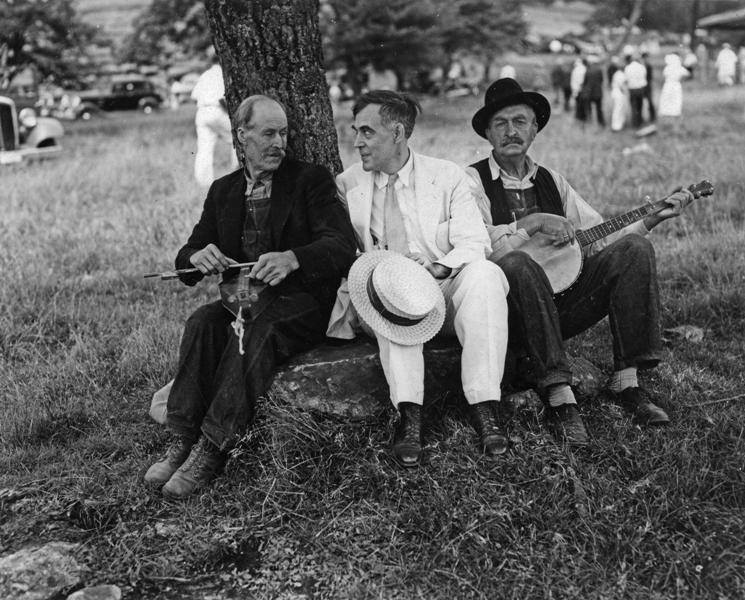
PHOTO: John Powell (center) learns a thing or two about bowing a dulcimer at the White Top Folk Festival, the festival he helped found, in the 1930s.