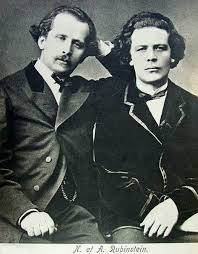
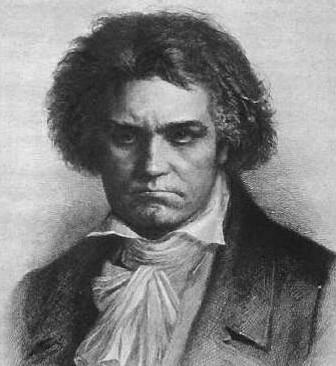
His manner of playing could border on the hysterical. His wild hair brought comparisons to Beethoven, while he obliterated orchestras in avalanches of sonority. His lack of restraint turned Clara Schumann’s stomach, while the notoriously prickly critic Eduard Hanslick was forced to concede that the sensual element of his playing carried all before it. “Yes, he plays like a god,” he wrote, “and we do not take it amiss if, from time to time, he changes, like Jupiter, into a bull.”
Anton Rubinstein was one of the most remarkable figures in Russian music. A pianist, composer and conductor – rumored, in fact, to be the illegitimate son of Beethoven (though physically impossible, since he was born 20 months after Beethoven’s death) – Rubinstein founded the Saint Petersburg Conservatory. His brother, Nikolai, the original dedicatee of Tchaikovsky’s Piano Concerto No. 1 (with which he had a complicated history), founded the conservatory in Moscow.
As a composer, Anton amassed a considerable output. He wrote orchestral works, chamber and instrumental music, and songs. His Piano Concerto No. 4 retains a foothold on the repertoire, though it is not nearly as often heard as it should be. The best known of his 20 operas, “The Demon,” remains popular in Russia. Though celebrated at home, throughout Europe and in the United States as a towering virtuoso, nothing is ever heard of his six symphonies.
The original version of his ambitious Symphony No. 2, subtitled “The Ocean,” was written in 1851. The piece grew in scope, through revisions over 29 years, as the composer became absorbed in the developments of Romantic “program” music – music that attempted to evoke extra-musical subjects. Though Rubinstein dedicated the symphony to Franz Liszt, with whom he enjoyed friendly relations and who offered much advice, don’t expect anything along the lines of Liszt’s more revolutionary structures. The revised “Ocean” falls into seven movements (expanded from the original four), but the music is more in line with the quieter innovations of the German classicists than anything from the New German School. Furthermore, there is little about it that sounds particularly “Russian.”
When he undertook the writing of his symphony, Rubinstein was still in search of an individual voice as a composer. In a way, the development of the piece mirrors his perpetual grappling with his own sense of self. “To Jews, I am a Christian; to Christians, I’m a Jew,” he wrote. “To Russians, I’m a German, but to Germans, I’m Russian. To the classicists, I’m an innovator, but to innovators, I’m a reactionary, and so on. The verdict: neither fish nor fowl, a pitiful identity.”
I hope you’ll join me today, from 12 and 4 p.m. EDT, as we set sail on Anton Rubinstein’s “Ocean” Symphony, among my featured works, on WWFM – The Classical Network and wwfm.org.
PHOTO: The amazingly talented and influential Brothers Rubinstein (Anton on the right)