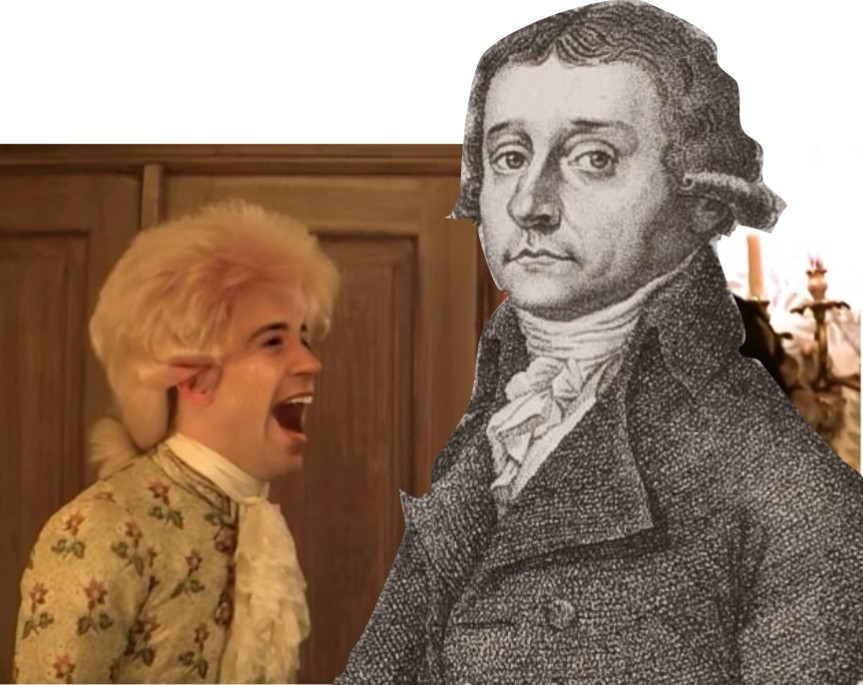
With the news that 149 lost works of Antonio Salieri have come to light, now seems like a good time to remind you about this year’s Bard Music Festival, “Mozart and His World” (to be held at Bard College in Annandale-on-Hudson, NY, August 7-16).
Is there Salieri on the program? Why, yes, yes there is. It falls under the category of “His World.” You see, even when the focus of the festival is on a well-known composer – and what composer is better-known than Mozart? – the planning committee goes into overdrive, racking their brains and spackling in around the edges with composers and works your average person-on-the-street may not have ever heard of, and certainly have never heard.
My preference, of course, is for the years Bard tackles figures such as Bohuslav Martinu or Carlos Chávez or Ralph Vaughan Williams or Erich Wolfgang Korngold; but under the Mozart umbrella, Christoph Willibald Gluck, Josef Mysliveček, Paul Wranitzky, Emanuel Schickaneder, Giovanni Paisiello, Muzio Clementi, Franz Xaver Süssmayr, Franz Xaver Mozart (Mozart’s composer son), and composer sons of the great Johann Sebastian Bach will have their moments to shine. Some of the works will be quite substantial, such as Michael Haydn’s Requiem in C minor.
And these are only the composers you might have heard of, through reading about Mozart in histories or program notes. How often, if ever, have you actually heard their music?
I don’t care about your level of expertise, or how jaded you may be, between the unusual repertoire, the imaginative juxtaposition of pieces, the pre-concert talks, and the Saturday morning panels with scholars and historians, you will ALWAYS learn something. Even if I personally may bristle at the idea of a Mozart festival – nothing wrong with it, it just doesn’t excite me – once you get me in the hall, I know it’s going to be fabulous.
The Bard Music Festival is part of the college’s larger celebration of the arts, Bard SummerScape (June 25-August 16), which encompasses opera, theater, dance, and cabaret at the campus’ Spiegeltent. If Mozart really doesn’t float your boat, there will be a fully-staged production of Richard Strauss’ opera “Die ägyptische Helena” (“The Egyptian Helen,” July 24-August 2). When’s the last time you heard that?
The Mozart festival will conclude with a semi-staged performance of “The Abduction from the Seraglio.”
Hang in there: 2027 will bring “Gershwin and His World.” That’s a subject that can shoot out tendrils in so many different, fascinating directions.
For tickets and information about Bard SummerScape, the Bard Music Festival, and “Mozart and His World,” visit https://fishercenter.bard.edu/.
——–
A blurb about the rediscovered Salieri works (which include canons, duets, and trios, in the composer’s hand), with a link to the original German source:
https://slippedisc.com/2026/06/found-149-autograph-works-by-salieri/
A selection from Salieri’s “Prima la musica e poi le parole” (“First the music and then the words”), first performed on the same occasion that introduced Mozart’s “Schauspieldirektor” (“The Impresario”), and his collaboration with Mozart, the cantata “Per la ricuperate salute di Ofelia” (“For the recovered health of Ophelia”), rediscovered in 2015, will be included on a Bard Music Festival concert on August 9.
@fishercenterbard
Tag: Bard Music Festival
-
Mozart and His World (Including Salieri) at the Bard Music Festival
-
Mozart at Bard; Botstein in the Bardo
I can’t believe it’s been two months already since the Fisher Center for the Performing Arts announced that the focus of this summer’s Bard Music Festival will be “Mozart and His World.” The festival, now in its 36th year, will we be held at Bard College in Annandale-on-Hudson, NY, August 7-16. The fact that I didn’t share the news immediately is attributable to several factors:
Firstly, I’m sorry, Mozart may have been one the greatest musical geniuses who ever lived – and he wrote some music I would never want to be without (e.g. “The Marriage of Figaro,” an opera I like to say basically saved my life, or least got me through a very rough time) – but the idea of two weekends of his music doesn’t exactly thrill me.
In the past, I wouldn’t have considered it an issue, since the “and His World” qualifier ensured there would be plenty of fascinating discoveries by the subject’s contemporaries, those who influenced him, and those he in turn influenced.
Also, historically, Bard has been exceptional in digging deep into composers’ basements and turning up neglected scores from cobwebbed corners of their attics. This year, alas, seems to be a little disappointing in these regards.
For one thing, I was hoping the programs would mix it up a bit more and cast some light into the future. After all, there are so many pieces influenced by or written in tribute to Mozart. One program will include Tchaikovsky’s “Mozartiana” – hardly a rarity, but at least it will be presented in a lesser-heard piano version – though I would expect the concerts to also weave in works such as Jean Françaix’s “Hommage à l’ami Papageno” for wind ensemble or, say, Francis Poulenc’s Concerto for Two Pianos, with its clearly Mozartian slow movement. If not those works specifically, perhaps a few like them.
Of course at Bard, you never know everything you’re going to get until the actual, physical program goes to print. This early in the process, what’s given on the website is frequently but a sketch. But I imagine the major works are in place.
Anyway, for all my grousing, I will be there for at least some of it, and once I am in the concert halls and into the music, I know I will have a good time, regardless, even if I can’t imagine buying a ticket based on being able to hear the “Prague Symphony” again.
Unquestionably, there will be rarities: a Michael Haydn mass, selections from a Salieri opera, a Clementi piano sonata that contains the germ for Mozart’s overture to “The Magic Flute.” But what about the Mozart-Salieri collaboration “Per la Ricuperata Salute di Ofelia,” rediscovered as recently as 2016? How about Rimsky-Korsakov’s one-act opera “Mozart and Salieri?” Or Reynaldo Hahn’s “Mozart?”
As always with these things, people will have their own ideas, and I know I should be thankful for anything this group organizes – and I am! But there’s no way I can pretend to be anywhere near as pumped for a Mozart festival as I was for those devoted to past subjects, such as Prokofiev, Sibelius, Rimsky-Korsakov, Berlioz, Vaughan Williams, Bohuslav Martinů, Carlos Chávez, and Erich Wolfgang Korngold.
Okay, I’ve been putting it off, but now at last I come to the elephant in the room. I so badly do not want to even address it, but there’s the unfortunate quagmire through which co-artistic director Leon Botstein – also president of Bard College since 1975 – is currently slogging. If you don’t already know it, Botstein is in the Epstein files. Not with anything like the same frequency as the President of the United States, mind you, or, from what we know so far, with anywhere near the same degree of skeeviness. Actually, it doesn’t appear there’s any skeeviness at all. But the timing couldn’t be worse. The excrement hit the fan just before this year’s festival would have to be announced.
The New York Times has covered Botstein’s interactions with Epstein extensively, but a lot of “journalists,” I’ve noticed, in particular those writing for the local papers of the Hudson Valley, seem to have their knives out, through suggestive phraseology and loaded words. The last thing Bard needs, in this sensitive situation, is for anyone to be striking sparks.
I hasten to add, although Botstein is kind of a hero to me, I am in no way discounting the real and lasting trauma experienced by any of Epstein’s victims or that of anyone else who has suffered sexual abuse in their personal lives or at the hands of anyone on the faculty of the college itself (which has been alleged; after all, it is a college, and there are often abuses of authority at such institutions). There have been no allegations of Botstein himself participating in any illegal behavior.
However, one of Epstein’s victims made an interesting point in an interview when she stated that the fact that Epstein was able to attract someone as estimable as Botstein to his sphere – and Botstein is FAR from the only one – it lent to an illusion of legitimacy, so that she and others like her struggled with the disconnect between what they were seeing, this kind of acceptance, and what they were actually experiencing.
But Botstein himself appears to be clean, and the man himself has done so much for not only music, but for education, for social causes, and for the school itself. It would be unfortunate if he were forced out for the sin of trying to elicit additional funds from a millionaire, who made an unsolicited $75,000 donation to the college.
But an independent investigation is ongoing. I will stand by the findings, as I hope the student activists will. There is a group on campus raising hell as only young people can.
Botstein, who is brilliant and brilliantly articulate, is conspicuously absent, or downplayed to the extent that I don’t see him mentioned anywhere in the Bard promotional material. I’m hoping he is not forced out of the festival altogether, as there is no one currently involved that could ever fill his shoes.
He’s still attached to this year’s opera production, which precedes the festival, as part of Bard SummerScape, a larger celebration of the arts that spans June 25-August 16. I already have my ticket to hear him conduct Richard Strauss’ “Die ägyptische Helena” (“The Egyptian Helen”). The opera runs July 24-August 2.
Furthermore, I will hear him at Carnegie Hall this Thursday, with vocal soloists and the American Symphony Orchestra, as he introduces and conducts Berlioz’s rarely-encountered edition of Carl Maria von Weber’s “Der Freischütz.”
One of the reasons I feel so disheartened by my own reaction to this year’s music festival – a reaction that I suspect will be shared by others attracted to Bard for its advocacy of unusual and neglected repertoire – is that I do not want the college to misconstrue my or anyone’s lack of enthusiasm and/or low attendance for distaste for, or protest against, Botstein.
Be that as it may, you’ll find the program, as it currently stands, at the links below. If you’re a Mozart nut, I hope you will consider attending.
Long live the Bard Music Festival. I’m hoping we’ll still have a few more years of Botstein, who will turn 80 in December, but appears to be as vital as ever, and in comparatively good health, at least on the evidence of what I’ve seen at Bard and at his concerts in New York City.
Next year, another neglected or underappreciated composer, please!
——-
Bard Music Festival
https://fishercenter.bard.edu/what-we-do/bard-music-festival/
Bard SummerScape, including Strauss’ “The Egyptian Helen”
https://fishercenter.bard.edu/what-we-do/summerscape/ -

Bard Music Festival Martinů Deep Dive
One more post to mop up a few things I’d been meaning to address about the Bard Music Festival, and then I promise to try to find other things to talk about until next year’s schedule is announced in February.
One of the great challenges at Bard, when the only time one really seems to have to sit and focus is while actually attending concerts, is that there is very little opportunity to write while the festival itself is actually in progress. The rest of the time is taken up by travel and eating and sleeping and socializing. I lament all the observations and clever turns of phrases and natural flow between ideas that have been lost for the simple matter of not being able to drive and type at the same time. And no, despite any evidence to the contrary, I am not a great dictator. By that I mean, I am not the greatest extemporizer. For me, writing is more like sculpting. I am forever building up and chiseling away at the raw material. To converse with the actual Classic Ross Amico is a very different experience from reading him. You might say I am a life student of the Jimmy Stewart School of Articulation.
Then, of course, I also have other things I have to write about. I like to promote my radio shows, for instance, so that knocks out a couple of days a week. Occasionally I’ll even have an article due. I don’t know how I did it, back in the days when I had a weekly column, on top of sometimes multiple radio jobs.
At any rate – and thanks for hanging in there, as I am finally about to get around to the meat of the matter – there are just a few more details about my experiences at this year’s festival, “Martinů and His World,” I would like to share. These include a few photos of festival merch, which as I commented elsewhere, for whatever reason, was much diminished from previous years, when Rhinebeck’s Oblong Books offered tables of recordings for attendees to peruse and purchase. And despite the proliferation of streaming options, yes, people did buy. Classical music people are a breed apart; many of us still love physical media. By the end of the second weekend, the tables were always fairly well picked over.
This year, no Oblong, but there was still the tie-in volume of essays, “Martinů and His World,” edited by festival scholars-in-residence Michael Beckerman and Aleš Březina. Some of the unusual attractions include a section devoted Martinů’s operas, a recently discovered Martinů diary, and recollections from some who knew the composer during his years in the United States. The book is still available for order from University of Chicago Press and other fine booksellers (likely online).
https://press.uchicago.edu/ucp/books/book/chicago/M/bo258537662.html
Of course, there was also the festival t-shirt, which I’ve already mentioned, this year sporting one of the composer’s amusing self-caricatures, with his hedgehog-headed alter ego seated at the piano. A lavishly-illustrated 70-page festival program (free with ticket) is chock full of information and always a valued keepsake.
https://fishercenter.bard.edu/wp-content/uploads/2025/08/8-7-25_SinglePages_Martinu.pdf
Attempting to fill the vacuum left by Oblong, in its more modest way, was the Bohuslav Martinů Foundation and Institute. There was a table of paraphernalia laid out to entice one to join the Martinů Society, along with some attractive books and, all too briefly, some of their in-house-produced CDs. I purchased one that includes “The Epic of Gilgamesh,” dating from 1959, the year of the work’s first performance. The recording features Marilyn Horne and Walter Berry (in great voice) and is conducted by Martinů champion Paul Sacher. Later, I googled this to learn that it is not available anywhere else. Nor were many of the other recordings, so now I regret not buying more. I would have loved to have heard some of the other historic material, a lot of which hasn’t even been uploaded to YouTube, and some of which is now, sadly, sold out even on the Martinu Foundation website.
https://www.martinu.cz/en/institutions/bohuslav-martinu-institute-in-prague/
Oh well. More items to add to my Holy Grail list.
I am saving the best for last, as I often meet interesting people at the festival, but none more compatible than Mather Pfeiffenberger, next to whom fate seated me while I was shoveling down a wan Bard wrap outside one of the venues in my desperation for some sustenance between events. Mather is extraordinarily knowledgeable. It’s rare that I meet anyone with whom I can communicate so freely, on every level, about music. We share a language of refined geekdom that, in my experience, is quite beyond the capacity of your average classical music weirdo.
In two years, Bard will be tackling “Gershwin and His World,” so somehow he and I got to talking about American music. It turns out that Mather has done quite a bit of radio work himself, at WHRB, Harvard. I’ve looked at some of his playlists, and I assure you he is first-rate. In fact, there was plenty of stuff I wasn’t familiar with, especially some of the historic recordings I didn’t even know existed, that I wouldn’t mind checking out myself. Furthermore, the guy’s interviewed Aaron Copland and harassed Walter Piston for autographs (twice).
In the words of Rick Blaine, this looks like the beginning of a beautiful friendship. A lively correspondence began almost immediately and has been full of enlightening information and links to, again, audio files I didn’t even know existed. I don’t think I flatter myself in saying I have held my own in reciprocation. I’ve been very busy in the week since my return from Bard – in fact the reason I wasn’t able to finish writing this and get it posted this morning was because I had to be on the road yet again – but I look forward to learning and listening to more.
Next year at Bard: “Mozart and His World” – and as I say, in 2027, Gershwin!
BONUS: I’d been sitting on this video for many months, hoping to share, but then forgot all about it. It’s a performance of Martinů’s vigorous and optimistic “Bergerettes,” presented, incongruously, film noir style. Enjoy!
Fisher Center at Bard
-

Bard’s Fisher Center Lost Letter Mystery
As an amusing addendum to this year’s recently-concluded Bard Music Festival: last week, I shared a photo of myself, standing before a life-size poster of Bohuslav Martinů outside the Richard B. Fisher Center for the Performing Arts. It was only later that I revisited the image and noticed something a little peculiar. If you look down at the bottom of the photo, on the concrete at the base of the poster gallery is a perfectly visible letter “F.”
This was on the first weekend of the festival. I determined to look for it when I returned for the second weekend, and can you believe it, THE “F” WAS STILL THERE! I picked it up and held it in my hand for a moment, considering whether or not I should have it mounted on a chain so that I could wear it around my neck gangsta-style. But the angel on my shoulder prevailed, and I turned it in at the Fisher Center Box Office.
I wonder how long it lay there unmolested? The photo at the bottom right was posted by someone else in May. Clearly, at that time, the “F” was still mounted in its rightful place.
What the “F?”
Fisher Center at Bard
-

Bard Music Festival Martinů Deep Dive
Another exhaustive – and exhausting – Bard Music Festival has come to end. In fact, so depleting can be this two-weekend gauntlet of marathon concerts, panels, and conversations – on top of the vagaries of travel, traffic, and simple bodily upkeep – that it can sometimes take me a good day or two to sufficiently recover. The trade-off can be a certain loss of fire in my reportage, but I hope not. I’ll do what I can here to stir the coals and recollect “Martinů and His World” in tranquility.
I’m not sure where I found the energy (lack of time is a powerful incentive), but somehow, I managed to fire off my reactions to Friday and Saturday at white heat early on Sunday morning. These I posted in raw form until I could touch them up and smooth them out a little bit the next day. This allows me to narrow my focus to Sunday, the final day of the festival. I’ll start off by saying I didn’t sleep well on Saturday night, or didn’t sleep enough. I have this thing sometimes, where I just snap awake at 4:00. All the more remarkable, then, that I was able to make it through the day – and then drive home – with as much energy and focus as I did. But it wasn’t always easy.
I’ve said it before, and I’ll say it again: Bard is not for the faint of heart. Certainly, anyone can attend a concert there and get real enjoyment from it and even walk away feeling as if they’ve experienced something special. But if you’re in for the full run of every concert, lecture, and panel, you’d better bring your Bard big-boy pants. Also, plan your meals and caffeine intake and do everything you can to get some good nights’ sleep.
Sunday morning’s chamber music concert wound up being a bit more demanding than the standard Bard matinee. You have to understand, these concerts are planned by academics, often supporting specific theses, and once they’ve secured the resources and assembled the performers and have you in the hall, they’re going to pile it on as much as they can. So don’t go into it expecting a pedestrian concert experience. You’re not there for mindless pleasure. You won’t be offered a tray of koláče. Sure, a musical pastry might serve to break things up a bit. Certainly, it would be enjoyable to listen to. It might even cleanse the palate, so that you can reset and be in the right frame of mind to take in yet another unknown work by a mostly-forgotten composer writing in perhaps a similar, uningratiating style to the one that came before. But comfort was not the aim of Sunday morning’s concert.
In recent years, Bard’s Sunday mornings have been full of delightful chansons and romances (“Berlioz and His World”) and English chamber music and British art song (“Vaughan Williams and His World”). With Bohuslav Martinů, there could very easily have been some Dvořák or some Copland that would have set easily on Sunday brunch.
But the theme was “Martinů’s Legacy,” an impressive menu, admittedly, constructed with great care and scrupulous attention to detail; but I’m afraid with the dishes, served as they were, one piled on top of another, and then another, there was the danger of the inherent piquancy of any individual work being blunted by the next.
The program opened with “Ten Bagatelles,” juvenilia compiled by Alexander Tcherepnin from his teen years, pieces which, if the truth be told, were not all that interesting. (He got better as an adult.)
Then Iva Bittová sang Martinů’s “Four Songs on Czech Folk Poetry,” with child-like simplicity, in a voice you would not expect from a middle-aged woman (still uncannily youthful at 67). But Bittová was new to me. I didn’t realize that in her native Czechia she is a celebrated avant-gardist. It wasn’t until she took up her violin for one of her own settings that I was confronted with the full scope of her pixilating force, slipping off her shoes to pace the stage in a toe-ring and employing a variety of extended techniques, with unconventional blocking, foot-stomping, and primeval vocalizations. I found her a paradoxical blend of disarming and disturbing. She’s like a Czech Meredith Monk, though clearly her own, feral animal. I should have suspected what I was in for when she presented her accompanist in the Martinů with a sprig of purple loosestrife, as opposed to, say, roses, another child-like gesture.
After Bittová, it was hard to downshift to Chou Wen-chung’s Suite for Harp and Woodwind Quintet, exquisitely imagined, delicately scored, with a kind of Chinese impressionism leavened with suggestions of folk music. You can tell when musicians (in this case, harpist Susan Drake and friends) feel they did a really good job, when at the end of a performance they’re all already smiling.
Witold Lutoslawski’s “Dance Panels,” another folk-inflected piece, for clarinet and piano, is one of the few works on the program that turns up on recitals and radio from time to time. Alone, it makes an impression. Here, it was just another act in the vaudeville. (Still, well-played.)
Frank Zappa’s “Ruth is Sleeping” was impressive for its embrace of some pretty serious atonality. Originally composed for synclavier, it was performed on Sunday in a transcription for piano four-hands. (The title refers to Ruth Underwood, a percussionist in Zappa’s band, The Mothers of Invention, who slept under her instrument.) At times, the work begins to suggest jazz improvisation. In any case, I’d be surprised if Ruth could sleep through it. Revisiting it on a recording, I like it a lot better now than I did on Sunday morning.
That said, I found the 1933 “Etude” that followed it, by Jaroslav Ježek, more rock-and-roll, along the lines of Prokofiev in firebrand mode, though without the evident melodic gift.
Joan Tower’s “Petroushskates,” for flute, clarinet, violin, cello, and piano, sprang from her enjoyment of figure skating and her admiration for Igor Stravinsky (especially the ballet “Petroushka”). The piece, which is most amusing at its start and finish (with an allusion to “The Rite of Spring”) was played with the composer in attendance. Tower has long served on the Bard faculty. If she had actually taken the stage, I might have gotten a worthwhile photo of her to share. But she didn’t, and that’s fine too.
The program was brought to a close with Martinů’s Quartet for Oboe, Violin, Cello, and Piano. Interestingly, the first performance featured oboist Mitchell “Mitch” Miller, later of “Sing Along with Mitch” fame, and violinist William Kroll, who wrote the famous encore piece “Banjo and Fiddle.” At 12 minutes, it was not the briefest work on the program, but laboring against the cumulative effect of the others, it still went by agreeably and quickly.
Lots of interesting material here, but again it risked being too much of a good thing. It played to intellectual curiosity more than visceral pleasure. There’s nothing wrong with that, as long as one comes into it with an open mind and an empty bladder. (Yet again, the concert, performed without intermission, ran long, and my morning cups of coffee were looking for the exit.)
After a break for lunch (and more coffee), I headed over to the Richard B. Fisher Center for the Performing Arts’ Sosnoff Theater for the next challenge, probably the most highly-praised of Martinů’s 14 operas, “Julietta.”
This one really snuck up on me. Walking in already battered after the morning concert and on about four-hours’ sleep, I felt harried and unamused for a good portion of the first act, with my eyes having to bounce back and forth between the rapid exchange of multi-lingual dialogue, sung and spoken by too many characters, to the English supertitles high above the stage. But by the end of the act, finally, there was some human connection, and things got much better from there.
The opera is based on Georges Neveux’s 1927 play “Juliette ou la Clé des songes” (“Juliette, or the Key to Dreams”). Martinů himself crafted the libretto, first in French and then later Czech. It was given its first performance in Prague in 1938. I don’t know about the play, but the opera could be described as an absurdist psychological dramedy about the hunger for human connection. There aren’t any real stand-apart arias or set-pieces – like surrealism itself, it’s hard to pin down – yet there is kind of elusive continuity. The nature of the character of Julietta is a very interesting one. I would have never suspected from the beginning of the opera, which as I say, I found a tad annoying, that it would turn out to be such a richly satisfying creation. I got the requisite shudder at the end which is always my gauge for an exceptional musical experience.
Martinů has an immediately recognizable “sound,” but when he steps away from traditional forms like those of the symphony, the concerto, the string quartet, the sonata, he really is quite expert at creating unique dramatic worlds. While a bit of a slippery shapeshifter himself, Martinů is about the last guy I would peg as a surrealist. There are photos of him wearing his street clothes as he lies on the beach. (On second thought…)
The opera also happens to have a lot of humor in it, some of it of a slightly queasy nature (again, surrealism), but there were also some genuine, uncomplicated laughs, such as when bass Kevin Thompson as the convict offers to show Michel his tattoos.
A procession of walk-on and recurring side-characters, wearing fezzes, pith helmets, and sailors’ caps, put me in mind of a Wes Anderson movie. But the enduring impression is more Kafkaesque. Where else but in Kafka would you find yourself at the Bureau Central des Rêves? A dream bureau would seem the very height of insurmountable bureaucracy. The writings of Philip K. Dick also sprang to mind, though of course these came much later, because of Dick’s tendency to blur the lines between reality and perception, or more accurately, reality and alternate, simulated, or counterfeit reality.
Interestingly, as a big Korngold fan, I also noted some parallels with the opera “Die tote Stadt” (semi-staged at Bard as the finale of “Korngold and His World” in 2019). A substantial portion of both stories takes place in dreams, there is an obsessive lover whose frustrated passion drives him to extreme measures, and the side characters are all commedia dell’arte or stock comic types. However, the ultimate decisions of the operas’ protagonists couldn’t be more unalike.
Anyway, dreams are the currency of surrealism. As one of the characters remarks, “You think dreams are just a fantasy?”
The singers were all exemplary, right down to the smaller roles – with the exception of one, who was basically a walk-on. (I think he must have been recruited from the choir and lacked the power of his colleagues.) Erica Petrocelli was excellent as Julietta. You can understand why anyone would idealize her. However, despite hers being the title role, she’s not really the lead. In this regard, the laurels must go to Aaron Blake as Michel, Julietta’s would-be lover, who chooses the possibility of attaining the illusion of love over reality. Blake, who is on-stage for just about the entire opera, is a tenor of superlative gifts. He rises to unforeseen challenges in the work’s final act, wowing with some extraordinary vocal stamina. If you want to know more about the rest of the singers, check the program at the link below. None of them were any less than rock solid.
The “semi-staging” – which may as well be considered staged (how much more action is required?), except for the fact that the orchestra shared the boards, and yeah, I suppose, the singers were never far from their scores – employed projections by John Horzen. The virtual backdrops were like Post-Impressionist child’s renderings of a French seaport town, some trees around a well in the forest, and the exterior of the Bureau Central des Rêves (Central Bureau of Dreams), with Little Nemoesque animated interludes involving a paddlewheel boat breaching clouds and skirting the moon. The production’s stage director was Marco Nistico.
Leon Botstein conducted the American Symphony Orchestra, of which he has been the music director since 1992.
One of the things I really like about Botstein – and there are many – is how sincerely he appreciates his colleagues’ artistry. He is always generous with his acknowledgments of young artists, as he was last week, with musicians and soloists performing with The Orchestra Now, and this week, taking the time to shake hands and speak with each of the artists during curtain calls. His public image is that of somewhat of a loveable curmudgeon – as if Eeyore were trapped inside the body, and made the sartorial choices, of a Bond villain. But there’s a lot of love in that man, and clearly he’s living his best life.
Lest I leave you with the wrong impression, I loved this year’s festival. Bard did what Bard does best and really swung for the fences, with the focus on an undeservedly neglected composer and a colorful supporting cast of largely unfamiliar players – by which I mean not the musicians, but the composers themselves.
The only indisputable repertory piece presented over the course of two weekends of concerts was Maurice Ravel’s Violin Sonata. You might recognize some of the others (Witold Lutoslawski’s “Dance Panels,” Joan Tower’s “Petroushskates”), but none of them are exactly overdone.
According to Bard co-artistic director Christopher H. Gibbs, the festival presented 33 works by Bohuslav Martinů in 7 days, which was more Martinů heard over a comparable period of time at any point in history anywhere in the world.
At least two of the works emerged as masterful, far exceeding expectations if only known previously from recordings: on Weekend One, the “Double Concerto for Two String Orchestras, Piano, and Timpani,” and on Weekend Two, “The Epic of Gilgamesh.” I mean, with a shelf and a half of Martinů at home, I was already familiar with some of the others (the Flute Sonata, the Cello Sonata No. 3, the Nonet), which are already among my favorites. That’s not to say I do not look forward to deepening my acquaintance with many others heard (by me) for the first time during the festival. The symphonies deserve to take their places alongside those of those of other well-known composers that for some reason seem to exist just along the periphery of the mainstream. They’re every bit as interesting and well-crafted as those of Carl Nielsen, for instance.
Next year at Bard, it’s “Mozart and His World,” with Gershwin on the way in 2027. I’m hoping the latter will provide a good excuse to explore some neglected American byways, on top of all the other intriguing directions the programming could possibly go.
When announcing Mozart, Botstein made a quip to the effect that we shouldn’t worry about the focus being on such a popular composer; they’ll still be sure to come up with plenty of things to disappoint everyone. Two guarantees at Bard: you’re going to get some very unusual stuff, and you’re going to get a lot of it. Let the pleasure-pain continue!
Thank you, Bard, from the bottom of my wizened little heart, for “Bohsulav Martinů and His World,” yet another festival subject I never thought I would live to see.
Here’s a pdf of this year’s 70-page program booklet. In keeping with the concerts themselves, it is no trifling undertaking, full of interesting biographical, historical, and musical information, and lavishly illustrated with photos and period artwork. Especially amusing are Martinů’s doodles and self-portraits. You won’t want to miss the panels in which he wrestles with a bear-like piano (pp. 34-37)!
https://fishercenter.bard.edu/wp-content/uploads/2025/08/8-7-25_SinglePages_Martinu.pdf
Fisher Center at Bard
Tag Cloud
Aaron Copland (94) Beethoven (95) Composer (114) Film Music (148) Film Score (143) Film Scores (255) Halloween (97) John Williams (196) KWAX (232) Leonard Bernstein (105) Marlboro Music Festival (125) Movie Music (163) Mozart (91) Opera (215) Philadelphia Orchestra (90) Picture Perfect (174) Princeton Symphony Orchestra (110) Radio (90) Ross Amico (244) Roy's Tie-Dye Sci-Fi Corner (290) The Classical Network (101) The Lost Chord (269) Vaughan Williams (107) WPRB (397) WWFM (881)